
Altarpiece of the Assumption of Mary (Ziortza-Bolibar)
- Church: Assumption of Mary Church (Saint Mary collegiate church of Cenarruza) (Ziortza-Bolivar)
- Location: High Altar
- Artists: Juan de Larrumbe, Juan de Anitua and Pedro de Orma (sculpture) and Francisco Vázquez (painting)
- Patron: community of the collegiate church of Cenarruza
- Chronology: 16th century (around 1530)
- Style: Renaissance
An altarpiece from the 16th century that combines painting and sculpture
Interactive altarpiece: click on the pictures to get more information.
Church:
According to tradition, the collegiate church of Cenarruza was founded in the 10th century, on 15 August 968, the feast day of the Assumption of Mary (to which the altarpiece is dedicated). It is said that on this day an 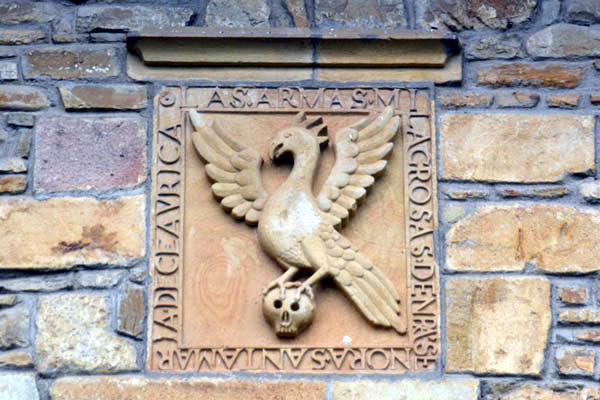
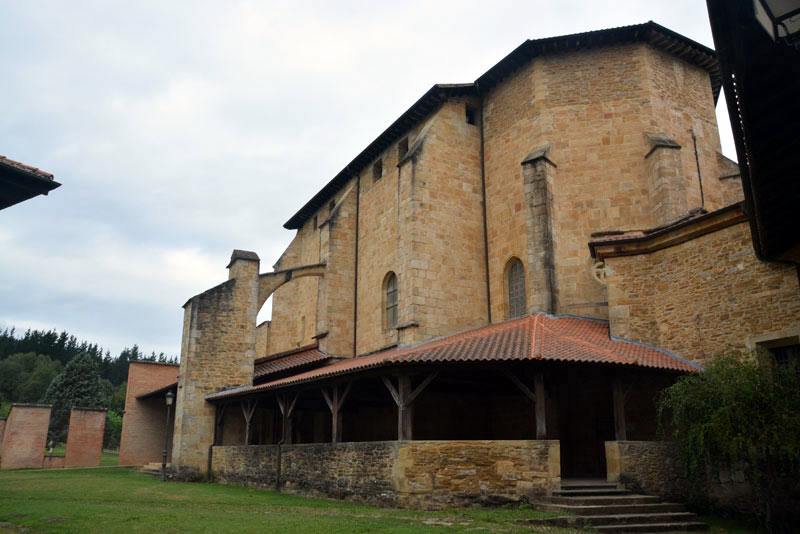
In 1379, it became a collegiate church administered by a college under the direction of an abbot, without being a monastery. The building was later renovated and around 1500 it got its current late gothic appearance.
In 1851, the church lost its status as collegiate church and became a normal parish church. After many years of vacancy, cistercian monks from the La Oliva monastery in Navarre moved into the building in 1988.
Patronage:
The altarpiece is dedicated to the Assumption of the Virgin Mary.
According to the catholic tradition, at the end of her life Mary was taken to heaven and is – together with Jesus Christ – the only person whose body and soul is in Paradise without having to wait for the Last Judgement and the Resurrection of the dead.
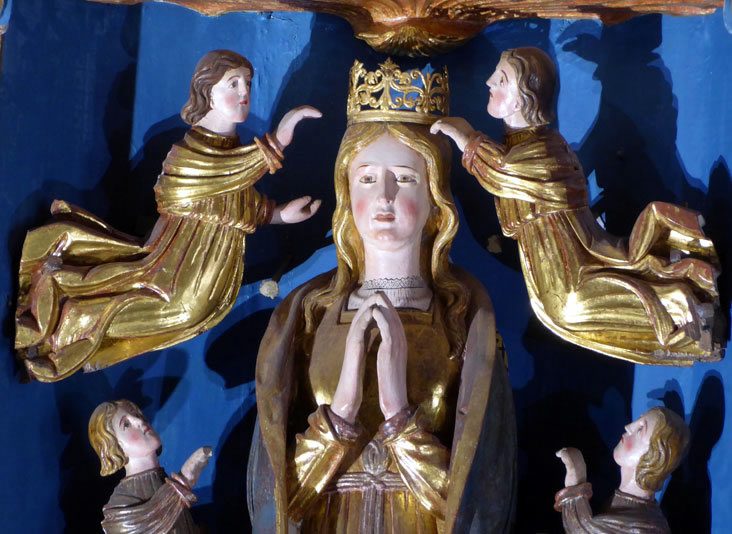
She is depicted standing on clouds and being surrounded by angels who crown her as the Queen of Heaven after having taken up her body into the Glory.
Description:
This altarpiece is placed on the altar. 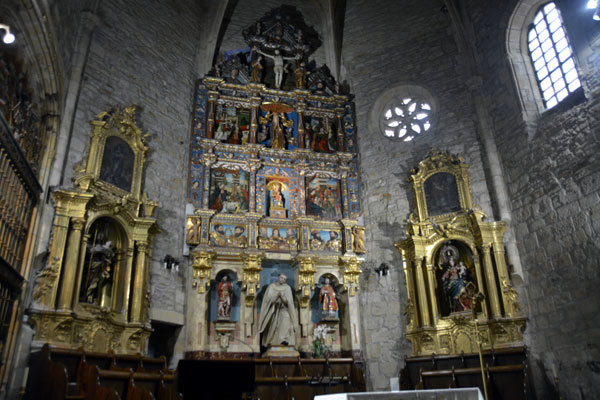
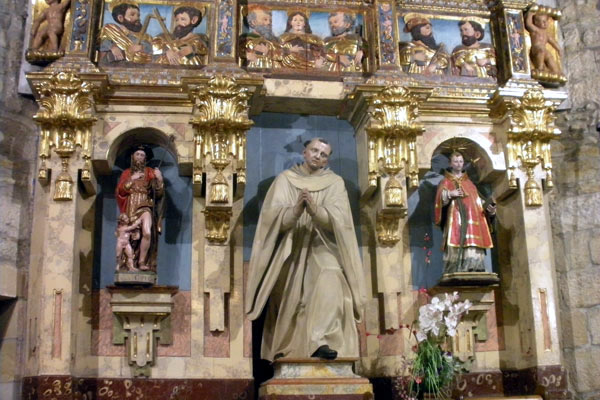
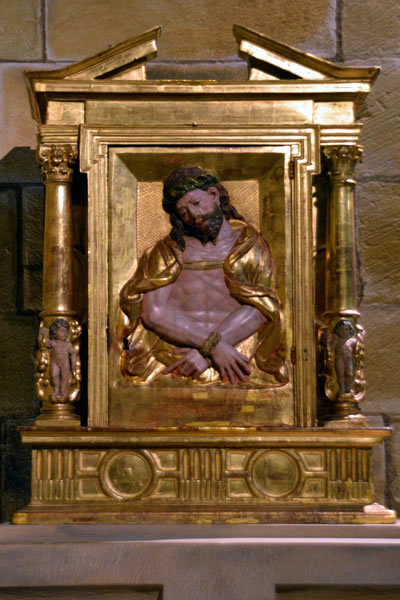
The altarpiece shows some episodes of the life of Mary to glorify her importance as the Mother of God. In the central section appear the pictures of Andra Mari (the Virgin with the Child) and the Assumption of Mary. Both Gothic carvings are from the 14th century and had been part of another altarpiece before. The lateral sections represent the Annunciation, Mary’s visit to Elisabeth, the birth of Jesus and the Adoration of the Wise Men. The sculptures on the lower part are dedicated to Saint Antoninus, Saint Roche, to some Apostles and to Saint Bernard the founder of the Order of Cistercians to which the monks of the collegiate church of Cenarruza belong. At the top of the altarpiece are the usual Calvary and the Eternal Father, and on the 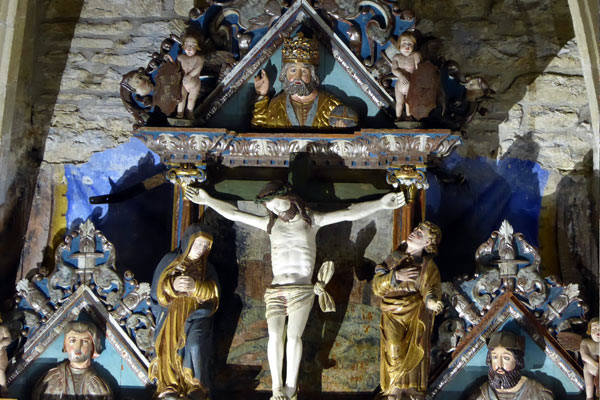
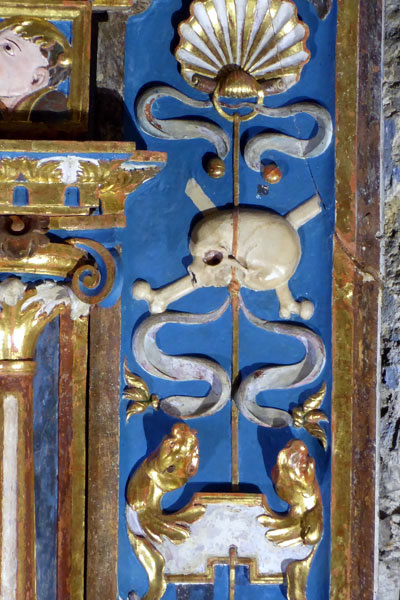
It is an interesting altarpiece as the high quality painting is combined with a rather modest sculpture. The decoration based on 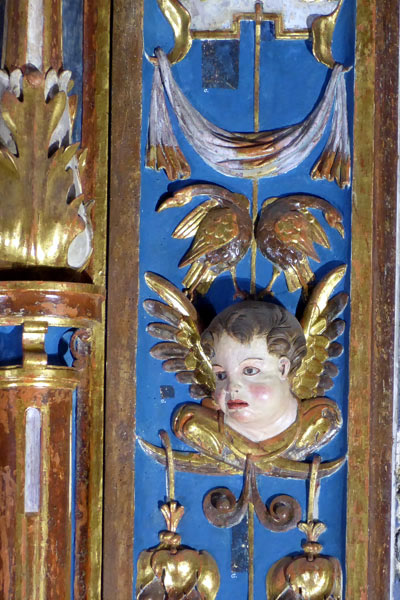
History:
The altarpiece of Cenarruza was ordered in 1543 by Diego de Irusta, the abbot of the collegiate, and paid by the college.
Juan de Larrumbe, Juan de Anitua and Pedro de Orman built the furniture and the sculptures and Francisco Vázquez from Bilbao was responsible for the paintings. Around 1550, the sculptures of the Virgin Mary and Saint John were added to the Crucifixion scene.
The altarpiece was refurbished in 1743 – the lower part was added – and between 2005 and 2006.
Sculptures:
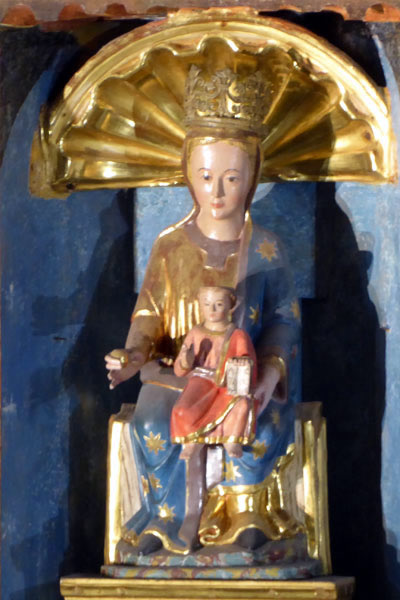
Andra Mari
Mary is sitting on a throne with the Child laying on her lap. In the Basque country, this sculpture is called “Andra Mari” (Basque for: “Lady Mary”).
It is a picture from the 14th century and is almost 200 years older than the other sculptures of the altarpiece. However, it was certainly repainted together with the furniture.
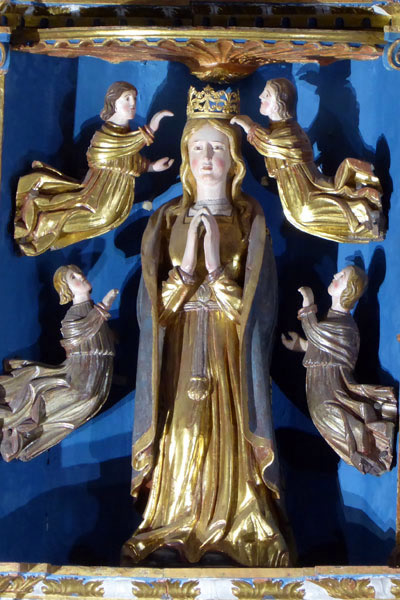
Assumption of Mary
According to the catholic tradition, at the end of her life Mary was taken to heaven. Four angels accompany Mary; they take her up into the Glory and crown her as the Queen of Heaven.
It is a picture from the 14th century and is almost 200 years older than the other sculptures of the altarpiece. However, it was certainly repainted together with the furniture.
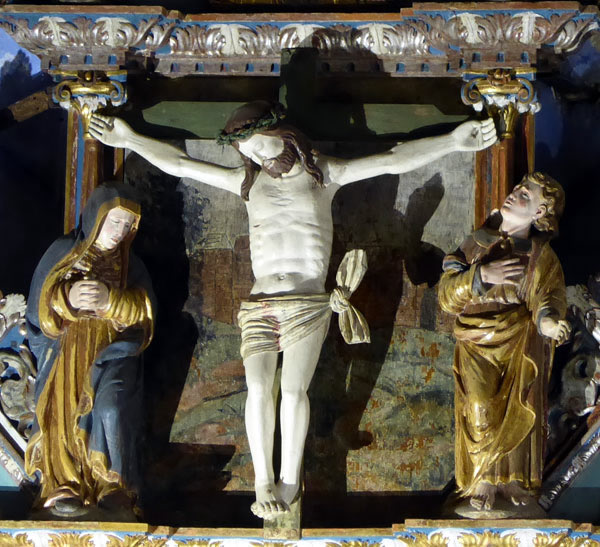
Golgotha
In the attic appears the crucifixion scene on mount Golgotha. The crucified Christ together with his Mother Mary and the apostle John, whom Jesus loved. Mary puts her hands together and inclines her head while John is looking towards Jesus and puts one hand on his chest to express his pain.
A landscape in the background alludes to the town of Jerusalem.
Around 1550, two sculptures representing Mary and John were added to the altarpiece. However, they were replaced in 1605 by the current sculptures.
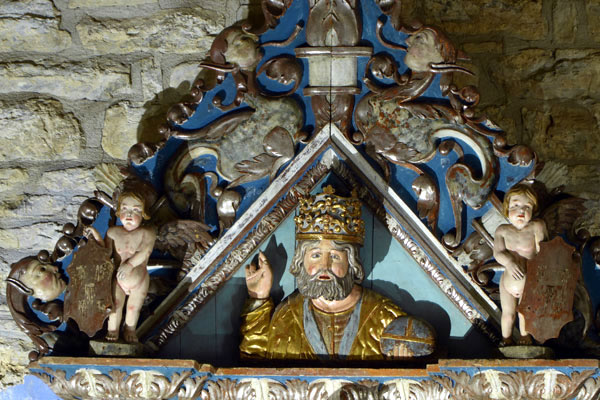
God the Father
God the Father is depicted as an old man with beard. He appears in a triangle, symbolising the Trinity. He wears a crown on his head, holds a globe in his left hand, the symbol for the world, and raises three fingers of his right hand to give the blessing. The picture is decorated in a renaissance style, with fantasy animals that have a bird’s body, a human head and long tongues. The decoration is completed with angels holding courts of arms depicting the Five Holy Wounds (the five wounds that Jesus Christ suffered during his crucifixion).
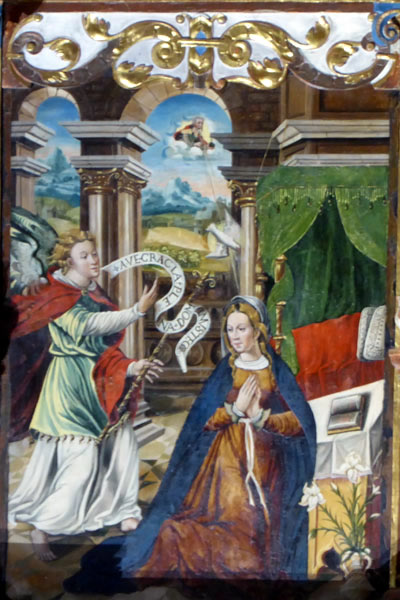
Annunciation
According to the gospels, the archangel Gabriel was send by God to announce to Mary that she will be the mother of the Messiah. This moment is of great symbolic importance for the christianity, as it represents the mystery of the Incarnation, which means, the moment when God becomes a human to save humanity from sin.
This painting shows the moment when the archangel appears to Mary greeting her with the words: “Ave Gracia Plena” (Hail Mary full of grace). Mary is reading a book and next to her are some white flowers, symbolising her purity and virginity. Above them appears God the Father, depicted as an old man, who sends a white dove to earth, the Holy Spirit, in allusion to the miraculous and divine conception of Christ.
In the background appears a landscape with high mountains.
It is a panel painting from Francisco Vázquez.
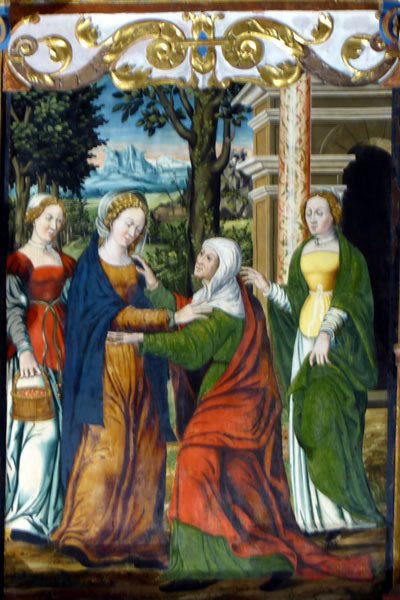
Mary visits Elisabeth
According to the gospels, Mary, who is pregnant with Jesus, visits her cousin Elisabeth, who is pregnant too, with John the Baptist. Mary tells her cousin that she will become the mother of God. Mary is accompanied by a woman who carries a fruit basket.
Elisabeth left her house, which is depicted in the background, to greet Mary who has just arrived. They embrace each other, while another woman is watching them.
It is a painting from Francisco Vázquez.
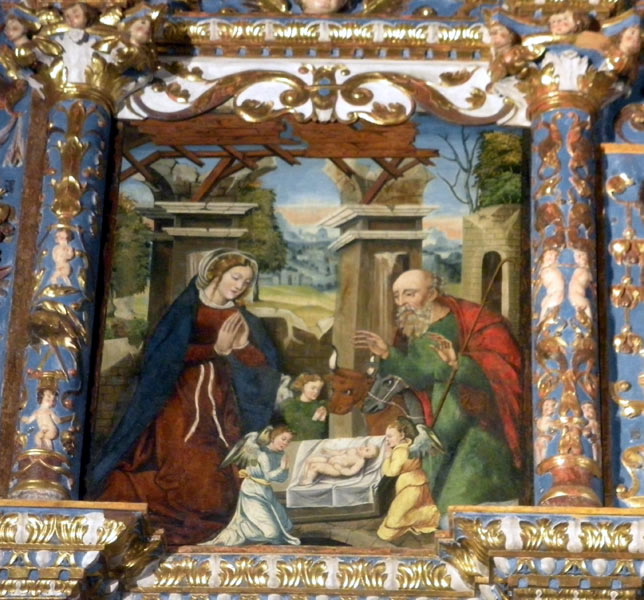
Birth of Jesus
This painting is inspired by the gospels: Mary and Joseph had to move to Bethlehem and found shelter in a stable, where Mary gave birth to Jesus. Everyone is looking at the Child, who is laying in the manger: his parents, three angels and even the donkey and ox, animals that traditionally accompany the pictures of the Nativity of Jesus.
It is a painting from Francisco Vázquez.
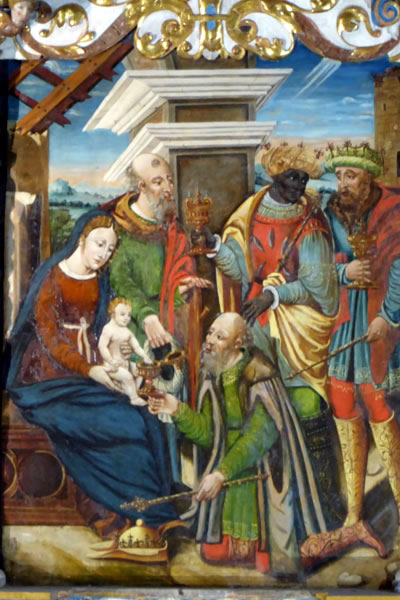
Adoration of the Wise Men or Epiphany
According to the gospels, some Wise Men from the East came to visit Jesus in Bethlehem. The gospels do not mention their names, nor the number or their backgrounds. However, the tradition tells that they were three, called Melchior, Caspar and Balthasar.
Since the 14th century, the latter one has been depicted as a young black man. It is said that they brought three gifts with them: gold the symbol for a king; incense for God; and myrrh, a very aromatic balm that was used to embalm the dead, representing Jesus as a human and therefore mortal.
Mary is sitting on a throne together with the Christ Child, while Joseph in the background receives the wise men.
Melchior puts the sceptre and crown, his Royal Insignia, on the floor and kneels down to pay tribute to Jesus and recognise him as the Son of God. Jesus is playing with the chalice, which he has received from the Wise Man. Caspar and Balthasar are standing in the background, watching the scene and talking to each other.
In the background appears a landscape. It is a panel painting from Francisco Vázquez.
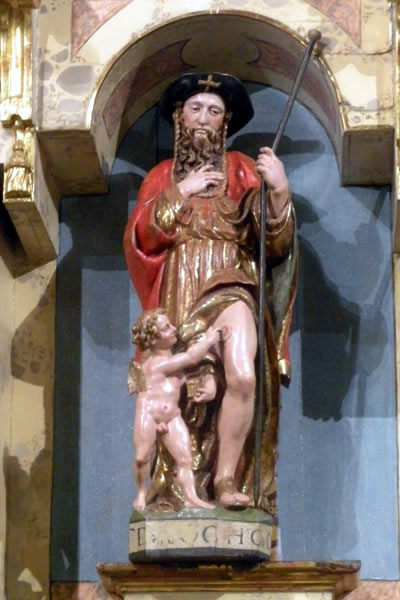
Saint Roch
According to the tradition, Roch was a young man from Montpelier (France) who had shared his heritage with the poor people and hiked through Italy as a pilgrim to cure sick people from the plague. Having been in contact with sick people, he himself became infected, so he decided to go into a forest to avoid spreading the disease. Therefore, he is the patron saint against epidemics and plagues.
Saint Roch is dressed like a pilgrim and accompanied by an angel who heals the plague marks on his leg.
Pedro de Mazaga built the sculpture in 1585 in the so-called romanism style, which is characterised by imitating artworks of the Italian sculptor Michelangelo.
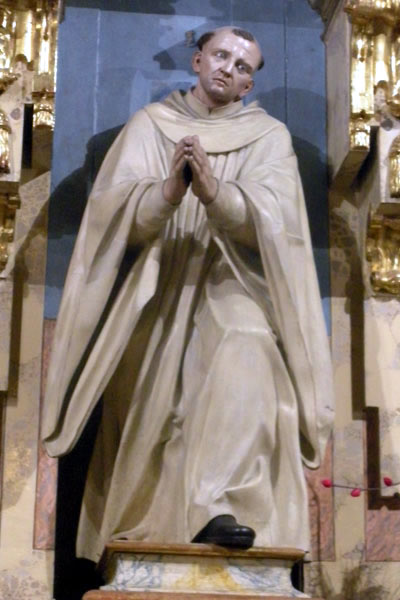
Saint Bernard of Clairvaux
Bernard of Clairvaux was the founder of the order of cistercians, to which the monks of the collegiate church of Cenarruza belong.
He wears the order’s white habit and puts his hands together for the prayer.
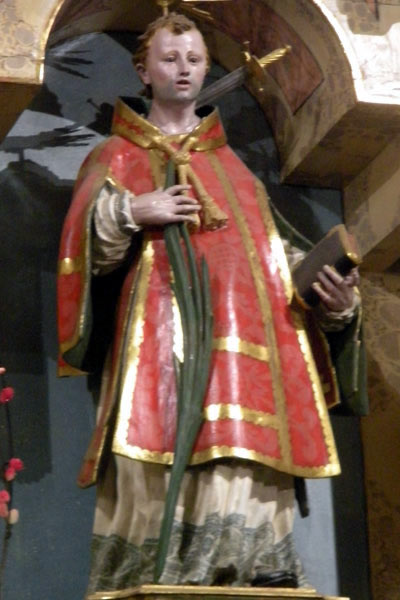
Saint Antoninus of Pamiers
According to his legend, Antoninus of Pamiers was a Visigoth martyr who lived between the 5th and 6th century in Gaul (today France). In his early age, he converted, rejected his asset and went to Rome, where he was ordained deacon. Therefore, Antoninus is portrayed with a short coat, opened on both sides and with sleeves to the elbow, called dalmatic.
In Pamiers, he was persecuted, arrested and sentenced to death by being teared into two. The Saint is depicted as a young man with a sword pierced in his neck, in allusion to his martyrdom. Furthermore, Antoninus holds a book in his left hand and a palm leave in his right one, which identifies him as a martyr.
This sculpture was built in the 18th century, almost 200 years later than the rest of the altarpiece.
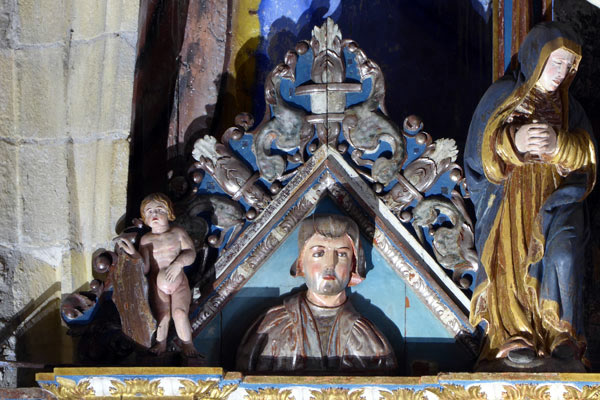
Busts
A bust of a beardless man accompanied by an angel holding a coat of arms, which probably shows the five wounds of Jesus.
The bust is inserted in a triangle and decorated in renaissance style.
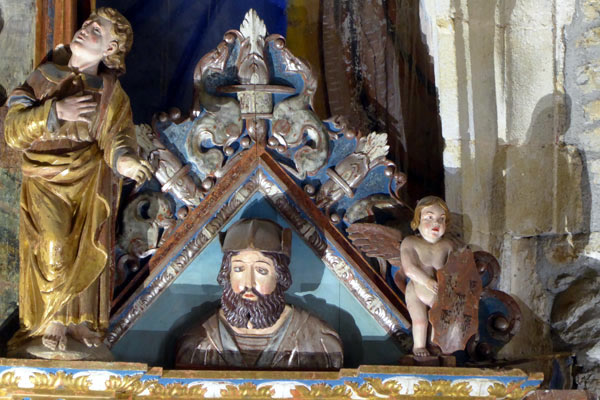
Busts
A bust of a beardless man accompanied by an angel holding a coat of arms, which probably shows the five wounds of Jesus.
The bust is inserted in a triangle and decorated in renaissance style.
Apostles
Simon holds a square and a book and James the Less is depicted with a stick. They are looking at and talking to each other.
Pablo holds a sword and a book while Peter can be recognised by the keys. John is depicted as a young man without beard holding a cup in allusion to his miracle. He once was offered a chalice filled with poison and after having blessed it, he could drink from it without dying.
Saint James the Great who is dressed as a pilgrim looks at Bartholomew who is depicted with a book and a demon.
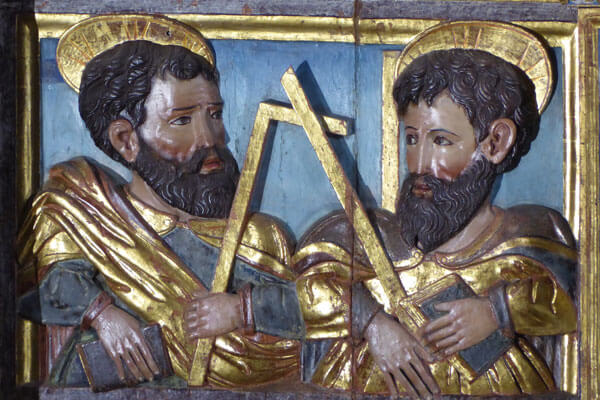
Simon and James the Less
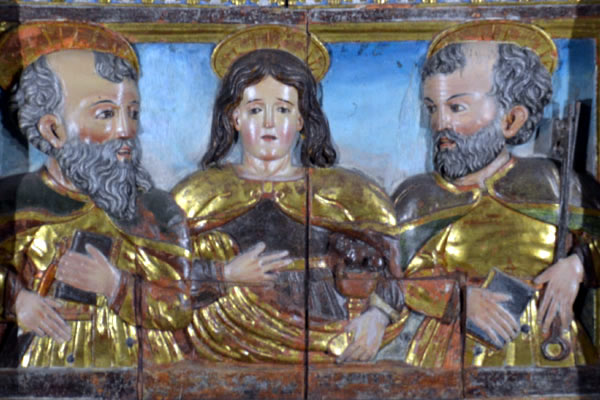
Paul, John and Peter
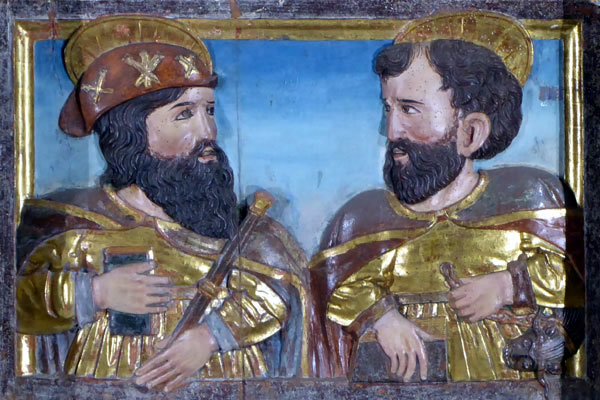
James the Great and Bartholomew