
Altarpiece of the Assumption of Mary (Zeanuri)
- Church: Assumption of Mary Church (Zeanuri)
- Location: High Altar
- Chronology: paintings: 16th century (around 1520), sculptures and reliefs: 16th century (around 1570), furniture: 18th century (1712)
- Style: paintings: Gothic, sculptures and reliefs: Renaissance, furniture: Baroque
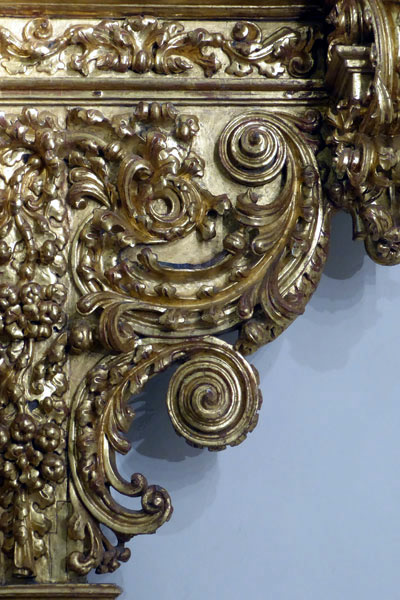
A monumental baroque picture frame for some of the best late gothic paintings preserved in Biscay
Interactive altarpiece: click on the pictures to get more information.
[zeanuri-EN]
Chruch:
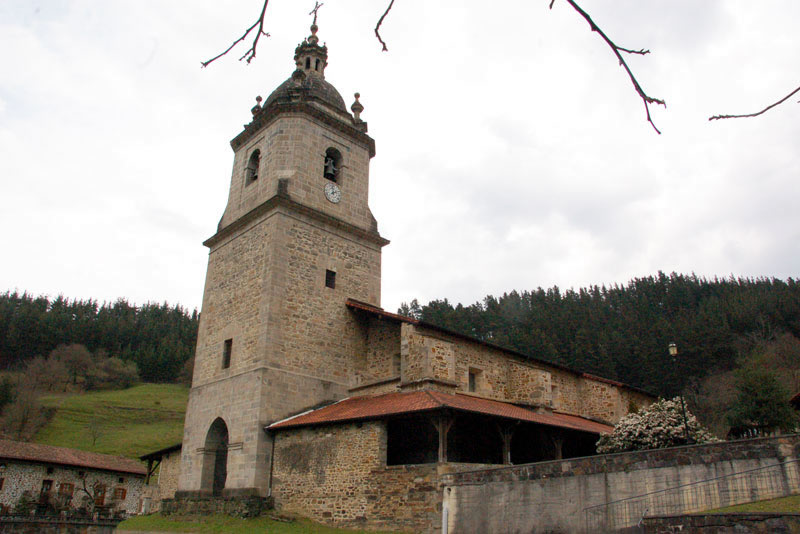
The Saint Mary church in Zeanuri is located on top of a hill in front of which the valley spreads out. The construction began in 1702 in accordance with the plans of Martín de Olaguibel, however the work took several decades.
Despite its Baroque style, it is a very austere building, notable for its portico supported by wooden posts and its tower on the outside, and the vaults of the naves 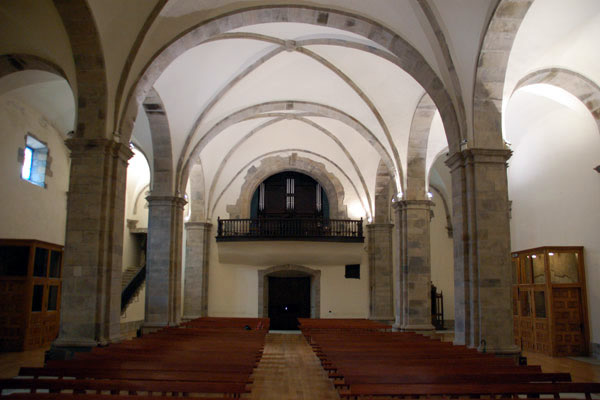

Advocación:
Both, the church and the altarpiece are dedicated to the Assumption of the Virgin Mary.
According to the catholic tradition, at the end of her life Mary was taken to heaven and is – together with Jesus Christ – the only person whose body and soul is in Paradise without having to wait for the Last Judgement and the Resurrection of the dead.
She is depicted standing on clouds and being surrounded by angels. They back her and crown her as the Queen of Heaven after having taken up her body into the Glory.
Descripction:
This 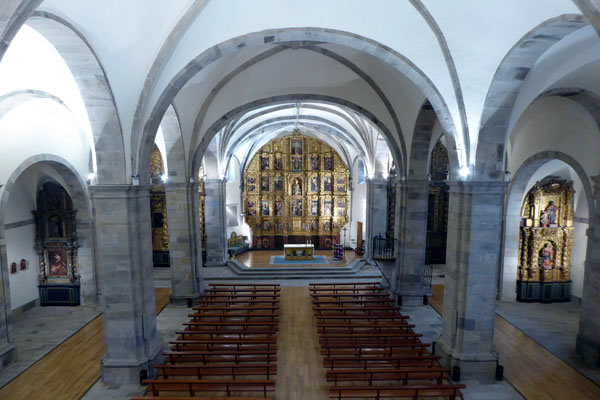
It is dedicated to the Virgin Mary; that is why most of the scenes depict episodes from her life. It is divided into a lower section or 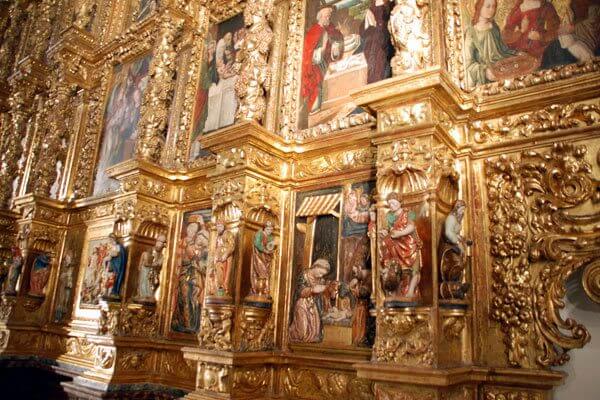


Vertically, the altarpiece is divided into seven sections. The central one, which is broader than the laterals contains the 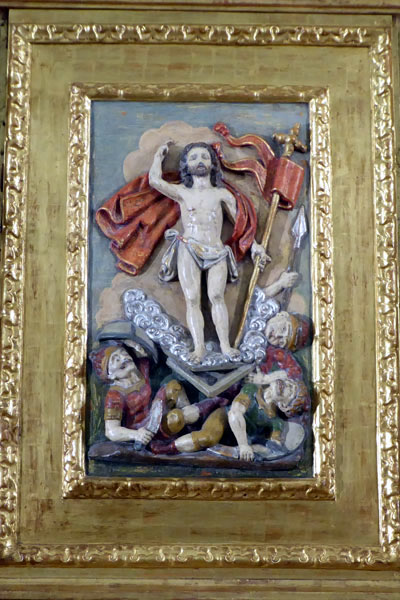

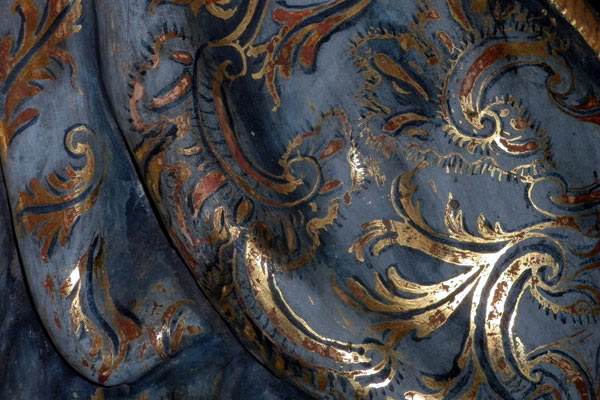
All pictures, with the exception of two, are in the late gothic style, in which the 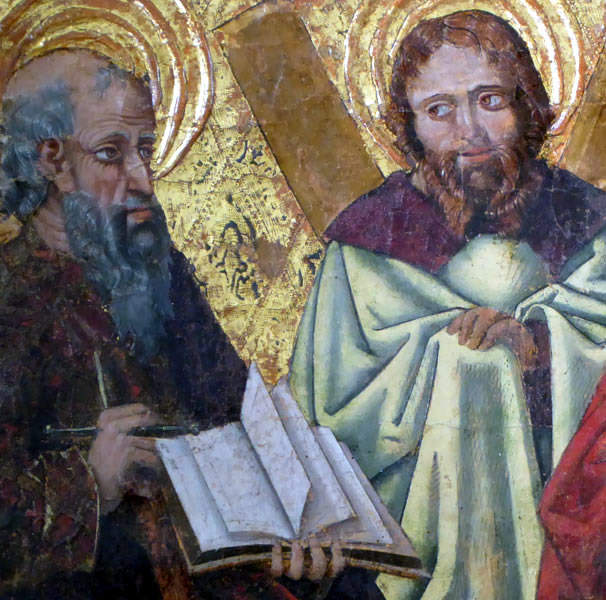

History:
There are very few historic information about the altarpiece available. However, due to its style, it is sure that the sculptures and paintings originally belonged to a former altarpiece. The oldest elements are the gothic paintings from around 1520. The reliefs from the lower part of the altarpiece were created fifty years later, at around 1570.
About 200 years later, at the beginning of the 18th century, a new furniture was built in which the paintings and reliefs were inserted together with two new paintings: the arrest of Christ and the Via Crucis.
According to an inscription on the upper part of the altarpiece, the construction was finished in 1712. However, the work took until 1760, when the altarpiece was gilded.
Sculptures:
Pedestal
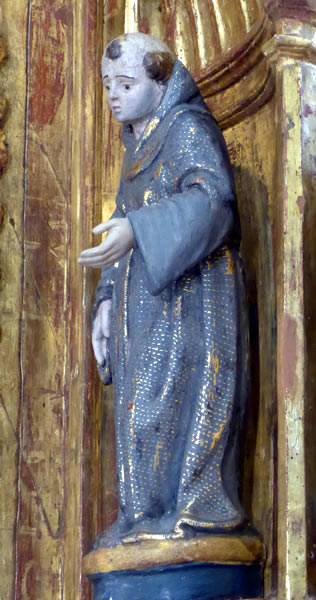
Franciscan Saint
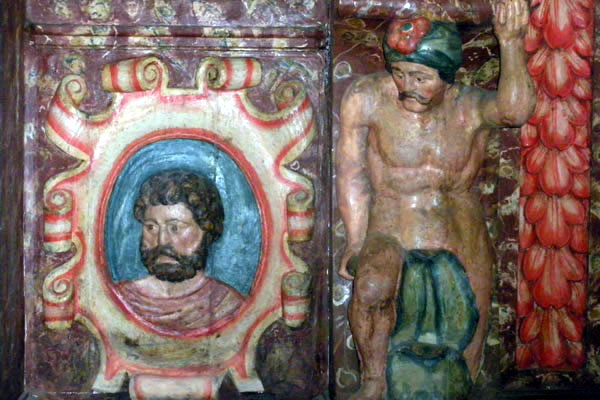
A sculpture from 1570 representing probably a franciscan monk dressed with a habit and his hair cut to a tonsure.
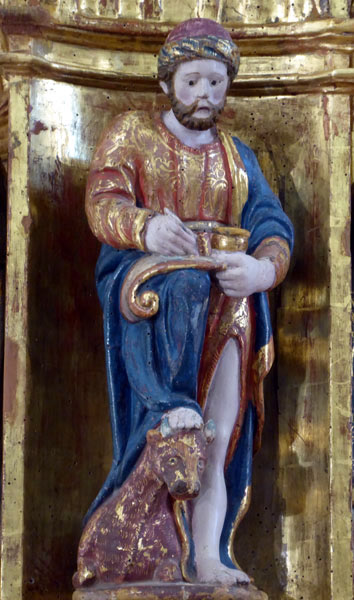
Saint Luke
Luke is the author of one of the four gospels, which the catholic church considers as directly inspired by God. Each evangelist has a symbol; the one for Luke is an ox, which in the picture appears next to Luke’s feet.
Luke is depicted as an old man with beard wearing a turban and writing on parchment.
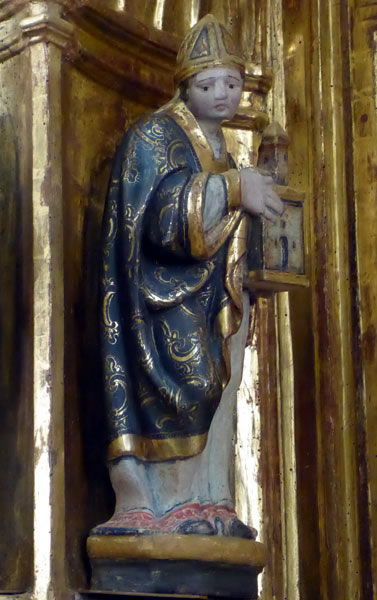
Saint Augustine
Augustine was a philosopher from the fourth century who converted to christianity and became bishop of the town of Hippo (today’s Algeria). Therefore, he wears a richly ornamented cloak and is crowned with the mitre – a hat used by bishops in solemn celebrations.
He was author of many works of theology and is therefore considered as one of the Fathers of the Catholic Church. Augustine commonly carries a small church.

Marriage of the Virgin
According to the tradition, the priests in the temple chose Joseph among a group of candidates as the suitable husband for the Virgin Mary. One priest put the hands of Mary and Joseph together, while the other candidates are watching the scene.
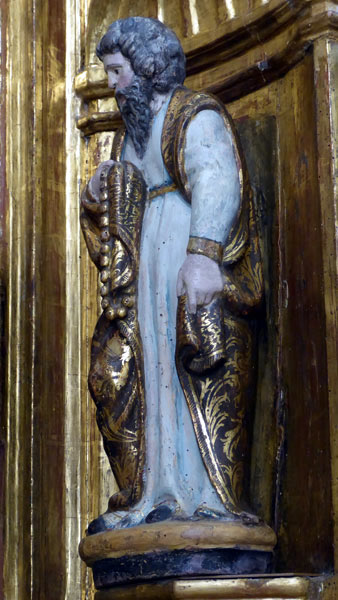
Saint Paul of Thebes
Paul of Thebes, also known as Paul the Hermit was a rich man from Egypt and lived in the early years of christianity. After having been denounced by his relatives, Paul had to leave everything and live as a poor man in the desert, as the romans were persecuting the christians at this time.
He is depicted wearing precious clothes – a long tunic and a luxurious cloak.
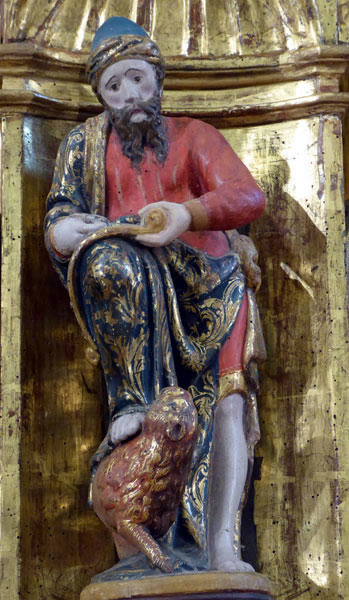
Saint Mark
Mark is the author of one of the four gospels, which the catholic church considers as directly inspired by God. Each evangelist has a symbol; the one for Mark is a lion. In this picture, Mark puts his right foot on the animal’s head.
Mark is depicted as an old man with beard wearing a turban and writing on parchment.
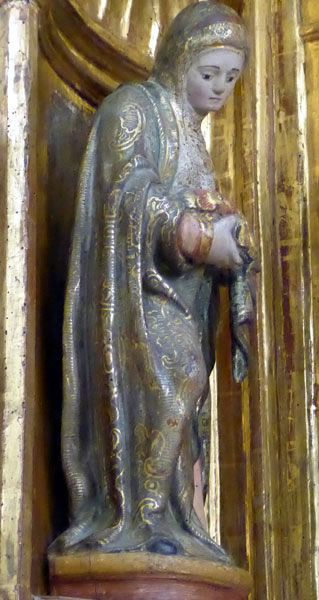
Hope
Hope is together with Faith and Charity one of the so-called theological virtues, as God directly infuses them.
The Hope is depicted as a woman dressed with a beautiful tunic holding a flower, which is the symbol for the confidence in the salvation and resurrection.
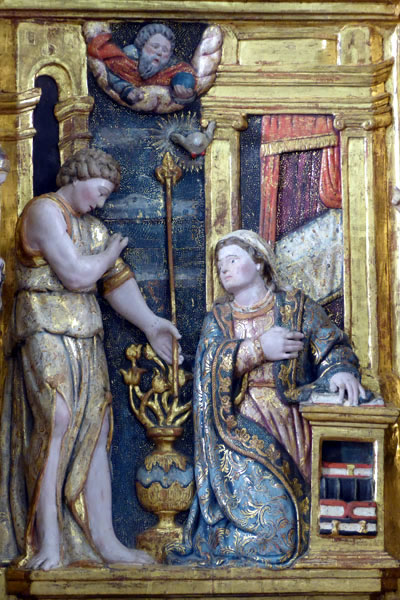
Annunciation
According to the gospels, the archangel Gabriel was send by God to announce Mary that she will be the mother of the Messiah.
This moment is of great symbolic importance for the christianity, as it represents the mystery of the Incarnation, which means, the moment when God becomes a human to save humanity from sin. This painting shows the moment when the archangel appears to Mary, who is reading. She turns her head towards the angel and opens her arms expressing her surprise. Above them appears God the Father blessing them while a white dove – the Holy Spirit – flies to Mary, in allusion to the miraculous and divine conception of Christ.
Between the Archangel and Mary is a bouquet of flowers symbolising the purity and virginity of Mary.
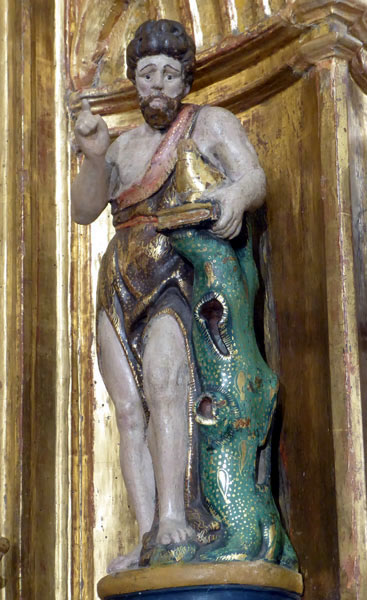
Saint John the Baptist
According to the gospel, John the Baptist carried out his work in the beginnings of christianity, in the region of the Jordan river. He baptised those who searched for the conversion – therefore he is called the Baptist. Among the people he baptised was Jesus of Nazareth.
The gospel describes him as a hermit who lived in the desert and covered himself with a camel-skin robe. He holds a book in his left hand on which appears a lamb, the symbol for Christ.
John raises his right hand towards heaven, which indicates that he was the first who recognised Jesus as the Messiah.
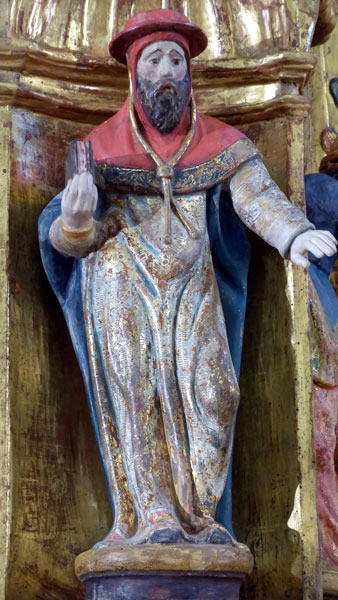
Saint Jerome
Jerome was a studious christian from the fourth century who translated the Bible to latin. Therefore, he is considered as one of the Fathers of the Catholic Church.
He became secretary of pope Damasus IV and that is why he is dressed like a cardinal with red clothes and a cardinal’s hat.
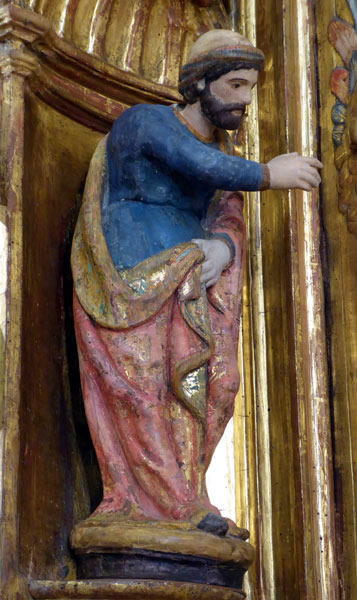
Saint (not identified)
A saint dressed with a blue tunic, a red coat and a turban. As the object he was holding in his hand has disappeared, it is not possible to identify him.
As the saint accompanies other hermits – Paul of Thebes, Anthony the Great, John the Baptist and a franciscan monk – he certainly lived a reclusive life, maybe also as hermit.
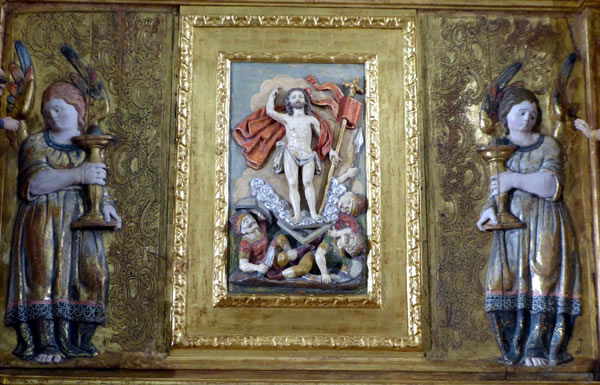
Tabernacle
The tabernacle is located the tabernacle is decorated with a picture of the Resurrection of Christ. Jesus is dressed with a red coat and holds a cross-shaped standard in his hand. On both sides, angels carry small to jars with incense.
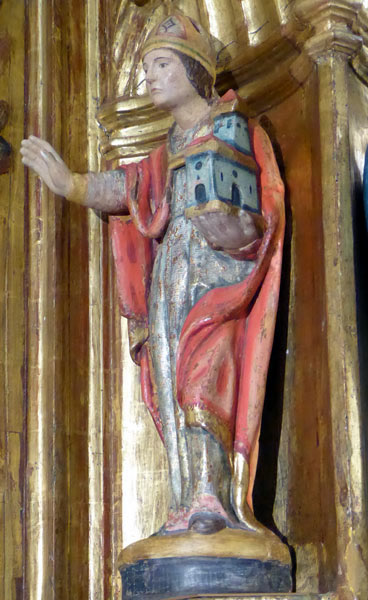
Saint Gregory the Great
Gregory was a pope from the sixth century. Therefore, he is dressed with beautiful clothes, a purple red cloak, and crowned with the tiara – a hat consisting of three crowns, which indicates his authority as pope, bishop and king.
He was author of many theological books and is therefore considered as one of the fathers of the catholic church. Gregory is depicted with a miniature church in his hand.

The Virgin with the Christ Child and the Infant Saint John the Baptist
Jesus and John the Baptist were relatives, as Elisabeth, the mother of John, was a cousin of the Virgin Mary. Therefore, the two boys are oftentimes depicted playing together, even though there is no pericope in the gospels about their childhood.
Mary holds the Christ Child in her arms, while John, who is dressed with a red cloak, is standing next to them.
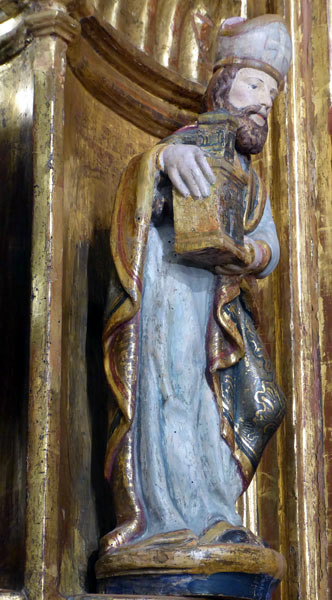
Saint Ambrose
Ambrose was bishop of Milan in the fourth century. Therefore, he is depicted with the mitre – a hat used by bishops in solemn celebrations.
As author of many theological books, he is considered as one of the fathers of the Catholic Church. Ambrose commonly carries a small church.
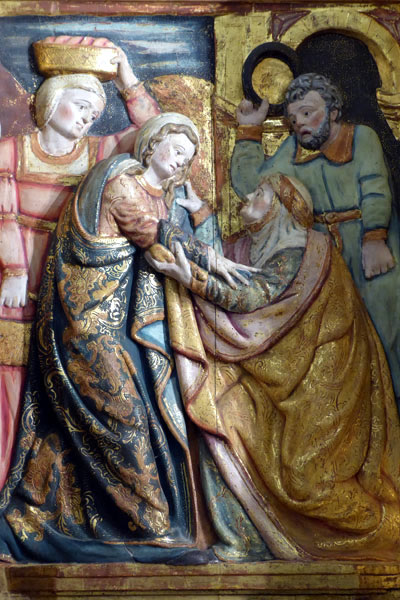
Mary visits Elisabeth
According to the gospels, Mary, who is pregnant with Jesus, visits her cousin Elisabeth, who is pregnant too, with John the Baptist. Mary tells her cousin that she will become the mother of God. Both women embrace each other, while a woman with a basket on her head and Zechariah the husband of Elisabeth are watching the scene.
Mary is bending over her cousin, who kneels down recognising Mary as the mother of the Messiah.
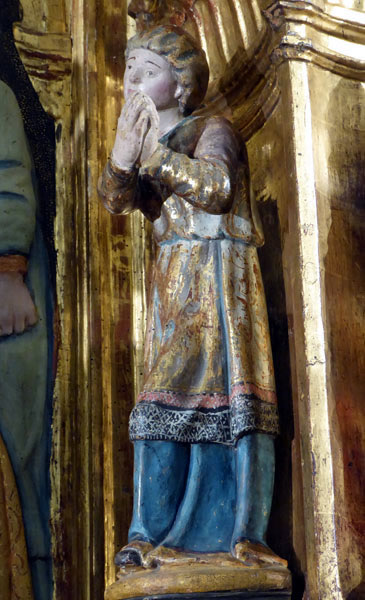
Faith
Faith is together with Hope and Charity one of the so-called theological virtues, as God directly infuses them.
Faith is depicted here as a woman who is praying with folded hands.
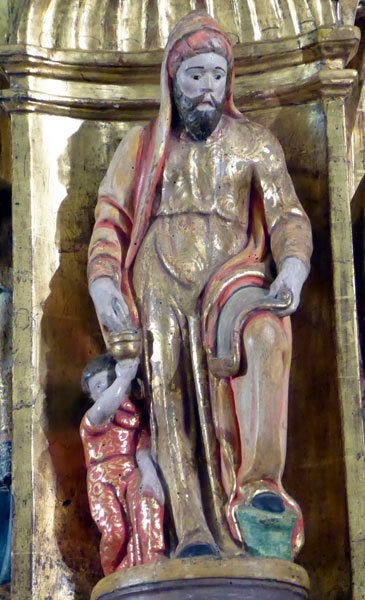
Saint Matthew
Matthew is the author of one of the four gospels in the Bible, which the catholic church considers as directly inspired by God.
Each evangelist has a symbol; the one for Matthew is a man who in this case is depicted as a child. The child carries an inkpot from which Matthew takes ink to write on the parchment on his left knee.
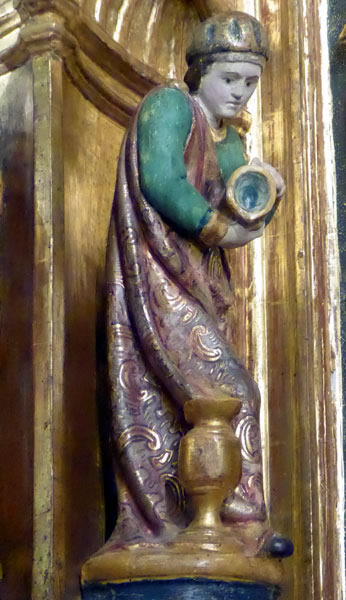
Temperance
Temperance is – together with Fortitude, Justice and Prudence – one of the four virtues, which the catholic religion calls cardinal. The aim is that people who live according to these virtues achieve honesty.
The Temperance is depicted as a woman pouring water into a wine jar to mitigate what stimulates the passions.
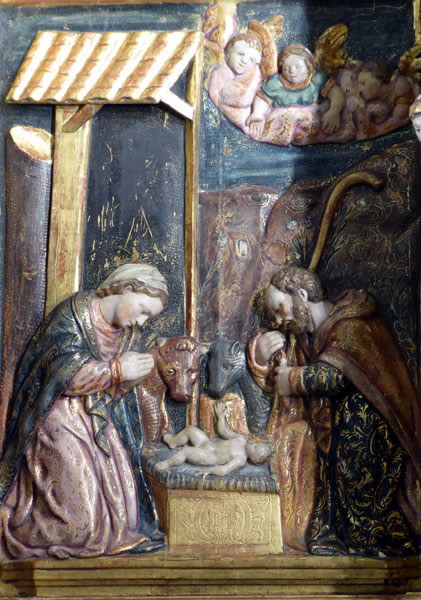
Birth of Jesus
This relief is inspired by the gospels: Mary and Joseph had to move to Bethlehem and found shelter in a stable, where Mary gave birth to Jesus.
Everyone is looking at the Child, who is laying in the manger: his parents, three angels from heaven and even the donkey and ox, animals that traditionally accompany the pictures of the Nativity of Jesus.
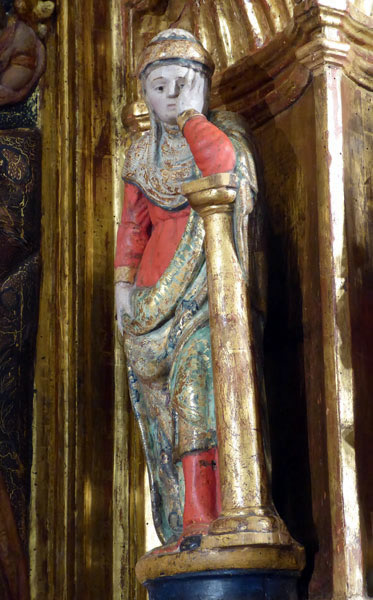
Fortitude
Fortitude is – together with Justice, Prudence and Temperance – one of the four virtues, which the catholic religion calls cardinal. The aim is that people who live according to these virtues achieve honesty.
Fortitude means to overcome fear and to flee from recklessness. It is portrayed as a woman who is leaning on a column as symbol for her strength.
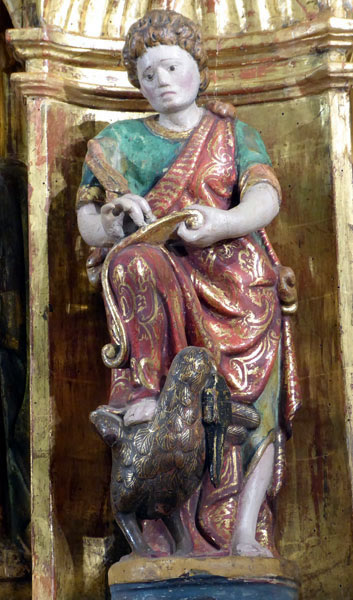
Saint John the Evangelist
John is the author of one of the four gospels in the Bible, which the catholic church considers as directly inspired by God. Each evangelist has a symbol; the one for John is an eagle, which accompanies the saint, who is standing with his right foot on the animal.
John is depicted as a young man without beard writing on parchment.
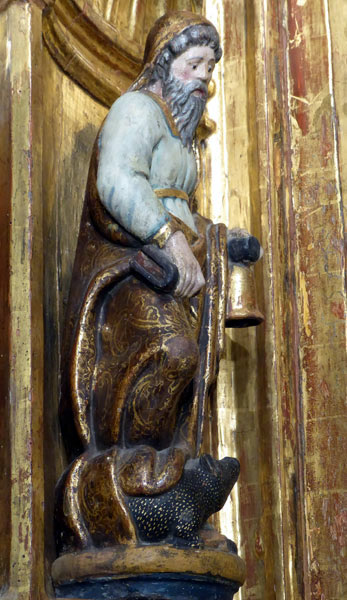
Saint Anthony the Great (Abbot)
Anthony was a very pious man, who was born in Egypt in the first years of christianity. At the age of 20, he sold all his belongings to live in poverty and in seclusion from society in a cave in the Sinai desert. Therefore, the christians venerate him as one of the first hermits who became a saint and as a role model for the life of the monks.
It is said that he gained wisdom by observing wild animals. Therefore, he is considered the patron saint of animals and depicted with a pig next to his feet.
Body 1
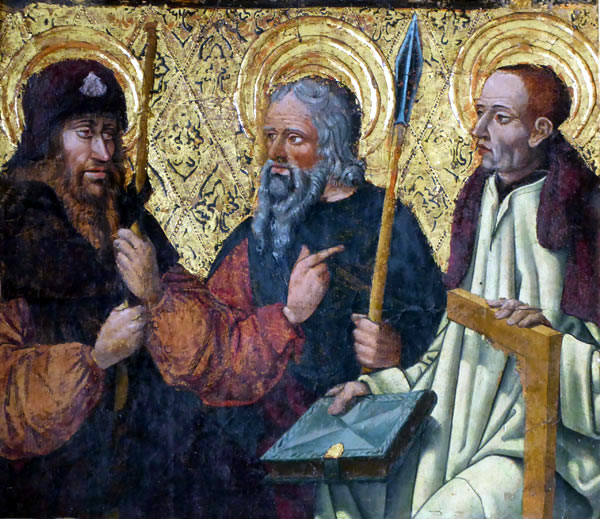
Saint James the Great, Saint Thomas and Saint Jude Thaddaeus
This picture depicts three of the twelve apostles who, according to the gospels, accompanied Jesus of Nazareth. They can be identified by the objects they carry.
James the Great holds a walking stick in his hands and wears a cap with a pilgrim’s scallop. Thomas carries a lance the symbol for his martyrdom, which he suffered during his preaching in India. Jude Thaddaeus is depicted with a book and a square.
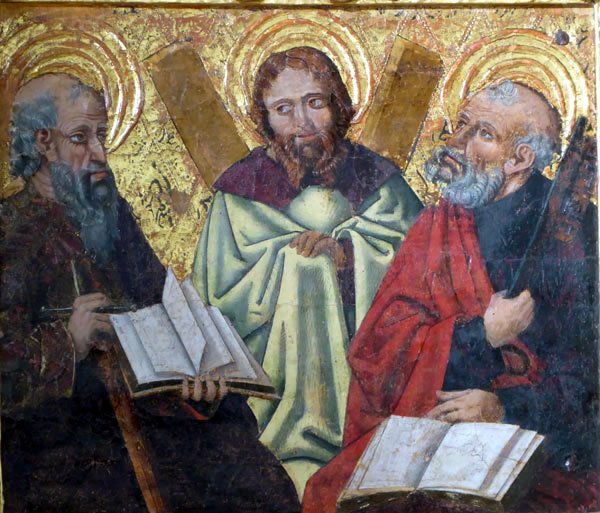
Saint Paul, Saint Andrew and Saint Peter
This picture depicts two of the twelve apostles who, according to the gospels, accompanied Jesus of Nazareth. They are accompanied by Paul of Tarsus, who was one of the first missionaries of christianity and is therefore known as “Prince of the Apostles.”
They can be identified by the objects they carry. Paul holds the sword of his martyrdom and an open book as reference to the Acts of the apostles and his fourteen Pauline Epistles in the Bible. Andrew is standing in front of the St. Andrew’s cross to which he was tied until his death. Peter carries a large key in allusion to the keys of Heaven that he guards, as Jesus of Nazareth appointed him as his successor.
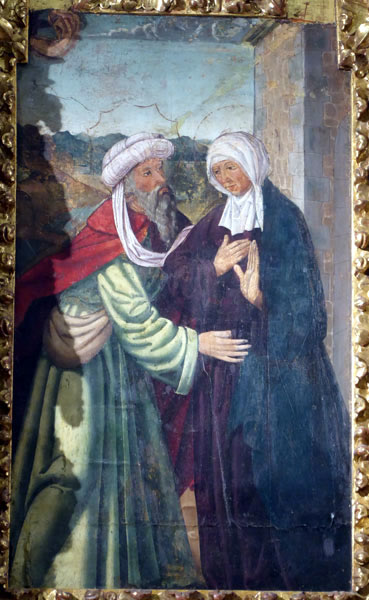
Embrace at the golden door
According to tradition, Joachim and Anne are the parents of Mary and therefore grandparents of Jesus of Nazareth. After twenty years of marriage, they were still childless, which among the Jews was interpreted as a sign of divine displeasure.
Joachim withdrew to the desert, where he fasted for 40 days. After this sacrifice, the archangel Gabriel appeared to both at the same time Joachim and Anne – who was alone in Jerusalem – to announce them that their prayers had been heard and that they have a child. Then, they met each other at the town wall of Jerusalem, at the so-called golden door. They conceived a child without any sexual intercourse.
This moment is depicted in the picture. Joachim puts his hand on his wife’s stomach to indicate that she has become pregnant.
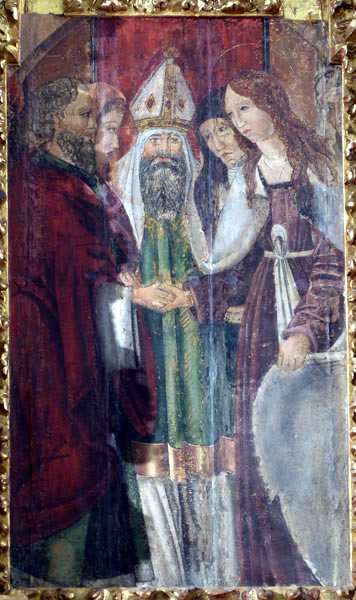
Marriage of the Virgin
According to the tradition, the priests in the temple chose Joseph among a group of candidates as the suitable husband for the Virgin Mary.
One priest put the hands of Mary and Joseph together, while the other candidates are watching the scene.
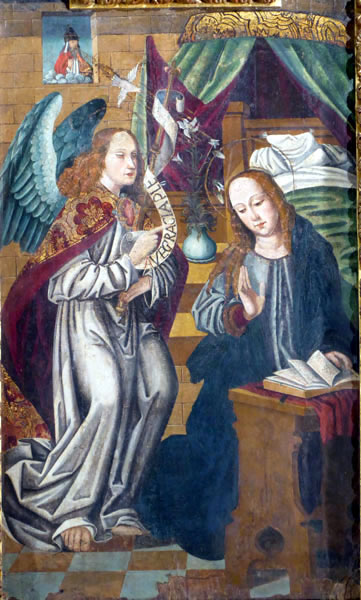
Annunciation
According to the gospels, the archangel Gabriel was send by God to announce Mary that she will be the mother of the Messiah. This moment is of great symbolic importance for the christianity, as it represents the mystery of the Incarnation, which means, the moment when God becomes a human to save humanity from sin.
This painting shows the moment when the Archangel appears to Mary, who is reading. Above them appears God the Father sending a white dove – the Holy Spirit – to Mary, in allusion to the miraculous and divine conception of Christ. Between the archangel and Mary is a bouquet of flowers symbolising the purity and virginity of Mary.
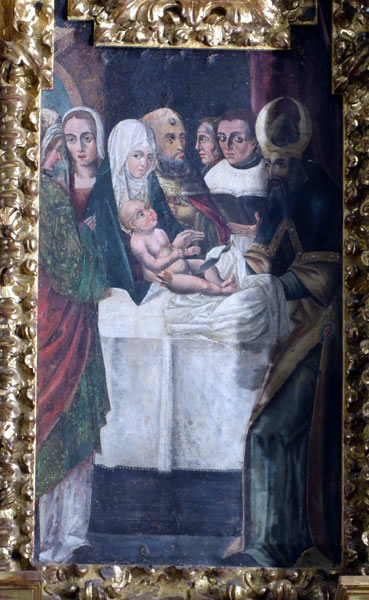
Circumcision of Jesus
According to the gospel of Luke, Jesus was born a Jew and circumcised on the eighth day in accordance to the Jewish tradition. All boys have to take part in this solemn ritual in which they get their names. This picture shows the moment when a Mary holds the Child while the priest circumcises him with a small knife. In the background appears Joseph next to Mary, putting his hand on his chest, while four other people are watching the ceremony.
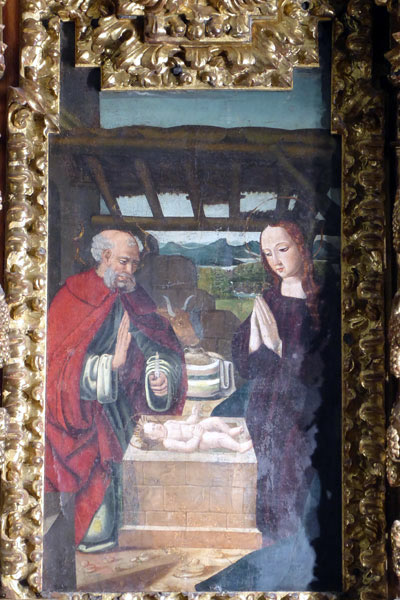
Birth of Jesus
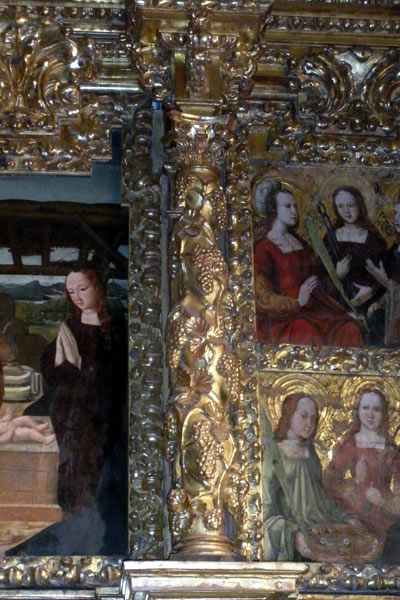
This painting shows an episode inspired by the gospel: Mary and Joseph, who had to move to Bethlehem, found shelter in a stable and Mary gave birth to Jesus there. The parents kneel down to pay respect to the Child, who is laying in the manger. Joseph holds a candle in his left hand, which symbolises the Child as saviour and light of the world.
Behind them appear a donkey and an ox, animals that traditionally accompany the pictures of the Nativity of Jesus. The stable is surrounded by a beautiful landscape.
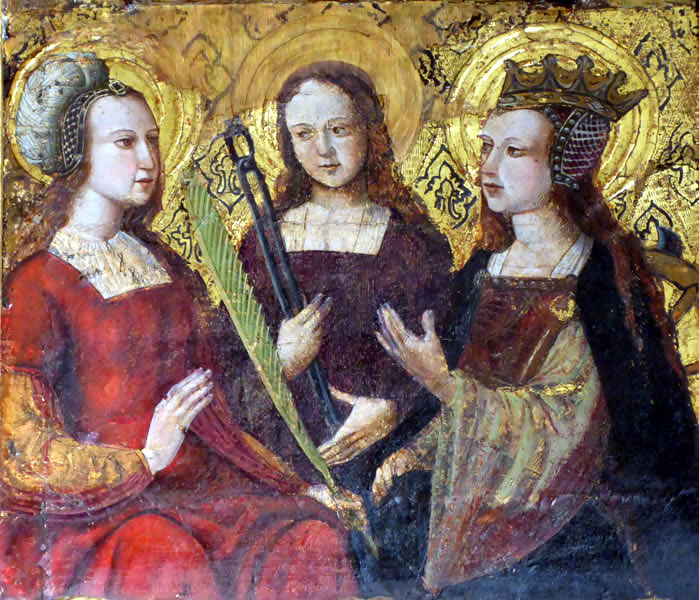
Three Saints
This painting depicts three women who became saint and serve as role models.
Apollonia carries large tongs with a tooth, in allusion to her martyrdom. Catherine of Alexandria is crowned as princess and can be recognised by the wheel behind her, which alludes to the most famous torture she suffered. Even though the left woman cannot be recognised, the palm leave in her hand – symbol for the victory over sin and death – identifies her as a martyr.
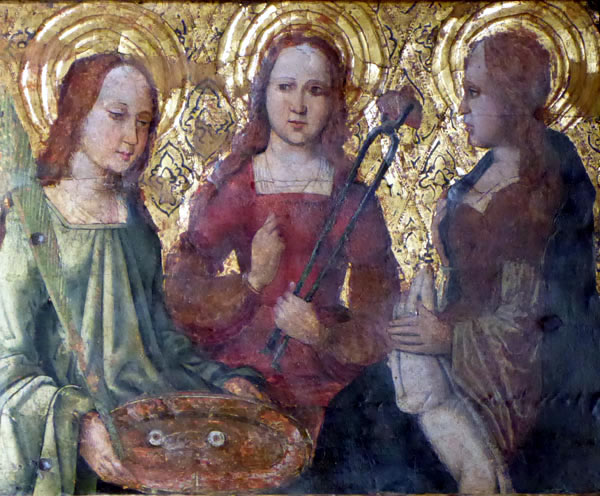
Saint Lucia, Saint Agatha and Saint Agnes
This painting depicts three women who became saint and serve as role models.
Lucia is holding a plate with her eyes on it, symbolising her martyrdom. According to the legend, her eyes were ripped out because she refused to make sacrifices to the pagan gods. Agatha carries a woman’s breast with tongs, in allusion to the torture she suffered. Her breast was cut because she had converted to christianity. Agnes is depicted with a lamb on her lap as the symbol of purity.
Body 2
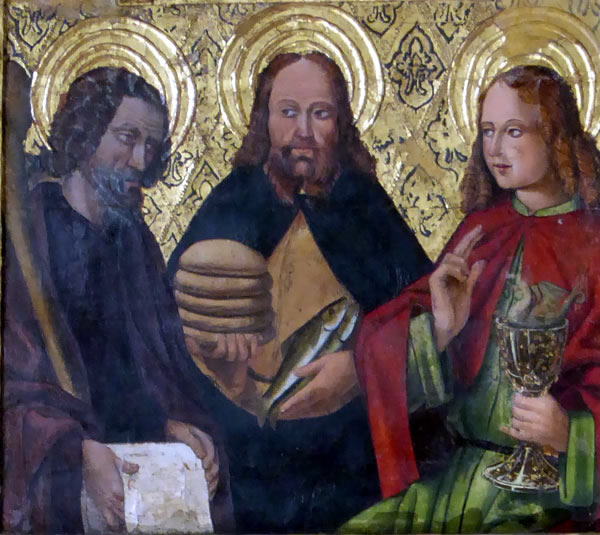
Saint James the Less, Saint Philip and Saint John
This picture depicts three of the twelve apostles who, according to the gospels, accompanied Jesus of Nazareth. They can be identified by the objects they carry.
Saint James the Less holds a club, the symbol for his martyrdom. He was martyred with a deathblow from a club on his head. Philip holds five breads and two fishes in his hands, as he accompanied Jesus at the day of the miracle, the feeding of the multitude. John is depicted with a chalice from which a small dragon emerges, in allusion to his most famous miracle. He once was offered a chalice filled with poison and after having blessed it, he could drink from the chalice without dying. This is the evidence that the christian faith is authentic.
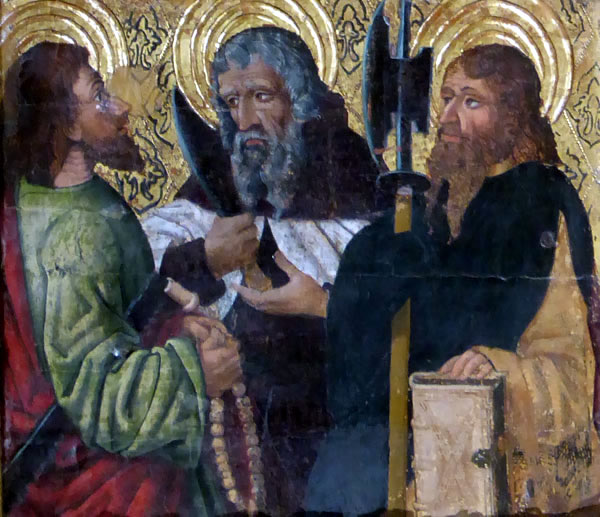
Saint Simon, Saint Bartholomew and Saint Matthew
This picture depicts three of the twelve apostles who, according to the gospels, accompanied Jesus of Nazareth.
They can be identified by the objects they carry. Simon carries a saw under his arm, as according to the legend he was sawn in two. Bartholomew holds a knife in his hands with which he was skinned. Matthew holds an executioner’s axe with which he was beheaded.

Adoration of the Wise Men or Epiphany
According to the gospels, some Wise Men from the East came to visit Jesus in Bethlehem. The gospels do not mention their names, nor the number or their backgrounds. However, the tradition tells that they were three, called Melchior, Caspar and Balthasar. Since the 14th century, the latter one has been depicted as a young black man.
It is said that they brought three gifts with them: gold the symbol for a king; incense for God; and myrrh, a very aromatic balm that was used to embalm the dead, mortal humans. Mary holds the Child while Melchior and Caspar kneel down to pay tribute to Jesus and recognise him as the Son of God. Balthasar is talking to Joseph who appears in the background.
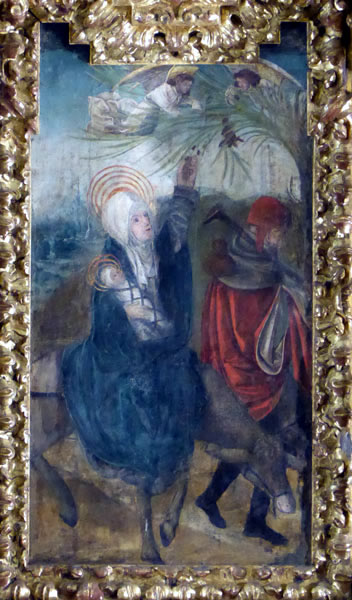
Escape to Egypt
According to the gospels, an angel warned Joseph that king Herod had commanded to kill all boys under the age of two years, because he was afraid that one of them would dethrone him. Mary and Joseph decided to flee to Egypt to save Jesus. Mary is sitting with the Child in her arms on the back of a donkey, led by Joseph in front of them.
The scene is set in a landscape, which makes it an everyday occurrence and more understandable. As the Holy Family passes by, the angels bend the branches of the palm trees so that Mary can harvest the dates easily and move forward rapidly.
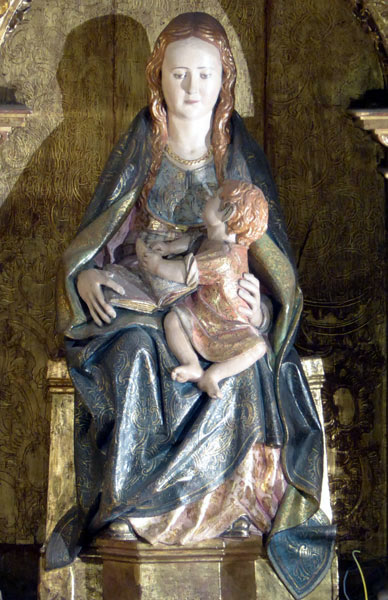
The Virgin and the Child
The Virgin Mary is sitting on a throne holding a book in her right hand, while the Child is laying on her lap. This sculpture is called “Virgin Mary on the Throne” and in the Basque region “Andra Mari” (“Lady Mary”).
Jesus turns his head towards the open book to play with it and read it despite his young age.
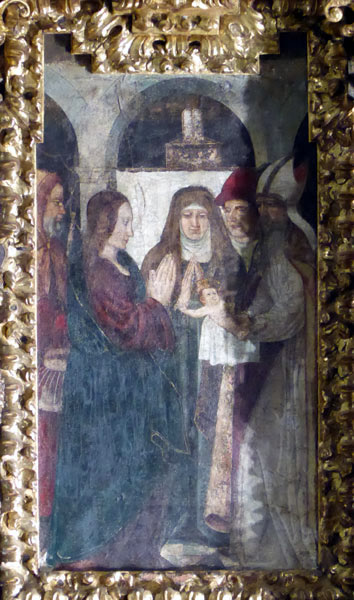
Presentation of Jesus in the temple
According to the Jewish law, all families had to present their firstborn male child to God offering in the temple a sacrifice of a pair of turtledoves or young pigeons. According to the gospel of Luke, Mary and Joseph took Jesus to the temple of Jerusalem to comply this precept, where two people recognised him as the Messiah: the elderly priest Simeon, who is dressed with beautiful clothes and holds the Child in his arms and the prophetess Anna, who folds her hands as if she were praying.
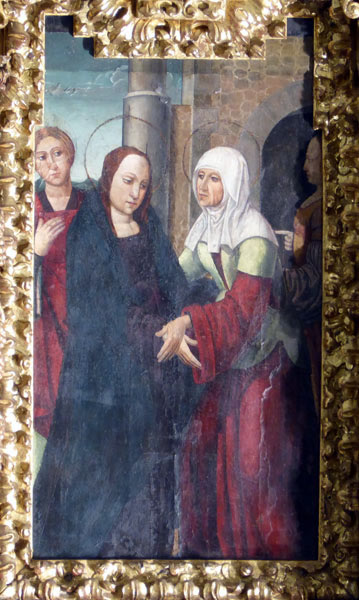
Mary visits Elisabeth
According to the gospels, Mary, who is pregnant with Jesus, visits her cousin Elisabeth, who is pregnant too, with John the Baptist. Mary tells her cousin that she will become the mother of God.
Both women embrace each other, while two other women are watching the scene.
Mary visits Elisabeth
According to the gospels, Mary, who is pregnant with Jesus, visits her cousin Elisabeth, who is pregnant too, with John the Baptist. Mary tells her cousin that she will become the mother of God.
Both women embrace each other, while two other women are watching the scene.
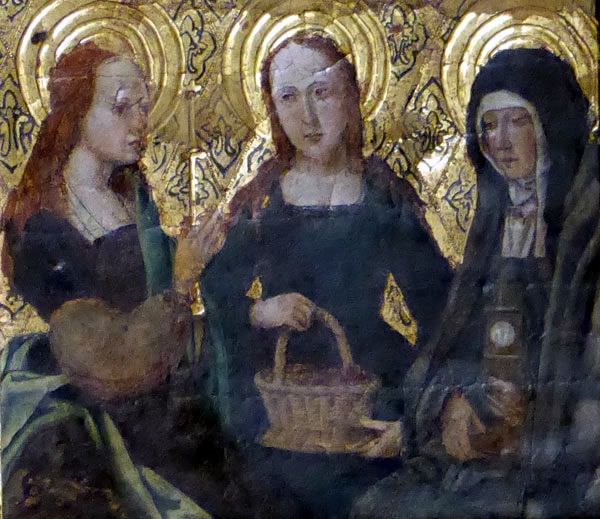
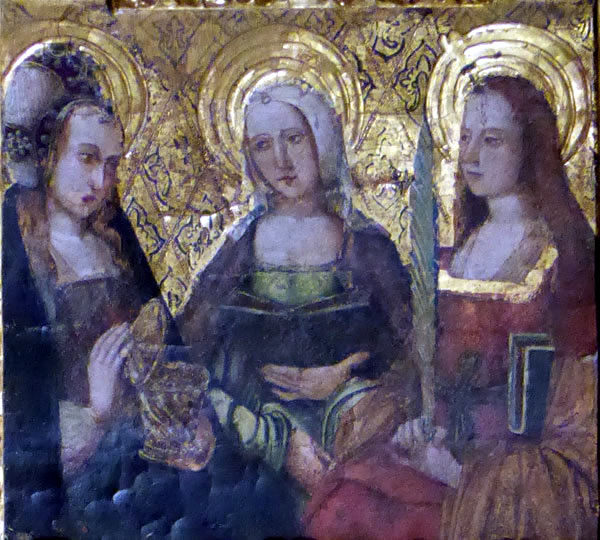
Three Saints
This painting depicts three women who became Saint and serve as role models.
Clare of Assisi is dressed with the habit of the clarisses, the congregation that she founded following the example of Francis of Assisi. She holds an ostensory in her hands, because it is said that the presence of the blessed sacrament alone was enough to defeat the saracens who tried to conquer the town of Assisi. Dorothea of Caesarea carries a basket of apples. According to her legend, the prefect ordered her beheading, because she refused to sacrifice to the pagan gods, which was deemed as proof that she was “wife of Jesus”, which means a Christian. While she was being tortured, the executioner mocked her and asked her for apples from her husband’s garden. Even though it was winter, a boy appeared and brought a fruit basket.
The third saint, holding a golden object (maybe a sceptre or crucifix), cannot be identified.
Body 3
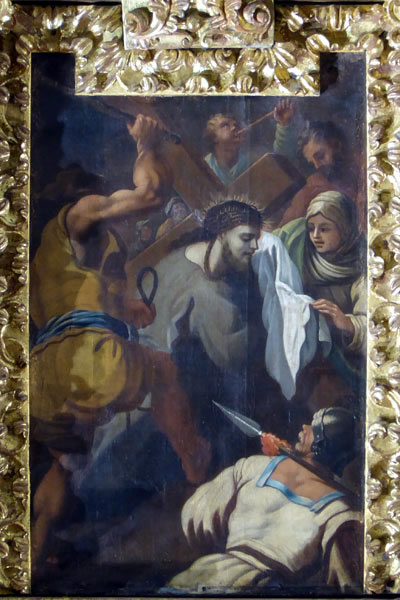
Via Crucis
Painting from 1712 depicting Jesus Christ carrying the cross through the streets of Jerusalem to mount Golgotha, where he was crucified.
The soldiers insult Jesus, surround him, threaten him with a lance and pull him on a cord. A woman accompanies Jesus and gives him a cloth so that he can dry the sweat and blood.
According to tradition, the face of Jesus has been miraculously imprinted on the cloth, which is why the woman is known as Veronica, which in Latin means “true image”.
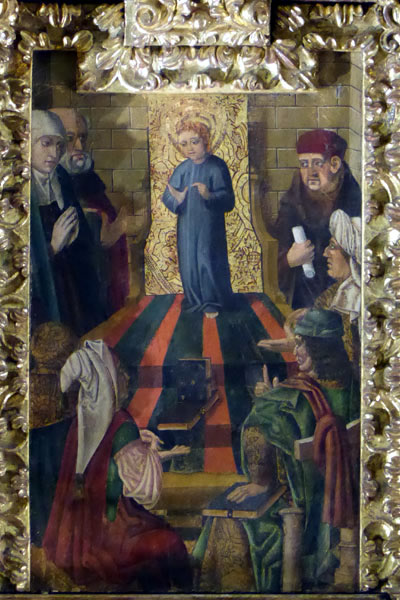
Christ among the Doctors
According to the gospels, at the age of 12 Jesus and his parents went to Jerusalem to celebrate the jewish feast Pesach/ Passover, where the child got lost in the crowd. After having looked for the child for three days, the parents found him in the temple, where Jesus was discussing with the priests and theologians, who were impressed by his wisdom.
Jesus appears in the temple being surrounded by the teachers who ask him and check his answers in the books.
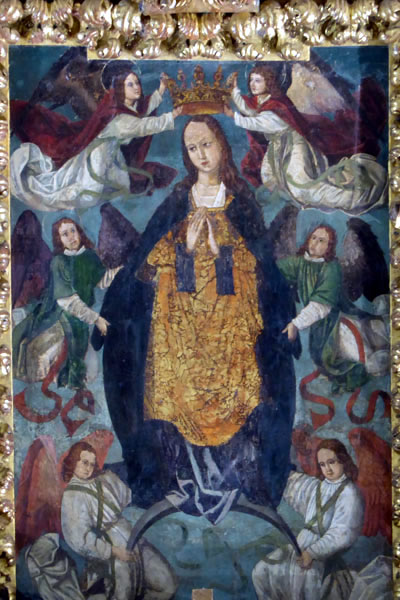
Assumption of Mary
According to the catholic tradition, at the end of her life Mary was taken to heaven and is – together with Jesus Christ – the only person whose body and soul is in Paradise without having to wait for the Last Judgement and the Resurrection of the dead.
Mary is depicted standing on a half-moon and being surrounded by angels, which back her and crown her as the Queen of Heaven after having taken up her body into the Glory.
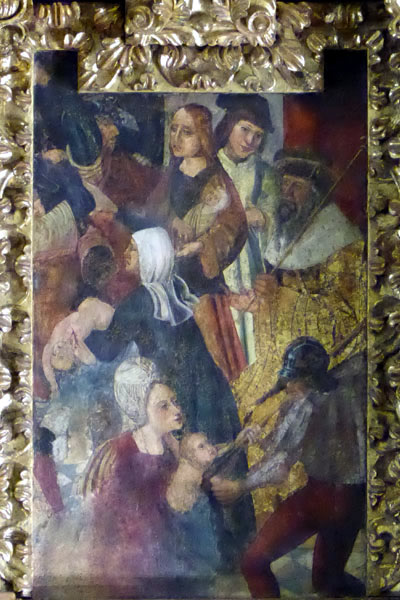
Massacre of the Innocents
According to the gospels, king Herod, who confused the birth of the Messiah with the birth of a future king of the Jews, commanded to kill all boys in Bethlehem under the age of two years, because he was afraid that one of them would dethrone him.
The scene shows all the cruelty, how the soldiers kill the boys without listening to the pleas of the children’s mothers.
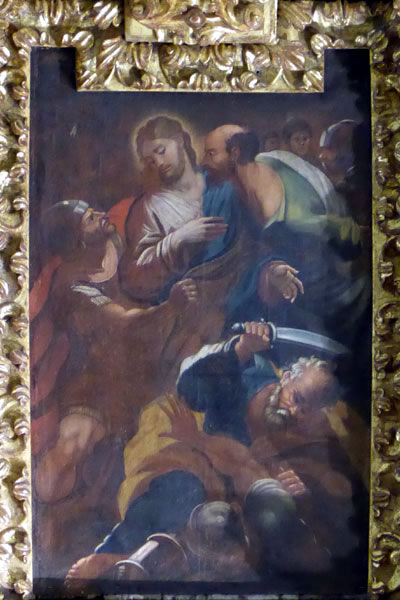
The arrest of Jesus
Painting from 1712 depicting the moment when Jesus is arrested by one of the guards, while his disciples try to prevent his arrest.
According to the gospels, the soldiers of Sanhedrin (the court of the jewish judges) come to Jesus, while he is praying in the garden of Gethsemane. Judas Iscariot, who betrays Jesus and makes it possible that the soldiers can arrest him, accompanies them.
Jesus is arrested by one of the guards, while his disciples try to prevent his arrest. Jesus Christ inclines his head accepting his destiny.
Peter stands out, as he has knocked a soldier down and raises a sword. According to the Bible, Peter cut off the soldier’s ear, but Jesus healed it miraculously.
Attic
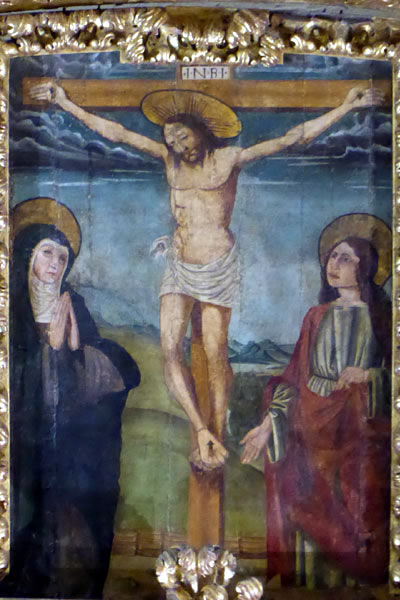
Golgotha
The crucified Christ is surrounded by his mother, Mary, and John, the disciple whom Jesus loved.
The picture shows the moment when Jesus has already died, with the bleeding wound to his torso, while Mary puts her hands together to express her piety and sorrow.