
Altarpiece of the Assumption of Mary (Portugalete)
- Church: Saint Mary Church (Portugalete)
- Location: High Altar
- Artists: Guiot de Beaugrant (sculptor), Juan de Beaugrant (sculptor), Juan de Ayala II (sculptor) and Andrés de Rada (gilder)
- Patron: Council of Portugalete and Lope García de Salazar
- Chronology: 16th century (1533-1555)
- Style: Renaissance
One of the best examples of the first Renaissance in Biscay
Interactive altarpiece: click on the pictures to get more information.
Church:
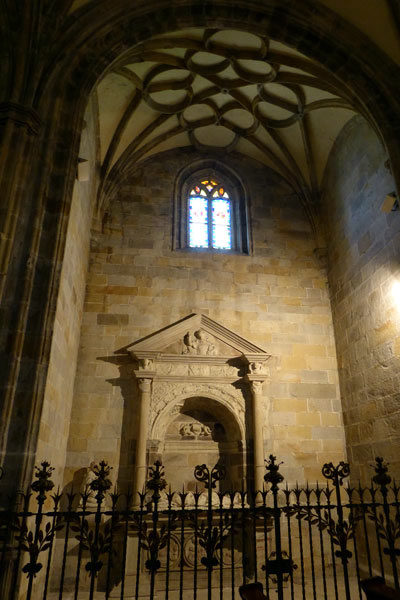
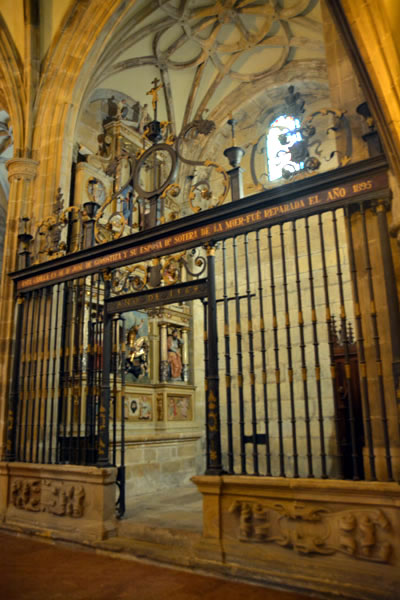
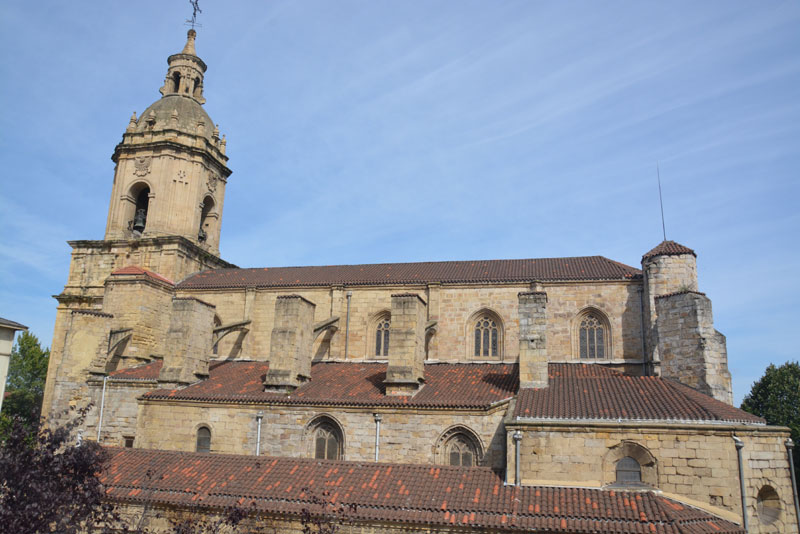
The Saint Mary Church in Portugalete is located in the place of a former small gothic church. The Lady of Biscay, María Díaz de Haro, ordered the construction of this gothic church in 1322. At this time, Portugalete was a prospering commercial town with a growing population so that it was necessary to build a new church. The construction work started at around 1492 and took more than a hundred years.
The current temple was therefore completed around 1600 and combines Gothic and Renaissance elements, with its 
The baroque belfry was finished at around 1750 and its upper part was refurbished in 1894.

Patronage:
The church and the altarpiece are dedicated to the Assumption of the Virgin Mary.
According to the catholic tradition, at the end of her life Mary was taken to heaven and is – together with Jesus Christ – the only person whose body and soul is in Paradise without having to wait for the Last Judgement and the resurrection of the dead.
She is depicted on clouds and surrounded by angels, because they took up her body into the Glory.
Description:
This 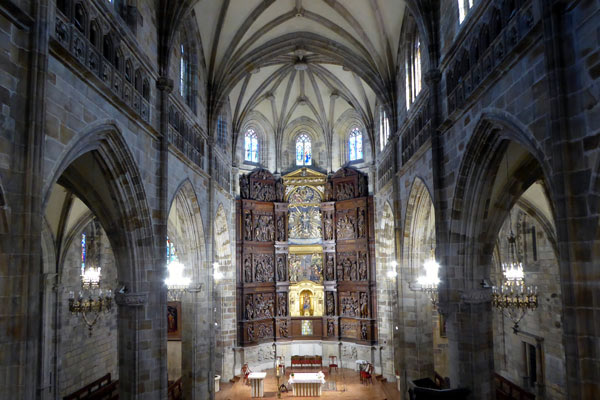
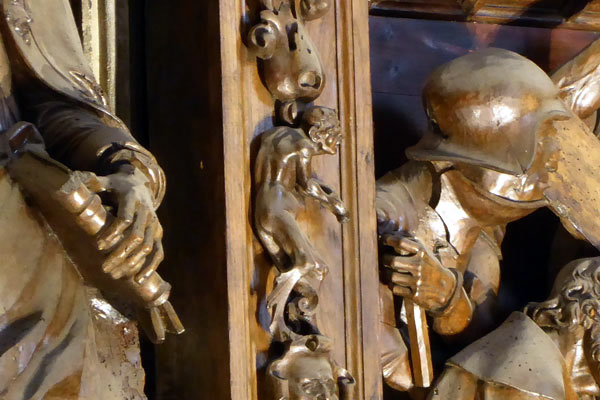
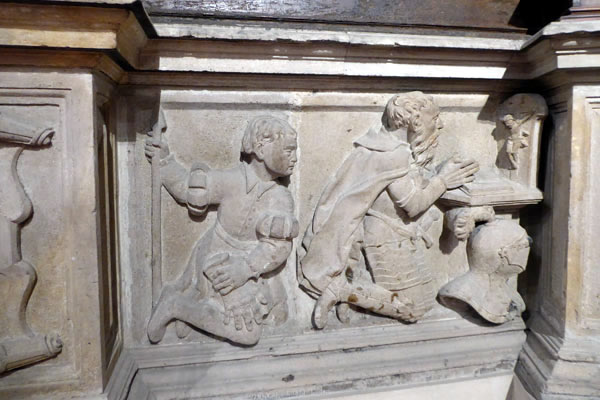
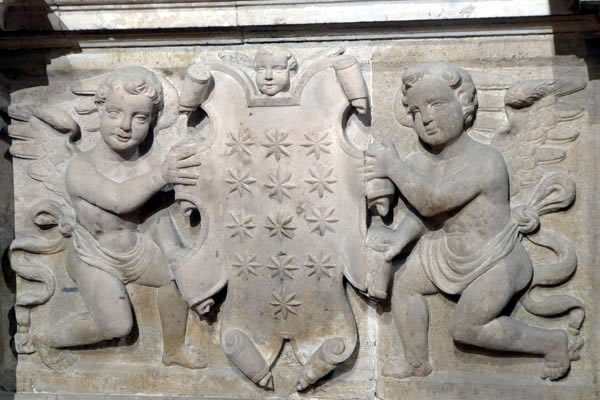
Vertically, it is divided into three sections: the central section is wider and is dedicated to the Virgin Mary, the patron saint of the altarpiece; the side sections are flanked by two intersecting sections that house the figures of the twelve apostles. In general, the images are full of 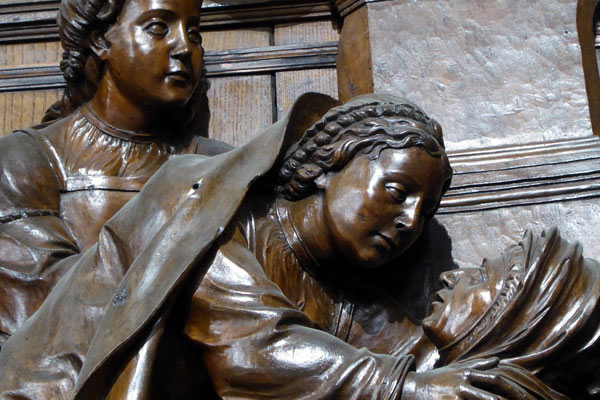
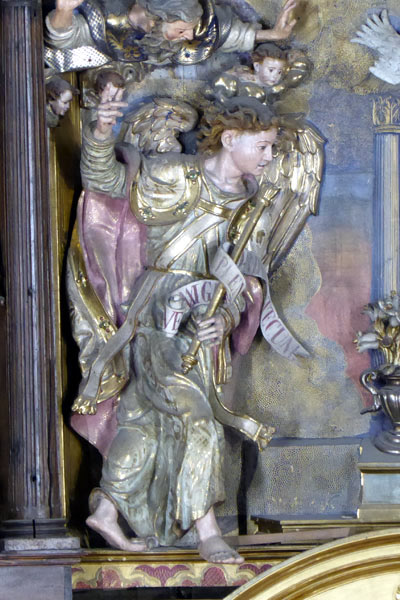
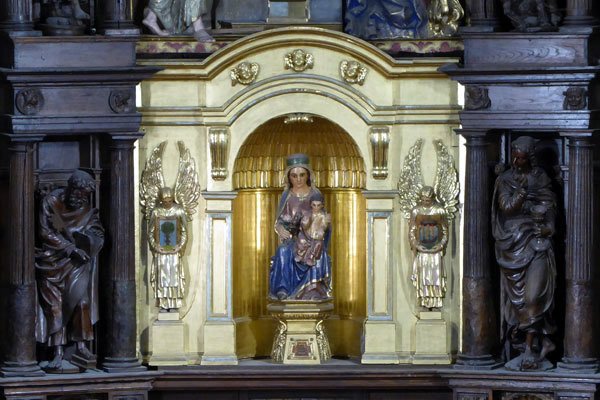
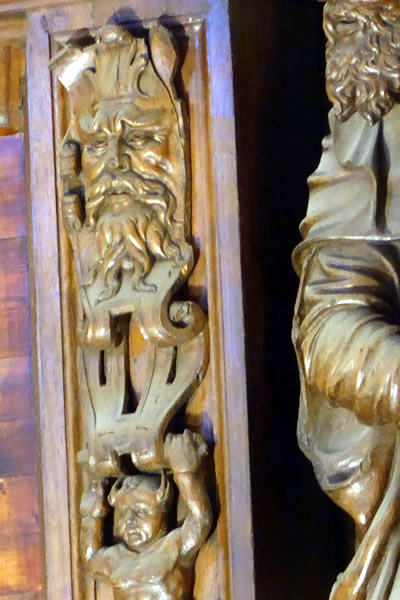
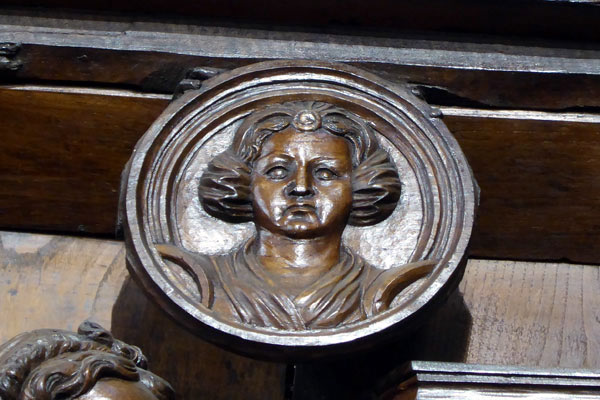
The decoration of the altarpiece is typical of the renaissance, with forms inspired by greek and, above all, roman antiquity: cherub heads called 
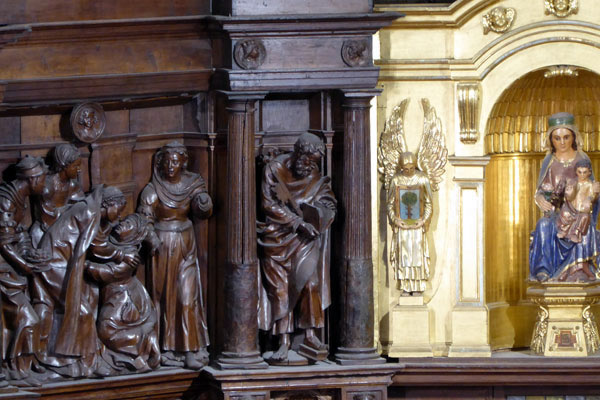
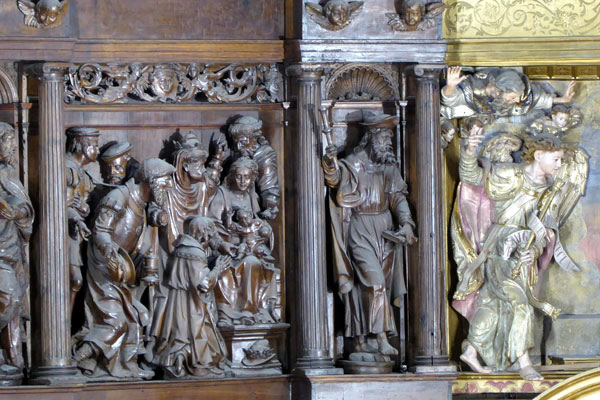
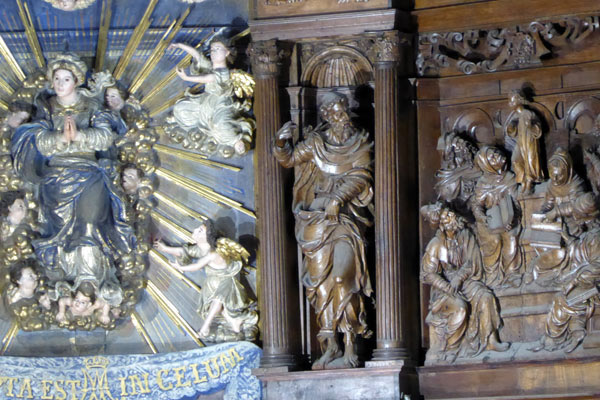
The polychromy is typically Baroque, with a predominance of 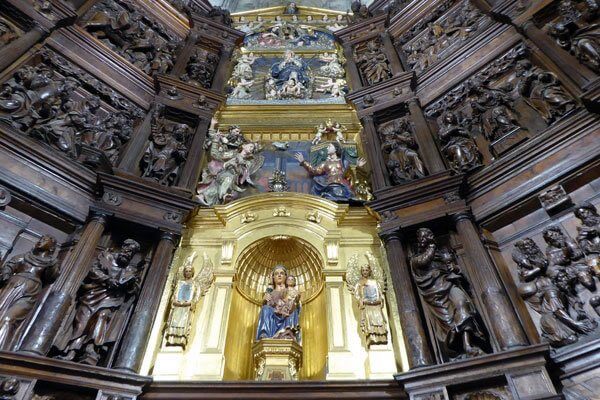
History:
In 1533, the council of Portugalete placed an order for this altarpiece with the flemish sculptor Guiot de Beaugrant, who lived in Biscay and was one of the best representative of the first renaissance. The work was paid thanks to the estate of the noble man Lope García de Salazar.
In 1549, Juan de Beaugrant, the brother of Guiot, became responsible for the construction work and collaborated with Juan de Ayala II. In 1555, the carving was finished and Francisco Vázquez started gilding and painting the central section.
However, in 1749, Andrés de Rada repainted the reliefs eliminating the original polychromy.
Sculptures:
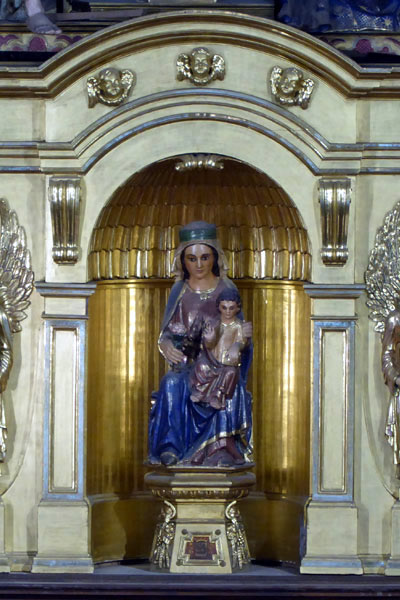
Andra Mari
The sculpture of the Virgin Mary sitting with the Child in her lap is called “Virgin Mary on the Throne” and in the Basque region “Andra Mari” (“Lady Mary”).
It is the oldest picture of the altarpiece, as it was created in the 14th century – at least 200 years older than the other sculptures and reliefs.
This gothic style sculpture is inspired by medieval examples. However, it was certainly repainted in the 18th century together with the other pictures from the central section.
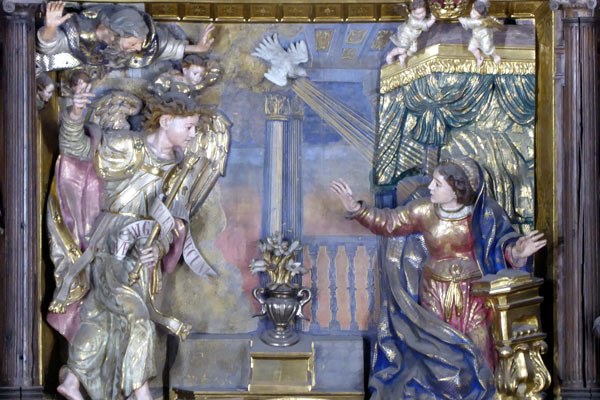
Annunciation
According to the gospels, the archangel Gabriel was send by God to announce Mary that she will be the mother of the Messiah. This moment is of great symbolic importance for the Christianity, as it represents the mystery of the Incarnation, which means, the moment when God becomes a human to save humanity from sin. This painting shows the moment when the archangel appears to Mary, who is reading. She turns her head towards the angel and opens her arms expressing her surprise. Next to Mary are some white lilies, the symbol of purity and virginity.
Above them appear to Angels carrying the crown, which indicates that the Mother of God is now Queen of Heaven. God the Father, who is depicted on the other side of the picture being surrounded by angels, send a white dove – the Holy Spirit – to Mary, in allusion to the miraculous and divine conception of Christ.
The gestures of the figures, the quality of the carving and the fine polychromy stand out.
It is a work of the sculptor Juan de Ayala II.
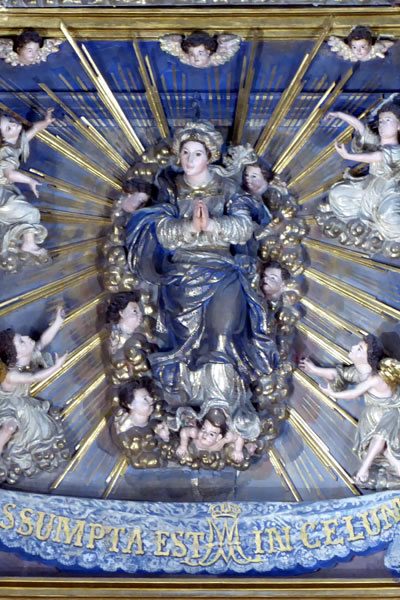
Assumption of Mary
According to the catholic tradition, at the end of her life Mary was taken to heaven and her body and soul are in Paradise. She is depicted on clouds and surrounded by angels, because they took up her body into the Glory.
It is a work of the sculptor Juan de Beaugrant.
Trinity
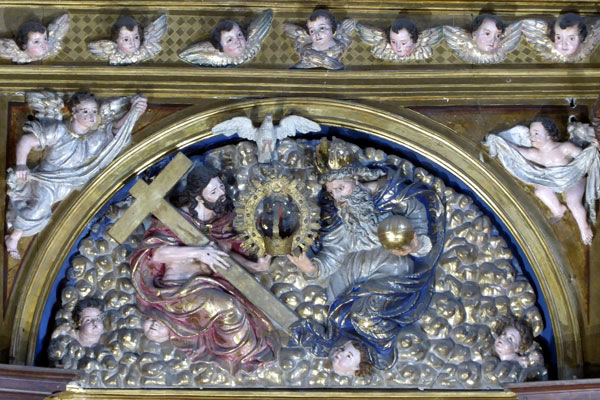
According to the tradition, after having arrived into the Glory Mary was crowned Queen of Heaven. Therefore, the Trinity carries a golden crown.
For christians, the Trinity is the symbolic representation of God who exists in three persons: the Father, the Son and the Holy Spirit. God the Father (on the right side) is depicted as an old man with a long beard holding a globe in his left hand. God the Son (on the left side) is depicted as the Risen Christ, with the nail hole in his hand. He is dressed with red and golden clothes and carries the cross in his right hand. The Holy Spirit (between them) is depicted as a white dove with outstretched wings forming a cross.
This relief is a work of the sculptor Guiot de Beaugrant.
God the Father
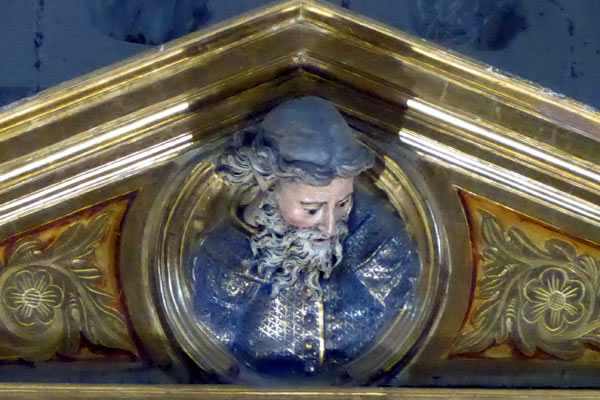
This picture located over the one of the Trinity shows God the Father as an old man with a large and frizzy beard.
The facial expression stands out intensified by the beautiful baroque polychromy.
Mary visits Elisabeth
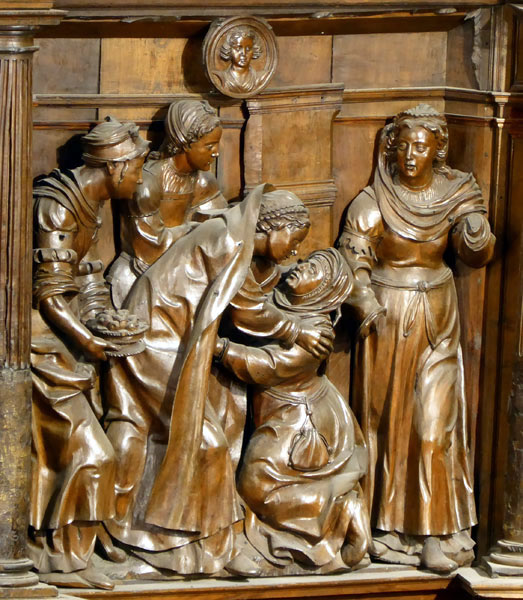
According to the gospels, Mary, who is pregnant with Jesus, visits her cousin Elisabeth, who is pregnant too, with John the Baptist. Mary tells her cousin that she will become the mother of God. Both women embrace each other, while three other women are watching the scene. The Virgin is bending over her cousin who is kneeling in front of Mary recognising her as the Mother of the Messiah.
The picture is full of details such as the bag on Elizabeth’s belt or the plate with fruits brought by one of the women.
It is a work of the sculptor Juan de Ayala II.
Adoration of the shepherds
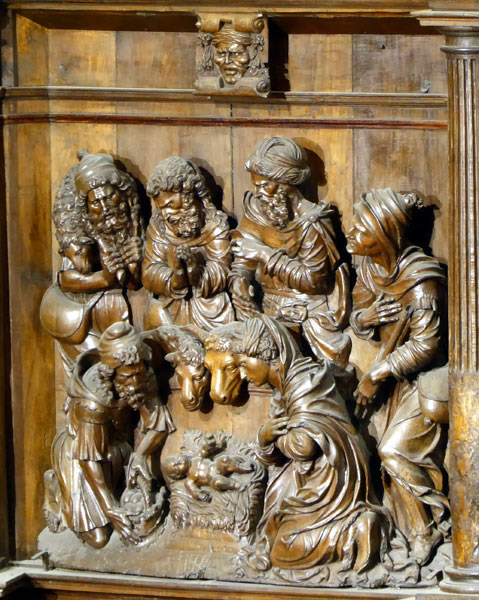
According to the gospels, after the birth of Jesus in Bethlehem, an angel announced the shepherds that the Messiah had been born. They went to the manger to adore him. Mary is kneeling in front of her son looking at him while a shepherd is bowing down to pay respect. The shepherd presents a box with eggs as gift.
Joseph is standing behind Mary and next to three other shepherds. One of the shepherds carries a lamb in allusion to Christ as the Lamb of God and therefore to his role as the Saviour of humanity.
Everyone is watching the child, even the donkey and the ox, animals that traditionally accompany the pictures of the Nativity of Jesus. It is a work of the sculptor Juan de Beaugrant.
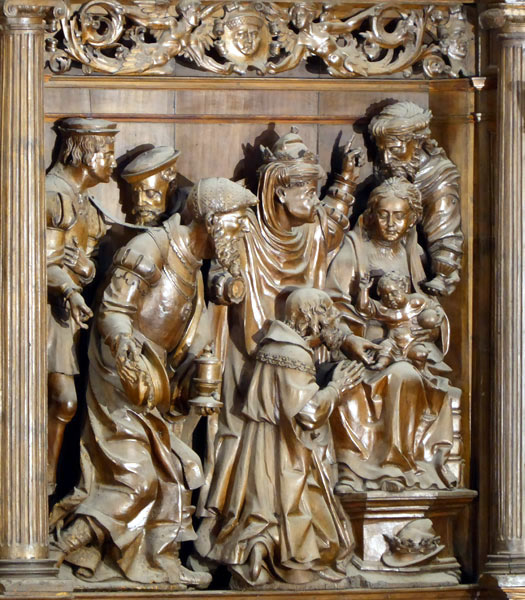
Adoration of the Wise Men or Epiphany
According to the gospels, some Wise Men from the East came to visit Jesus in Bethlehem guided by a star from the sky. The gospels do not mention their names, nor the number or their backgrounds. However, the tradition tells that they were three, called Melchior, Caspar and Balthasar. Since the 14th century, the latter one has been depicted as a young black man. It is told that they brought three gifts with them: gold the symbol for a king; incense for God; and myrrh, a very aromatic balm that was used to embalm the dead, mortal humans.
Mary holds the Child, while the first Wise Man Melchior is kneeling in front of the Son of God. He puts his crown, which symbolises him as king, on the ground. Caspar puts down his hat paying respect to Jesus. Balthasar is standing behind them and points towards heaven indicating that the star guided them the way to the place were God was born. Joseph, in the background, holds a jar given to him by Melchior, while two pages appear behind Caspar, wanting to observe the scene.
It is a work of the sculptor Juan de Ayala II.
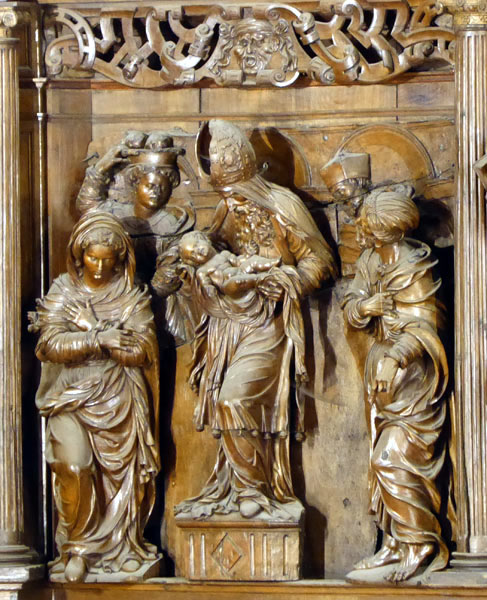
Presentation of Jesus in the temple
According to the jewish law, all families had to present their firstborn male child to God offering in the temple a sacrifice of a pair of turtledoves or young pigeons. According to the gospel of Luke, Mary and Joseph took Jesus to the temple of Jerusalem to comply this precept. In the temple, the elderly priest Simeon, who is dressed with beautiful clothes, holding the Child in his arms recognised Jesus as the Messiah.
It is a work of the sculptor Juan de Beaugrant.
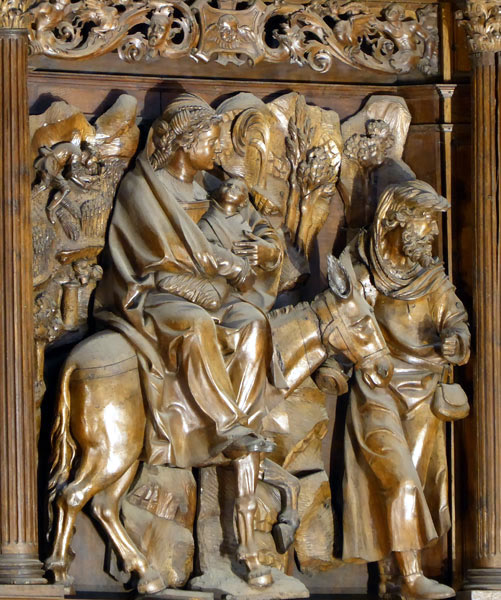
Escape to Egypt
According to the gospels, an angel warned Joseph that king Herod commanded to kill all boys under the age of two years, because he was afraid that one of them would dethrone him. Mary and Joseph decided to flee to Egypt to save Jesus. Mary is sitting with the Child in her arms on the back of a donkey, led by Joseph in front of them.
The scene is set in a landscape, which makes it an everyday occurrence and more understandable. On the left side in the background appears a man cutting grain in the field. It might be an allusion to a Northern European legend, which is rarely represented in the basque region. There is another example of this legend in Biscay, in the triptych of Gizaburuaga, which is dedicated to the childhood of Jesus and today displayed in the Diocesan museum.
According to the tradition, as the Holy Family passed the grain field, the ear of the cereal grew miraculously in only one day. When king Herod’s soldiers asked the farmer the next day whether a family had come along, he replied that they passed shortly after the grain had been seed. As the soldiers saw that the grain was already being harvested, they thought it couldn’t be Mary, Jesus and Joseph, and stopped persecuting them.
It is a work of the sculptor Juan de Ayala II.
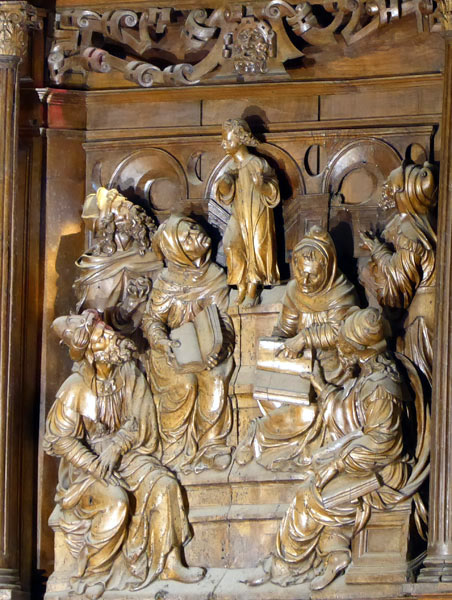
Christ among the Doctors
According to the gospels, at the age of 12 Jesus and his parents went to Jerusalem to celebrate the jewish feast Pesach/ Passover where the child got lost in the crowd. After having looked for the child for three days, the parents found him in the temple, where Jesus was discussing with the priests and theologians, who were impressed by his wisdom. Jesus appears in the temple, surrounded by the teachers who ask him and check his answers in the books.
The gestures and facial expressions of the men stand out.
It is a work of the sculptor Juan de Beaugrant.
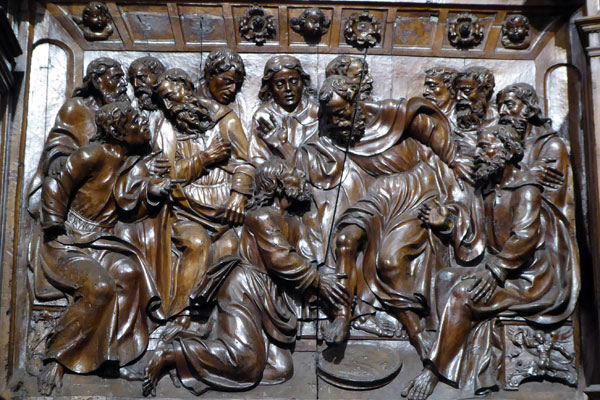
Foot washing
According to the Gospel of John, before the Last Supper on the day before his death, Jesus washed the feet of the twelve apostles. He explains them to act with humility and that they are all men with clean hands, except one – Jesus knows that Judas Iscariot will betray him. In this picture, Jesus is kneeling in front of Peter to wash his feet, while the other apostles express their surprise.
The relief is rich in detail with the typical renaissance decoration of the room’s ceiling and the seat on the right edge.
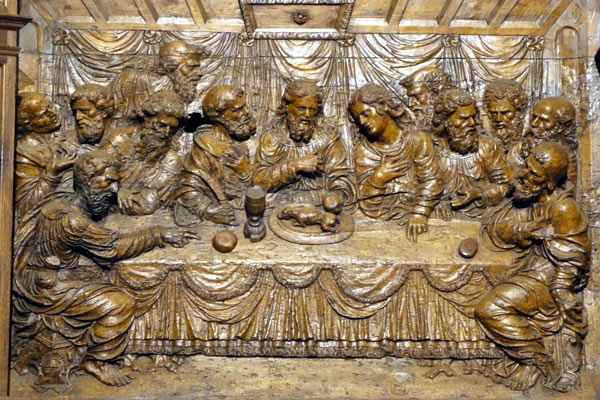
Last Supper
A scene from the gospels describing the moment when Jesus meets with his disciples for dinner and announces that one of them will betray him. The Apostles make gestures to express their surprise. They talk to each other to find out who of them will be the betrayer. The picture shows the apostles sitting around the table, which is set with many details of everyday life such as plates, knives and cups.
Jesus takes a bread as reference to the institution of the Eucharist, which the catholics remember every mass.
Judas Iscariot is sitting at the far left of the table, carrying a small bag on his belt filled with money, which he received for betraying Jesus.
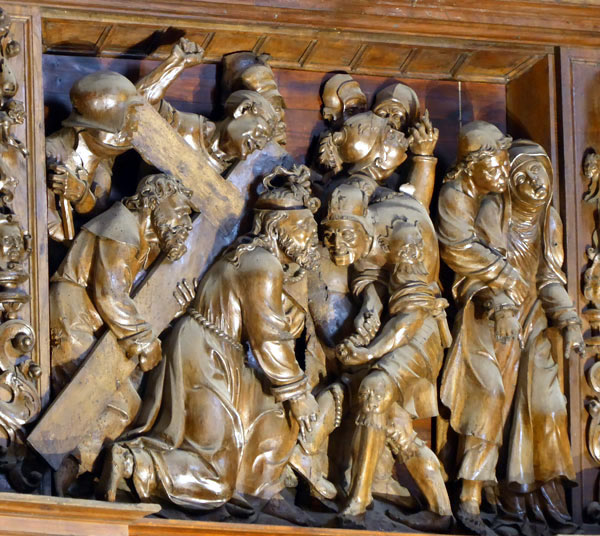
Jesus falls on the Via Crusis
Jesus is forced to carry the cross through the streets of Jerusalem to mount Golgotha, where he will be crucified. The soldiers insult him and pull him on a cord, which is fixed on his belt. Simon of Cyrene accompanies Jesus helping him to carry the cross.
On the far right of the picture, Mary is collapsing and John, the disciple whom Jesus loved, is supporting her.

The fifth Sorrow (Crucifixion and Death of Jesus)
Mary and the disciples mourn for Jesus. Mary is leaning over the death body of her son holding him with a cloth, the shroud in which he was then enwrapped. Beside his feet appears Mary Magdalene dressed with beautiful clothes and wipes the blood from the wounds with a sponge.
Four other people appear in this scene: John is standing behind the Virgin Mary; Joseph of Arimathea, who asked the roman governor Pontius Pilate for permission to take the death body of Jesus from the cross and to lay him in a sepulchre, appears next to Mary Magdalene, dressed with a turban.
The death body’s anatomy stands out and resembles the works of the Italian sculptor Michelangelo.
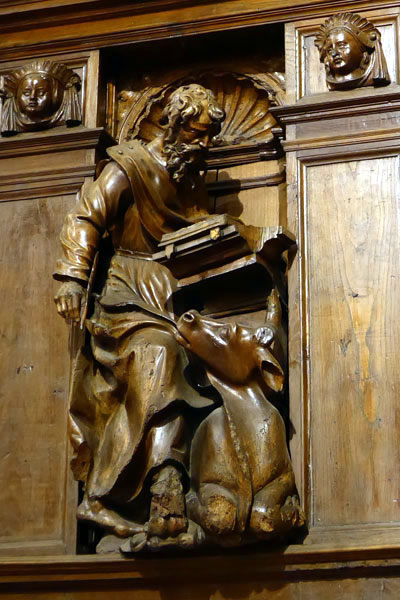
Saint Luke
Luke is the author of one of the four gospels in the Bible, which the catholic church considers as directly inspired by God. Each evangelist has a symbol; the one for Luke is an ox, which in the picture appears next to Luke’s feet.
The saint is depicted as an old man with beard standing in front of a lectern.
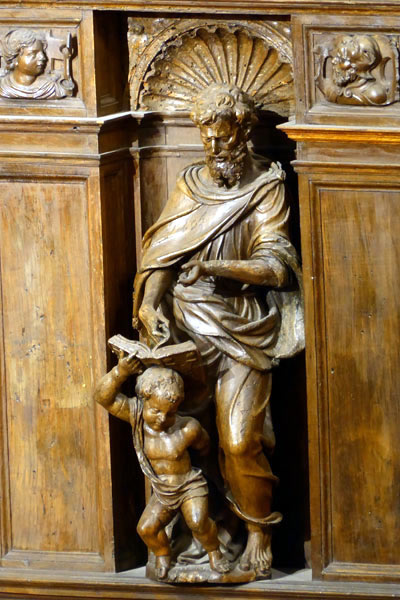
Saint Matthew
Matthew is the author of one of the four gospels in the Bible, which the catholic church considers as directly inspired by God.
Each evangelist has a symbol; the one for Matthew is a man who in this case is depicted as a child. The child carries a book on his back, which Matthew is riffling through.
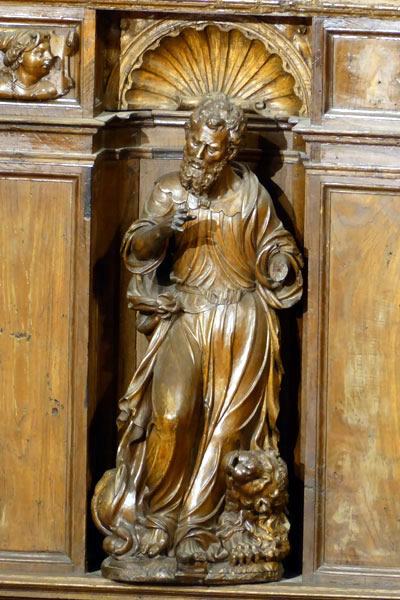
Saint Mark
Mark is the author of one of the four gospels in the Bible, which the catholic church considers as directly inspired by God.
Each evangelist has a symbol; the one for Mark is a lion lying next to his feet, which in the picture is roaring.
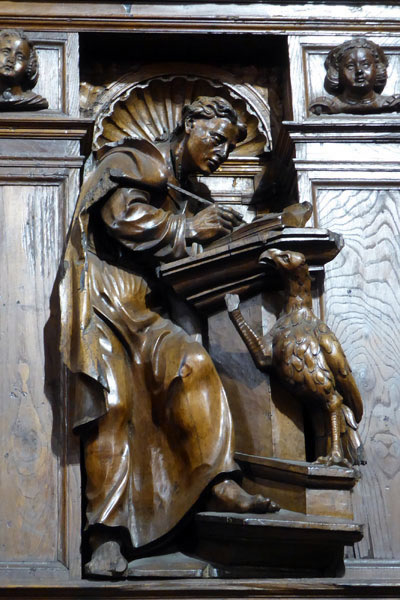
Saint John the Evangelist
John is the author of one of the four gospels in the Bible, which the catholic church considers as directly inspired by God. Each evangelist has a symbol; the one for John is an eagle such as in this picture.
John is depicted as a young man without beard standing in front of a lectern.
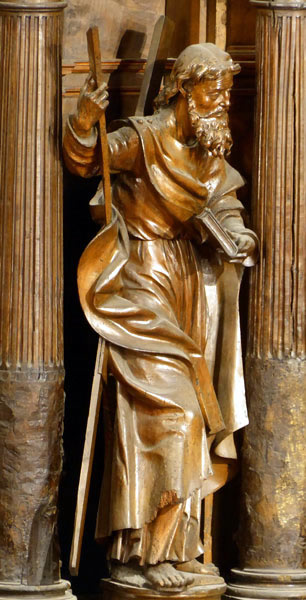
Saint Andrew
According to the gospels, Andrew was together with his brother Peter the first of the twelve apostles, which were called by Jesus of Nazareth. His legend tells that he preached in Thrace (a region in today’s Greece, Bulgaria and Turkey) where he was sentenced to be whipped and bound to an X-shaped cross (known as the “Saint Andrew’s Cross”) until he dies. The saint is depicted with the Saint Andrew’s cross behind him and an open book in his left hand – symbolising him as apostle.
It is a work of the sculptor Guiot de Beaugrant.
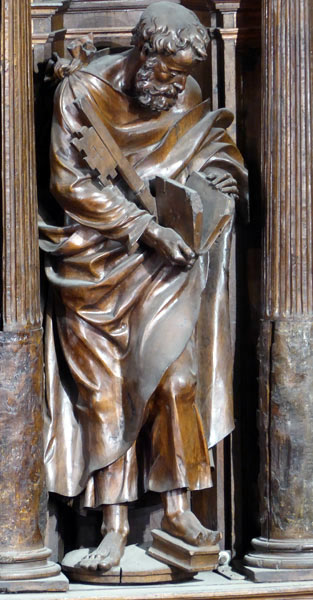
Saint Peter
According to the gospels, Peter was together with his brother Andrew the first of the twelve apostles, who were called by Jesus of Nazareth. Jesus appointed Peter as his successor, therefore he is considered as the first Pope of the catholic church. In this picture, Peter is holding a book and the keys of the Kingdom of Heaven.
His facial expression and the fringes of his clothes stand out.
It is a work of the sculptor Guiot de Beaugrant.

Saint John
According to the gospels, John was the youngest apostle, who followed Jesus of Nazareth. He is depicted as a young man without beard, raising his right hand to bless the chalice in his left one. This is an allusion to one of his miracles, as, according to the christian tradition, he was forced to drink poisoned wine. However, after John had blessed the chalice he could drink the wine without dying which shows the real faith in Christ.
It is a work of the sculptor Guiot de Beaugrant.
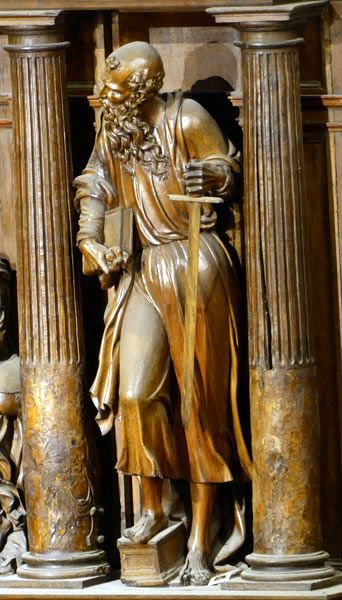
Saint Paul
Paul was one of the first missionaries of christianity, the religion to which he himself converted after Christ had appeared to him. In this picture, he is portrayed with a large sword, the symbol for his death by beheading, and the book, a reference to the text of the acts of the apostles and his fourteen Pauline epistles that are part of the Bible.
The fine carving of the beard and clothes stands out.
It is a work of the sculptor Guiot de Beaugrant.
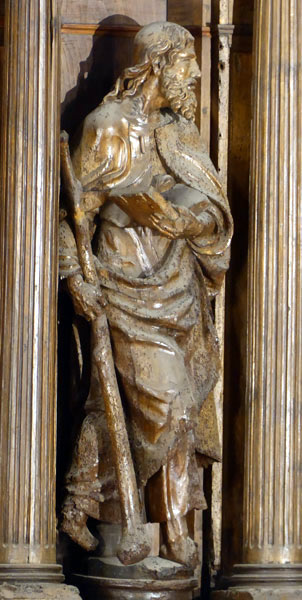
Saint James the Less
Saint James, son of Alphaeus, was one of the twelve apostles, who, according to the gospels, accompanied Jesus of Nazareth. He is known as Saint James the Less to distinguish him from the other Apostle Saint James the Great, son of Zebedee. According to the tradition, the jewish priest Ananias ordered to stone him next to the temple in Jerusalem to prevent him from preaching the gospel. As he had not died after a while, he was martyred with a deathblow from a club on his head. In this picture, James is depicted carrying a large stick in his right hand and a book in his left one, which identifies him as apostle.
It is a work of the sculptor Guiot de Beaugrant.
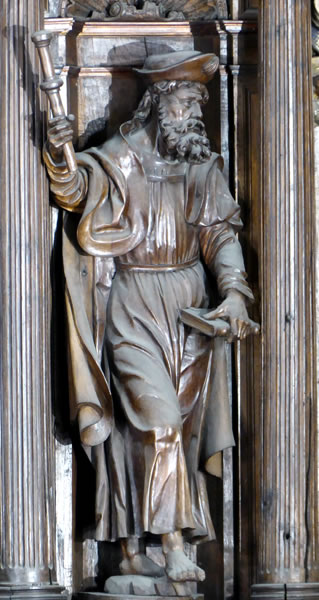
Saint James the Great
Saint James, son of Zebedee, was one of the twelve apostles, who, according to the gospels, accompanied Jesus of Nazareth. He is known as Saint James the Great to distinguish him from the other apostle Saint James the Less, son of Alphaeus. According to a medieval tradition, James the Great is buried in Iria Flavia (Compostela). This was the origin for the pilgrimage to his grave and for the Camino de Santiago. The Saint is dressed like a pilgrim with a hat, a shell, a stick in his right hand and the book, which indicates him as one of the apostles.
It is a work of the sculptor Guiot de Beaugrant.
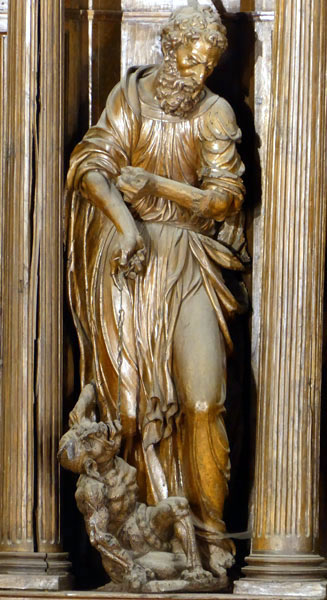
Bartholomew
According to the gospels, Bartholomew was one of the twelve apostles who accompanied Jesus of Nazareth. Bartholomew is depicted together with a chained demon, which the Saint according to the tradition defeated.
It is a work of the sculptor Guiot de Beaugrant.
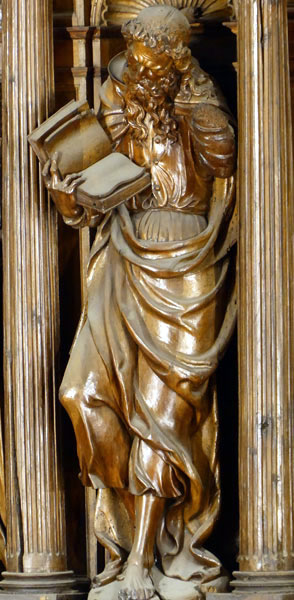
Apostle
One of the twelve apostles who according to the gospels followed Jesus of Nazareth. The right hand has disappeared with which he certainly was carrying an object, which would have allowed the apostle to be identified.
It is a work of the sculptor Guiot de Beaugrant.
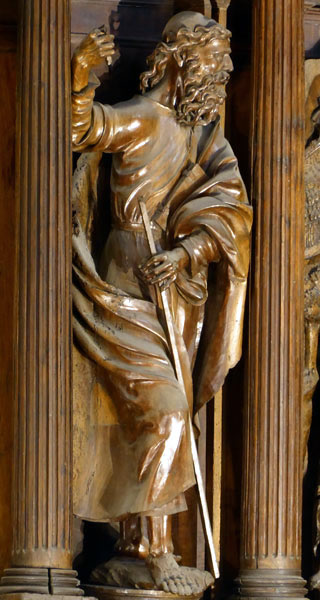
Apostle
One of the twelve apostles who according to the gospels followed Jesus of Nazareth. Although the object he carries is broken, it looks like a large square, which could represent Jude Thaddaeus who was an architect.
It is a work of the sculptor Guiot de Beaugrant.
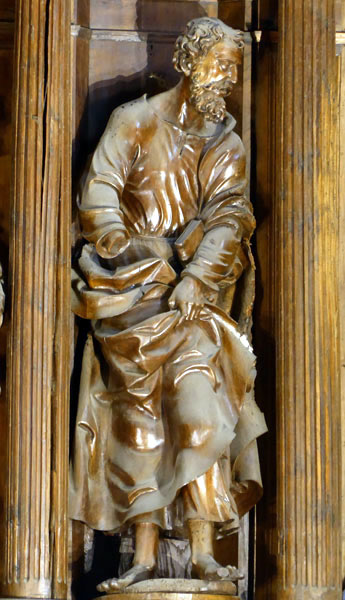
Apostle
One of the twelve apostles who according to the gospels followed Jesus of Nazareth. The right hand has disappeared with which he certainly was carrying an object, which would have allowed the apostle to be identified.
It is a work of the sculptor Guiot de Beaugrant.
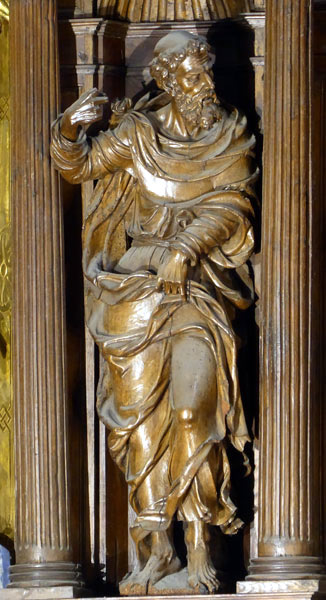
Apostle
One of the twelve apostles who according to the gospels followed Jesus of Nazareth. The right hand has disappeared with which he certainly was carrying an object, which would have allowed the Apostle to be identified.
It is a work of the sculptor Guiot de Beaugrant.
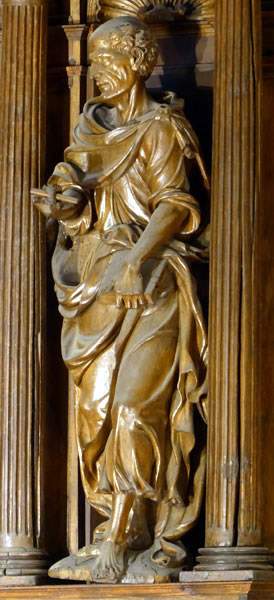
Saint Philip
According to the gospels, Philip was one of the apostles who followed Jesus of Nazareth. According to the tradition, Philip was fixed on a cross and stoned to death. Therefore, he carries a Latin cross in his right hand and a book in the left one, which identifies him as apostle.
It is a work of the sculptor Guiot de Beaugrant.
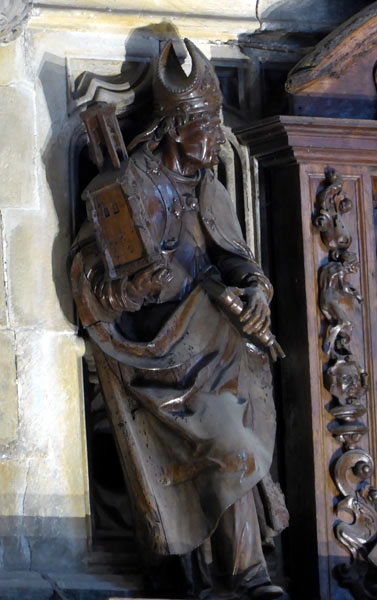
Saint Augustine
Augustine was a philosopher from the fourth century who converted to christianity and became bishop of the town of Hippo (today’s Algeria). Therefore, he wears a richly ornamented coat and is crowned with the mitre – a hat used by bishops in solemn celebrations.
He was author of many works of theology and is therefore considered as one of the fathers of the catholic church. Augustine commonly carries a small church.
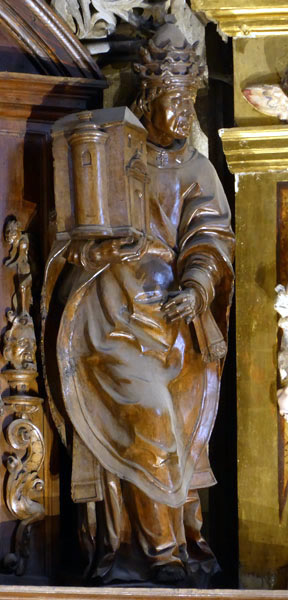
Saint Gregory the Great
Gregory was a pope from the sixth century. Therefore, he is depicted with the tiara – a hat consisting of three crowns, which indicates his authority as pope, bishop and king.
He was author of many theological books and is therefore considered as one of the fathers of the catholic church.
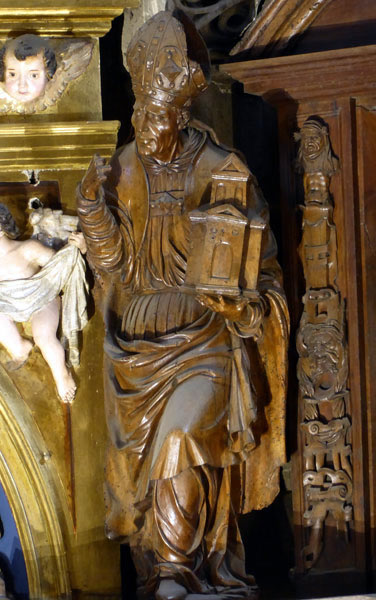
Saint Ambrose
Ambrose was bishop of Milan in the fourth century. Therefore, he is depicted with the mitre – a hat used by bishops in solemn celebrations.
As author of many theological books, he is considered as one of the fathers of the catholic church. Ambrose commonly carries a small church.
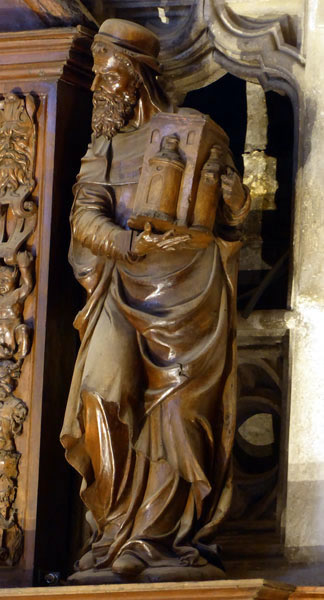
Saint Jerome
Jerome was a studious christian from the fourth century who translated the Bible to Latin. Therefore, he is considered as one of the fathers of the catholic church.
He became secretary of pope Damasus and that is why he is dressed like a cardinal.
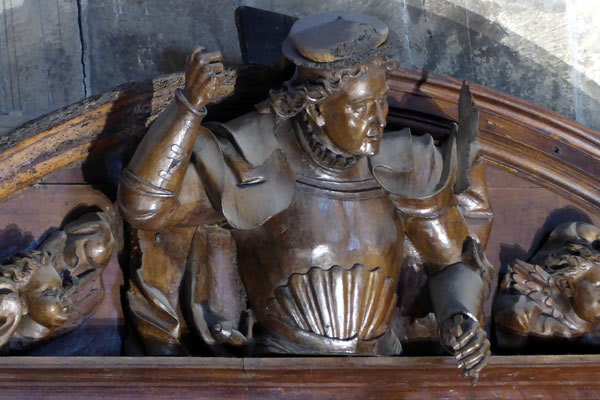
Saint Michael Archangel
Michael is one of the archangels mentioned in the Bible. His name means: “Who is like God?” According to the tradition, Michael defeated Lucifer when he rebelled against God.
Therefore, Michael is portrayed as a soldier with helmet, suit of armour, sword and shield (has disappeared) which is the symbol for his triumph against the demon.
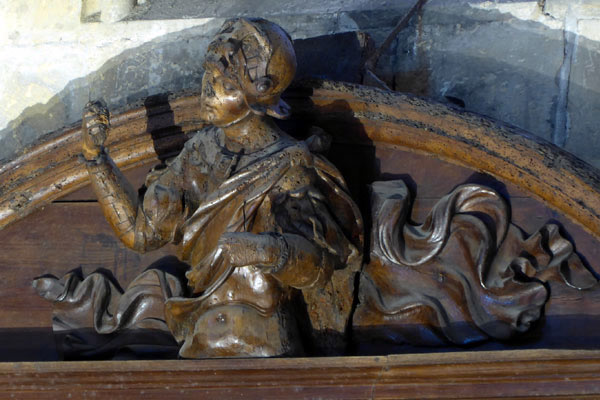
Saint George
George was a roman soldier who lived in Cappadocia (today’s Turkey) in the first years of christianity. According to his legend, he knew that a dragon was threatening the inhabitants of Silca (today’s Libya) who had to offer daily human sacrifices to the dragon. The brave soldier fought against the dragon to save the beautiful princess, whom the dragon wanted to eat.
George is depicted as a warrior dressed with armour and helmet. He carries a lance (has disappeared) in his right hand, symbolising his triumph, which is interpreted as the victory of the virtue over the sin.