
Altarpiece of Saint Peter
- Church: Assumption of Mary Church (Saint Mary) (Orduña)
- Location: Chapel of the Olaso family
- Patron: Juan Sáenz de Herrán y Fernández de Arbieto
- Chronology: 16th century (around 1520)
- Style: Renaissance
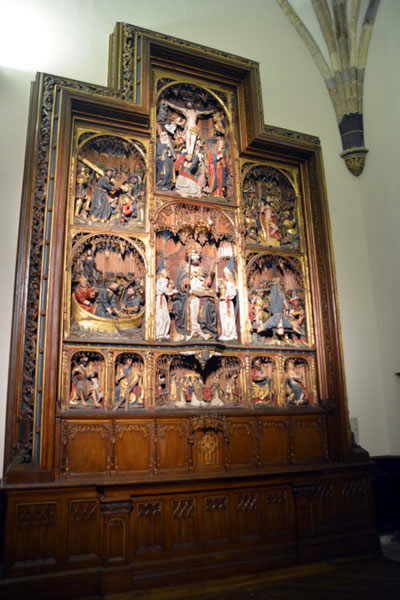
A beautiful work from Antwerp in the interior of the Chapel of the Olaso family
Interactive altarpiece, klick on the pictures to get more information.
Church:
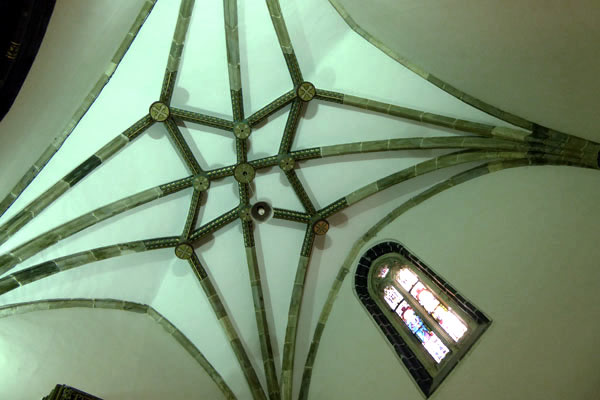
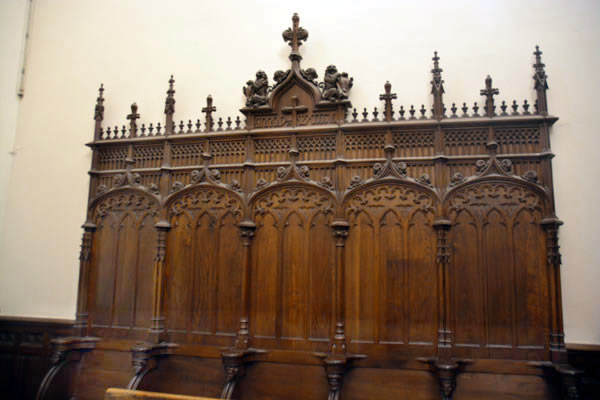
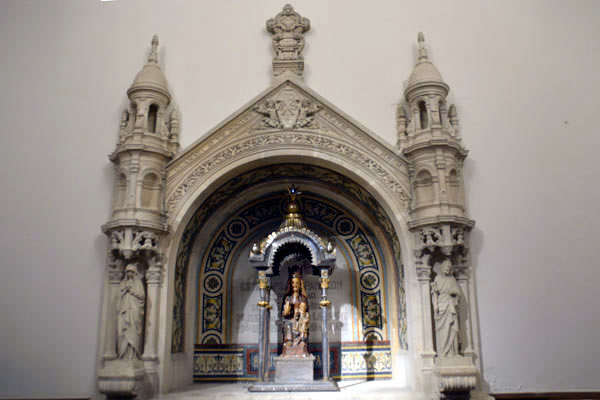
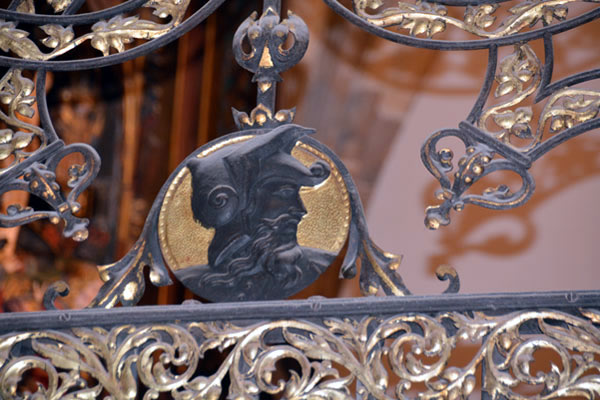
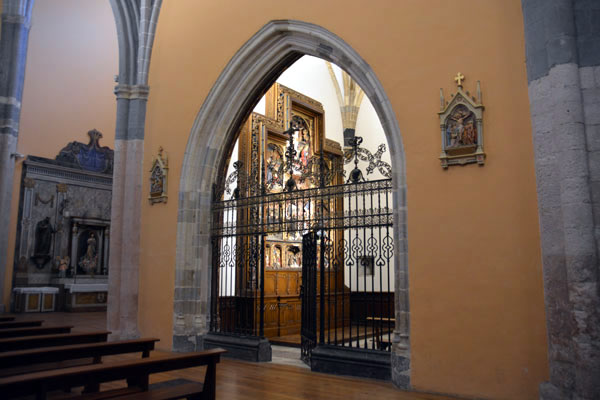
The Assumption of Mary church, which is the main church in Orduña, was built between the 13th and 16th century in the Gothic style. It is a fortified church built as part of the town wall. Inside, there are several chapels; the altarpiece of Saint Peter is located in one of them: the Olaso Chapel, which is Gothic in style with a ribbed vault and is located on the right-hand side of the central nave.The chapel was refurbished and refurnished in 1906 by the architect José María Basterra. He created the wooden choir stalls located in front of the altar and the alcove with the sepulchre of the Olaso family in the Chapel’s wall. The chapel is closed with a fence of iron bars designed by the sculptor Daniel Zuloaga.


Patronage:
Peter and his brother Andrew were fishermen in Capernaum and the first apostles of Jesus. Peter was the closest disciple of Jesus, to the extent that Jesus even said of him: “on this rock I will build my church”. After Jesus had died, Peter had to leave Jerusalem as he was persecuted by Herod. According to the tradition, he went to Rome, where he became the first bishop and therefore the first pope. He was arrested under Nero and in the year 67, he was sentenced to be crucified. However, Peter asked to get crucified head-down, as he didn’t consider himself worthy to die the same manner as Christ.
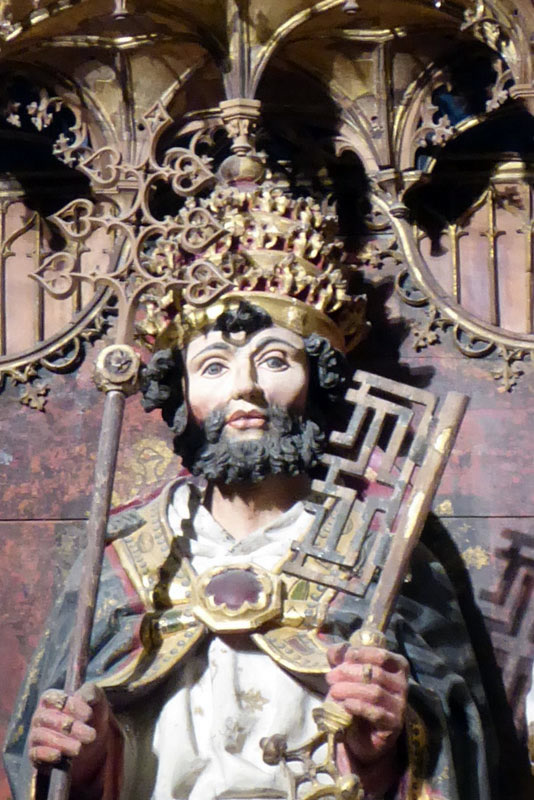
Peter is depicted as the first pope, dressed with beautiful clothes and the tiara – a head consisting of three crowns, which represents his authority as pope, king and bishop.
Descriptionn:
The altarpiece from the 16th century is located in chapel of the Olaso family. It is a triptych altarpiece consisting of three vertical sections and of two horizontal body parts over the 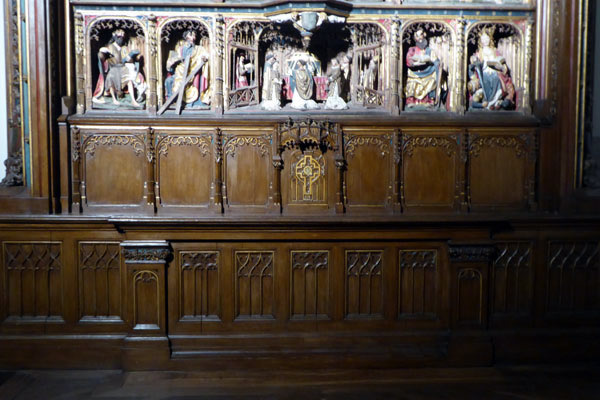
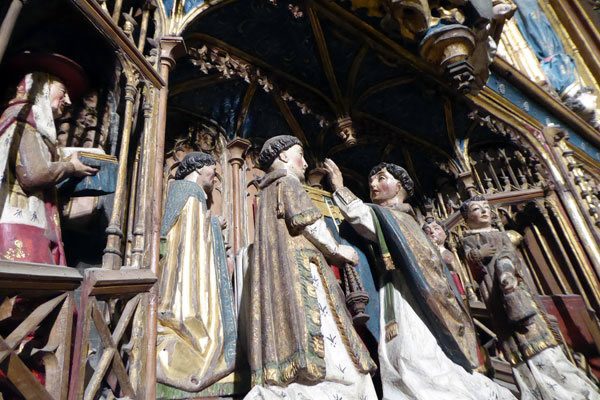
The boxes that house each scene have been crafted with great precision, especially in the 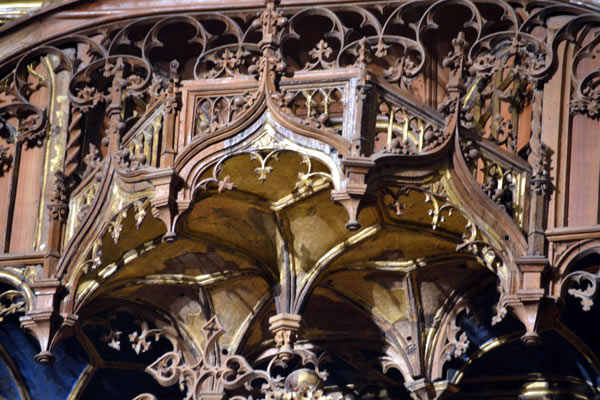
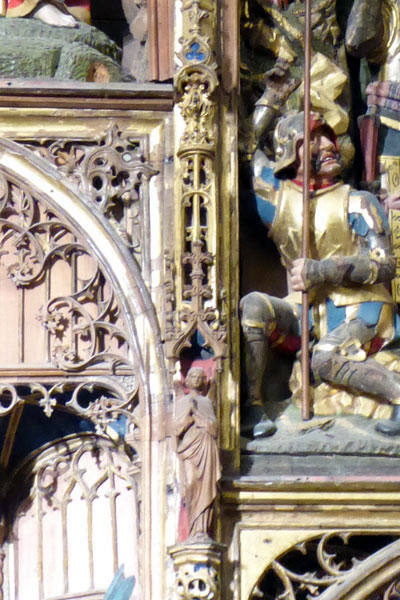
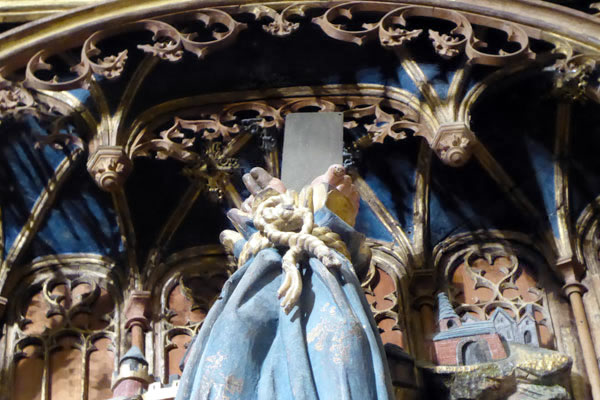
The polychromy, based on 
History:
The chapel of the Olaso family was founded in 1516 by the merchant Juan Sáenz de Herrán y Fernández de Arbieto, who certainly bought also the altarpiece in the town of Antwerp (today’s Belgium). The chapel had been belonging to the family until the end of the 19th century and was acquired in 1898 by José Rufino de Olaso, a resident of Trapagaran who was married to María Dolores Madaria from Orduña.
Some reforms were made, which also affected the altarpiece. It was inserted into a wooden piece of furniture with a gothic style decoration.
Sculptures:
Pedestal
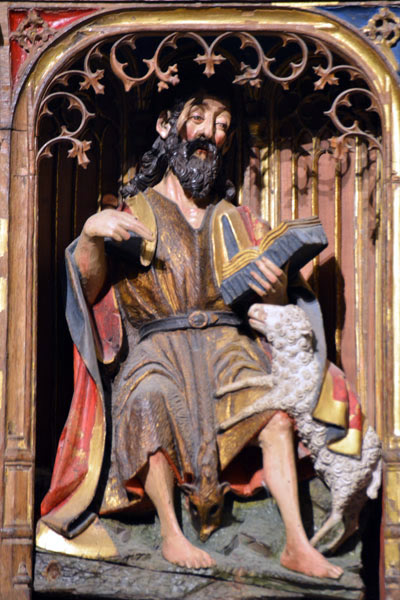
Saint John the Baptist
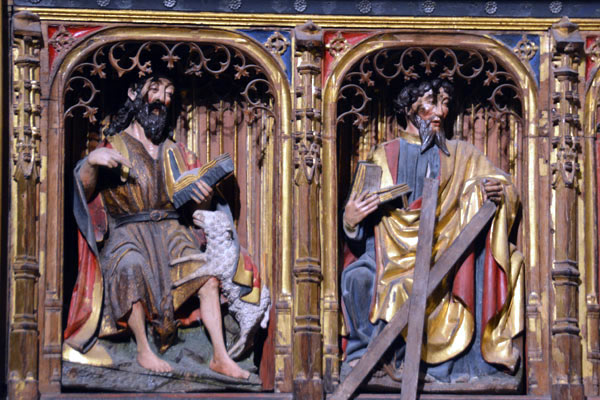
According to the gospel, John the Baptist was sanctified in the womb of his mother Elizabeth during the visit of her cousin, the Virgin Mary. John is called the “forerunner of Christ” as, according to the tradition, he was the last prophet who announced the arrival of the Messiah. The gospel describes him as a hermit who lived in the desert and covered himself with a camel-skin robe. The Baptist is sitting under a beautiful gothic decoration. He is depicted as a man with scruffy hair and beard, wearing a camel-skin robe and pointing with two fingers at the lamb, which is laying over his knee. The lamb is the symbol for Jesus.
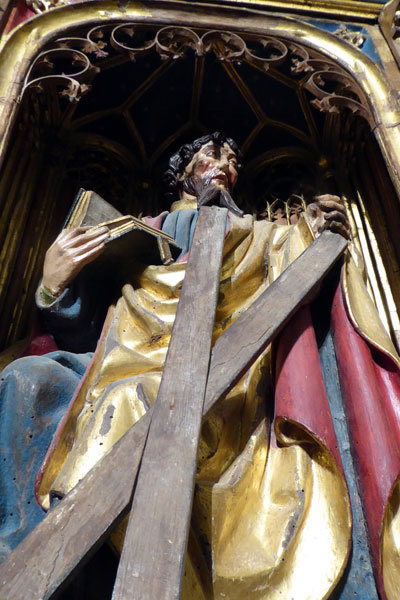
Saint Andrew
According to the gospels, Andrew was one of the twelve apostles who accompanied Jesus of Nazareth. He was the brother of Peter and probably the first disciple called by Jesus. His legend tells that he preached in Thrace (a region in today’s Greece, Bulgaria and Turkey) where he was sentenced to be whipped and bound to an X-shaped cross (known as the “Saint Andrew’s Cross”) until he dies. The Saint is depicted holding the Saint Andrew’s cross in his left hand and a closed book in his right one. The cross is the symbol for his martyrdom and the book identifies him as apostle.
He is depicted as an old man and his facial expression stands out.
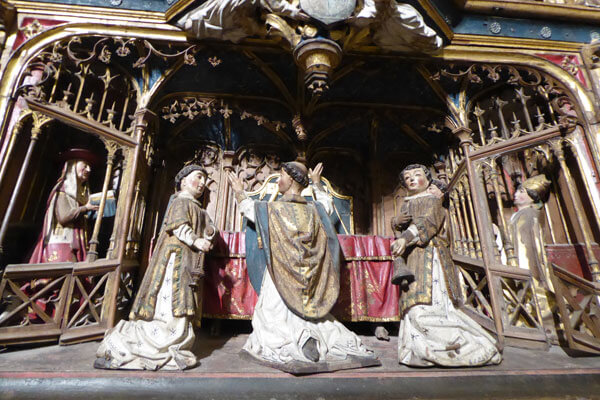
Mass of Saint Gregory
The relief shows one of the miracles ascribed to Pope Gregory the Great. The apparition of Christ during a Christmas mass celebrated by Saint Gregory. Jesus showed his wounds from the passion. This history intensifies the Eucharist as a symbol for the renewal of Christ’s sacrifice to save humanity. Gregory is kneeling being accompanied by two altar servers. The left one carries the censer and the other one the bells, which ring during the consecration to indicate that bread and wine become the body and blood of Jesus Christ.
A cardinal dressed with red clothes and a bishop with mitre are kneeling and watching the scene from the side. Above the altar are the symbols of the Passion of Christ: the lance, the cross and the ladder. The picture is filled with many details such as the garment of Saint Gregory and the colourful altar cloth.
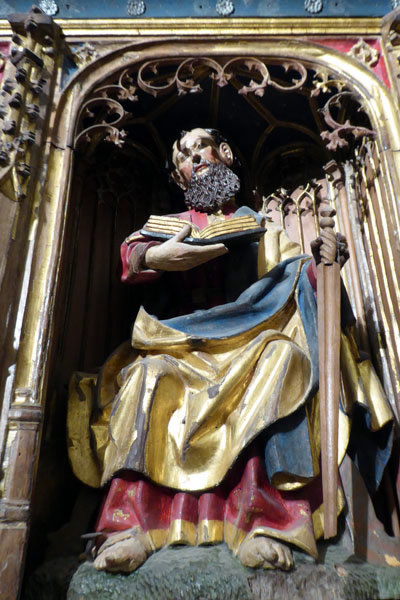
Saint Paul
Paul was one of the first missionaries of christianity, the religion to which he himself converted after Christ had appeared to him. He is depicted as an old man standing under a beautiful gothic decoration. Paul is portrayed with the sword, the symbol for his death by beheading, and the book, a reference to the text of the Acts of the apostles and his fourteen Pauline epistles that are part of the Bible.
The polychromy of his face and of the garments stands out.
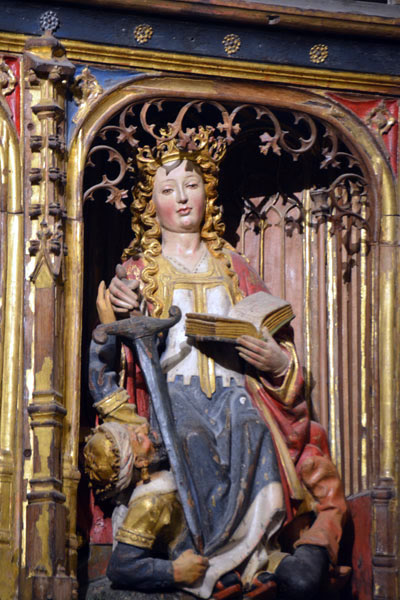
Saint Catherine of Alexandria
Catherine was a christian martyr from the fourth century born in Alexandria (Egypt). As she belonged to a noble family, she is depicted as a princess with blond hair and a crown on her head, standing under a beautiful gothic decoration. As she stood out for her intelligence and knowledge about poesy and philosophy, she holds an open book in her right hand. Catherine is standing on the emperor Maximian, who persecuted her for not wanting to sacrifice the pagan gods. Therefore, Maximian sentenced her to death by beheading. The sword in Catherine’s right hand is the symbol for her martyrdom.
The emperor’s angry face is contrary to Catherine’s calm countenance.
Body 1
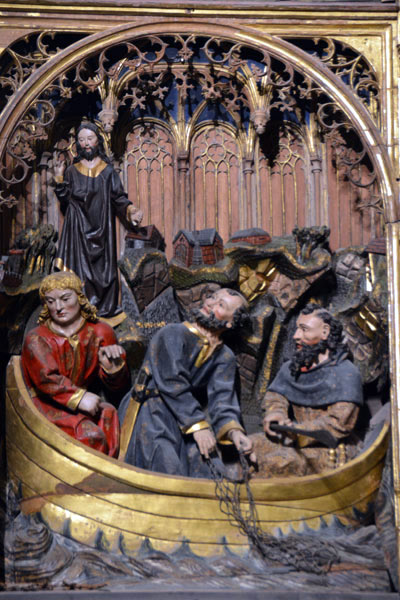
The Miraculous Catch of Fish
The scene shows an episode of the life of Peter, which is part of the gospels. The fishermen Peter, John and James unsuccessfully tried to fish on the sea of Galilee. Even though they threw the net again and again, it always was empty. Jesus appeared and showed them where to cast the nets. They obeyed and the nets were filled miraculously. The three apostles can be perfectly recognised: Peter is sitting in the middle, John, a young blond man without beard, is sitting to his right side and James, who is dressed like a pilgrim, is sitting to Peter’s left.
The relief is full of details such as the small houses and trees on the coastline, the beautiful carving of the net, the waves of the sea…
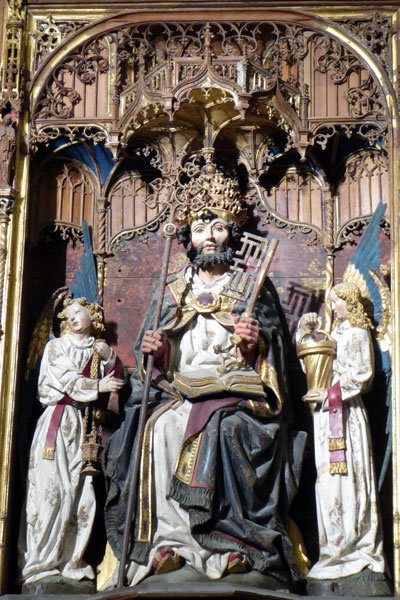
Saint Peter the Pope
According to the gospels, Peter was one of the Apostles and Jesus appointed him as his successor. Therefore, he is considered the first pope of the catholic church. Peter is holding a book on his lap, the keys of the Kingdom of Heaven in his left hand and the papal ferula (papal crosier) in his right one. He is crowned with a large detailed carved tiara, which consist of three crowns representing the power as king, bishop and pope. Peter is sitting on the cathedra (bishop’s throne) being accompanied by two angels, which carry a censer and a jar. Peter is sitting under a finely carved gothic baldachin.
The beautifully painted and gilded clothes stand out.
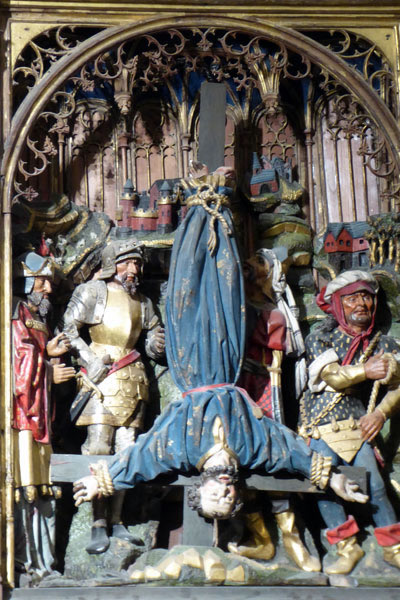
Crucifixion of Saint Peter
According to the tradition, after having been sentenced to death on the cross, Peter asked to get crucified head-down, as he did not consider himself worthy to die the same manner as Christ. There are many people depicted: In the foreground, Peter is hanging head-down on the cross being accompanied by the hangmen and soldiers who had fixed him on the cross. Their faces are perfectly carved as well as the details of their clothes and armours.
In the background appears a town protected by a town wall (Rome, the place where Peter died) and a shepherd with his herd – almost invisible.
Body 2
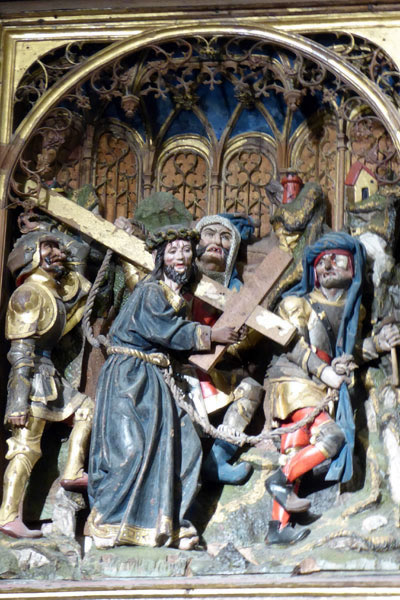
Via Crucis
According to the gospels, before his death Jesus was forced to carry the cross through the streets of Jerusalem to mount Golgotha, where he was crucified. He was insulted by the soldiers and they pulled the cord to which Jesus was fixed.
The facial expression of the soldiers, the beautiful carving of the picture with the landscape in the background, and the polychromy stand out.
Golgotha
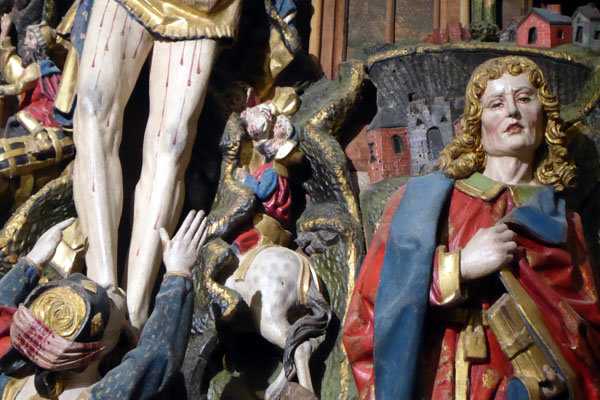
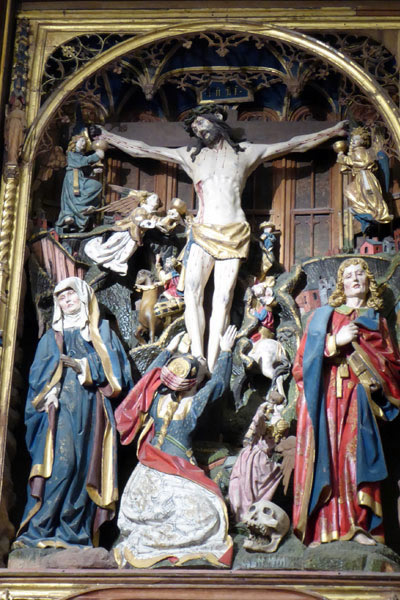
The altarpiece is crowned with the Golgotha scene. The dead body of Jesus Christ with the bleeding wound to his torso is hanging on the cross. Mary, who is depicted next to the cross as an old woman wearing a headscarf, is mourning for Jesus. On the other side of the cross appears John, the disciple whom Jesus loved, depicted as a young man without beard. At the foot of the cross is Mary Magdalene, dressed with beautiful clothes and raising her arms to express her pain. Three angels with chalices are depicted next to the cross collecting the blood of Christ as allusion to the Eucharist.
In the background appear several people standing or riding horses. The skull in the foreground stands out in allusion to the mount where Jesus was crucified: Golgotha means; the place of skulls. The colourful elements in the scene and the beautiful carving make this relief an example of artistic quality.
Resurrection of Christ
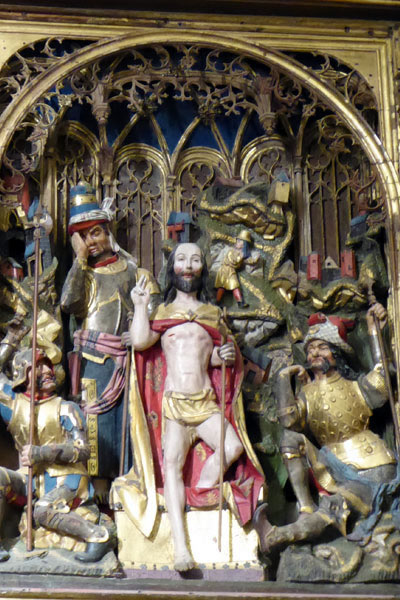
According to the Bible, the third day Jesus rose from the dead. The relief shows Christ triumphantly leaving the sepulchre. He is surrounded by the soldiers who had the order from Pontius Pilate to guard the sepulchre and avoid that the followers of Jesus take his body. The polychromy of the soldier’s clothes, which imitates materials such as metal, stands out.
The persons’ facial expressions stand out and make the seen more realistic. In the background appears a landscape with mountains, houses and even a man is walking around wearing a head.