
Altarpiece of Saint Mary of La Antigua (Orduña)
- Church: Sanctuary of Our Lady of La Antigua (Orduña)
- Location: High Altar
- Artists: Esteban de Alegría (planner) and Mauricio de Valdivielso (sculpture)
- Patron: Council of Orduña
- Chronology: 19th century (1804-1805)
- Style: neoclassic
A picture of the Virgin found in a mulberry tree
Interactive altarpiece: click on the pictures to get more information.
Church:
According to the legend, the Saint Mary of La Antigua church in Orduña was built on the same place where a shepherd had miraculously found a picture of the Virgin Mary, while he was leading his flock to Mount Txarlazo. From 1256 onwards, the church was called “the old” to distinguish it from the new Saint Mary church, which was built in this year next to the town wall of Orduña. The current church was built between 1752 and 1782 in the neoclassic style by the architects Juan Bautista de Ybarra, Antonio de Vega, Tomás Peña, Pedro de Gorbea and Alejo de Miranda. It substitutes the former church, which was in very bad conditions. The 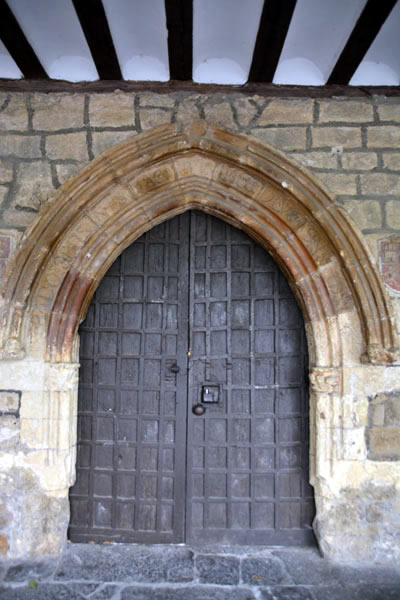

Patronage:
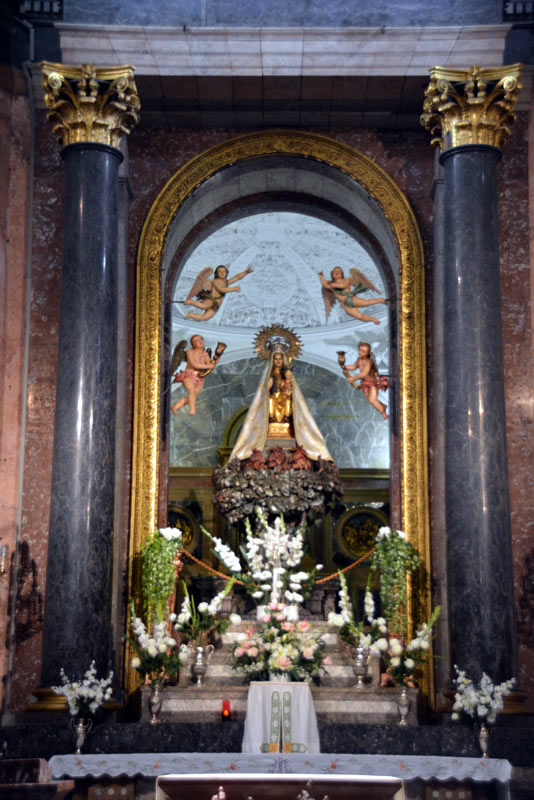
According to the legend, a shepherd found miraculously this picture of the Virgin Mary between the branches of a mulberry tree while he was leading his flock to graze on mount Txarlazo. The people of Orduña have always had great devotion to this picture of the Virgin Mary, who in 1639 became the town’s patron saint.
Description:
The 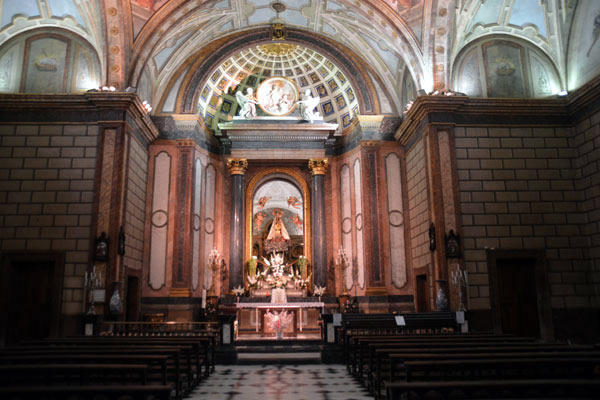


Behind the altarpiece is a large 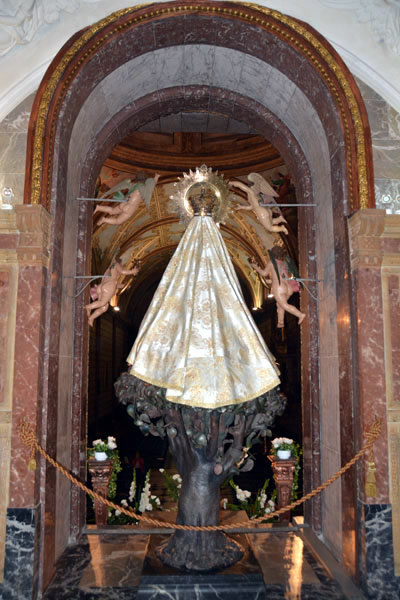
History:
In 1804, more than 20 years after the construction of the new Sanctuary of Our Lady of La Antigua had been finished, the council of Orduña ordered together with the local council of priests and the help of private donators, e.g. Josefa de Rivacoba, an altarpiece for the sanctuary’s high altar. Esteban de Alegría from Madrid was in charge of the construction work. Alejo de Miranda, an architect from the Real Academia de Bellas Artes de San Fernando (San Fernando Royal Academy of Fine Arts) was responsible for the reformation of the apse. At this time, the Real Academia dominated all aspects of arts. In the attic, the sculptor Mauricio de Valdivielso from Vitoria carved a relief with the apparition of the archangel Michael to the bishop Saint Laurence of Maioranus. According to the tradition, the apparition took place on 8 May 490 – 8 May is also the feast day of the Antigua in Orduña. In 1832, Juan Bautista de Aldasoro carved the mulberry tree above which the sculpture of La Antigua appears. One century later, between 1922 and 1932 the altarpiece was concluded with the shrine designed by Teodoro Anasagasti, an architect from Biscay.
Sculptures:
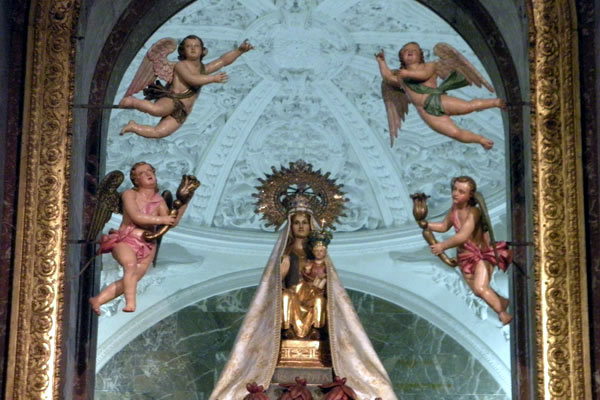
Our Lady of La Antigua
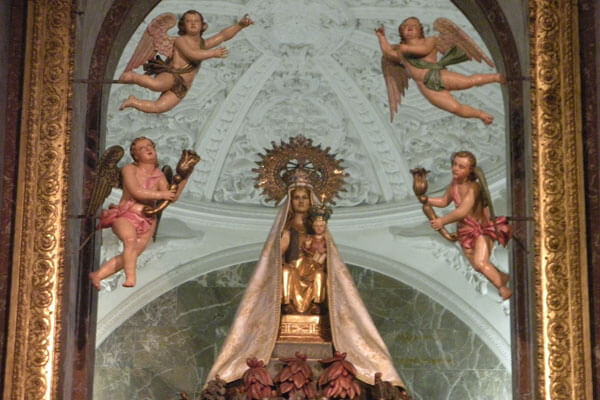
A Gothic picture from the 14th century representing the Virgin Mary with the Child. Mary holds a fruit in her right hand and the Child raises one hand for the blessing and carries a book in the other hand. This highlights Mary as Mother of Christ and her role in the salvation of humankind. The sculpture of the Virgin Mary sitting with the Child in her lap is called “Virgin Mary on the Throne” and in the basque region “Andra Mari” (“Lady Mary”). The sculpture is carved in lime wood and painted with blue, red and golden tones. Next to the Virgin’s feet appears a carved mulberry tree in allusion to the place the picture was found.
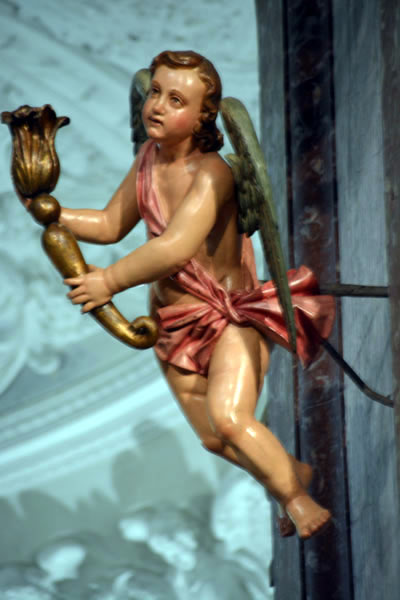
Originally, it was just the wooden picture, but in the course of time, some elements were added, such as the cloak and the crowns. The Virgin is surrounded by four angels, which are part of the neoclassic altarpiece from 1804-1805.
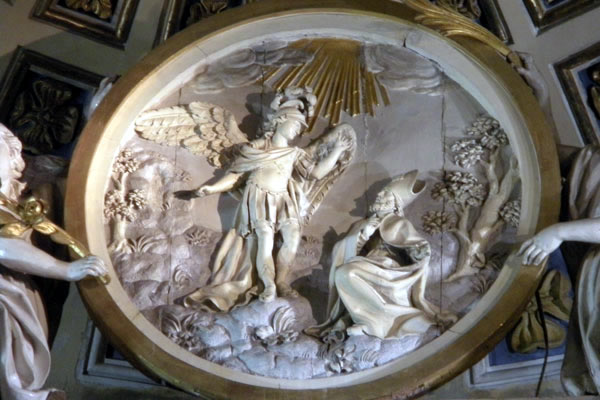
Apparition of Saint Michael to Saint Laurence Maioranus
Two angel carry a circular relief, which is carved in wood and has a white and golden polychromy, which resembles marble. The relief shows one of the apparitions of the archangel Michael – dressed with a roman armour and helmet to symbolise his role as supreme commander of the angels. Saint Laurence Maioranus – bishop of Siponto (Italy) – is kneeling in front of the archangel as Michael asked the bishop to venerate him on mount Gargano. Laurence is dressed with the pointed mitre used for solemn masses.
Two white angels sustain the picture and carry some golden elements: a flourished branch and a palm leaf.