
Altarpiece of the Assumption of Mary (Markina-Xemein)
- Church: Assumption of Mary Church (Markina-Xemein)
- Location: High Altar
- Artist: Juan Martinez de Ayala el Viejo (sculptor) and Juan de Beaugrant (sculptor)
- Patron: Parish of the Assumption of Mary, Council of Xemein and private donations
- Chronology: 16th century (1526-1545)
- Style: Renaissance
The first documented Renaissance altarpiece in Biscay
Interactive altarpiece: click on the pictures to get more information.
Church:
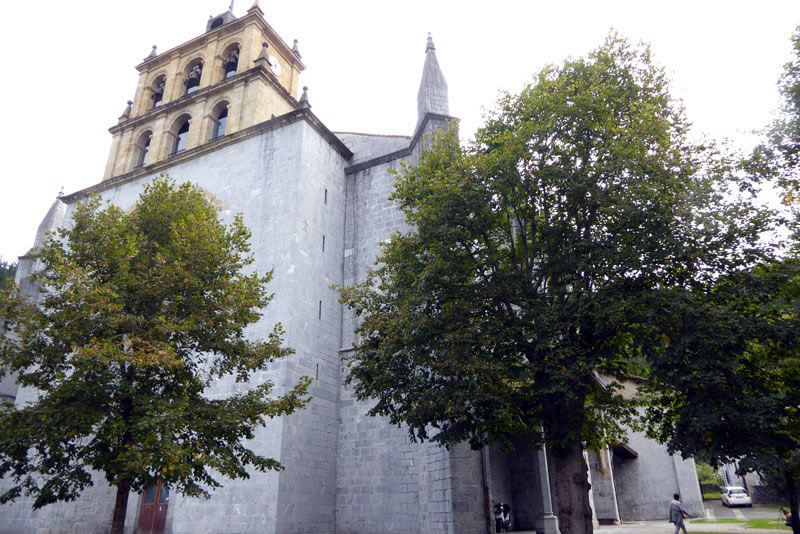
The Assumption of Mary church is located in the district of Xemein and its construction started in 1515.
It follows the model of Central European churches, which all have naves of the same height; these are known as 
Their most characteristic feature is their 
Patronage:
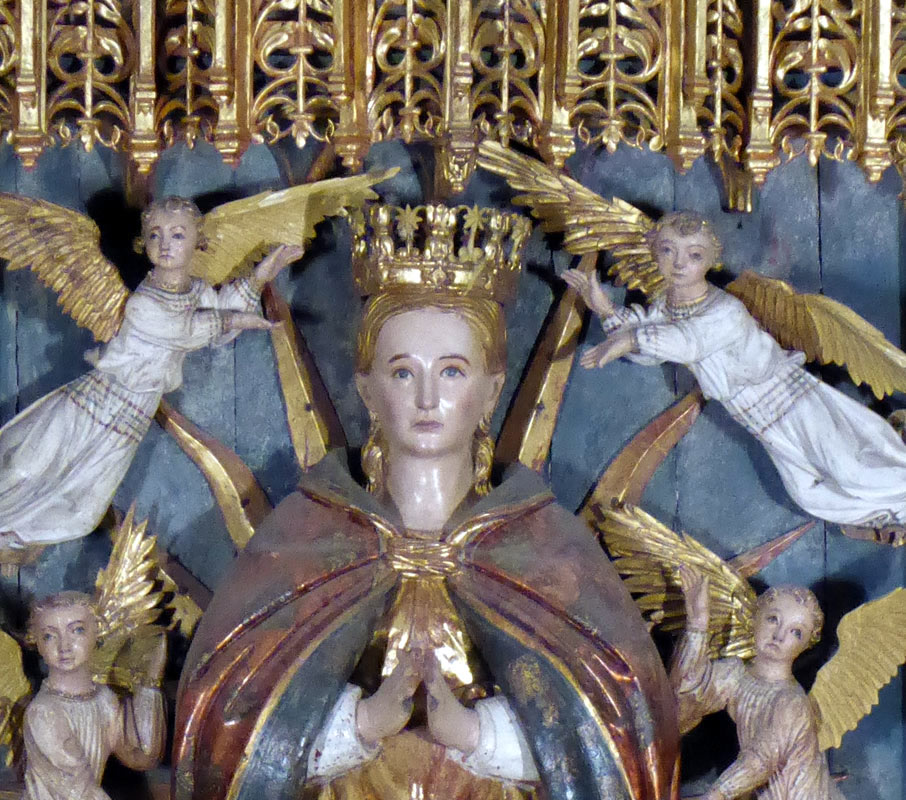
The Church and the altarpiece are dedicated to the Assumption of the Virgin Mary. According to the catholic tradition, at the end of her life Mary was taken to heaven and is – together with Jesus Christ – the only person whose body and soul is in Paradise without having to wait for the Last Judgement and the Resurrection of the dead.
She is depicted as Queen of Heaven and with a golden crown on her head. Mary is standing on clouds and surrounded by angels, because they took up her body into the Glory.
Description:
The 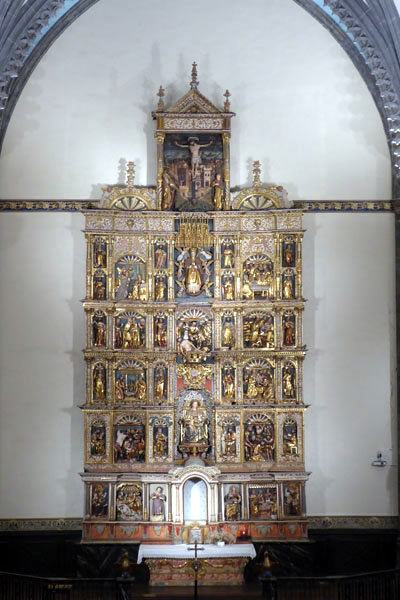
It is divided into three sections and the reliefs show scenes from the childhood and passion of Christ and from the life of the Virgin Mary to emphasise her role as Mother of God. The central section is the broadest one and contains the most important sculptures: the picture of our Lady of Xemein, the mourning for the dead Jesus and the Assumption of Mary to which the altarpiece is dedicated. The other sections contain sculptures of saints, apostles and evangelists.
In the pedestal part appear the 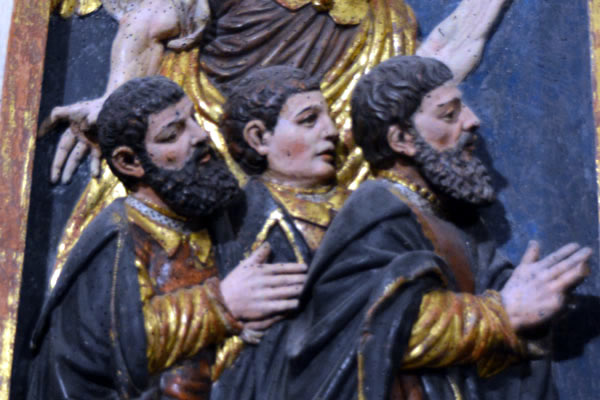
The decoration, finely carved and highlighted with white and gold 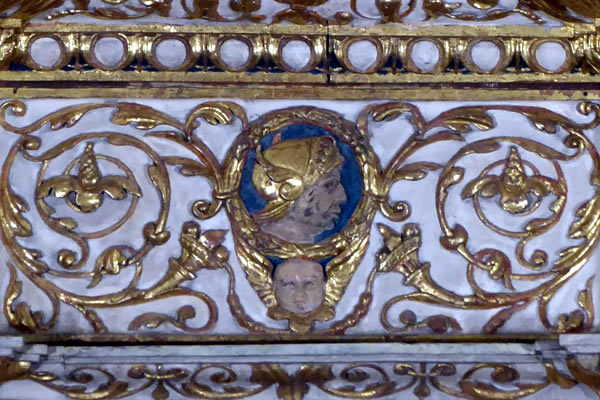
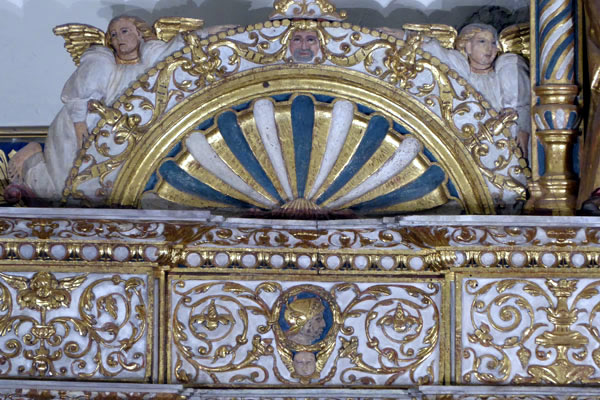
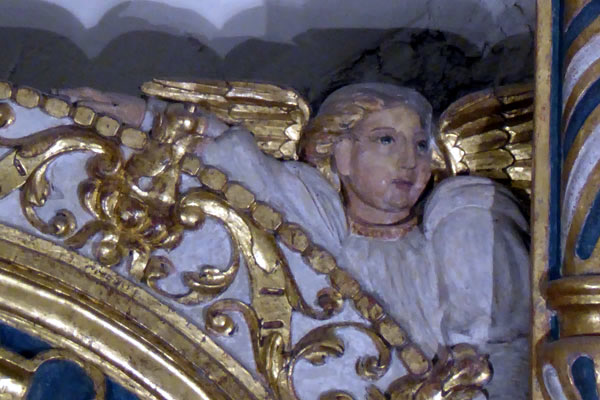

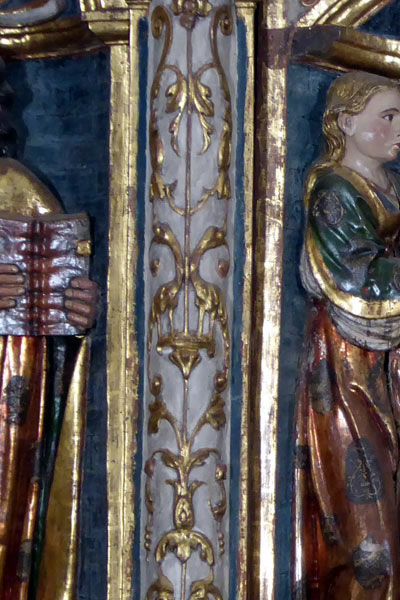
All of this is characteristic of the renaissance style, of which this altarpiece is one of the oldest and best examples in Bizkaia.
History:
In 1526, an order for this altarpiece was placed with the sculptor Juan Martínez de Ayala. It was paid with financial resources from the church and above all from lay donators. The work took many years and around 1540 Juan de Beaugrant, who was one of the most important sculptors at that time, was hired to finalize the lower part of the pedestal.
Short time later Martín Basabe, a sculptor from Biscay, was asked to add a reliquary.
In 1601 finally, José de Arroquia built a Baroque alcove for the sculpture of Our Lady of Xemein. The painting work on the altarpiece was not completed until 1734, when Pedro de Arroquia gilded the central alcove.
In 2001, the altarpiece was refurbished and the original polychromy was largely recovered.
Sculptures:
The Virgin Mary with the Child
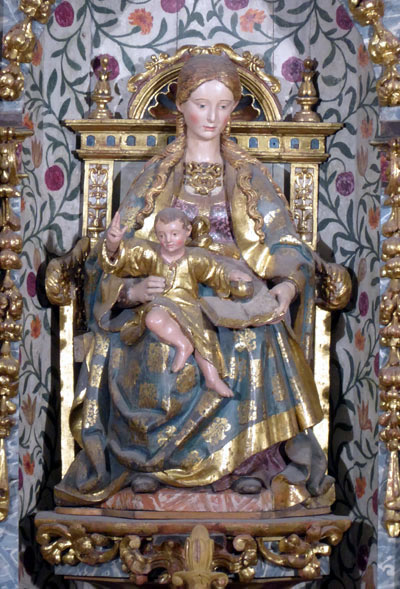
This sculpture is located in the central alcove, which is richly decorated with plant elements. Mary carries a book in her left hand sitting with the Child on her lap. To show the divine character of her son, he is holding a globe in his hand, as allusion to the triumph of christianity in the world, and raises his right hand for the blessing.
The picture stands out with the much-decorated throne and the golden-based polychromy on the clothes of the Child and the Virgin Mary.
Mourning for Jesus
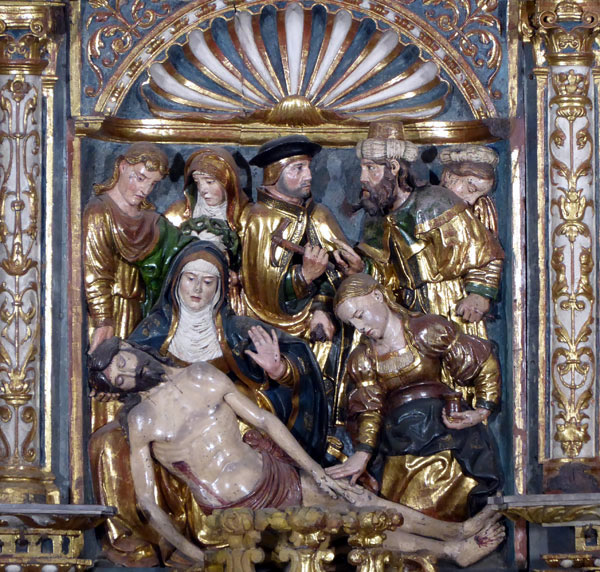
The death body of Christ is put down from the cross by people who were closest to Jesus. They show the symbols of his passion. Jesus is laying in his mother’s lap, who mourns about his death and supports his head. Mary Magdalene is kneeling next to the dead body carrying in her left hand a jar with sweet spices.
Behind them is standing John, depicted as a young man with blond hair and without beard putting his right hand on the head of Christ. Next to him appears a woman carrying the crown of thorns, whose wounds are still visible on the forehead of Jesus. Joseph of Arimathea is dressed with beautiful clothes and carries the hammer with which Christ was nailed to the cross. Nicodemus, who followed Jesus in secret, seems to talk to Joseph of Arimathea. Another woman standing behind Nicodemus cries bitterly and dries her tears with his clothes.
It is a very expressive relief showing the emotions of each person.
Assumption and Coronation of Mary
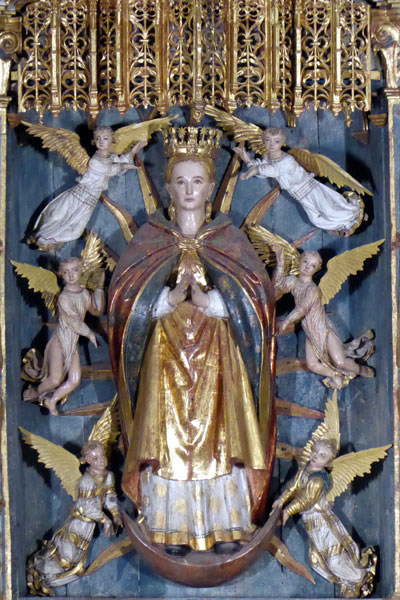
According to the catholic tradition, at the end of her life, Mary was taken to heaven and her body and soul is in Paradise. Mary is standing on the moon and surrounded by angels, who crown her and bring her body into the Glory.
It is the most important picture of the altarpiece.
Golgotha
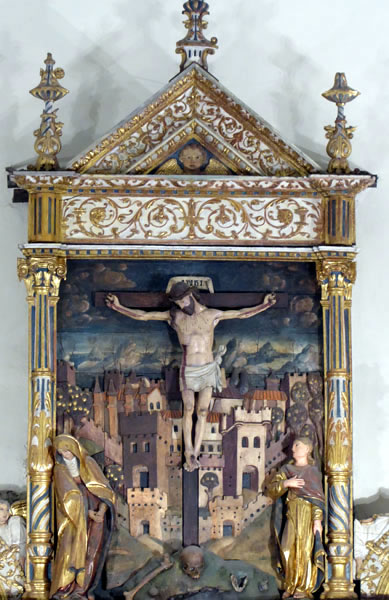
The altarpiece is crowned with the Golgotha scene. The crucified Christ is accompanied by his mother Mary, who turns her face away from Jesus so that she do not have to look at her dead son, and John, the disciple whom Jesus loved. John puts his hand on his chest to express the pain he is feeling. At the foot of the cross is a skull and some bones in allusion to the place of the crucifixion “Golgotha”, which literally means “the place of the skull”. According to a medieval legend, the tree whose wood was used to build the cross on which Jesus was crucified had grown from Adam’s skull.
Behind the sculptures appears the panorama of the town of Jerusalem with many details.
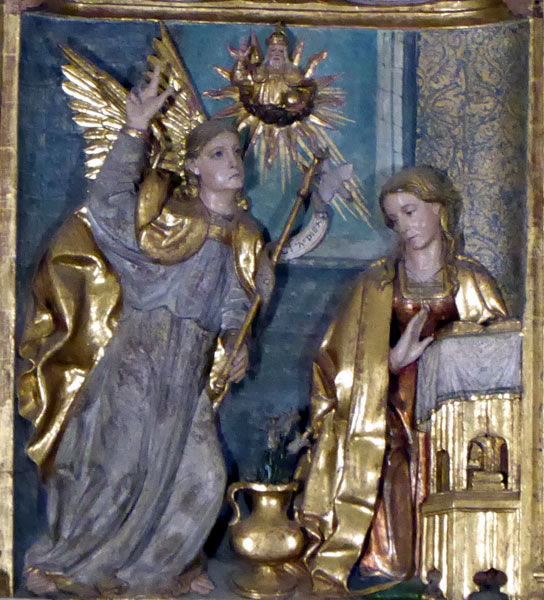
Annunciation
According to the gospels, the archangel Gabriel was send by God to announce Mary that she will be the mother of the Messiah. This moment is of great symbolic importance for the christianity, as it represents the mystery of the Incarnation, which means, the moment when God becomes a human to save humanity from sin.
This scene shows the moment when the archangel appears to Mary, who is reading and inclines her head to express humility and her acceptance. God the Father appears above them blessing and the Holy Spirit is flying as a white dove to Mary. This is an allusion to the miraculous and divine conception of Jesus Christ. Between the archangel and Mary are some white lilies, the symbol of purity and virginity.
It is a very expressive picture in which the gestures of the people, the quality of the carving and the golden polychromy stand out.
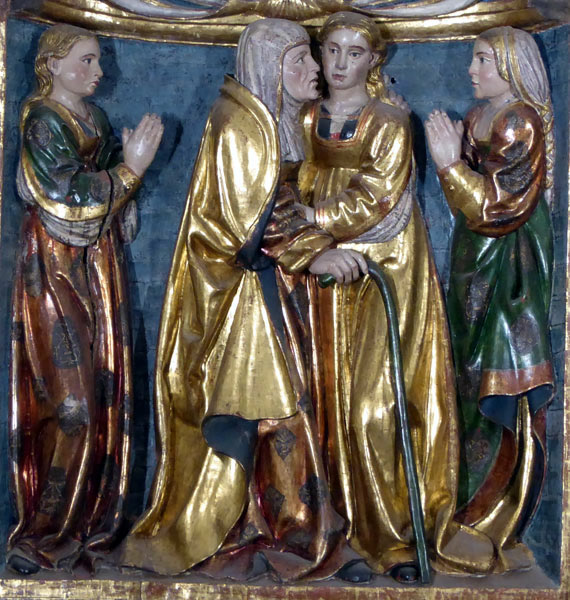
Mary visits Elisabeth
Mary, who is pregnant with Jesus, visits her cousin Elisabeth, who is pregnant too, with John the Baptist. Mary tells her cousin that she will become the mother of God. Both women embrace each other and Mary touches the belly of her cousin.
In accordance with the gospel, Elisabeth is depicted as an old woman and even carries a walking stick. In contrast, Mary is a young woman and does not cover her hair.
Beside them are two women with folded hands paying her respect and watching the scene.
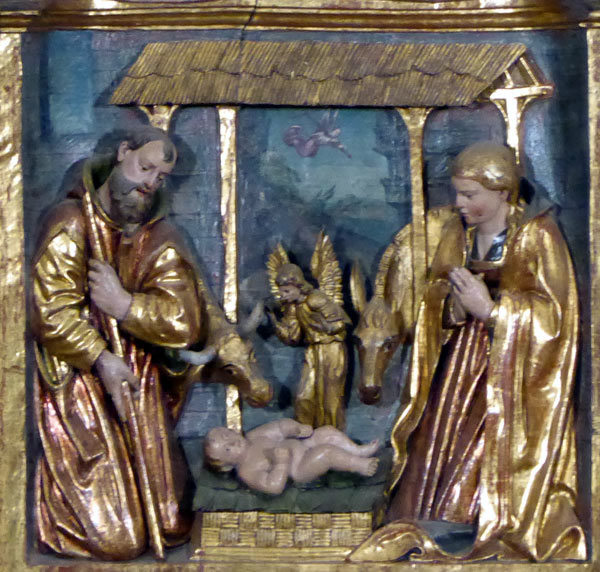
Birth of Jesus or Christmas
The picture was inspired by the gospels and shows a landscape, which represents the town of Bethlehem. Mary and Joseph had founded shelter in a stable and Mary gave birth to Jesus there. Animals surround them and everyone is looking at the Child, which is in the middle of the scene: his parents, an angel kneeling in front of him and even the donkey and the ox.
The expressiveness of the figures and the careful carving stand out.
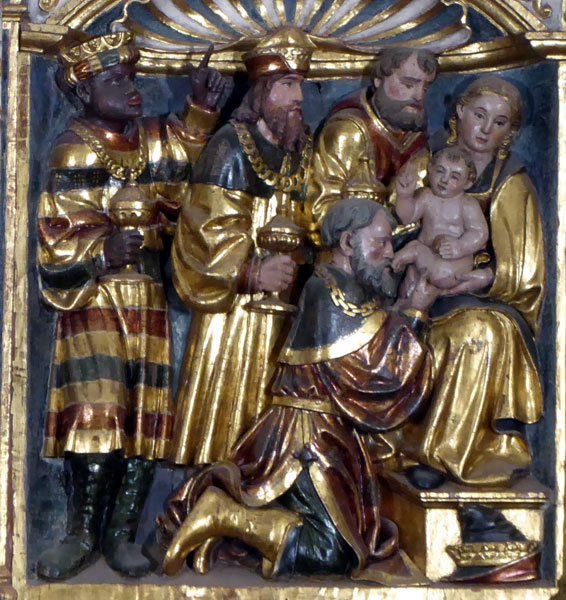
Adoration of the Wise Men or Epiphany
According to the gospels, some Wise Men from the East came to visit Jesus in Bethlehem. The gospels do not mention their names, nor their number or their backgrounds. According to the tradition, however, they were three man, called Melchior, Caspar and Balthasar. Since the 14th century, the latter one has been depicted as a young black man. It is said that they brought three gifts: gold as the symbol for a king; incense for God; and myrrh, a very aromatic balm that was used to embalm the dead, mortal humans. Mary is sitting on a throne with the Child on her lap emphasising her role as Mother of God, while Joseph is standing in the background.
Melchior is kneeling down in front of Jesus, showing his respect and recognising him as the Son of God. He puts his crown, which symbolises him as king, on the ground and kisses the feet of Jesus, while Gaspar and Balthasar show their gifts.
Balthasar points towards heaven indicating that the star guided them the way to the place were God was born.
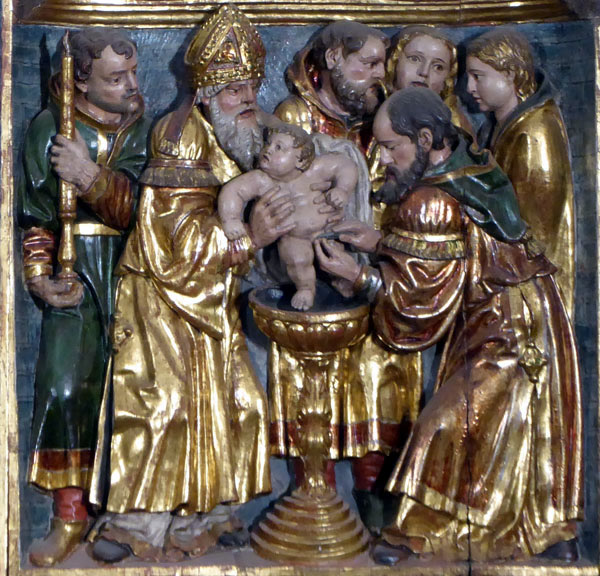
Circumcision of Jesus
According to the gospel of Luke, Jesus was born a Jew and circumcised on the eighth day in accordance to the jewish tradition. All boys have to take part in this solemn ritual in which they get their names. This picture shows the moment when a priest holds the Child while an assistant circumcises him with a small knife.
Behind the priest is a man holding a candle and contemplating the scene. In the background, Mary and Joseph are talking to a third person.
It is a very expressive picture in which the nude Child stands out.
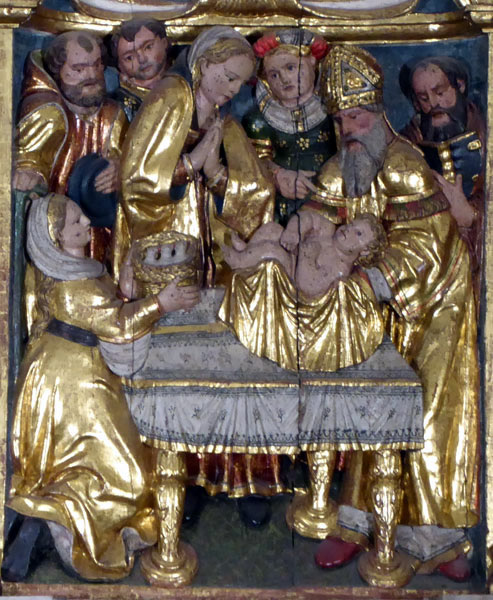
Presentation of Jesus in the temple
According to the Jewish law, all families had to present their firstborn male child to God offering in the temple a sacrifice of a pair of turtledoves or young pigeons. According to the gospel of Luke, Mary and Joseph took Jesus to the temple of Jerusalem to comply this precept. In the temple, two people recognised Jesus as the Messiah: the elderly priest Simeon, who is dressed with beautiful clothes and holds the Child in his arms, and the prophet Anne, who is standing behind Simeon and points at Jesu.
Mary and Jesus are the main protagonists in the large crowd.
The golden polychromy attract attention and makes details such as the altar cloth and the basket with the turtledoves stand out.
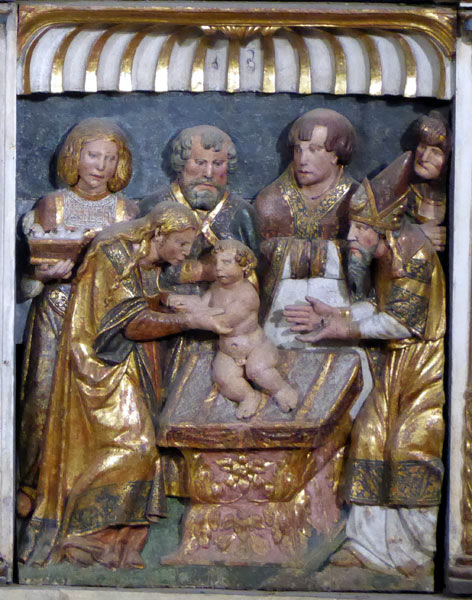
Presentation of Jesus in the temple
According to the jewish law, all families had to present their firstborn male child to God offering in the temple a sacrifice of a pair of turtledoves or young pigeons. According to the gospel of Luke, Mary and Joseph took Jesus to the temple of Jerusalem to comply this precept. In the temple, two people recognised the Jesus as the Messiah: the elderly priest Simeon, who is dressed with beautiful clothes and the prophet Anne, who is standing behind Simeon.
It is a very expressive relief showing the naturalness of the people. Jesus in the centre is looking towards his mother, while Simeon is stretching his arms to present him.
In the background, Joseph is contemplating the scene together with an acolyte and a woman, who carries the basket with the turtledoves for the offering.
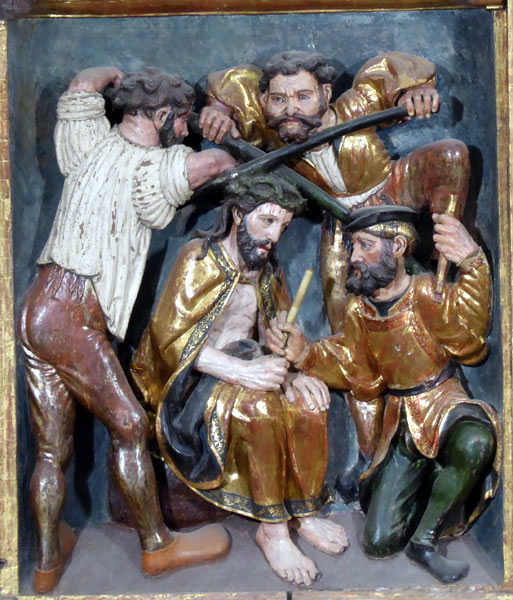
Jesus is crowned with thorns
According to the gospels, after having been sentenced, Jesus was whipped by the roman soldiers. To mock him, they dressed him with a purple coat to make him look like the emperor. According to the tradition, the roman soldiers gave him a sceptre and crowned him with thorns.
Two man with strong facial expressions put the crown of thorns on Jesus’ head, while another man is kneeling in front of him, mocking Jesus, who bears all the suffering.

Jesus falls during the Via Crucis
According to the gospels, before his death Jesus was forced to carry the cross through the streets of Jerusalem to mount Golgotha, the place of his crucifixion. The soldiers insult him and pull him with a cord. Simon of Cyrene accompanies Jesus and helps him to carry the cross. The soldier on the left side, dressed with the armour, attracts attention. He hits Jesus with his leg and forces him to stand up. A man in the background plays a trumpet announcing the crucifixion.
In the background appear three people: Mary, who is mourning for her son, John, the disciple whom Jesus loved and Mary Magdalene, who dries the tears of Mary.
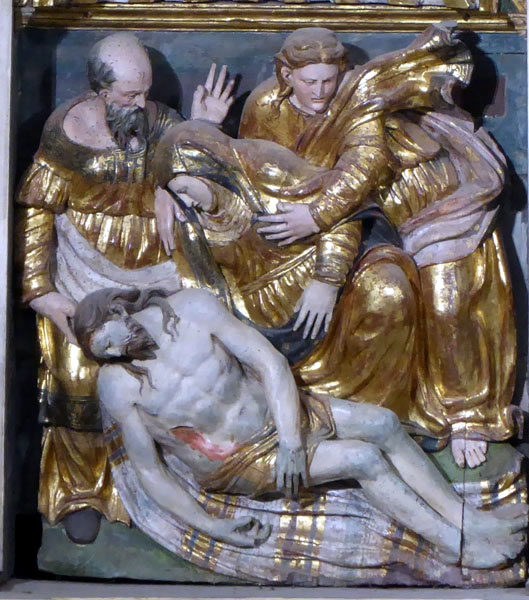
Mourning for Jesus
The dead Christ is mourned by his mother and his closest followers. To express Mary’s pain, she is depicted bending over her son, while John is carrying her.
Joseph of Arimathea helps to lay the dead body down on the ground, carrying it with a cloth – the holy shroud in which Jesus then was wrapped. According to the gospels, Joseph of Arimathea asked the Roman governor Pontius Pilate for permission to take the body of Jesus down from the cross and lay him in a sepulchre.
The death body stands out, as its anatomy resembles the works of the Italian sculptor Michelangelo.
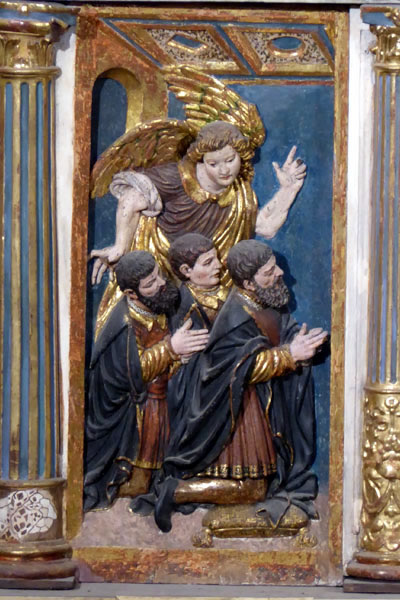
Donors
On both sides of the pedestal are reliefs showing the donors who gave money to finance the altarpiece. To show their devotion, they wanted to be depicted kneeling and praying in front of the altar and next to an Angel, who protects them. The Angel presents them as people worthy of standing before the Virgin Mary, the patron Saint of the church, at whom the Angel points.
On the left side of the altarpiece appear the male members of the family, dressed with luxurious clothes.
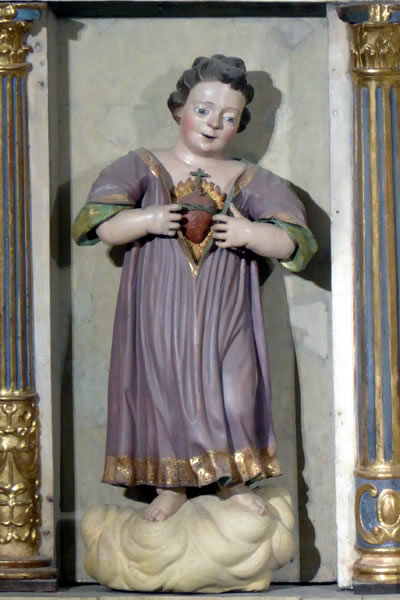
Sacred Heart of the Christ Child
The Christ Child is dressed with a beautiful tunic and shows a heart on his chest. The heart is surrounded by the crown of thorns and is crowned with a cross from which flames radiate.
The Sacred Heart is a symbolic picture of God’s love for humanity. God even strengthened this love by sending his son, Jesus Christ, to earth to die on the cross.
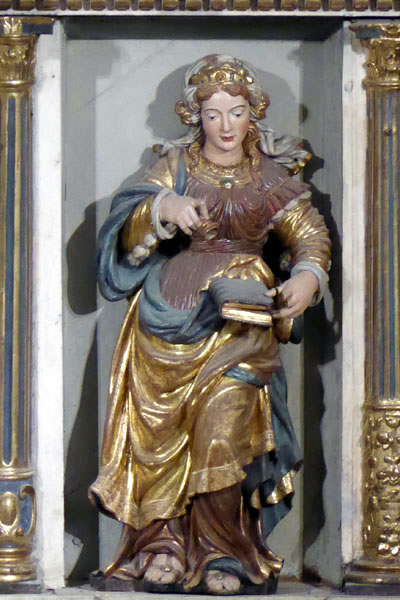
Mary Magdalene
According to the gospels, Mary Magdalene was one of the women who followed Jesus of Nazareth. She must have been very close to him as she was next to the cross together with the Virgin Mary. Furthermore, on sunday she came to the sepulchre were Jesus had been buried to embalm his body. However, the sepulchre was empty and Mary Magdalene became a witness of his Resurrection. She is dressed with beautiful clothes and carries a small jar with sweet spices with which she wanted to anoint the body of Jesus.
The beautiful polychromy makes the fine carving and the sculpture’s face stand out.
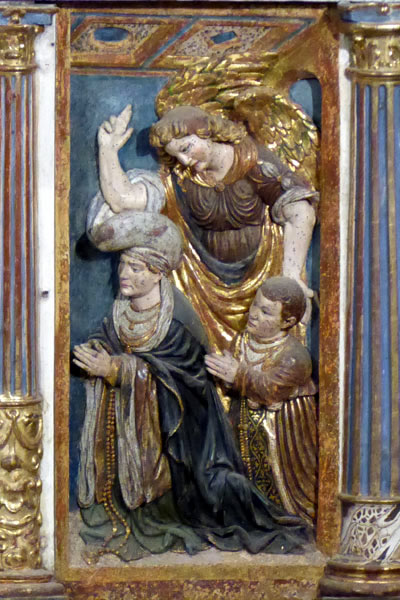
Donors
On both sides of the pedestal are reliefs showing the donors who gave money to finance the altarpiece. To show their devotion, they wanted to be depicted kneeling and praying in front of the altar and next to an angel, who protects them. The angel presents them as people worthy of standing before the Virgin Mary, the patron saint of the church, at whom the angel points.
On the right side of the altarpiece appear the female members of the family, dressed with luxurious clothes. The senior woman stands out wearing a traditional headdress for biscayan noblewoman of the time.
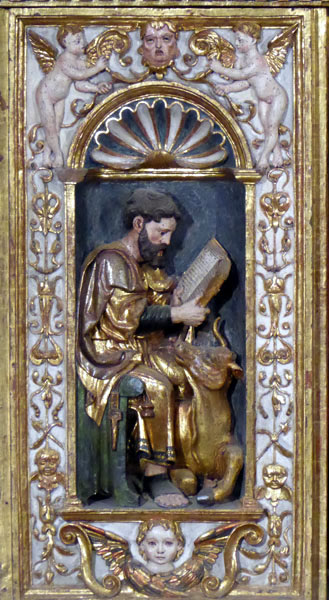
Saint Luke
According to the Bible, Luke was a disciple of Paul of Tarsus. Luke is the author of two biblical books: one of the four gospels, which are directly inspired by God, and the Acts of the Apostles. Each Evangelist has a symbol: Luke’s symbol is the ox, which in this relief is lying next to the Evangelist’s feet. Luke is holding a book in his hands as allusion to the texts he wrote.
The carving of the alcove where the sculpture is located, the gilded clothes and the golden and white decoration with typical renaissance elements stand out.
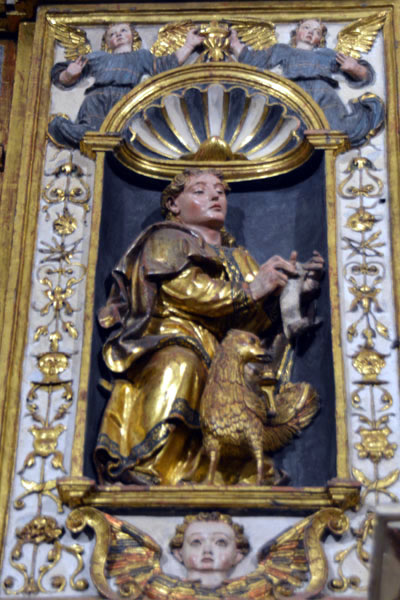
Saint John the Evangelist
John is the author of one of the four gospels in the Bible, which the catholic church considers as directly inspired by God. Each evangelist has an own symbol: the one for John is an eagle, which accompanies the saint in this relief. John is depicted as a young man writing with the feather in his right hand (has disappeared) on the parchment in his left one.
The carving of the alcove where the sculpture is located, the gilded clothes and the golden and white decoration with typical renaissance elements stand out.
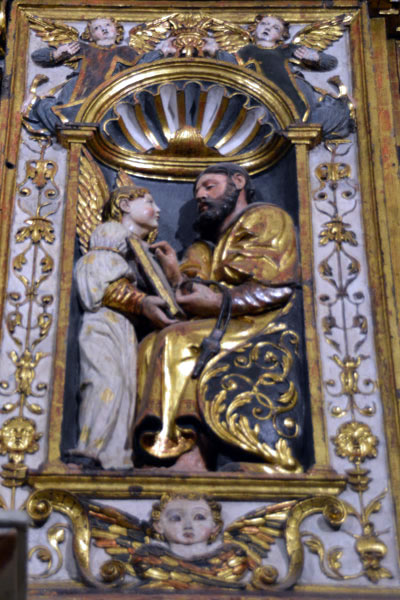
Saint Matthew
Matthew is the author of one of the four gospels in the Bible, which the catholic church considers as directly inspired by God. Each evangelist has an own symbol: the one for Matthew is a man, who is often depicted with wings, as he were an angel. In this picture, the angel accompanies the saint, who is writing and holding an inkpot in his left hand.
The carving of the alcove where the sculpture is located, the gilded clothes and the golden and white decoration with typical renaissance elements stand out.
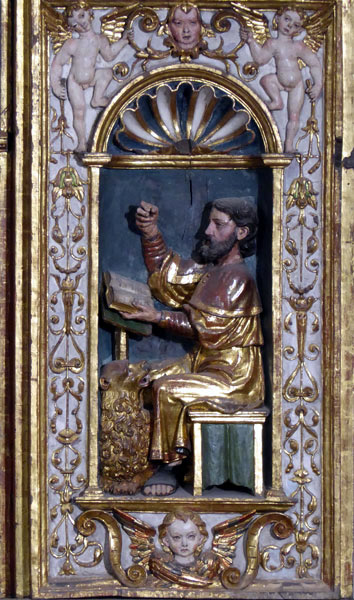
Saint Mark
Mark is the author of one of the four gospels in the Bible, which the catholic church considers as directly inspired by God. Each evangelist has an own symbol: the one for Mark is a lion, which in this relief is depicted next to his feet. With the feather (has disappeared) in his right hand, he is writing in the open book, which he is holding in his left hand.
The carving of the alcove where the sculpture is located, the gilded clothes and the golden and white decoration with typical renaissance elements stand out.
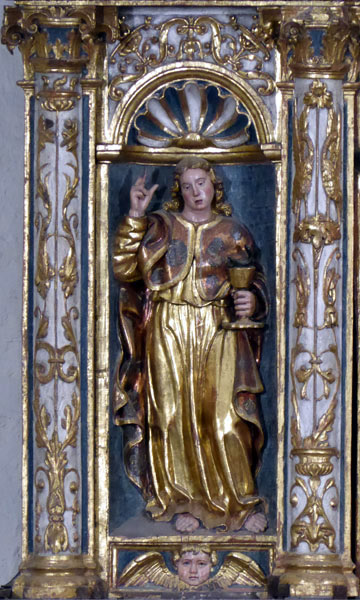
Saint John
According to the gospels, John was the youngest apostle, who followed Jesus of Nazareth. He is depicted as a young man without beard, raising his right hand to bless the chalice in his left one, from which a snake is emerging.
This is an allusion to one of his miracles, as, according to the christian tradition, he was forced to drink poisoned wine. However, after John had blessed the chalice, a snake emerged from it and the saint could drink the wine without dying.
The carving of the alcove where the sculpture is located, the gilded clothes and the golden and white decoration with typical renaissance elements stand out.
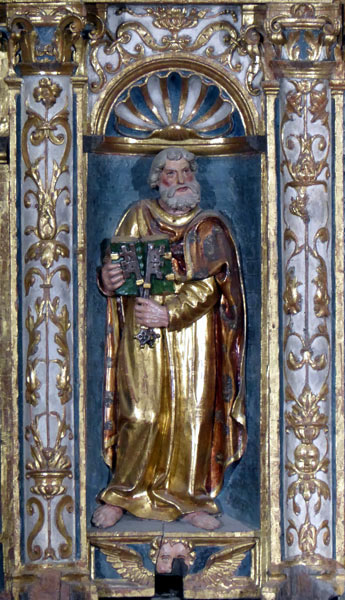
Saint Peter
According to the gospels, Peter was one of the apostles and Jesus appointed him as his successor. Therefore, he is considered the first pope of the catholic church. Peter is holding a book in his right hand and the keys of the Kingdom of Heaven in his left one.
The facial expression, the carving of the alcove where the sculpture is located, the gilded clothes and the golden and white decoration with typical renaissance elements stand out.
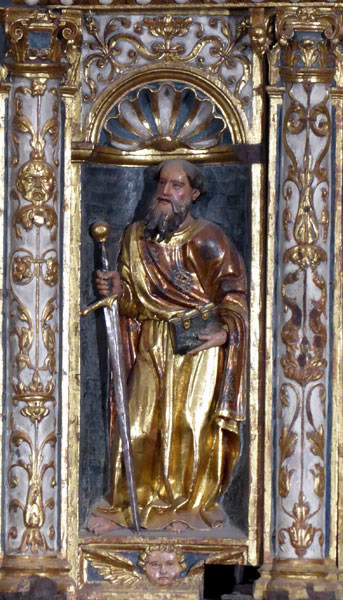
Saint Paul
Paul was one of the first missionaries of christianity, the religion to which he himself converted after Christ had appeared to him. In this picture, he is portrayed with a large sword, the symbol for his death by beheading, and the book, a reference to the text of the Acts of the Apostles and his fourteen Pauline epistles that are part of the Bible.
The carving of the alcove where the sculpture is located, the gilded clothes and the golden and white decoration with typical renaissance elements stand out.
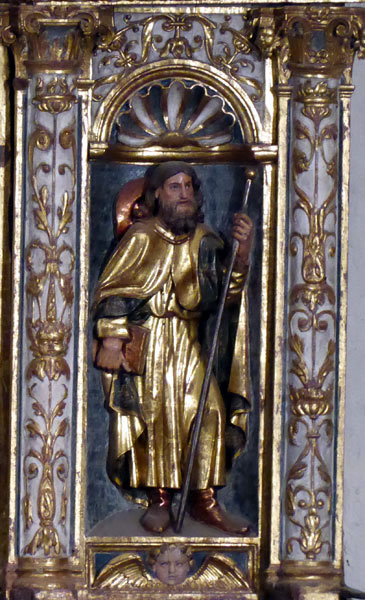
Saint James the Great
Saint James, son of Zebedee, was one of the twelve Apostles, who, according to the gospels, accompanied Jesus of Nazareth. He is known as Saint James the Great to distinguish him from the other Apostle Saint James the Less, son of Alphaeus.
According to a medieval tradition, James the Great is buried in Iria Flavia (Compostela). This was the origin for the pilgrimage to his grave and for the Camino de Santiago. The saint is dressed like a pilgrim with a stick in his left hand and a closed book in the right one.
The carving of the alcove where the sculpture is located, the gilded clothes and the golden and white decoration with typical renaissance elements stand out.
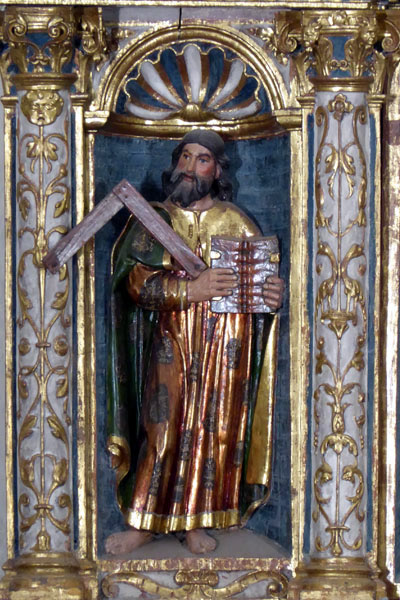
Saint Thomas
According to the gospels, Thomas was one of the twelve apostles who accompanied Jesus of Nazareth. According to the christian tradition, he was an architect and therefore he is depicted with a square in his right hand.
The carving of the alcove where the sculpture is located, the gilded clothes and the golden and white decoration with typical renaissance elements stand out.
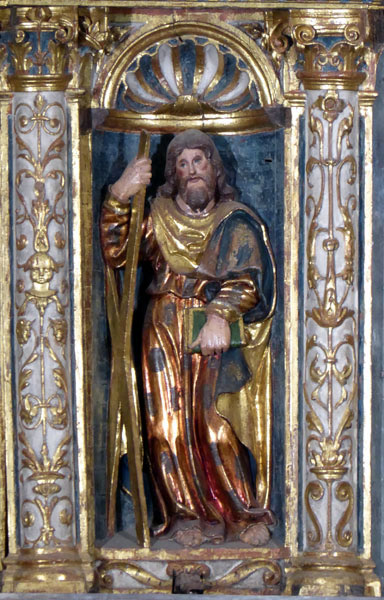
Saint Andrew
According to the gospels, Andrew was together with his brother Peter the first of the twelve apostles, who were called by Jesus of Nazareth.
His legend tells that he preached in Thrace (a region in today’s Greece, Bulgaria and Turkey) where he was sentenced to be whipped and bound to an X-shaped cross (known as the “Saint Andrew’s Cross”) until he dies. The Saint is depicted holding the Saint Andrew’s cross in his right hand and an open book in his left one. The cross is the symbol for his martyrdom and the book identifies him as apostle.
The carving of the alcove where the sculpture is located, the gilded clothes and the golden and white decoration with typical renaissance elements stand out.
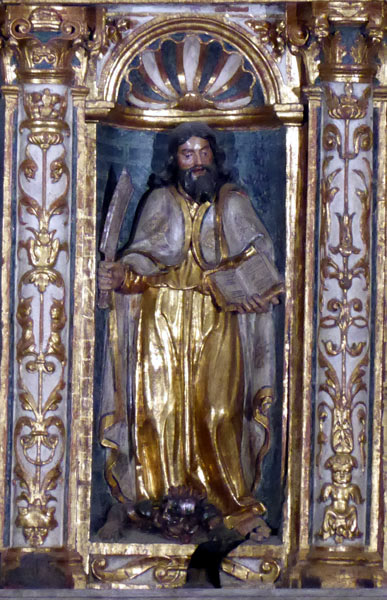
Saint Bartholomew
According to the gospels, Bartholomew was one of the twelve apostles who accompanied Jesus of Nazareth. According to the tradition, he was martyred in Armenia, where the king wanted him to renounce christianity. As the Saint refused to do so, the king ordered to flay his skin until he dies. He holds a knife in his right hand as symbol for his martyrdom. In his left hand, he carries a book, which identifies him as apostle.
The carving of the alcove where the sculpture is located, the gilded clothes and the golden and white decoration with typical renaissance elements stand out.
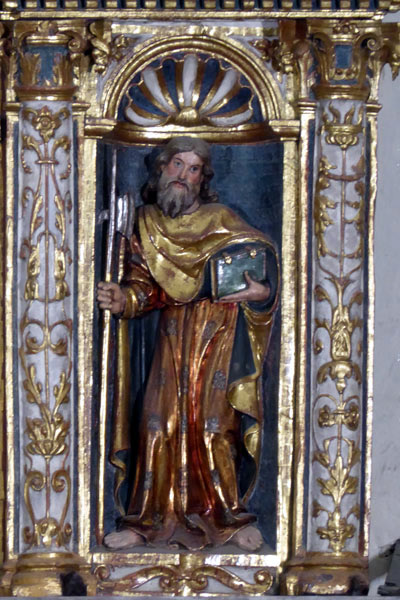
Saint Matthias
According to the Bible, Matthias was the elected apostle to substitute Jude Iscariot after he had betrayed Jesus. According to his legend, Matthias was beheaded with an axe. Therefore, he is depicted carrying an axe in his right hand as the symbol for his martyrdom and a book in his left hand, which identifies him as apostle.
The carving of the alcove where the sculpture is located, the gilded clothes and the golden and white decoration with typical renaissance elements stand out.

Saint James the Less
Saint James, son of Alphaeus, was one of the twelve apostles, who, according to the gospels, accompanied Jesus of Nazareth. He is known as Saint James the Less to distinguish him from the other apostle Saint James the Great, son of Zebedee.
According to the tradition, the jewish priest Ananias ordered to stone him next to the temple in Jerusalem to prevent him from preaching the gospel. As he had not died after a while, he was martyred with a deathblow from a club on his head. In this picture, James is depicted carrying a large stick in his right hand and a book in his left one, which identifies him as apostle.
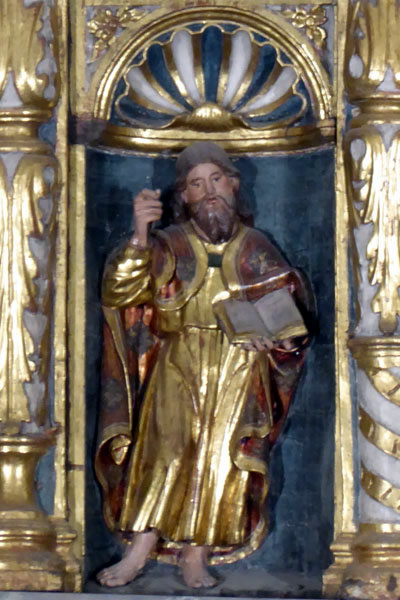
Saint Matthew
Matthew was one of the twelve apostles who accompanied Jesus of Nazareth. Furthermore, he is considered as the author of one of the four gospels recognised by the catholic church as directly inspired by God. Therefore, in his left hand he holds an open book in which he writes with a feather (has disappeared).
The carving of the alcove where the sculpture is located, the gilded clothes and the golden and white decoration with typical renaissance elements stand out.
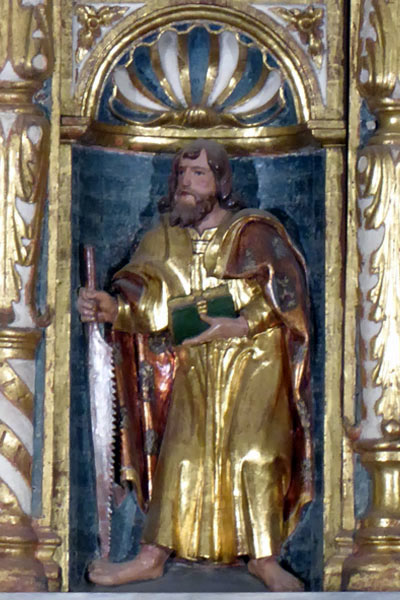
Saint Simon
Simon was one of the twelve apostles, who, according to the gospels, followed Jesus of Nazareth.
According to the tradition, Simon was sawn in two for defending christianity. He is depicted with a large sew in his hand as symbol for his martyrdom and a book which identifies him as apostle.
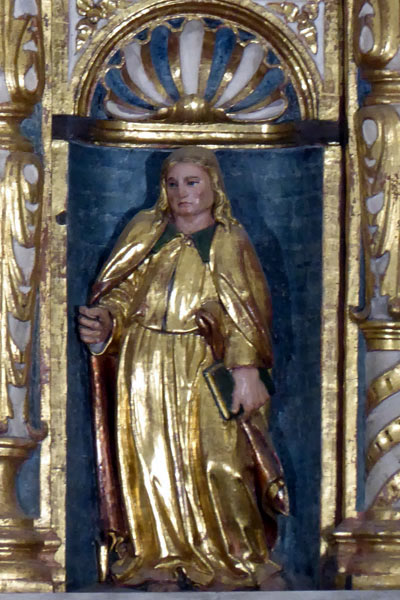
Saint Philip
This sculpture depicts one of the twelve apostles who followed Jesus of Nazareth. He appears as a young man with a book in his left hand as symbol for the apostles and another object (has disappeared) in his right one.
Probably it is Philip, who occasionally is depicted as a young man.
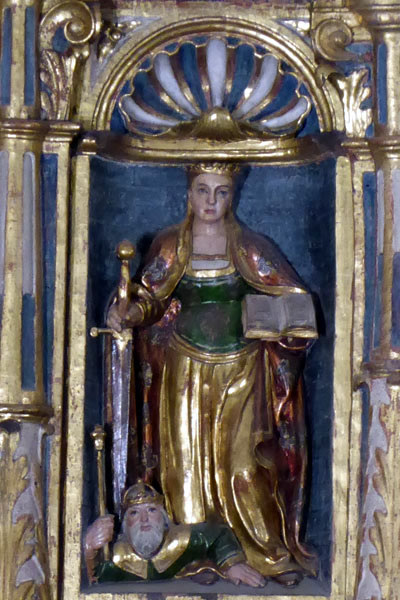
Saint Catherine of Alexandria
According to the legend, Catherine was a Princess of Alexandria, who defended her christian faith against the local pagan philosophers. She was a very beautiful young woman and the emperor Maxentius wanted to marry her. However, Catherine refused, because she had decided to devote herself to Christ. Maxentius was offended by her decision and after Catherine had suffered many tortures, the emperor ordered her to be behead with a sword.
The Saint is depicted dressed as princess with beautiful clothes and a crown on her head. She holds the sword in allusion to her martyrdom and an open book as symbol for her wisdom. Next to her feet appears the emperor Maxentius, whom she defeated. This shows the triumph of the christian faith.
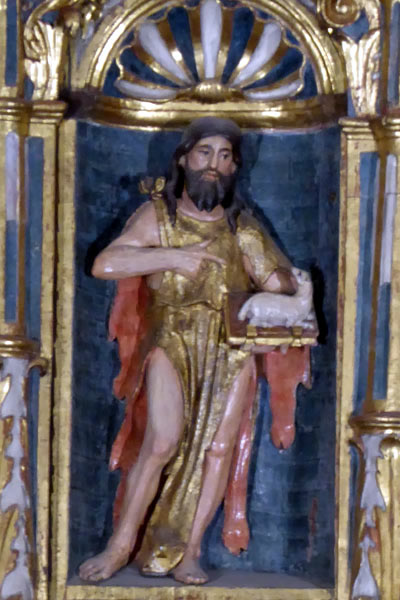
Saint John the Baptist
According to the gospels, John the Baptist carried out his work in the beginnings of christianity, in the region of the Jordan river. He baptised those who searched for the conversion – therefore he is called the Baptist. Among the people he baptised was Jesus of Nazareth.
The gospel describes him as a hermit who lived in the desert and covered himself with a camel-skin robe. He is portrayed as a semi-nude man wearing a camel-skin robe. He carries a book in his left hand and a lamb – the symbol of Christ – to which he points as John was the first who recognised Jesus as the Messiah.
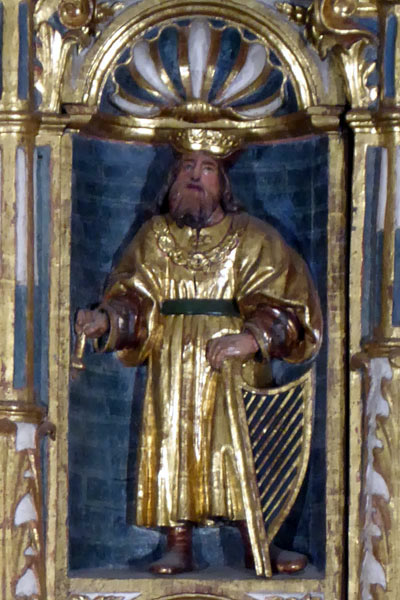
King David
David was one of the kings of the jews mentioned in the Bible. He is very important for the christians, as, according to the gospels, Jesus was related to this king through his adoptive father Joseph.
David is depicted with a crown and a harp, as, according to the history, he played this instrument very well.
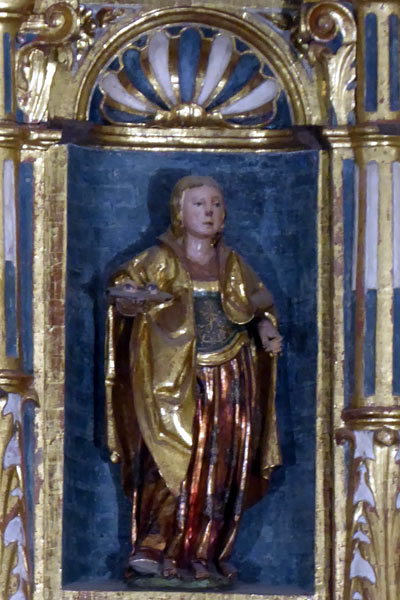
Saint Lucia
According to the legend, Lucia was a young woman from Sicily, who was denounced by her betrothed of being christian, therefore martyred and beheaded for not wanting to make sacrifices to the roman gods.
During her martyrdom her eyes were ripped out, which are depicted on a plate.