
Altapriece of the Assumption of Mary (Lekeitio)
- Church: Assumption of Mary Church (Lekeitio)
- Location: High Altar
- Patron: Council of Durango and parish of Saint Mary
- Chronology: 16th century (1500-1505)
- Style: Gothic
This more than 500-year-old work is the most important gothic altarpiece in the Basque country
Interactive altarpiece: click on the pictures to get more information.
Church:
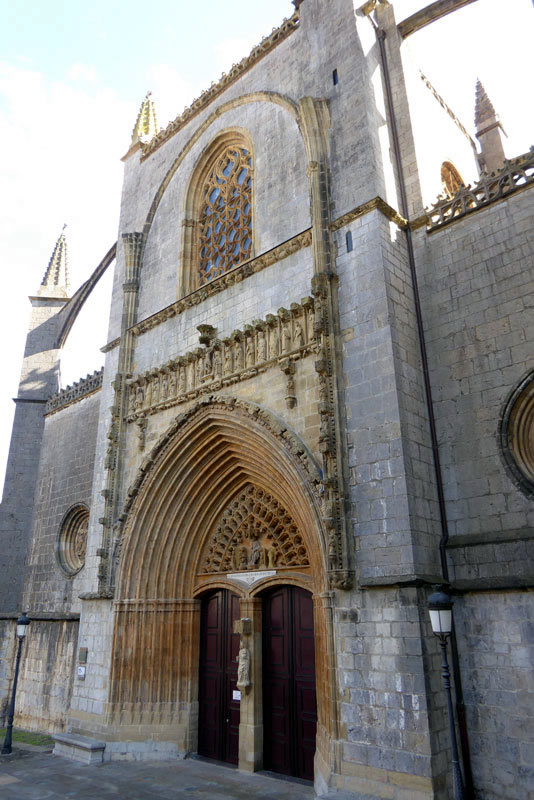
The Saint Mary Church was built in the 15th century and replaced an older building. It is a gothic church, which stands out in the town of Lekeitio due to its size and location in the middle of the bay, next to the port. The church has a beautiful 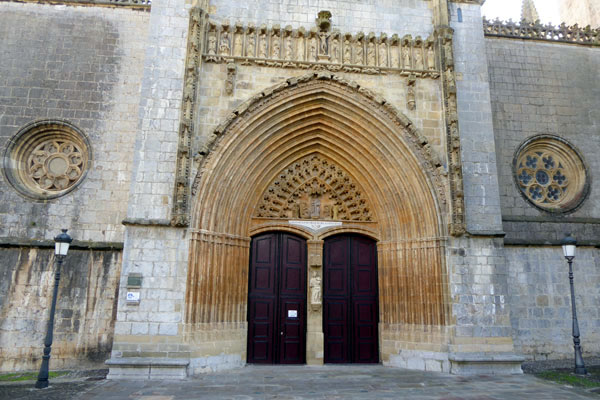
Over the centuries, this church has undergone numerous extensions and modifications; as a result, the exterior features slender 
Patronage:
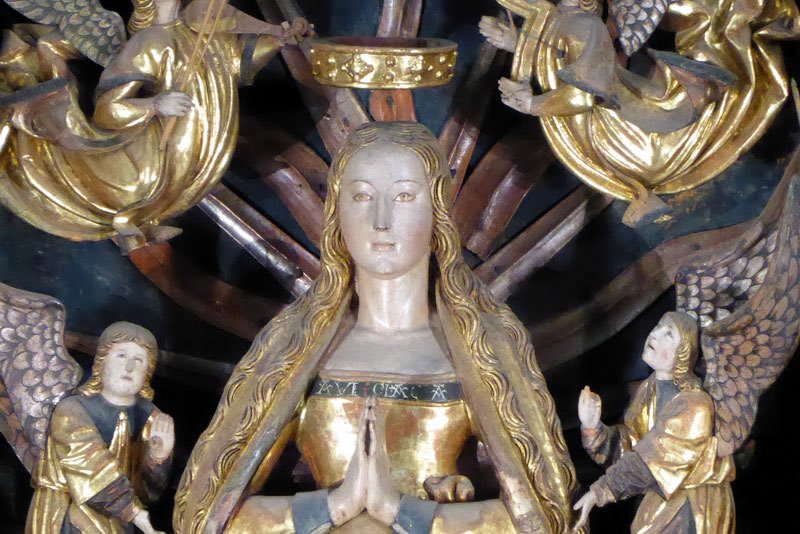
The church and its main altarpiece are dedicated to the Assumption of the Virgin Mary. According to the catholic tradition, at the end of her life Mary was taken to heaven and is – together with Jesus Christ – the only person whose body and soul is in Paradise without having to wait for the Last Judgement and the Resurrection of the dead.
She is depicted as Queen of Heaven standing on clouds and being crowned by angels, which surround her, because they took up her body into the Glory.
Description:
The 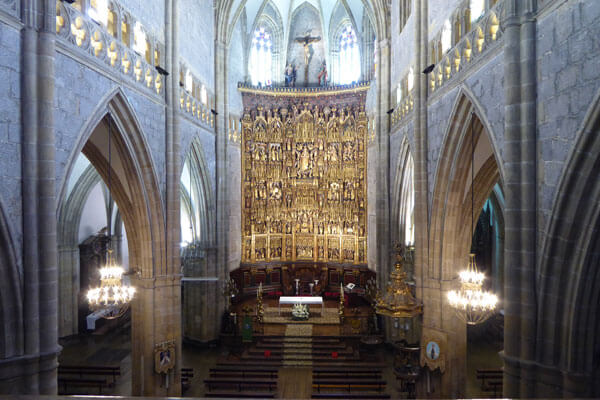
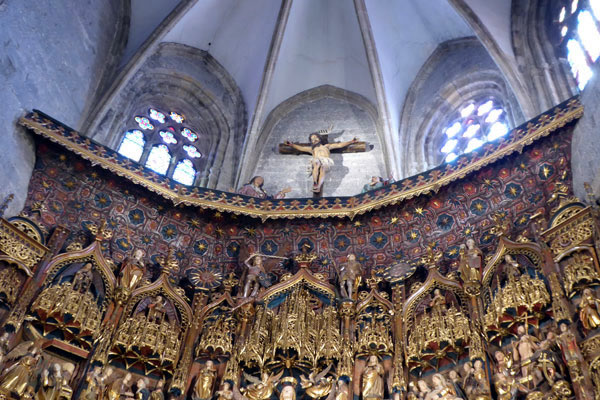
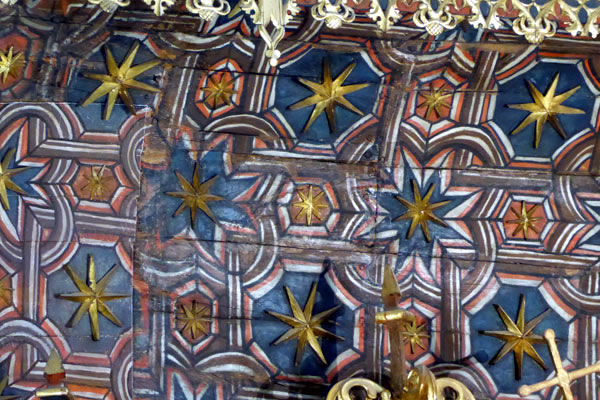
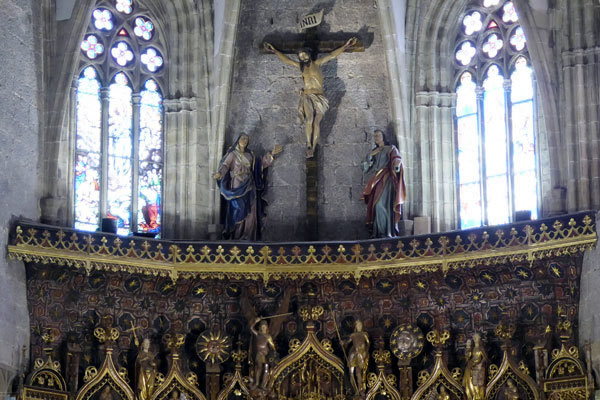
Most of the pictures describe the life of Mary to whom the altarpiece is dedicated. The two most important 
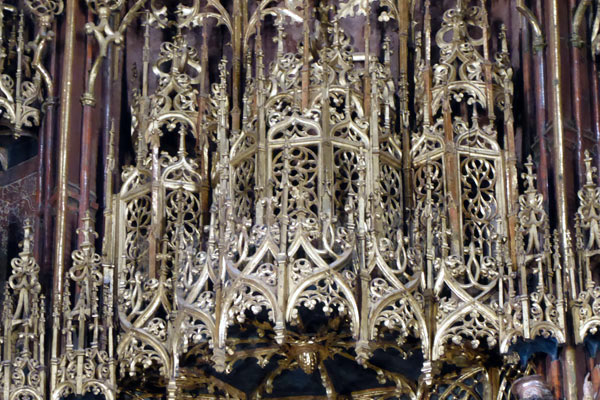
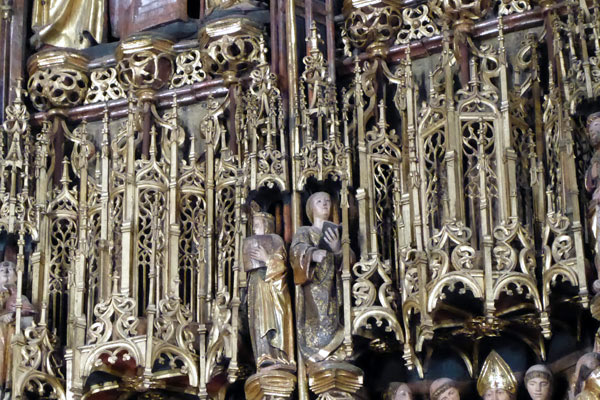
The intricate 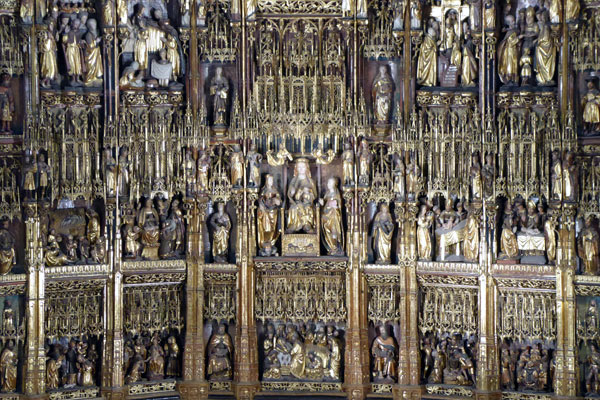
History:
The altarpiece of the Assumption of Mary was ordered in the beginning of the 16th century, between 1500 and 1505. At this time the construction of the gothic church was finished. It is not clear, who the artist of the altarpiece was; probably a sculptor from northern Europe, from the Lower Rhine-Moselle region (between today’s Germany, France and Belgium). He might have worked together with flemish and french artists and had built other works in Castilla, in the regions of Burgos and Palencia.
After the sculptures had been finished and the altarpiece had been set up, around 1514, Juan García de Crisal was placed an order for the polychromy. To carry out such a project, which cost more than 500.000 maravedí (local currency at that time), great economic efforts were necessary. The altarpiece was paid with money from the parish and the local council and with donations from the residents of Lekeitio, both from those who lived there as well as from those who hold high offices at the royal court.
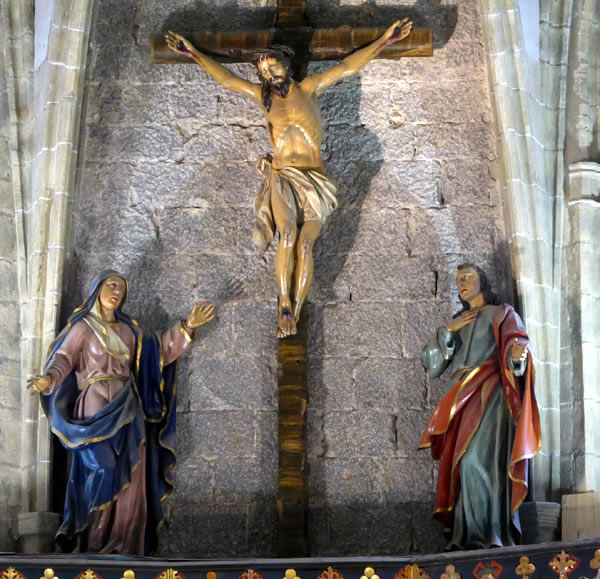
In 1741, the baroque Golgotha scene was added, which was built by the sculptor Juan Antonio de Hontañon from Cantabria and painted by Luis Fonseca.
Imagery:
Pedestal
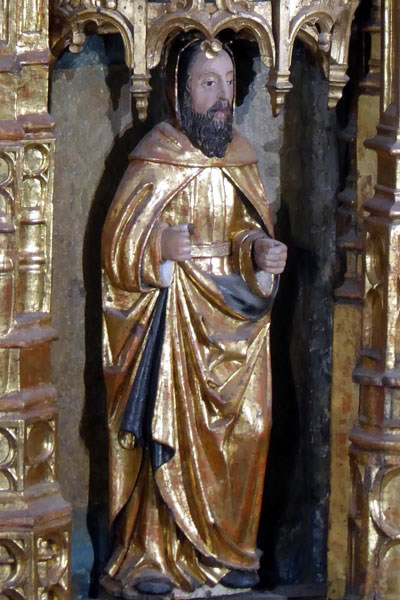
Saint
Image of a bearded saint dressed as a monk.
He has lost the objects he was holding, so it is not possible to identify him.
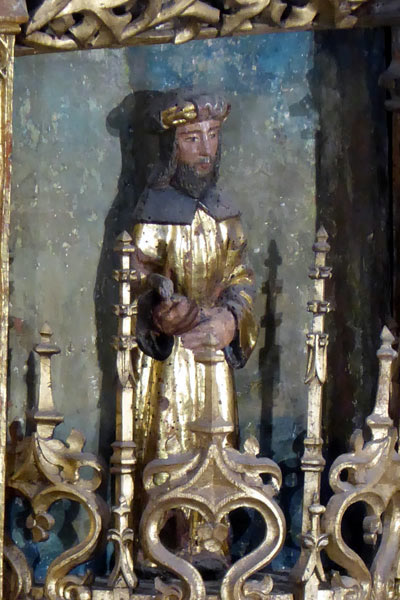
Prophet
Image of a prophet, dressed in a tunic and turban.
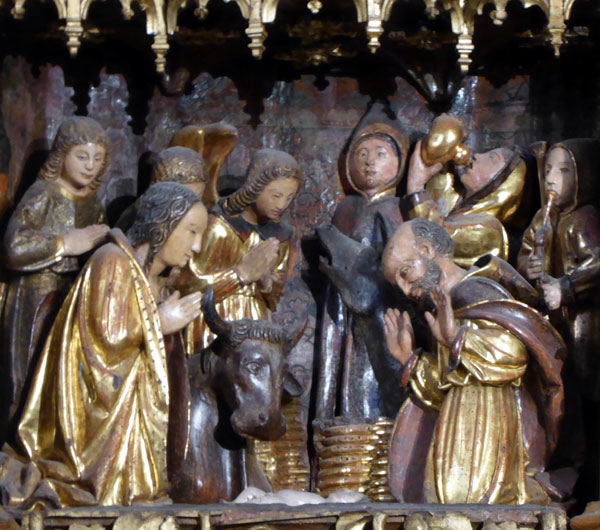
Adoration of the Shepherds
The Gospel recounts that, after being told by an angel that the Messiah had been born, the shepherds went to the stable in Bethlehem. This relief shows the Virgin Mary kneeling before the Child, who is lying on her cloak. Opposite her, Joseph, also kneeling, raises his hands. The shepherds arrive on the right side of the scene, playing instruments and drinking from their canteens. Next to them, several angels join their hands and bow before the Child, indicating that he is the Son of God.
The scene is completed by the mule, depicted as if it were braying, and the ox, the animals that traditionally accompany representations of the birth of Jesus.
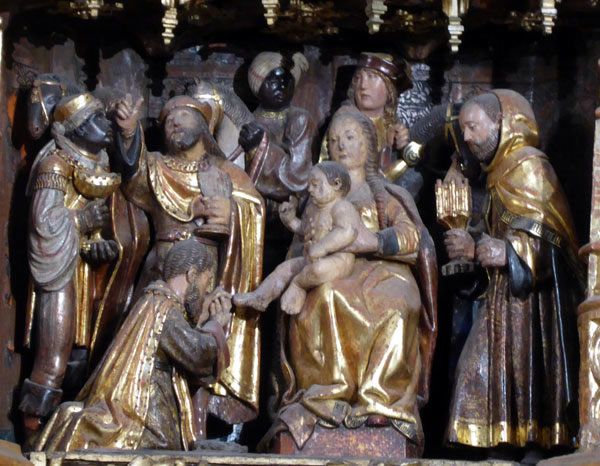
Adoration of the Magi or Epiphany
According to the Gospels, Magi from the East visited Jesus in Bethlehem, where they arrived following a star that shone in the sky. Their names, number, and race are not mentioned, although tradition has it that there were three: Melchior, Gaspar, and Balthazar. Since the 14th century, the latter has usually been depicted as a young black man. However, it is said that they brought three gifts: gold, as king; frankincense, as god; and myrrh, a highly aromatic balm used to embalm the dead, as man and therefore mortal.
Mary holds the Child while the first magus, Melchior, has placed the crown that identifies him as a king on the ground and kneels before the Son of God. Behind him, Gaspar stands pointing to the sky, showing Balthazar, who is looking at him, the star that has guided them there. Joseph, standing behind the Virgin, holds one of the gifts brought by the Magi. The scene is completed by two pages on horseback.
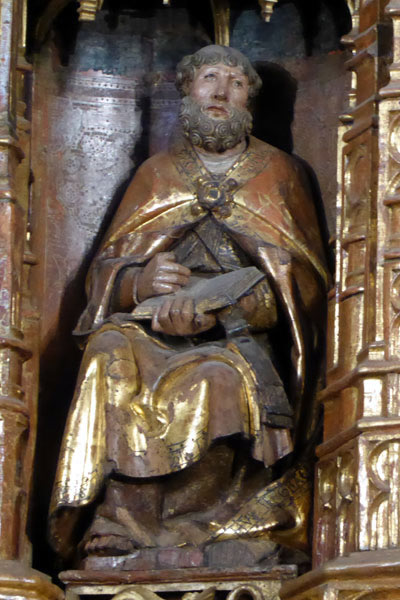
Apostle
A figure representing one of the twelve apostles who, according to the gospels, accompanied Jesus of Nazareth.
He is richly dressed, wearing a highly decorated cloak, and holding a book.
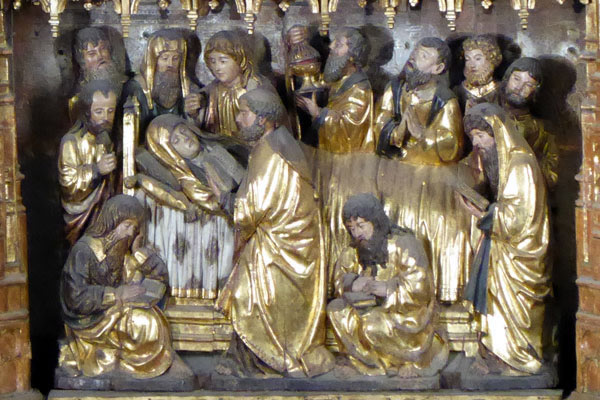
Assumption of the Virgin Mary
According to catholic tradition, before being taken body and soul to Heaven, Mary did not die, but remained asleep after all the apostles had come to accompany her. This moment is depicted here: Mary, lying on the bed with her eyes closed, is surrounded by the twelve apostles, who stand out for their expressive gestures: some are reading their books, one has his hands clasped and is looking up to the sky, another has his hand on his cheek in a sign of grief, another is preparing a censer…
Among them we recognise John, the youngest and beardless, who is looking directly at Mary.
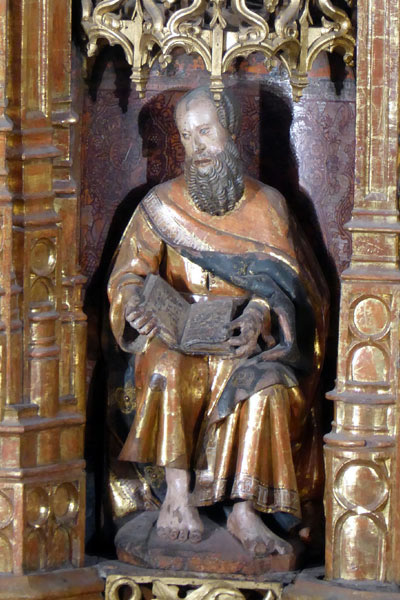
Apostle
A figure representing one of the twelve apostles who, according to the gospels, accompanied Jesus of Nazareth.
He is richly dressed, wearing a highly decorated tunic and cloak, and holding a book.
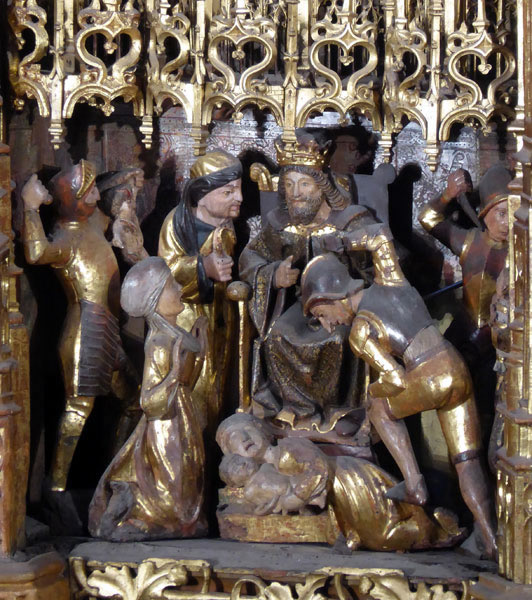
Massacre of the innocents
The gospels recount that Herod, confusing the birth of the Messiah with that of a future monarch of the Jews, ordered the murder of all children under two years of age in Bethlehem for fear that one of them would dethrone him. The scene is presented in all its cruelty: in the centre, king Herod watches as one of the soldiers, dressed in armour and a helmet, goes to execute a child, ignoring the pleas of his mother who tries to protect him.
Herod also ignores the woman kneeling beside him, screaming, while he appears to listen to an advisor.
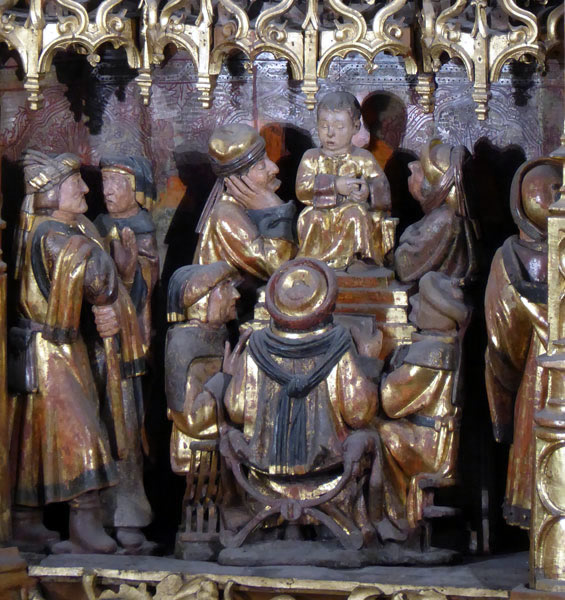
Jesus among the doctors
According to the gospels, when Jesus was 12 years old, he went to Jerusalem with his parents to celebrate Passover and got lost in the crowd. After searching for him for three days, they found him in the temple, arguing with the priests and theologians, who were amazed at his wisdom. In the scene, Jesus appears in the centre, surrounded by the wise men who ask him questions and listen attentively, or comment in surprise on his knowledge. The expressive gesture of the Child’s hands is striking, as he seems to enumerate and reason out his answers.
It is a scene full of details, such as the clothing and the chairs on which the doctors sit.
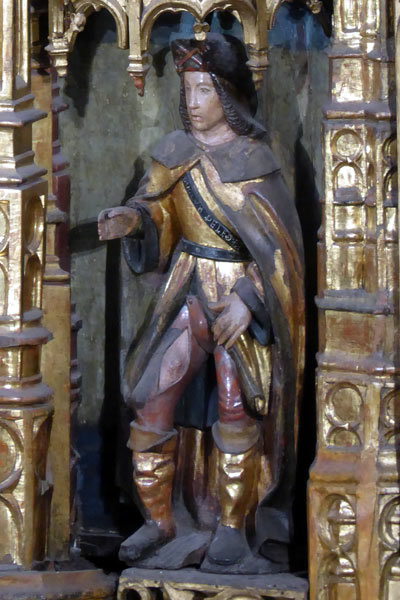
Saint Roch
Roch was a young man who had distributed his inheritance among the poor and devoted himself to caring for those suffering from the plague. He himself became infected, so he decided to retreat to a forest to avoid spreading the disease. That is why he is the patron saint against epidemics and plagues.
Here he appears dressed as a pilgrim and showing the mark of the plague on his leg.
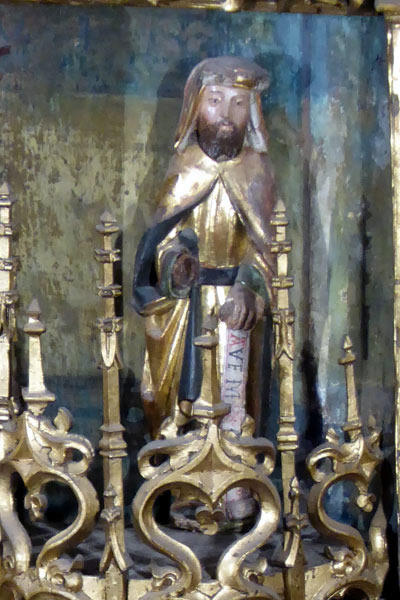
Prophet
Image of a prophet holding a band in his left hand on which the words AVE María (Hail Mary) can be read.
Body 1
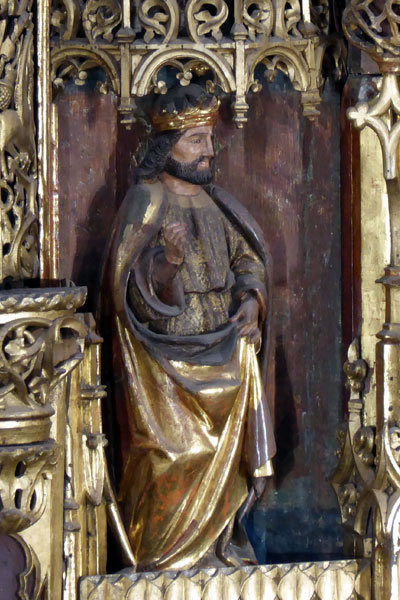
King
Image of one of the kings of Israel mentioned in the Bible, dressed in a rich tunic and golden cloak and wearing a crown.
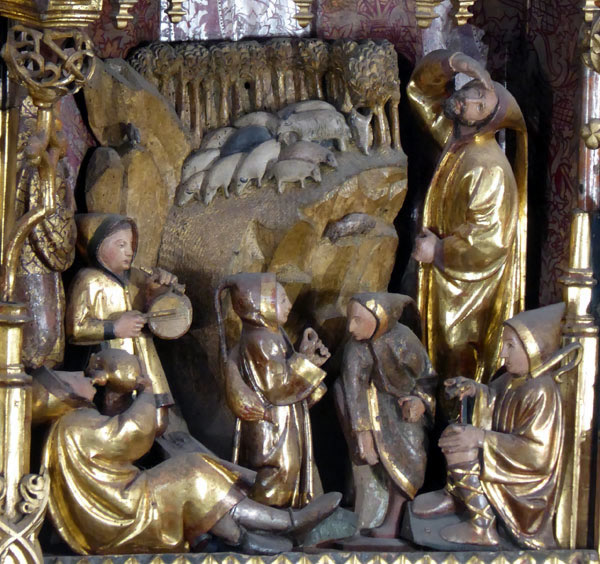
Announcement to the shepherds
According to the gospels, shortly after Jesus was born in Bethlehem, an angel appeared to the shepherds who were tending their flocks nearby to announce that the Messiah, the saviour of humanity, had been born. In this scene, one of the shepherds looks up at the sky, while the others seem unaware of the apparition: they play instruments, drink from their boots or chat among themselves.
It is a scene full of details, such as the shepherds’ clothes, the flocks, the landscape…
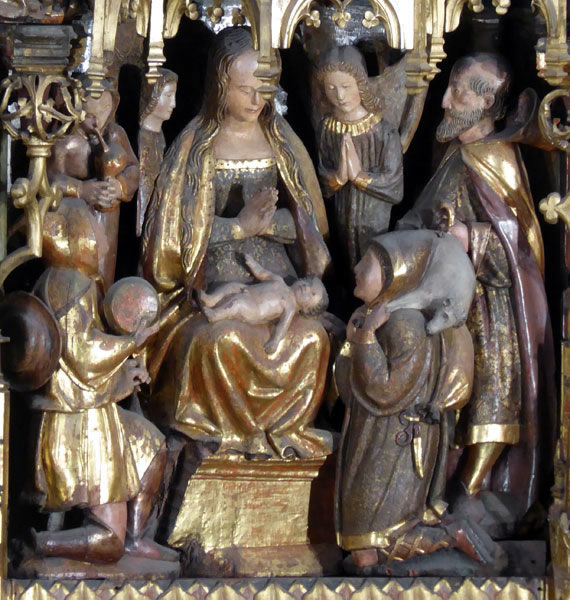
Adoration of the Shepherds
The gospel recounts that, after being told by an angel that the Messiah had been born, the shepherds went to the stable in Bethlehem. This relief shows the Virgin Mary seated with the Child in her lap, while the shepherds approach her. Two of them kneel in respect, while a third, standing, plays a musical instrument.
Behind Mary, two angels join hands, indicating that the Child is the Son of God. Joseph, for his part, gazes at Mary, completing this moving scene.
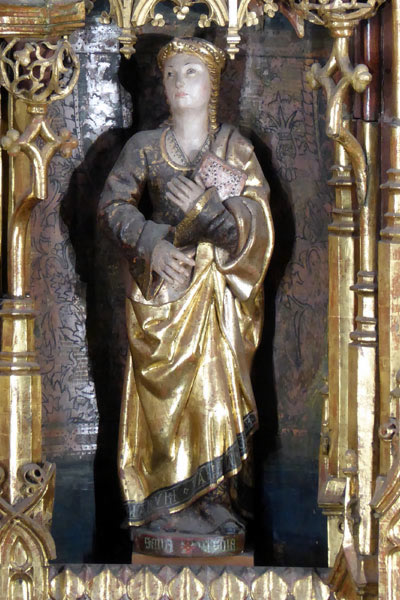
Saint
Image of a saint, richly dressed and holding a book.

Virgin with Child
This sculpture is the oldest in the altarpiece. It was made in the 1300s, making it more than a hundred years older than the rest of the images. It is a representation of Mary seated with the child on her lap, of the type known as the Virgin-Throne, which in the Basque Country is called Andra Mari (‘Lady Mary’). The sculpture has been placed on a richly decorated throne, made in 1500, above which two angel musicians fly. On either side of the Virgin are two saints: on the left is Saint Catherine of Alexandria, recognisable by the crown that identifies her as a princess, the sword representing her death by beheading, and the figure of Maximian at her feet, the emperor who ordered her execution but was morally defeated by the saint. She was a woman who stood out for her wisdom, which is why she also carries an open book in her left hand.
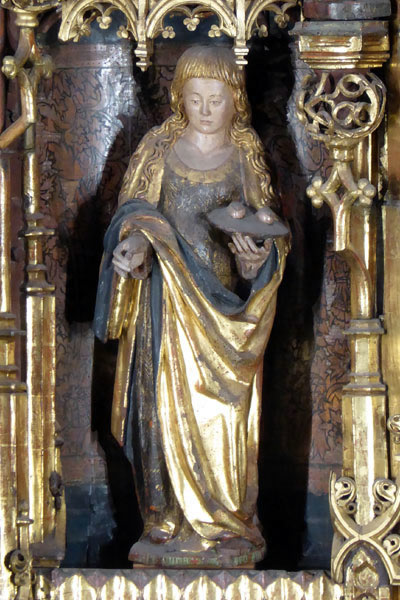
Saint Agatha
Agatha of Catania was a young woman who converted to christianity and suffered numerous tortures as a result. The most well-known is that her breasts were cut off, which is why she is depicted here as a beautiful young woman holding a plate on which these attributes appear.
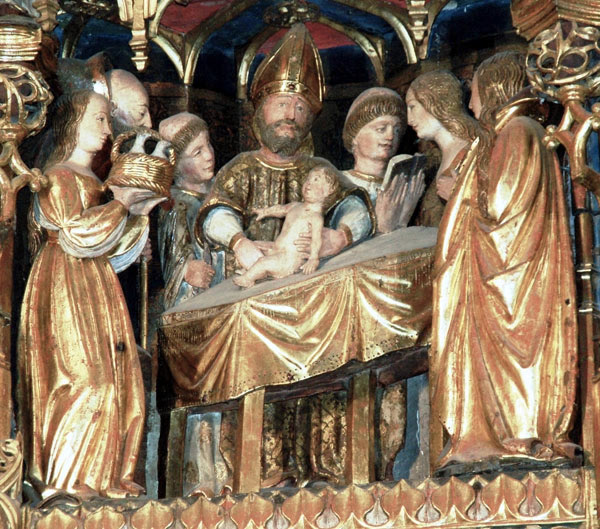
Circumcision of Jesus
The gospel of Luke recounts that Jesus, jewish by birth, was circumcised eight days after his birth, following the practice of the jewish religion which establishes that all male children must participate in this ritual ceremony, in which they are also given a name. The painting captures the moment when the priest holds the child to circumcise him, accompanied by two acolytes, while two women watch the scene.
On the right are Joseph, leaning on a staff, and Mary, carrying a basket with two turtledoves, an offering that was traditionally left at the temple.
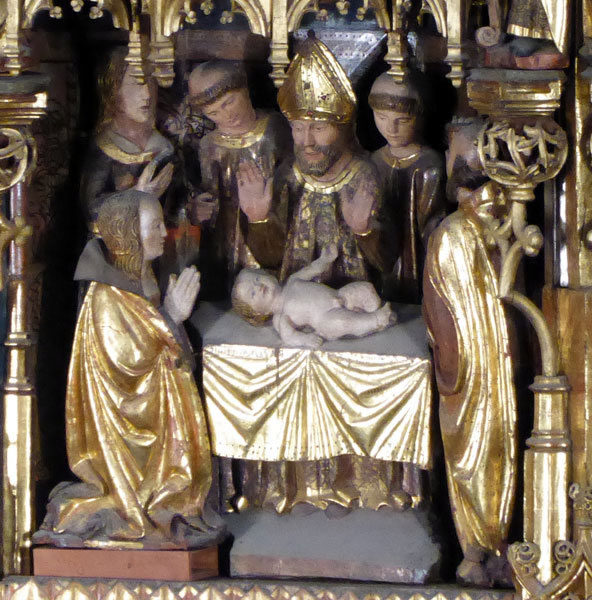
Presentation at the temple
According to jewish law, all families had to present their firstborn son to God. The gospel of Luke recounts that, in accordance with this precept, Mary and Joseph took Jesus to the temple in Jerusalem. There, two people recognised the Child as the Messiah: the elderly Simeon, who appears here as a richly dressed priest raising his hands, and the prophetess Anna, who appears standing on the left. In front of her, Mary kneels and folds her hands.
The scene is completed by the figure of Joseph, standing on the right, and two acolytes accompanying Simeon and contemplating Jesus, lying on the altar of the temple.
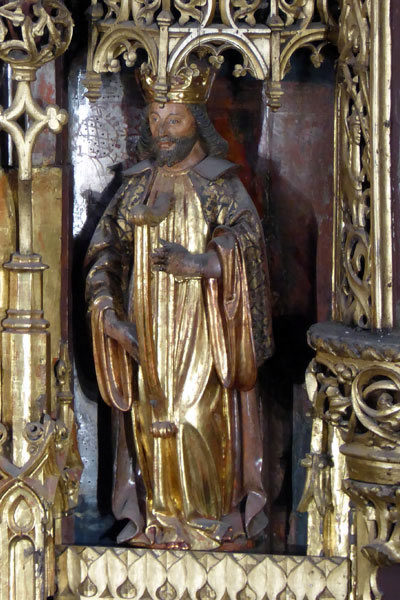
King David
Image of one of the kings of Israel mentioned in the Bible, dressed in a rich tunic and golden cloak and wearing a crown. He is playing the harp, which identifies him as king David, as history tells us that he was very skilled at playing this instrument.
He is a very important figure for christians, as according to the gospels, Jesus of Nazareth was related to this king through his adoptive father, Joseph.
Body 2
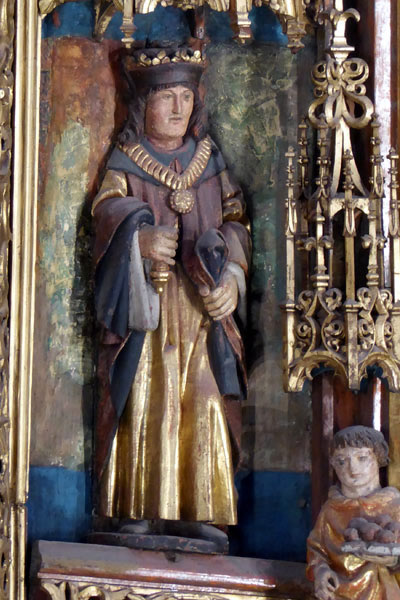
King
Image of one of the kings of Israel mentioned in the Bible, richly dressed, with a medal and sceptre, and wearing a crown.
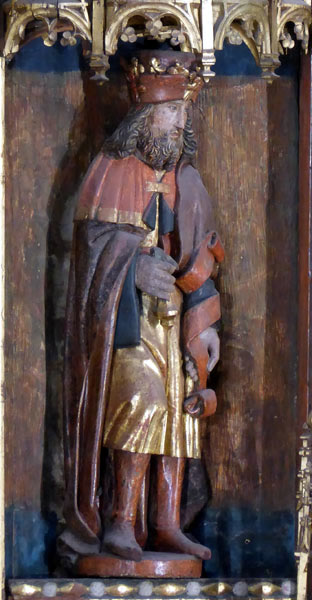
King
Image of one of the kings of Israel mentioned in the Bible, richly dressed, carrying a sceptre and wearing a crown.
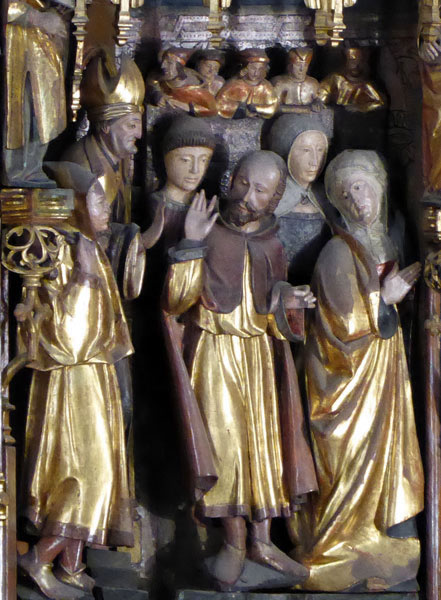
Offering of Saint Joachim in the Temple
According to tradition, Joachim is the father of the Virgin Mary and therefore the grandfather of Jesus. After many years of marriage to his wife, Anne, they had no children, which among the Jews was considered a divine curse. Therefore, they tried to ingratiate themselves with God by making offerings in the temple, but these were rejected by the high priest.
The relief depicts this moment, with the priest raising his right hand in a sign of rejection and Joachim and Anne leaving the temple, while three other figures watch the scene and, in the background, a group of men seem to mock them for not being able to have children.
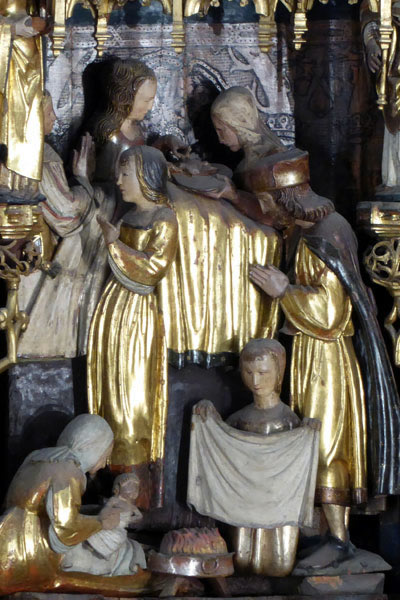
Birth of Mary
The Bible says very little about Mary’s life, which we know mainly from medieval legends and traditions. Here her birth is depicted as an everyday event: her mother, Anne, has already given birth and is being cared for in bed by three women who offer her plates of food, while two midwives wrap the newborn in warm cloths. At the foot of the bed, Joachim, Anne’s husband and Mary’s father, stands with his hands clasped in a sign of respect.
It is a scene full of details, such as the flames of the brazier where the midwives warm the cloths.
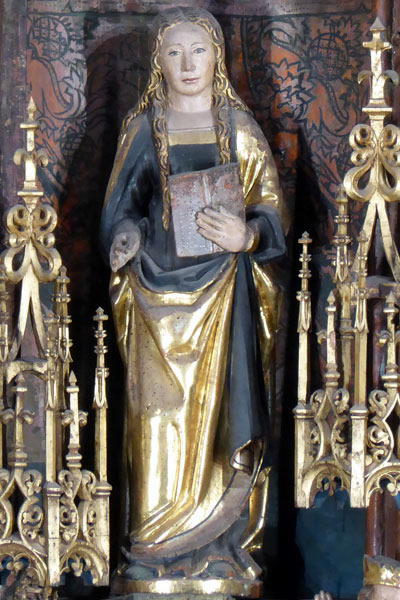
Saint
Image of a saint, richly dressed and holding a book.
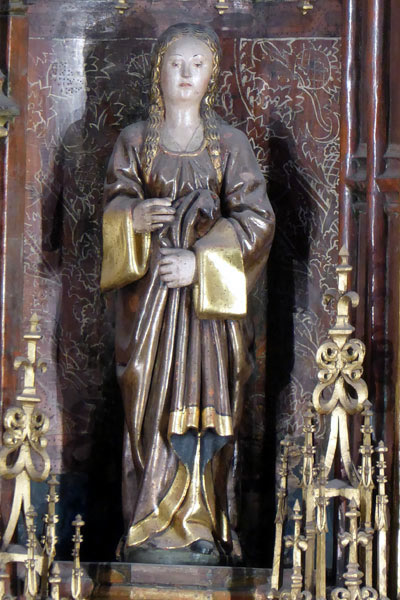
Saint
Image of a richly dressed saint, gathering her cloak
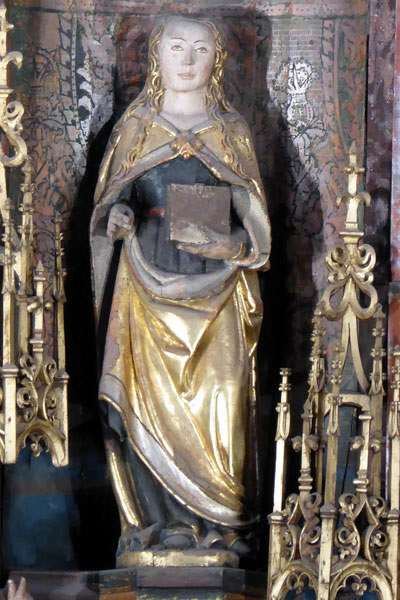
Saint
Image of a saint, richly dressed and holding a book.
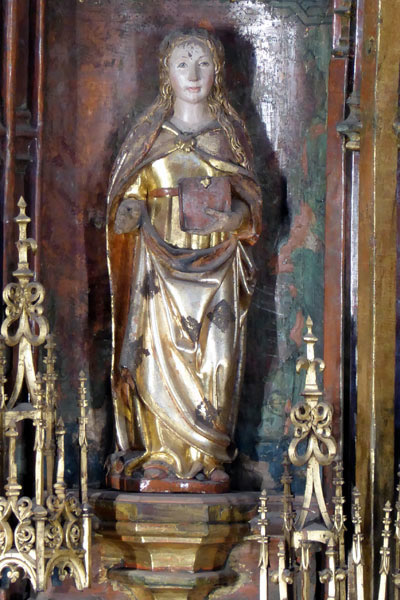
Saint
Image of a saint, richly dressed and holding a book.

Presentation of Mary in the Temple
The Bible says very little about Mary’s life, which we know mainly from medieval legends and traditions. When she was very young, Mary’s parents, Joachim and Anne, took her to the temple in Jerusalem, where she would be educated by the priests until she reached marriageable age. This scene depicts the moment when the priest Barachias receives the girl as she climbs the steps of the temple and prophesies that she will be the Mother of the Messiah, while her parents and some women look on.
The figures peering down from the top of the temple are striking, as is the detail in the architecture.
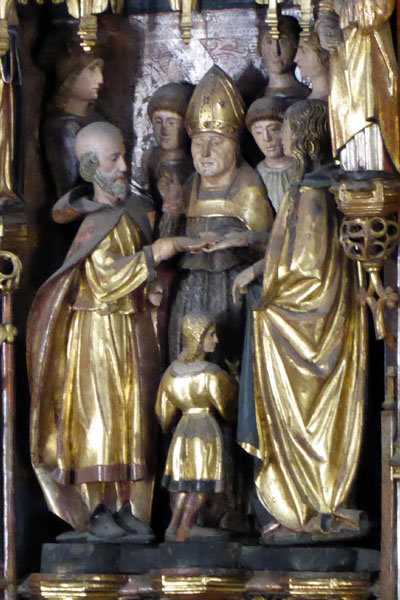
The betrothal of Mary and Joseph
According to tradition, the priests of the temple chose Joseph from among several suitors as the most suitable husband for the Virgin Mary.
The scene depicts the moment when a priest joins the hands of Mary and Joseph, while the other suitors look on.
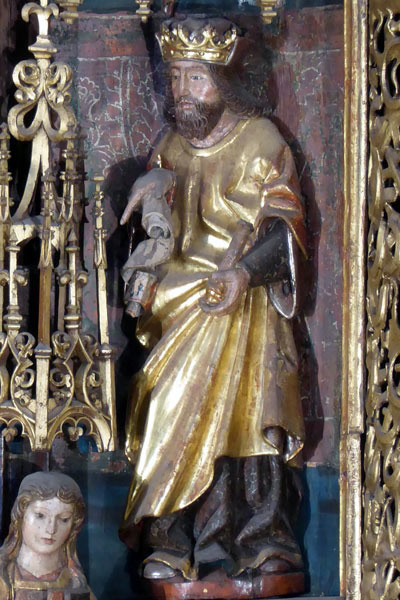
King
Image of one of the kings of Israel mentioned in the Bible, richly dressed, carrying a sceptre and wearing a crown.
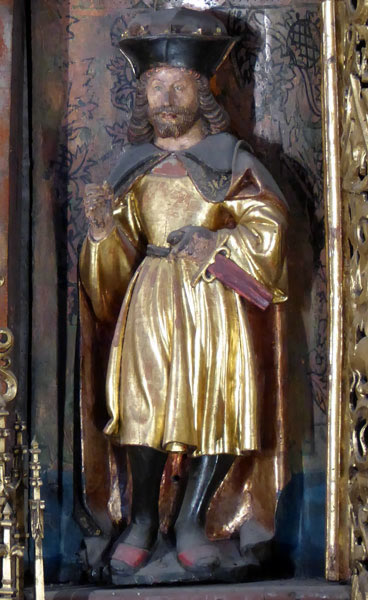
King
Image of one of the kings of Israel mentioned in the Bible, richly dressed, carrying a sceptre and wearing a crown.
Body 3
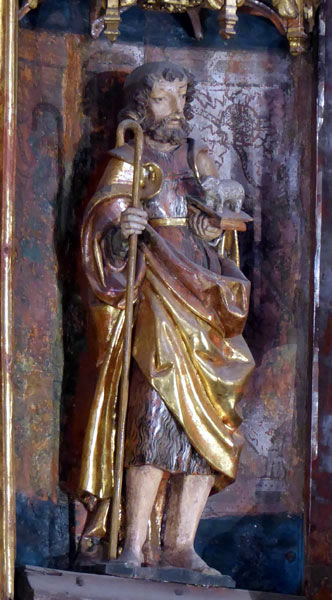
Saint John the Baptist
According to the gospels, John the Baptist carried out his mission at the beginning of the christian era, on the river Jordan, where he baptised those seeking conversion, hence his nickname. Among those he baptised was Jesus of Nazareth. He is described as a hermit who lived in the desert and covered himself with camel skins; here he appears covered in skins and carrying a staff or cane.
In his left hand he holds a book and, above it, a lamb, symbol of Christ, since it was the Baptist who first recognised Jesus of Nazareth as the Messiah.
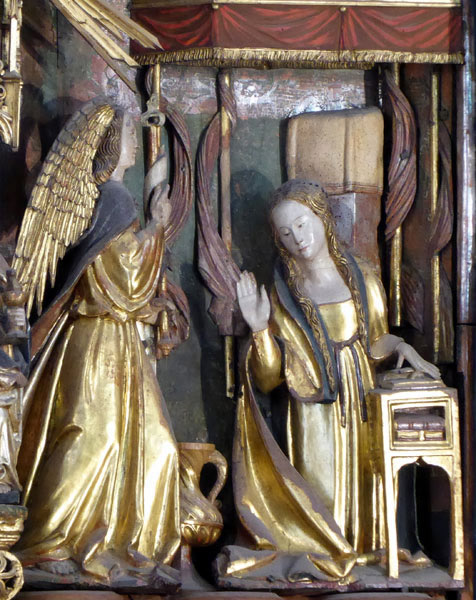
Annunciation
According to the gospels, the archangel Gabriel was sent by God to announce to Mary that she would be the Mother of the Messiah. It is an episode of great symbolic importance for christianity, as it represents the mystery of the Incarnation, that is, the moment when God became man to save humanity from sin. This relief shows the moment when the archangel appears before Mary, while the woman, who is reading, lowers her eyes in a sign of humility. Above them are golden rays coming from heaven, alluding to the miraculous and divine conception of Christ. Between the archangel and Mary there is a vase; it probably contained white flowers symbolising the woman’s purity and virginity, but these have been lost.
The scene is set inside a bedroom to make it more intimate and expressive, and is full of details such as the curtains and the table with the books on it.
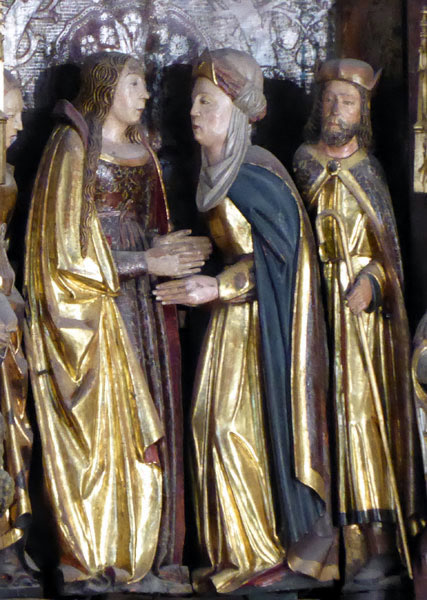
Visitation
According to the gospel, Mary, pregnant with Christ, visits her cousin Elizabeth, who was also pregnant with John the Baptist, to tell her that she is going to be the Mother of God. In this relief, Mary and Elizabeth greet each other, while Zechariah, Elizabeth’s husband, who is standing behind her, watches the scene.
Following the Bible account, Elizabeth is depicted as an elderly woman, while Mary, as a maiden, has her hair loose and uncovered.
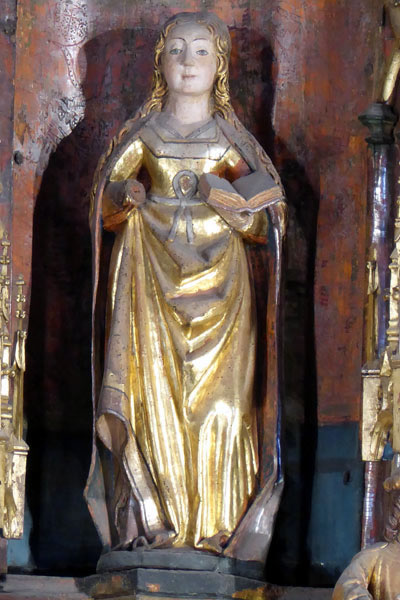
Saint
Image of a saint, richly dressed and holding an open book in her left hand.
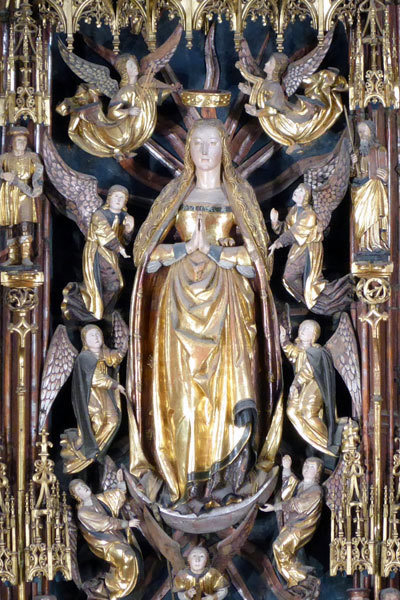
Assumption
According to catholic tradition, at the end of her life Mary was taken up to Heaven and, together with Jesus Christ himself, is the only person who is in Paradise in body and soul, without having to wait for the Last Judgement and the Resurrection of the dead. She is depicted standing on a crescent moon, surrounded by rays of sunlight and accompanied by angels who crown her as Queen of Heaven and support her, as they were the ones responsible for transporting her body to Glory.
The elegance of Mary’s figure, richly dressed, contrasts with the complicated postures of the angels, particularly the two above, who are playing musical instruments.
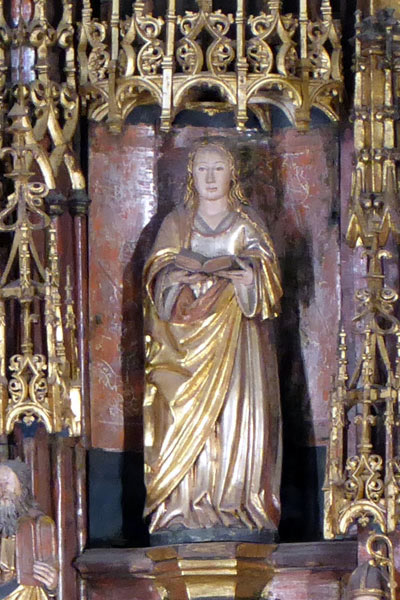
Saint
Image of a saint, richly dressed and holding an open book.
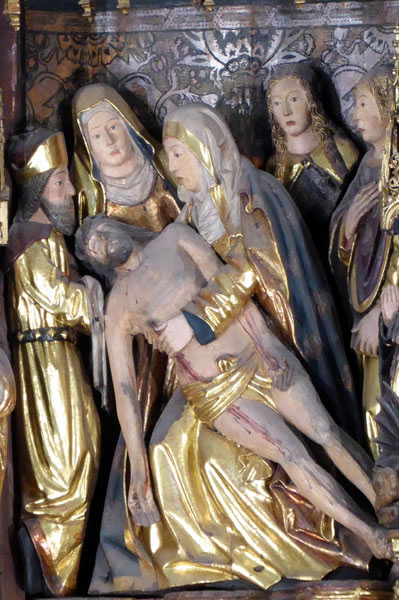
Piety
Christ, now dead, is mourned by his mother and his closest followers. To express Mary’s grief, the body of her son appears here. They are accompanied by four other figures, among whom Joseph of Arimathea can be recognised, standing on the left of the scene, who, according to the gospels, asked the roman governor, Pontius Pilate, for permission to take Jesus’ body down from the cross and lay it in a tomb.
The rigidity of Jesus’ body stands out, with an expressive polychromy that highlights the blood from his wounds.
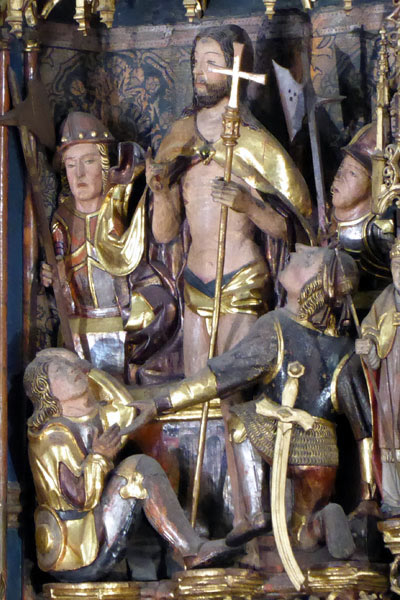
Resurrection
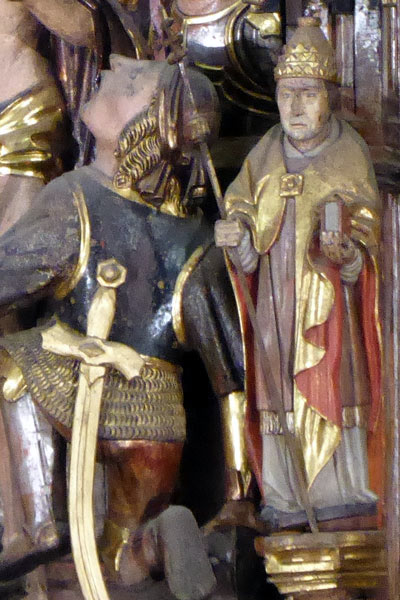
According to the gospels, three days after being crucified, Jesus rose from the dead. This event is depicted by showing him emerging triumphantly from the tomb, half-naked and displaying the wounds of the crucifixion, with a cross-shaped staff representing his victory over death. He is surrounded by soldiers, who fall to the ground upon witnessing the miracle.
The soldiers’ clothing is striking, as they are depicted wearing armour, helmets and weapons typical of 1500, the period when the altarpiece was made: shields, curved swords, large axes called halberds.
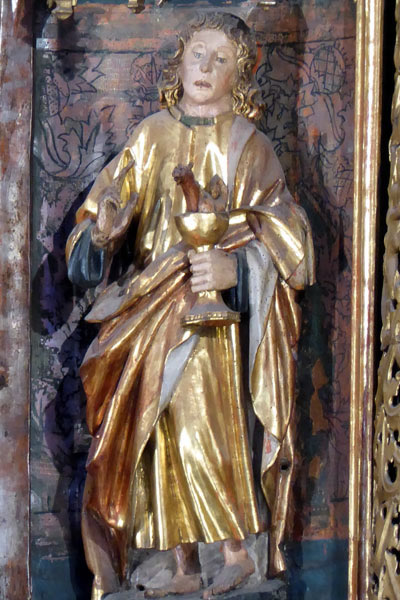
Saint John
John was one of the twelve apostles and also the author of one of the four gospels that the catholic church considers to be inspired by God and which are included in the Bible. In this sculpture, he is shown holding a cup from which a small dragon emerges.
This is a reference to his most famous miracle: one day he was offered a cup of poison, but the saint blessed it and was able to drink from it without dying, thus showing that christianity is the true faith.
Attic
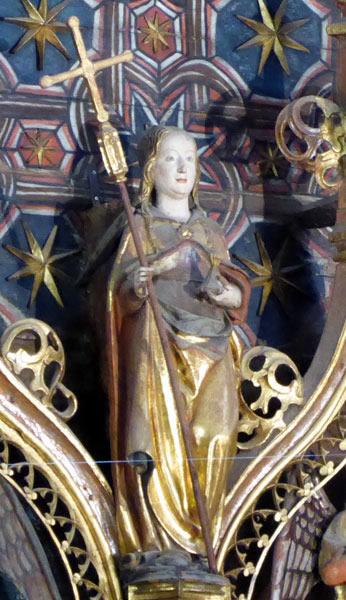
Church
Symbolic representation of the christian church as a beautiful young woman dressed in a toga, holding a large cross in her right hand, alluding to true faith.
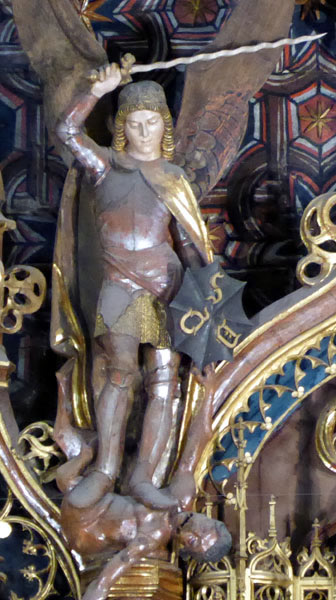
Saint Michael the archangel
Michael is one of the four archangels mentioned in the Bible. His name means “Who is like God?”; that is why he carries a shield bearing the initials QSD, the Latin abbreviation for Quid sicud Deus? (Who is like God?), in reference to his name. According to tradition, he defeated Lucifer when he rebelled against God.
Hence, he is depicted as a soldier, wearing armour and a cape, and holding a sword in his right hand, which he raises against the devil, defeated at his feet.
Saint George
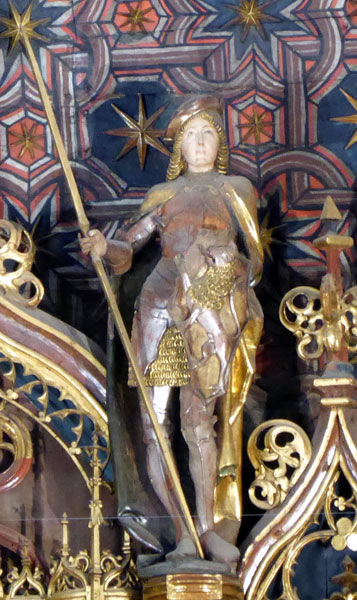
George was a roman soldier from Cappadocia (in present-day Turkey) who lived in the early years of christianity. Legend has it that one day he learned that a dragon was threatening the inhabitants of the city of Silca (in present-day Libya), who had to offer human sacrifices to it every day. The brave George then confronted the dragon, saving the beautiful princess it was about to devour.
That is why he is depicted here as a warrior dressed in armour and with a lion, symbol of courage, on his shield. In his right hand he holds a spear, symbol of his triumph, which is interpreted as the victory of virtue over sin.
Synagogue
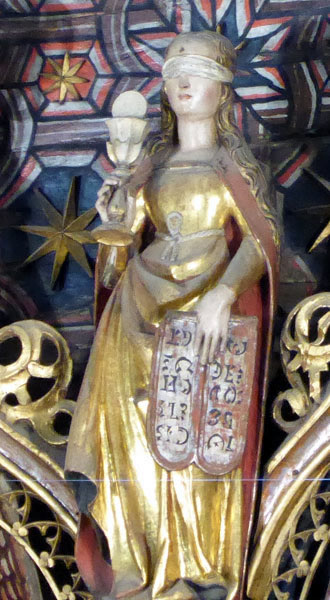
A symbolic representation of the jewish religion, whose main temple is the synagogue. She appears as a young woman holding the tablets of jewish law, on which, according to the Bible, were written the ten commandments that God gave to Moses and which are shared by jews and christians.
The young woman is blindfolded to express that, although it was right before them, the jewish religion failed to see that Jesus was the son of God and, therefore, the saviour of humanity.
Calvary
The altarpiece is crowned with three sculptures in a style very different from the rest. It is a representation of Calvary, that is, Christ crucified surrounded by his mother, Mary, and his favourite disciple, John. Here, the moment when Jesus has already died is depicted, as shown by the bleeding wound in his side, while Mary and John express their pity and grief.
It is a baroque work, created in 1741 by the sculptor Juan Antonio de Hontañón and polychromed by the painter Luis Fonseca.