
Altapriece of Saint Emeterius and Saint Celedonius (Goikolexea, Larrabetzu)
- Church: Saint Emeterius and Saint Celedonius Church (Goikolexea, Larrabetzu)
- Location: High Altar
- Chronology: 16th century (1520-1525)
- Style: Gothic
The main altarpiece for five centuries of an “iglesia juradera” in the Lordship of Biscay
Interactive altarpiece, klick on the pictures to get more information.
Church:
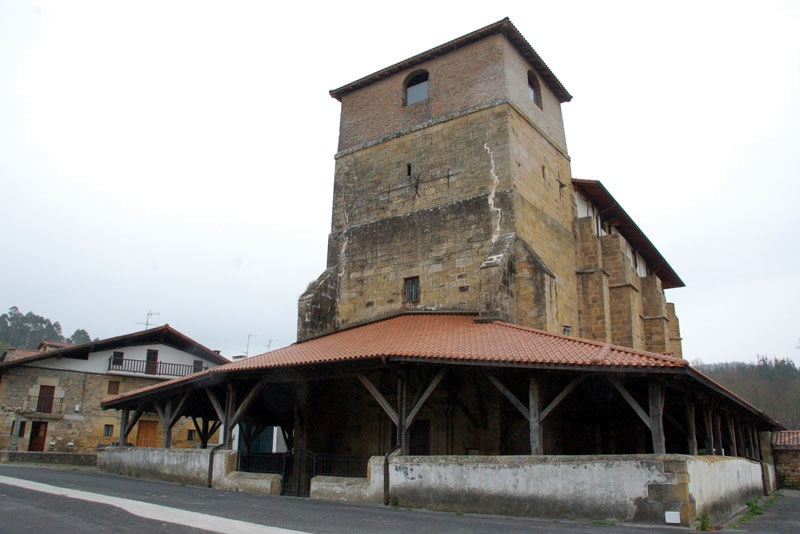
The saint Emeterius and saint Celedonio church is located in the most important district of Larrabetzu, Goikolexea, to which it gives its name (goikolexea means “church from above” in basque). There had been another church before, certainly from the 12th century. The construction of the current one started around 1500 in a gothic style. The 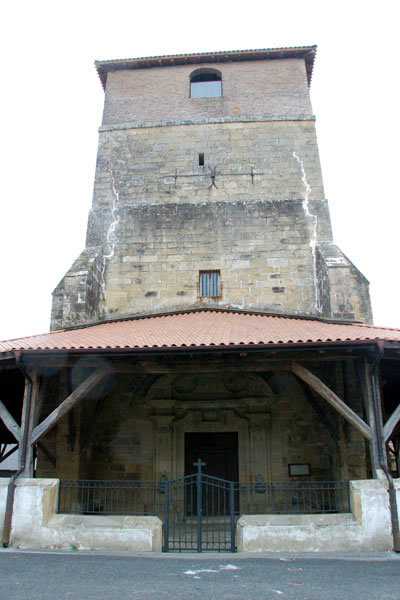
Patronage:
Celedonius and Emeterius were two roman soldiers, probably brothers, who suffered the martyrdom by beheading for refusing to abandon their christian faith. According to the tradition, they served in the roman legion which was based in Calahorra (La Rioja) at the end of the third century. The house they were jailed is known today as “casa santa” (holy house). They were convicted there and brought to the riverbanks of the Cidacos river, where they were beheaded.
Years later, the cathedral of Calahorra was built at this place.
Description:
This 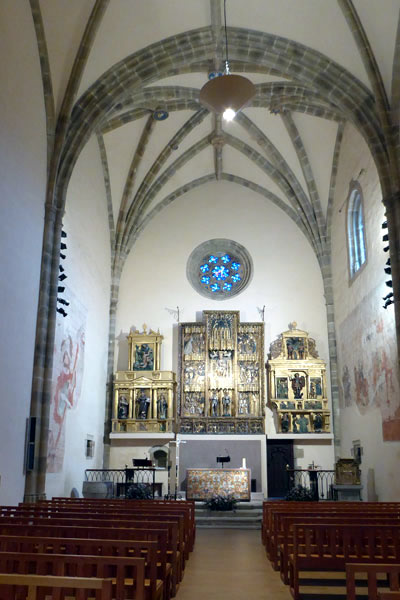
The altarpiece is dedicated to Saint Emeterius and Saint Celedonius. Therefore, their sculptures occupy the central section. Above them is the picture of the Virgin Mary, who is crowned by angels, together with the Child.
The lateral sections tell more about the life of the two saints. The upper part describes the life of Mary, emphasising her role as Mother of Jesus. The 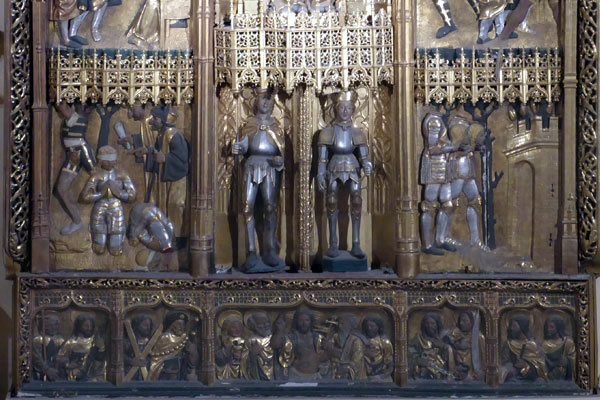
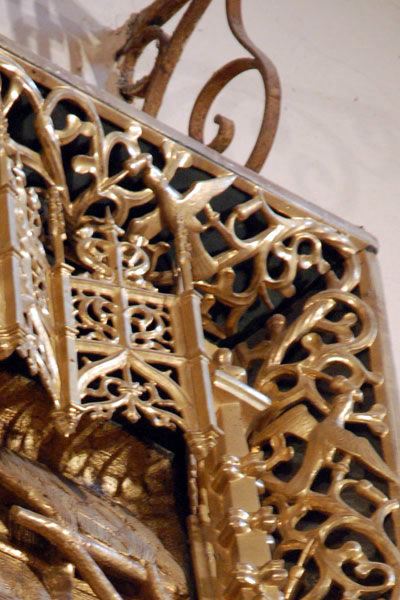
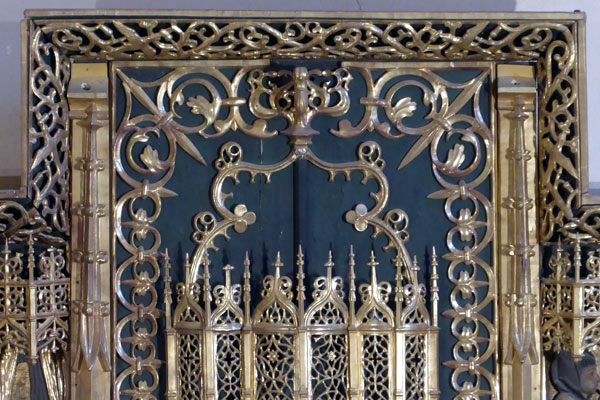
This work contains typical elements of the Gothic style, such as 
History:
We know little about this work. It should have been built in-situ by local artists. The reconstruction of the church was completed probably around 1520-1525 making it one of the oldest altarpieces in Biscay. Even though Goikolexea is a small rural district, it contains such an important work, because at the time of the construction of the altarpiece it was one of the stopovers of the “ruta juradera”. The altarpiece is dedicated to two saints, Emeterius and Celedonius. Even though they are little known in Biscay, they are the patron saints of Calahorra, the diocese to which the churches of Biscay belonged in the 16th century.
Sculptures:
Pedestal

Saint Philip and Saint James the Less
The apostles Philip and James the Less, who, according to the tradition, died at the same day, are depicted beneath an expressive arch, which is decorated in a gothic style.
They can be recognised thanks to the symbols of their martyrdoms. Philip, without beard, carries a latin cross, as he was tied to a cross until his death. Saint James the Less holds a club with which he was struck on his head to death.
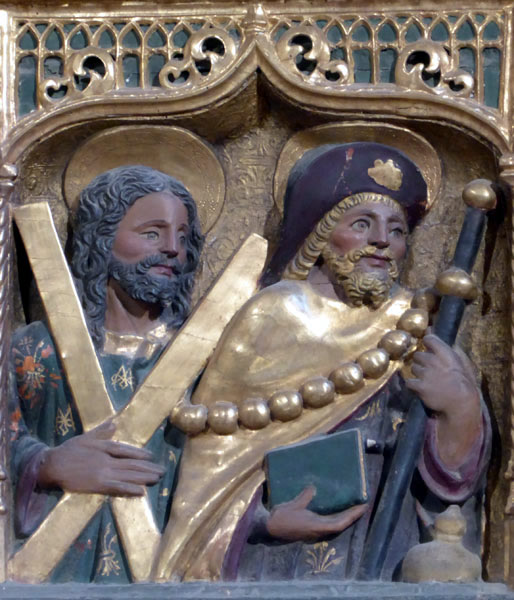
Saint Andrew and Saint James the Great
The apostles Andrew and James the Great are depicted beneath an expressive arch, which is decorated in a gothic style.
They can be recognised thanks to the symbols of their martyrdoms. Andrew carries the St Andrew’s cross on which he was tied until his death. Saint James is dressed like a pilgrim and carries a walking stick with the pumpkin, which he used as water bottle.
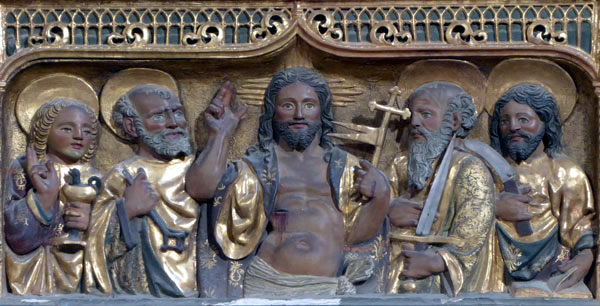
The Risen Christ surrounded by Saint John, Saint Peter, Saint Paul and Saint Matthew
Beneath an ample arch, which is decorated in a gothic style, are five sculptures. The Risen Christ in the centre is depicted with the holy wounds; the nail holes in his hands and to his torso. He is dressed with red and golden clothes and crowned with rays. Jesus is holding a standard in his hand in the shape of a cross as symbol for his victory over the death. Beside him are the so-called “Princes of the Apostles”: Peter holding the keys of Heaven and Paul with the sword as symbol for his beheading.
Furthermore, the picture shows the two apostles John and Matthew, who are recognised by the Catholic Church as authors of the gospels which are directly inspired by God. John, a young blonde-haired man without beard, is holding a chalice from which a snake emerges alluding to one of his miracles. Matthew carries a knife in allusion to his martyrdom.
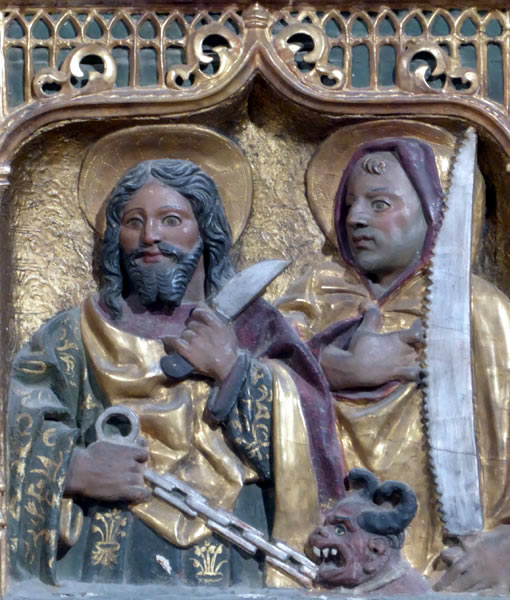
Saint Bartholomew and Saint Simon
The apostles Bartholomew and Simon are depicted beneath an expressive arch, which is decorated in a gothic style.
Bartholomew and Simon can be recognised thanks to the symbols of their martyrdoms. Bartholomew carries a knife with which he was skinned and pulls a tethered demon in allusion to one of his miracles. Simon is depicted as a man without beard holding a saw as he was sawn in two.
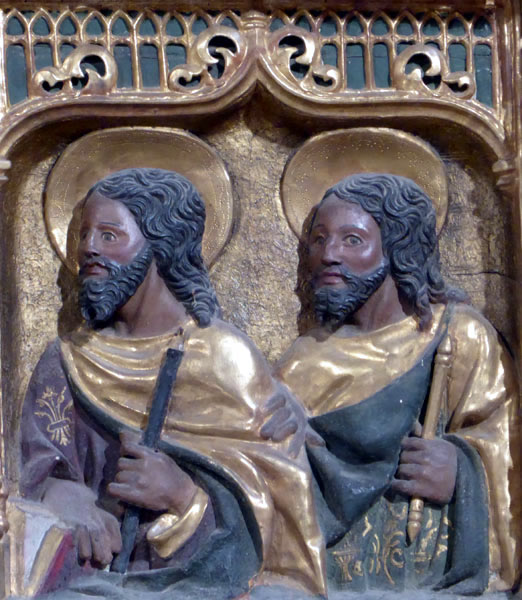
Saint Jude Thaddaeus or Saint Matthias and Saint Thomas
Two apostles, who are probably Thomas, Jude Thaddaeus or Matthias, are depicted beneath an expressive arch, which is decorated in a gothic style.
In this case, it is difficult to identify the objects they are holding in their hands. However, the left one could be Jude Thaddaeus, who was struck to death with a club, and the right one Thomas, who was stabbed to death with a lance.
Body
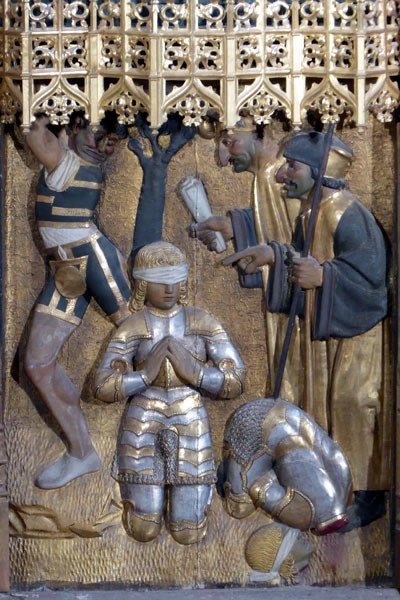
Beheading of Saint Emeterius and Saint Celedonius
The picture shows the moment of the martyrdom of Emeterius and Celedonius. They are dressed with armours and their eyes are blindfolded. One of them has already been beheaded, while the other one kneels down and puts his hands together as he were praying, waiting for his death.
The expressiveness of the executioner, who is preparing himself to strike the blow with which the two young men will be killed, stands out. The two judges, who sentenced the Saint to death, are watching the beheading.
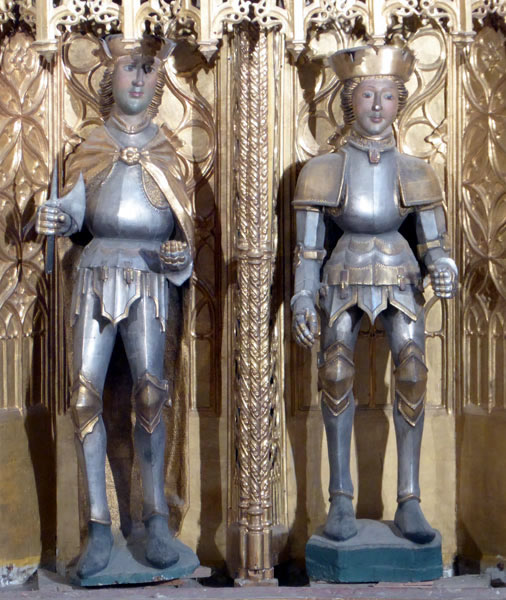
Saint Emeterius and Saint Celedonius
Celedonius and Emeterius are depicted as two young men dressed with military clothing, armour and gauntlets. One of them holds in his right hand the axe with which they were beheaded according to the legend.
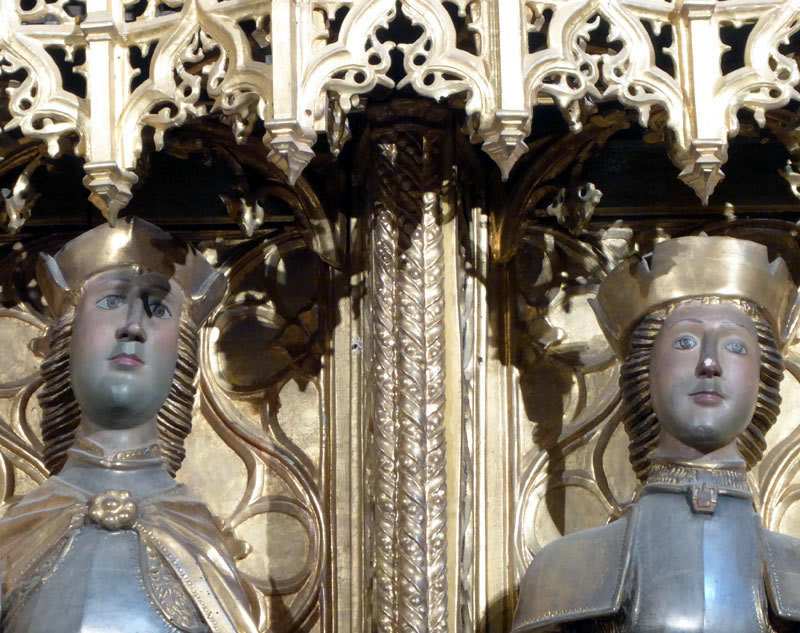
The careful polychromy based on golden and silver colour tones stands out and makes the two sculptures the centre of attention of the altarpiece.
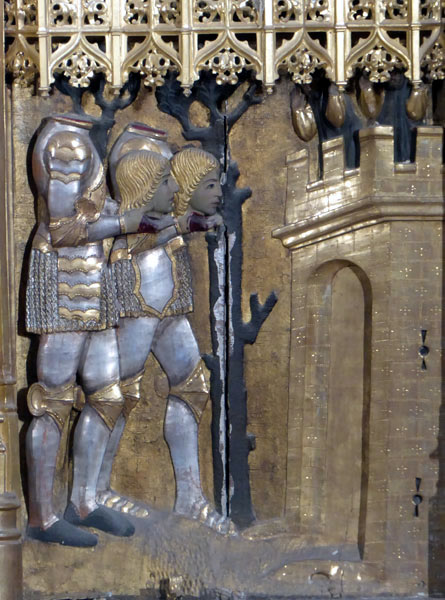
Saint Emeterius and Saint Celedonius preaching in front of the town wall of Calahorra
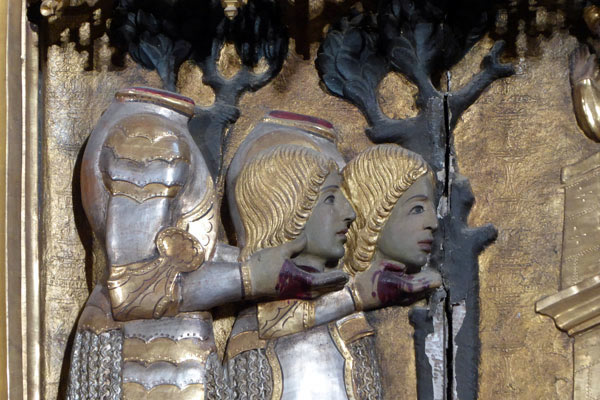
According to the tradition, after having been beheaded, the saints appeared miraculously in front of the town wall of Calahorra and preached their faith carrying their heads in the hands.
The polychromy of the clothes based on gold and silver attracts attention.
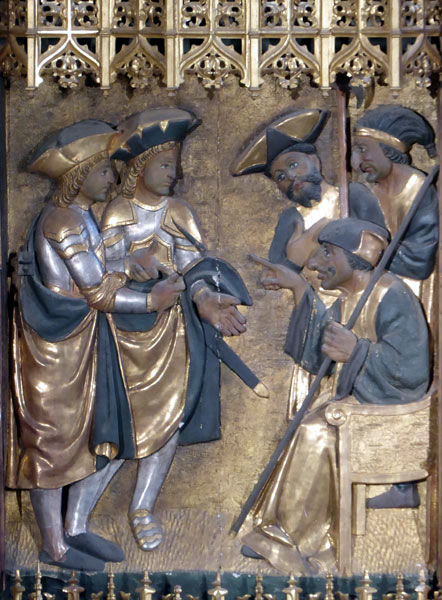
Judgment over Saint Emeterius and Saint Celedonius
The saints dressed in military clothes are standing in front of the judges who will condemn them. The gestures indicate that they are discussing and defending their christian faith, just in accordance with their legend. Emeterius and Celedonius, standing, stretch out their hands, while the judge, sitting, is pointing with his fingers at them.
Behind the judge, two men dressed with precious clothes are listening to the judge and the prisoners. The careful polychromy and the expressiveness of the protagonists stand out.

The Virgin crowned by Angels
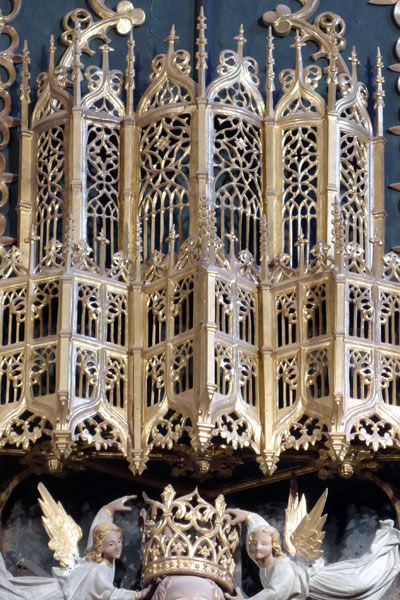
The Virgin Mary with the Child in her lap crowned by angels as the Queen of Heaven. To highlight the divine character of her son, the Child holds a globe in his left hand and gives the blessing with the right one. Above them appear two angels with a precious crown indicating that Mary as Mother of God is also Queen of Heaven.
The sculpture is located under a much-decorated and finely carved gothic baldachin.
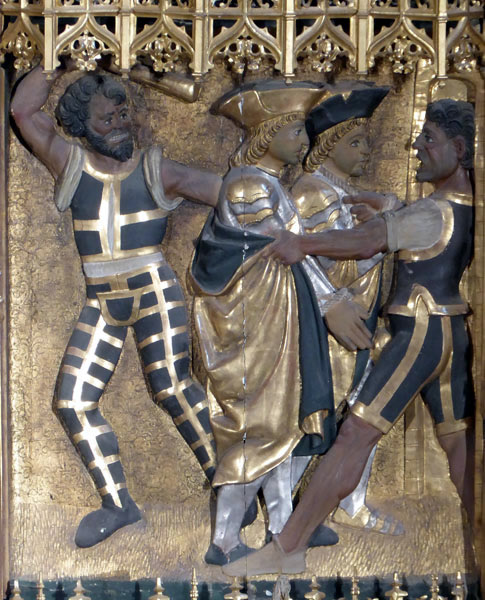
Emeterius and Celedonius brought to prison
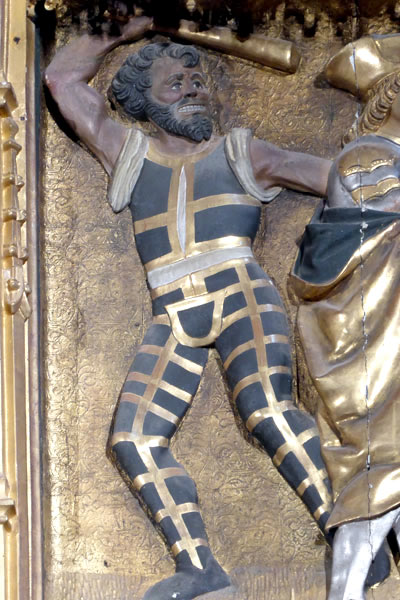
The two saints are brought to the executioners, who grab them and hit them with a club. They have already been convicted and are fixed with a string on their neck and their hands are tied up. The calm facial expressions of the saints stand out and is contrary to the brutality of the executioners.
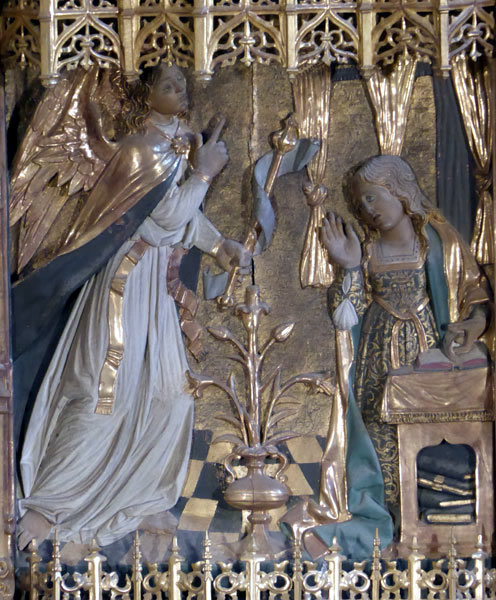
Annunciation
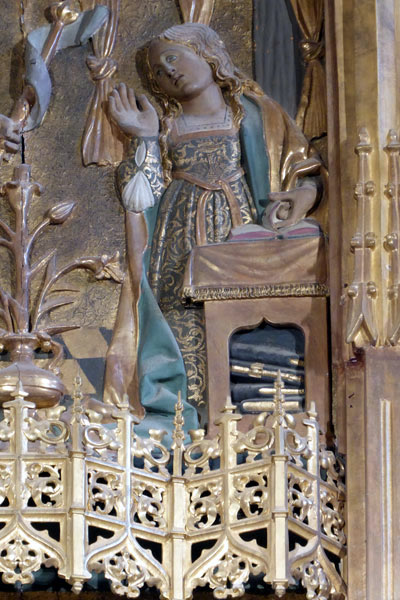
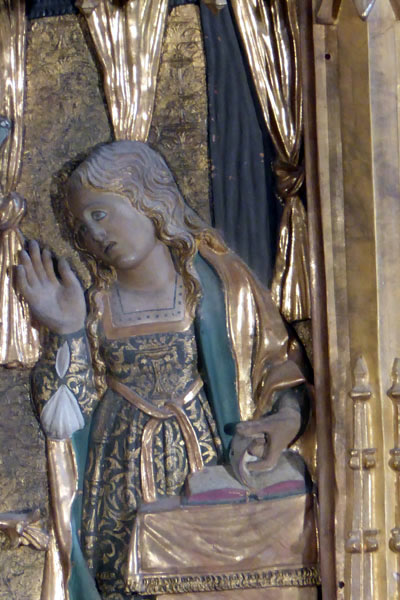
According to the gospels, the archangel Gabriel was sent by God to announce Mary that she will be the Mother of the Messiah. This symbolic moment is of great importance for christianity, as it shows the mystery of the Incarnation, which means, the moment when God becomes human to save humanity from sin. The picture shows the moment, when the archangel appears to Mary and greets her. He points with his finger towards heaven indicating that he was sent by God. Mary is reading a book and raises her hand to express her surprise. There is a vase with lilies between them symbolising the purity and virginity.
It is a relief with many details, such as the knotted curtains in the background, the books under the table where Mary is reading, or in which manner the Virgin is holding a page showing that she was interrupted.
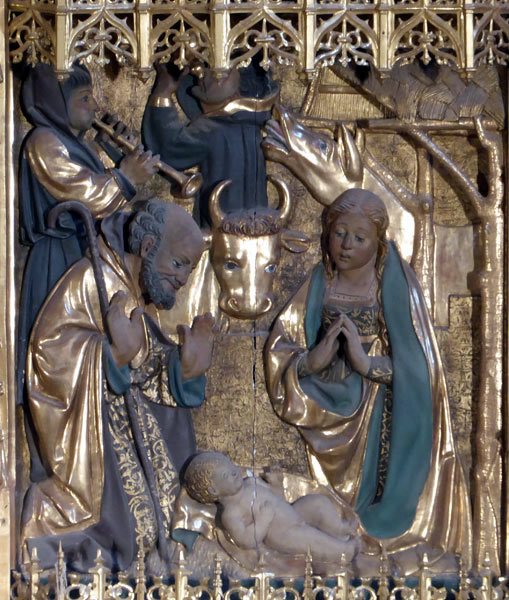
Birth of Jesus
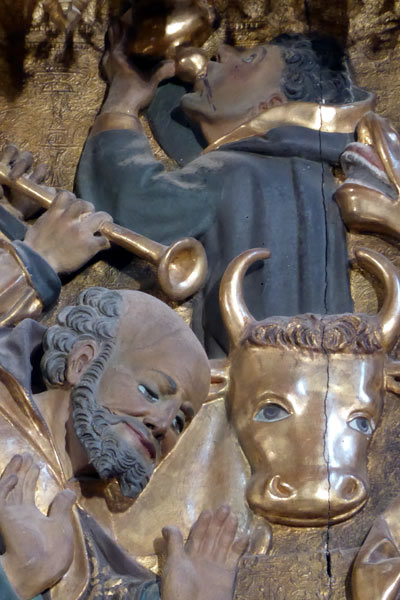
The picture is inspired by the gospels. After having searched vainly for a place to stay for the night, Mary and Joseph found shelter in a stable and Jesus was born there. The parents kneel down in front of him to indicate that the child is the Son of God. A shepherd in the background drinks wine from a wineskin and another one plays the Chirimia[1] announcing the good news.
It is a very expressive relief in which the donkey and ox appear; two animals which traditionally are part of the nativity scene. The donkey is braying full of joy and the ox is looking at the recent born child.
[1] A woodwind instrument similar to an oboe.