
Altapriece of the Assumption of Mary (Güeñes)
- Church: Saint Mary Church (Güeñes)
- Location: High Altar
- Artists: Bartolomé Martinez de Villaviad (architect), Juan Gil de Sopeña (architect), Juan de Palacio Arredondo (sculptor) and Emeterio del Castillo (gilder)
- Patron: administration council of the Saint Mary community
- Chronology: 17th century (1631-1637)
- Style: Baroque
A 17th century pioneer work of the baroque in Biscay
Interactive altarpiece: click on the pictures to get more information.
Church:
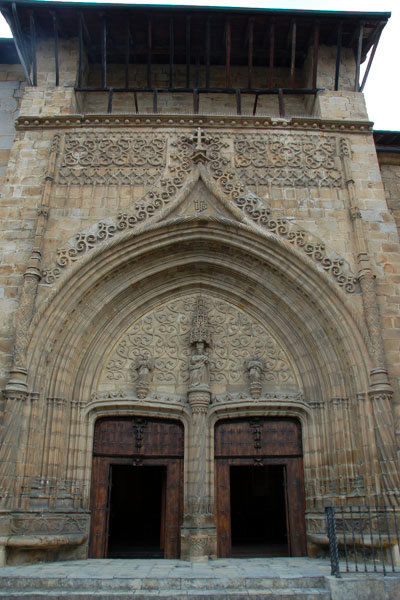
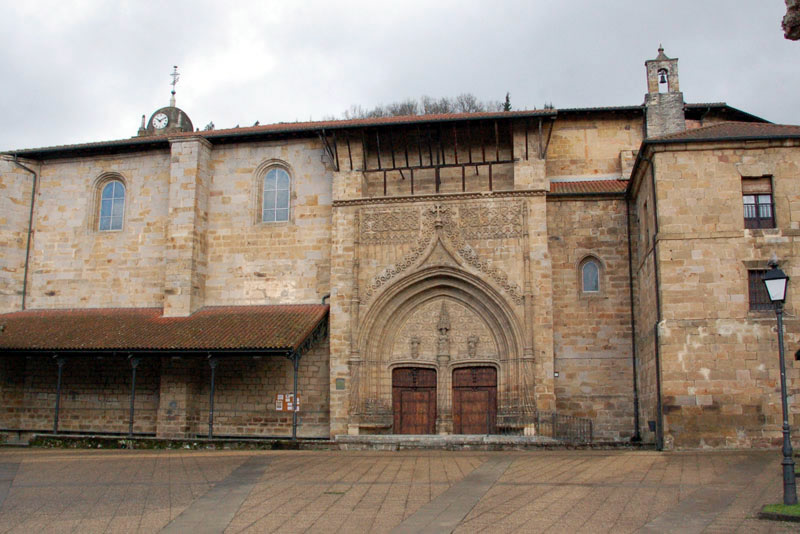
The Saint Mary church is located in the centre of Güeñes and its front side is oriented towards crossroads. The church was built during the entire 16th century and several artists were included. However, Juan de Rasines was in charge of the general planning.
It is a monumental church with gothic and renaissance elements, as it can been seen at the main entrance.
Patronage:
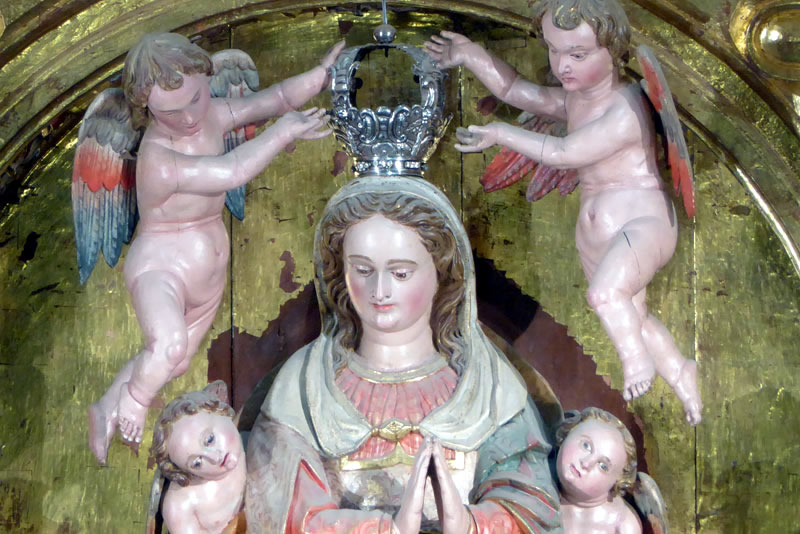
The church and its main altarpiece are dedicated to the Assumption of the Virgin Mary.
According to the catholic tradition, at the end of her life Mary was taken to heaven and is – together with Jesus Christ – the only person whose body and soul is in Paradise without having to wait for the Last Judgement and the Resurrection of the dead.
She is depicted on clouds and surrounded by angels, because they took up her body into the Glory.
Description:
This large and polygonal 

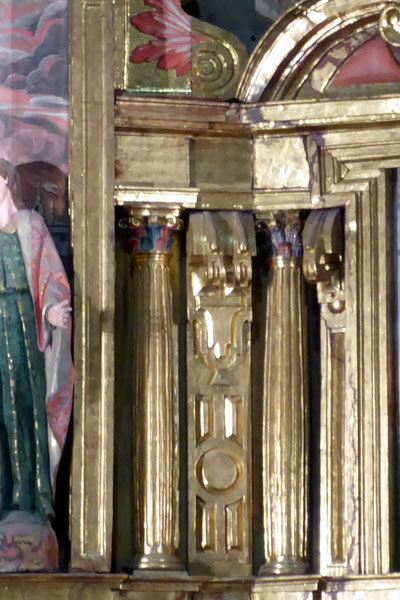
This altarpiece is dedicated to the Virgin Mary, praising her as the Mother of God. Therefore, the reliefs depict parts of her life and the main sculpture is dedicated to her Assumption. Beneath the central picture is a richly decorated baroque 
It is one of the first baroque altarpieces created in Bizkaia. Both its 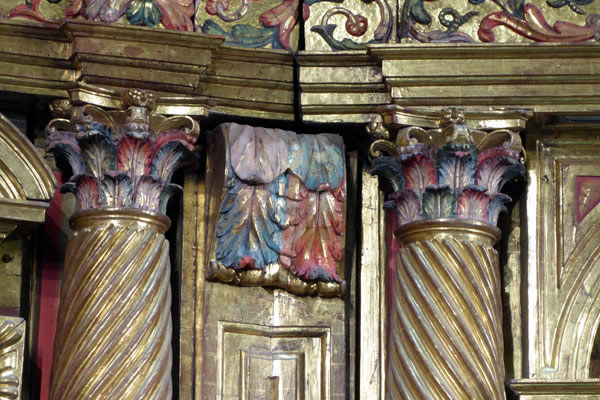
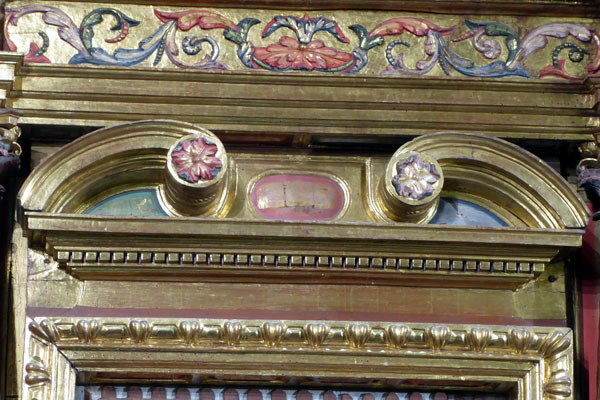

as.
History:
In 1631, the administration council of the Saint Mary community decided to order a monumental altarpiece for the high altar. After having chosen the best design, they signed the contract in 1632 with the architects Bartolomé Martínez and Juan Gil de Sopeña, who were both from Liendo (Cantabria).
In 1636, the architectural work finished and the carving of the sculptures began. Juan de Palacio Arredondo from Limpias (Cantabria) was in charge of the sculptures. Finally, in 1679, the gilder Emeterio del Castillo from Balmaseda started with the painting process. The entire altarpiece was finished in 1680, almost 50 years after the project began.
Sculptures:
Banco
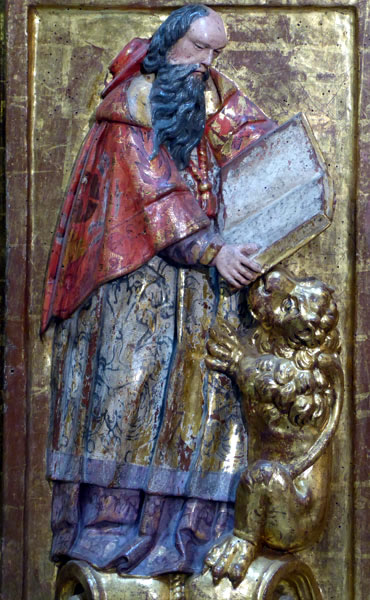
Saint Jerome
Jerome was a studious christian from the fourth century and translated the Bible to latin. Therefore, he is considered as one of the fathers of the catholic church. In this picture, he is depicted writing. Jerome became secretary of pope Damasus IV. Therefore, he is dressed like a cardinal with a red robe and a cardinal’s hat. The golden polychromy of the clothes stands out.
According to the legend, he was always accompanied by a lion, which has followed Jerome like a tame dog since the Saint had pulled out a splinter of its paw. The animal carries the book Jerome is reading.
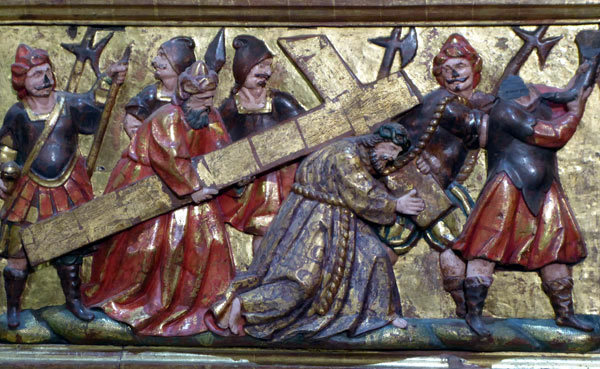
Christ carrying the cross on his shoulders
According to the gospels, before his crucifixion Jesus was forced to carry the cross through the streets of Jerusalem to mount Golgotha. The soldiers insulted him and pulled him on a string, which was fixed on his neck.
Simon of Cyrene accompanied Jesus helping him to carry the cross. He is depicted with a rich tunic and a turban.
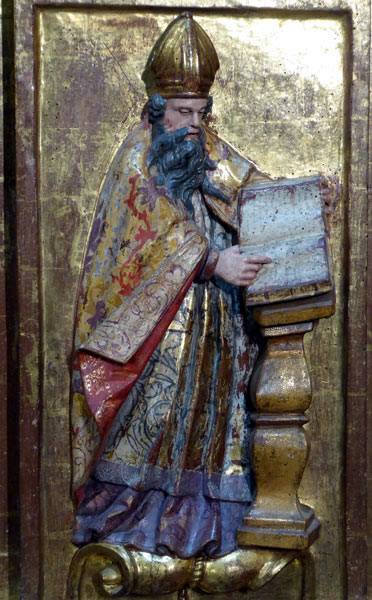
Saint Ambrose
Ambrose was bishop of Milan in the fourth century. Therefore, he is depicted with the mitre – a hat used by bishops in solemn celebrations – and dressed with richly decorated clothes. As author of many theological books, he is considered as one of the fathers of the Catholic Church and depicted reading a book, which is put on a lectern.
The polychromy of the coat, based on plant elements, stand out.
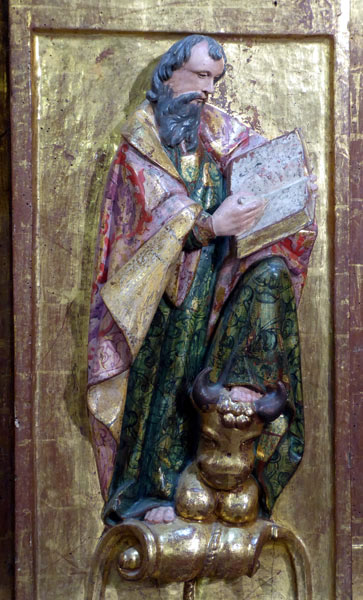
Saint Luke
Luke is the author of one of the four gospels in the Bible which the Catholic Church considers as directly inspired by God. Each evangelist has a symbol: Luke’s symbol is the ox, which in this relief is lying under the evangelist’s coat. Luke is depicted as a middle-aged man writing the book, which he is holding in his left hand.
The colourful clothes and his standing position, putting one leg on the head of the animal, stand out.
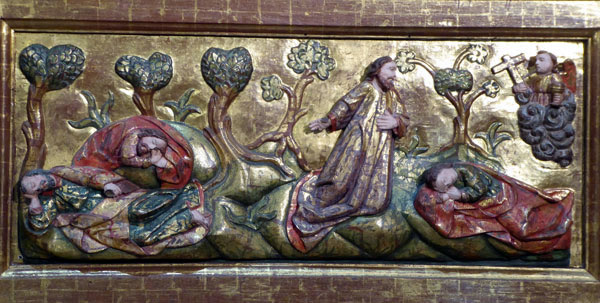
Prayer in the garden Gethsemane
According to the gospels, after the Last Supper, Jesus went out as usual with his disciples to the garden Gethsemane to pray. Knowing that he will be arrested and crucified, he asked God: “Father, if you are willing, take this cup from me; yet not my will, but yours be done.” This shows that he suffers like a human the imminent death, but that he accepts God’s will.
Jesus is depicted praying in the garden Gethsemane kneeling and with folded hands. An Angel appears offering him a chalice and a cross. The three apostles, John, James and Peter, who accompany Jesus, are depicted sleeping, in accordance with the text in the Bible. In front of Jesus is John, depicted as a young man without beard. Behind Jesus are Saint James the Great dressed with a red robe and Peter holding a knife with which he defended Jesus when he was arrested.
The background stands out, with the trees making the scene seem realistic.
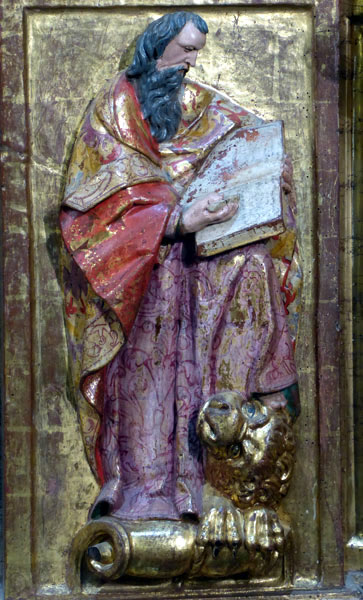
Saint Mark
Mark is the author of one of the four gospels in the Bible, which the catholic church considers as directly inspired by God. Each evangelist has an own symbol: the one for Mark is a lion, which in this relief is depicted next to his feet. With the feather in his right hand, he is writing in the open book, which he is holding in his left hand.
The colours and details of the clothes and his leg put on the head of the animal attract attention.
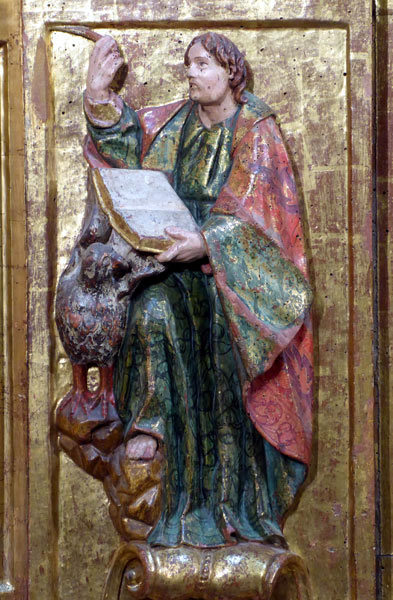
Saint John the Evangelist
John is the author of one of the four gospels in the Bible, which the catholic church considers as directly inspired by God. Each evangelist has an own symbol: the one for John is an eagle, which accompanies the saint in this relief. The saint is depicted as a young man without beard. With the feather in his right hand, he is writing in the open book, which he is holding in his left hand.
The colours and details of the clothes, his leg put on a rock and the book put on the head of an eagle stand out.
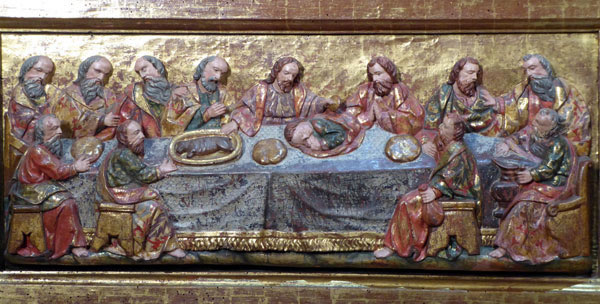
The Last Supper
According to the gospels, the day before his death, Jesus met with the twelve apostles to celebrate the jewish feast Pesach. They are sitting at a table with food such as the lamb and bread. Among the apostles, we can see John, who is depicted as a young man next to Jesus sleeping at the table, and Judas Iscariot, a man with red hair carrying a bag with coins, which he got for betraying Jesus.
During the Last Supper, Jesus announces that the disciple whom he offers a slide of bread will betray him. Therefore, Jesus puts forth his hand towards Judas, who is astonished and points with the right hand at himself. Some apostles look at the betrayer and the others look at each other as if they were talking.
The picture contains many details, such as the tablecloth, the chairs of the apostles and the wine jar, which one of them is holding in his hands.
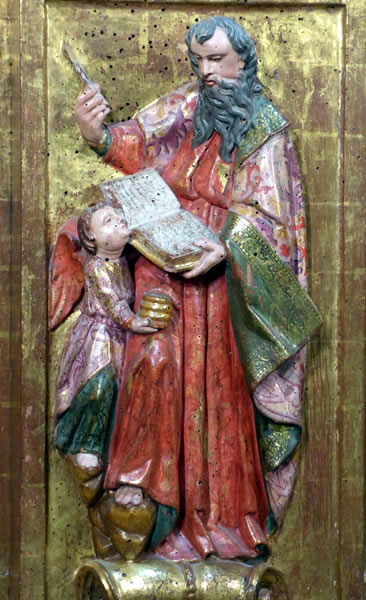
Saint Matthew
Matthew is the author of one of the four gospels in the Bible, which the catholic church considers as directly inspired by God. Each evangelist has an own symbol: the one for Matthew is a man, who is often depicted with wings, as he were an Angel.
In this picture, the angel accompanies the saint carrying the inkpot so that Matthew can write with the feather in his right hand in the open book, which he is holding in his left one.
The careful polychromy of the robe with the many details stands out.
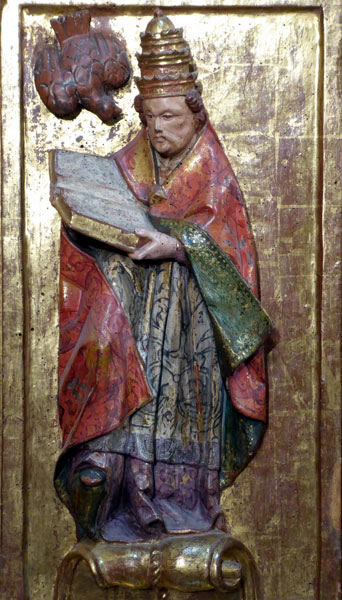
Saint Gregory the Great
Gregory was a pope from the sixth century. He is dressed with precious clothes and is crowned with the tiara – a hat consisting of three crowns, which indicates his authority as pope, bishop and king. He was author of many theological books and is considered as one of the fathers of the Catholic Church. Therefore, Gregory is reading a book while he gets the inspiration from the Holy Spirit, which is depicted as a dove.
The careful polychromy of his garments with the many details stands out.

Arrest of Jesus
According to the gospels, the soldiers of Sanhedrin (the court of the Jewish Judges) come to Jesus, while he is praying in the garden of Gethsemane. Judas Iscariot, who betrays Jesus and makes it possible that the soldiers can arrest him, accompanies them. Judas approaches to Jesus, who then is arrested by one of the guards. Judas carries a bag with the coins he received for betraying Jesus. The disciples are trying to prevent the arrest.
Peter stands out on the left side of the picture, as he has knocked a soldier down, while he is raising a sword. According to the Bible, Peter cut off the soldier’s ear, but Jesus healed it miraculously.
It is a very expressive scene, intensified by the gold colour shade and the details of the polychromy.
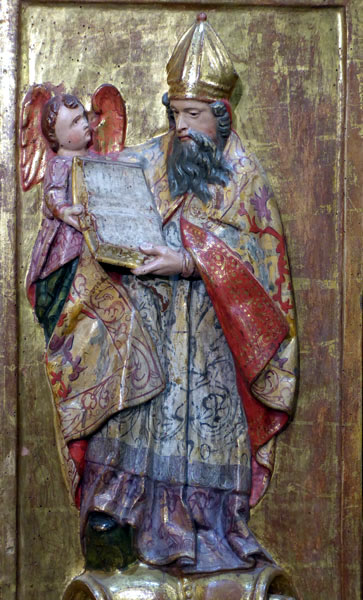
Saint Augustine
Augustine was a philosopher from the fourth century, who, after having converted to christianity, became bishop of Hippo (today’s Algeria). Augustine is dressed like a bishop with a richly ornamented coat and crowned with a so-called Mitre – a hat used by bishops in solemn celebrations.
As author of many theological books, he is considered one of the fathers of the Catholic Church and is depicted reading. An angel accompanies him, which highlights the divine character of his books.
The rich polychromy of his clothes stands out.
Cuerpo 1
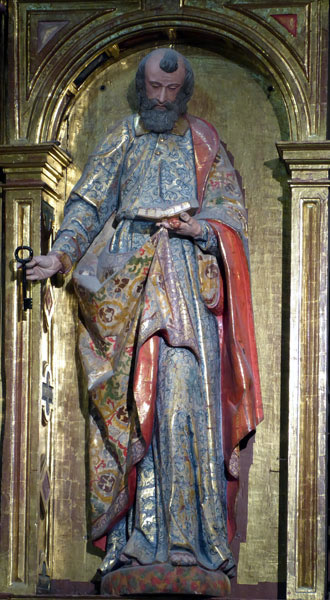
Saint Peter
According to the gospels, Peter and his brother Andrew were the first of the twelve apostles who were called by Jesus of Nazareth. Peter is considered the first pope of the catholic church, as Jesus appointed him as his successor. Peter is holding a book in his left hand and the keys of the Kingdom of Heaven in his right one.
The rich polychromy of the clothes attract attention.
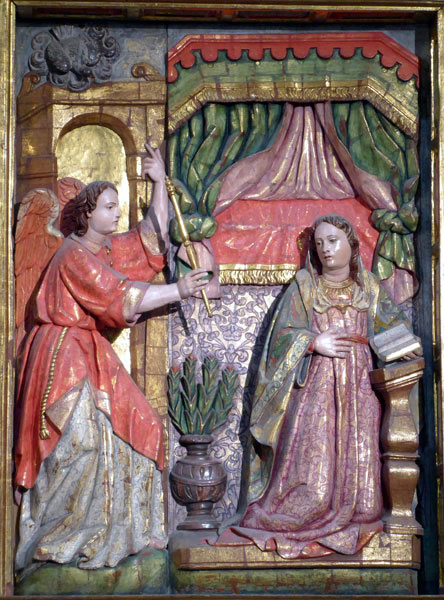
Annunciation
According to the gospels, the archangel Gabriel was sent by God to announce Mary that she will be the Mother of the Messiah. This symbolic moment is of great importance for christianity, as it shows the mystery of the Incarnation, which means, the moment when God becomes human to save humanity from sin.
The archangel Gabriel appears to Mary, who is reading. She puts her hand on her stomach to show that she will be the Mother of God. Above them, the Holy Spirit is depicted as a dove with outstretched wings forming a cross as allusion to the miraculous and divine conception of Christ.
It is a very expressive scene. The gestures of the people, the quality of the carving and the careful polychromy stand out.
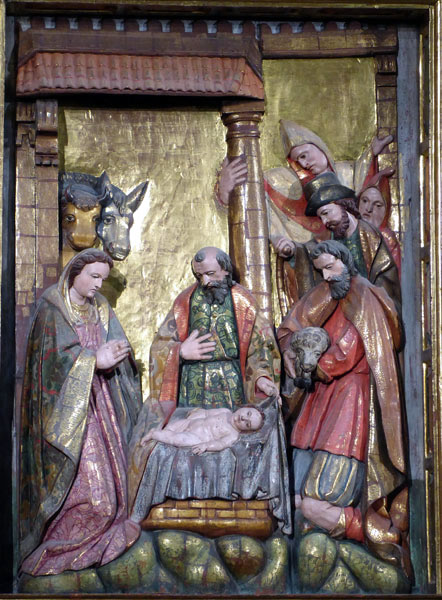
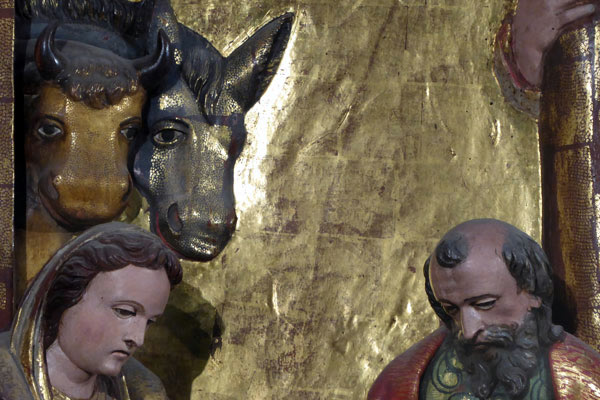
Adoration of the shepherds
According to the gospel, after an angel had announced the shepherds that the Messiah had been born, they went to Bethlehem to show him their respect.
Mary and Joseph are next to the Child and one shepherd kneels down to show his respect. He offers a lamb as a gift, alluding to Jesus Christ as the Lamb of God and to his role as the redeemer of humanity. The picture is completed with other shepherds looking at the Child as well as the donkey and the ox, animals that traditionally accompany the pictures of the Nativity of Jesus.
The garments are colourful and the picture is full of beautiful details such as the carving of the manger or the shepherd, who is holding a column.
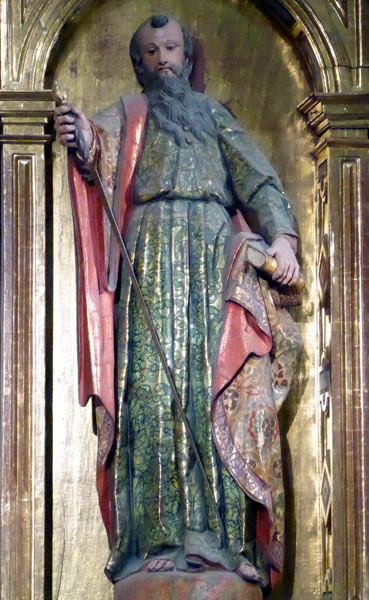
Saint Paul
Paul was one of the first missionaries of christianity, the religion to which he himself converted after Christ had appeared to him. In this picture, he is portrayed with the sword, the symbol for his death by beheading, and the book, a reference to the text of the Acts of the Apostles and his fourteen Pauline Epistles that are part of the Bible.
His facial expression and the polychromy of the clothes stand out.
Between Body 1 and Body 2
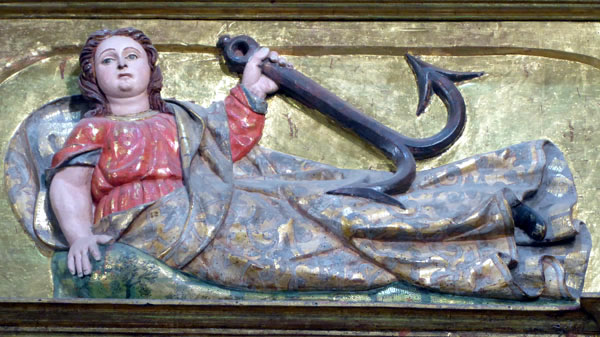
Hope
Hope is together with Faith and Charity one of the so-called theological virtues, as God directly infuses them.
Hope is depicted as a woman dressed with large clothes, who holds an anchor, which symbolises the confidence for the salvation and the resurrection.
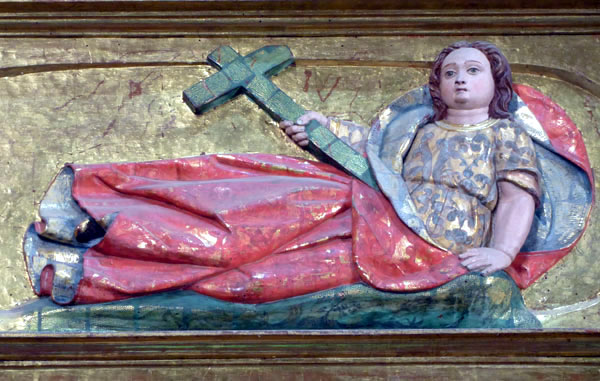
Faith
Faith is together with Hope and Charity one of the so-called theological virtues, as God directly infuses them.
Faith is depicted as a woman, who is dressed with large clothes and carries a cross – the symbol for christianity.
Cuerpo 2
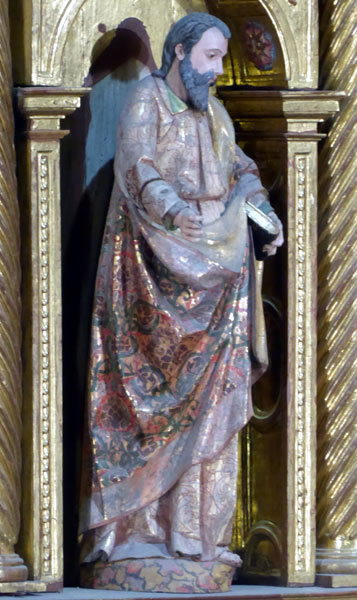
Apostle
The sculpture of one of the twelve apostles who, according to the gospels, accompanied Jesus of Nazareth.
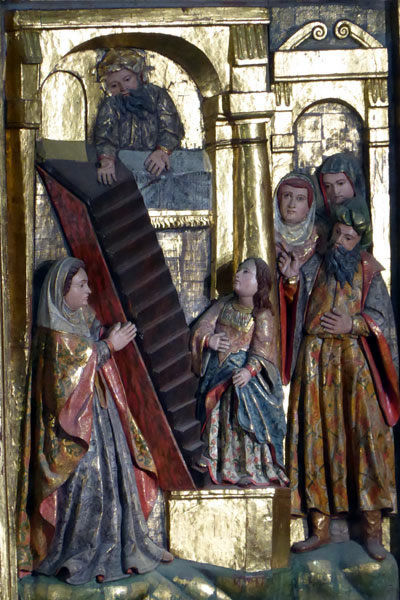
The Presentation of the Blessed Virgin Mary in the Temple
The Bible tells hardly anything about the life of Mary. We know her mainly from legends and medieval traditions. At a young age, her parents, Joachim and Anne, took her to the temple in Jerusalem, where she was educated by the priests until she reached the marriageable age. This is the moment, when the priest Berechiah receives Mary, who climbs the stairs of the temple of Jerusalem and prophesies that she will be the mother of the Messiah. Her parents and some women are watching the scene.
The gestures of Joachim and Anne as well as the polychromy of the clothes and the details of the architecture stand out.
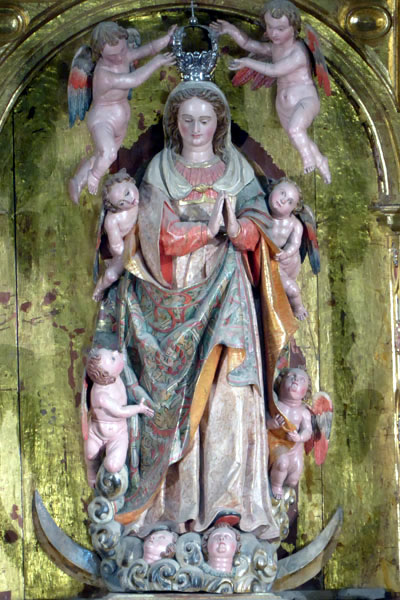
Assumption
According to the catholic tradition, at the end of her life Mary was taken to heaven and is – together with Jesus Christ – the only person whose body and soul is in Paradise without having to wait for the Last Judgement and the Resurrection of the dead.
Mary is standing on clouds and on the half-moon and is surrounded by angels. They crown her as the Queen of Heavens, as they had taken up her body into Glory.
The carving and polychromy stand out.
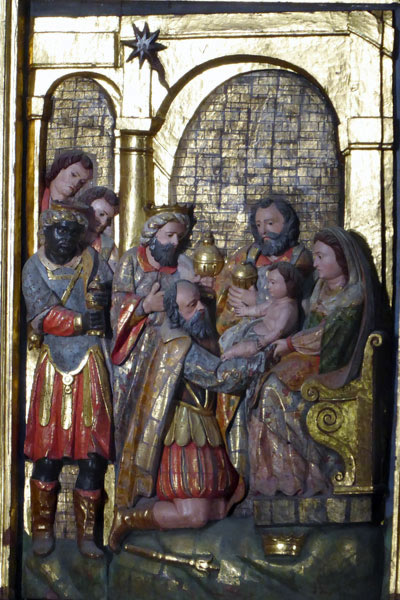
Adoration of the Wise Men or Epiphany
According to the gospels, some Wise Men from the East came to visit Jesus in Bethlehem guided by a star from the sky. The gospels do not mention their names, nor the number or their backgrounds. However, the tradition tells that they were three, called Melchior, Caspar and Balthasar. Since the 14th century, the latter one has been depicted as a young black man. It is told that they brought three gifts with them: gold the symbol for a king; incense for God; and myrrh, a very aromatic balm that was used to embalm the dead, mortal humans. Mary holds the Child, while the first Wise Man Melchior is kneeling in front of the Son of God. He puts his crown, symbolising him as king, on the ground.
Caspar and Balthasar are watching the scene standing. The star, which guided the Wise Men, is shining in the sky. Joseph, in the background, holds a jar given to him by Melchior, while two pages appear behind Balthasar, wanting to observe the scene.
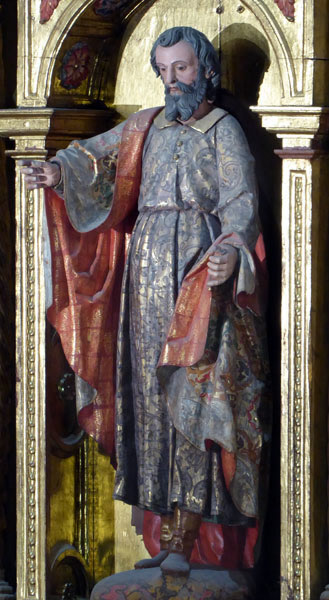
Apostle
The sculpture of one of the twelve apostles who, according to the gospels, accompanied Jesus of Nazareth.
Attic
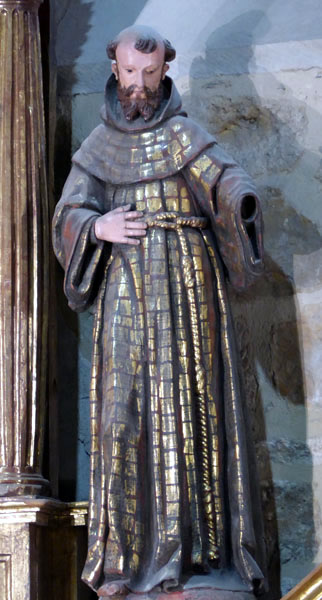
Saint Francis of Assis
Francis was the son of a wealthy mercer from the town of Assisi (today’s Italy). As a young man, he decided to relinquish his money and founded the franciscan order. The order’s members have to take three vows or solemn promises: chastity, obedience and above all poverty.
Therefore, Francis is dressed with simple clothes: the habit of his order and the cincture with three knots standing for the three vows.
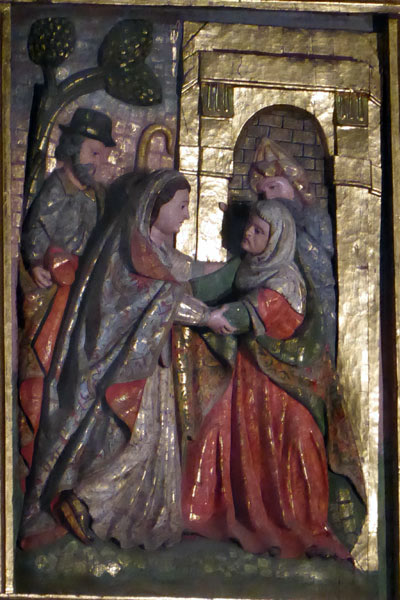
Mary visiting Elisabeth
According to the gospel, Mary, who is pregnant with Jesus, is visiting her cousin Elisabeth, who is also pregnant with John the Baptist, to tell her that she will be the mother of God. Both women embrace each other, while their husbands, Joseph (with hat and stick) and Zechariah (with turban), are watching the scene.
It is a very expressive work, emphasised by the polychromy of the clothes.
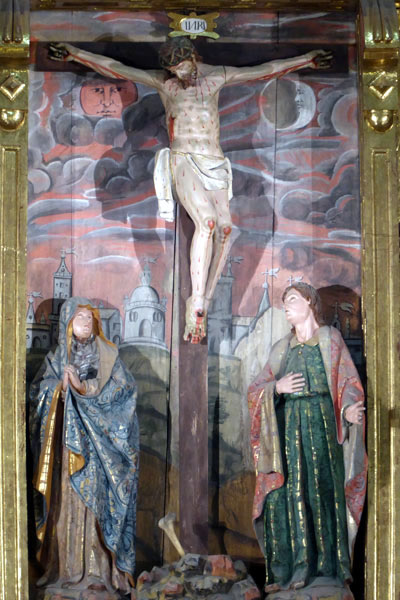
Golgotha
The crucified Christ with his mother Mary and John, the disciple whom Jesus loved, next to him. Mary is depicted with folded hands to express her pain and John puts his right hand on his chest. Behind them appears a landscape representing the town of Jerusalem. Beside the cross appear the sun and the moon as allusion that, according to the gospels, on the day of the crucifixion darkness came over the land from noon until three in the afternoon. John and Mary are looking at the death body of Jesus, who inclined his head and is bleeding from the wound to his torso.
At the bottom of the cross are some human bones as allusion to the Hebrew name of the place “Golgotha”, which means “the place of the skull”. At the time, prisoners of Jerusalem were executed there.
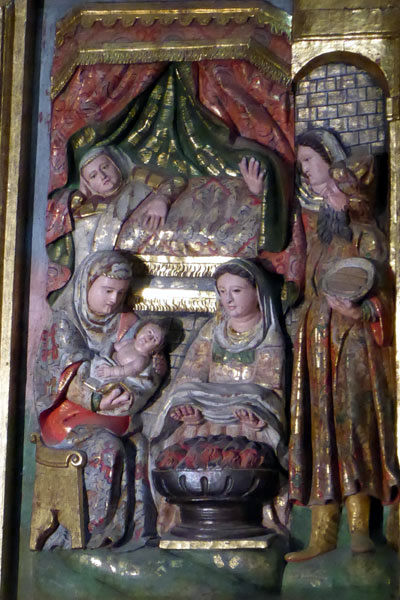
Birth of the Virgin Mary
The Bible tells hardly anything about the life of Mary. We know her mainly from legends and medieval traditions. Mary’s birth is depicted as an everyday occasion. Her mother Anne has given birth and is lying in the bed, while two midwives take care of Mary. One is carrying the recent born child and the other one is standing on a fireplace heating the clothes in which the girl will be enwrapped.
Joachim the father of Mary seems to appear with a plate of food. Another woman opens the curtain, which is fixed over the bed, so that he can see Anne. It is a very expressive scene with many details.
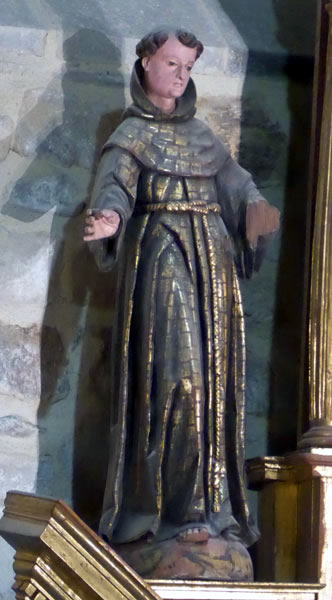
Saint Anthony of Padua
Anthony of Padua was a franciscan monk, who preached against the greed of creditors who received excessive interest for their deals. He is dressed as a franciscan monk, with a habit fixed with a corded rope belt and his hair cut like a tonsure.
In his right arm, he certainly was holding the Christ Child, which now has disappeared. According to the legend, he was so pious that even the Christ Child came to attend his prayer.