
High Altarpiece of Saint James the Great
- Town: Ermua
- Church: Saint James the Great Church
- Location: High Altar
- Artist: ascribed to José de Zuaznábar (architect) and Juan de Munar (sculptor)
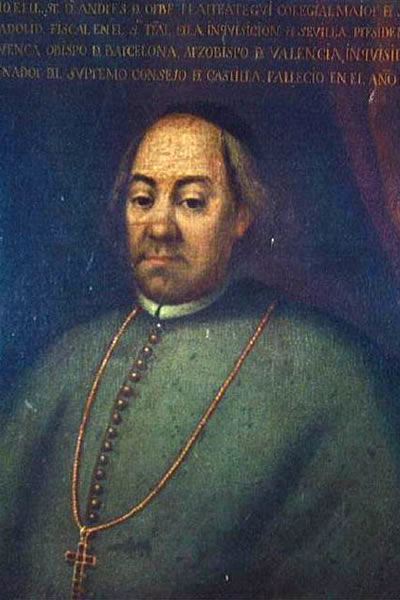
- Patron: Andrés de Orbe y Larreátegui (Bishop of Barcelona and Archbishop of Valencia)
- Chronology: 18th century (1742-1746)
- Style: Baroque
The bishop of Barcelona, who also was archbishop of Valencia, promoted the construction of this important baroque altarpiece
Interactive altarpiece: click on the pictures to get more information.
Church:
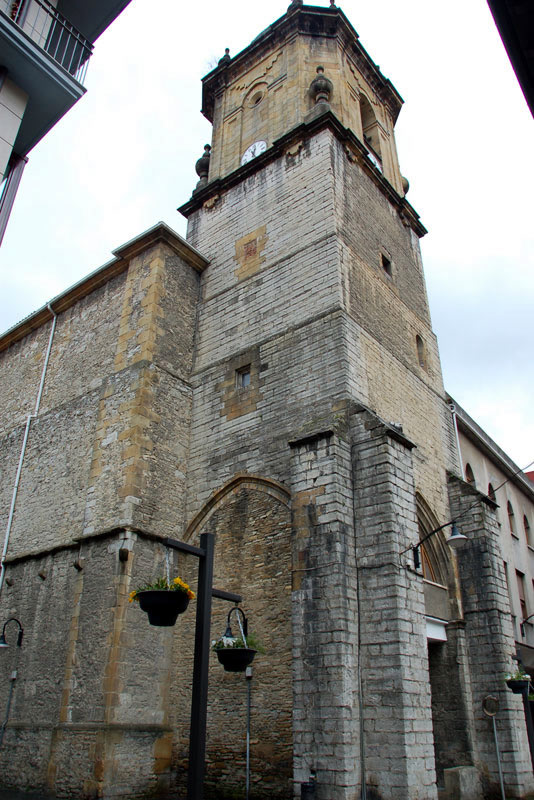
The Saint James the Great Church in Ermua is a beautiful building, which stands out with its 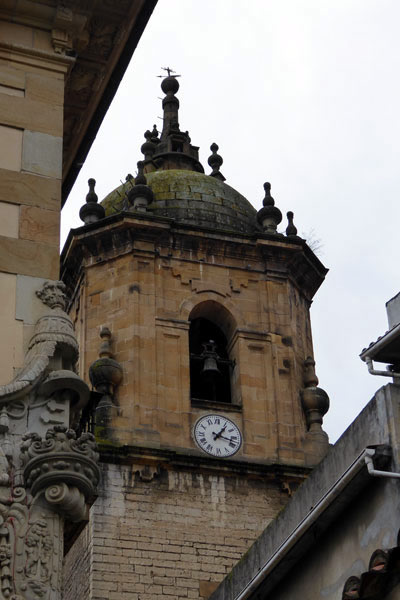
Inside the church, the crypt with the 
Patronage:
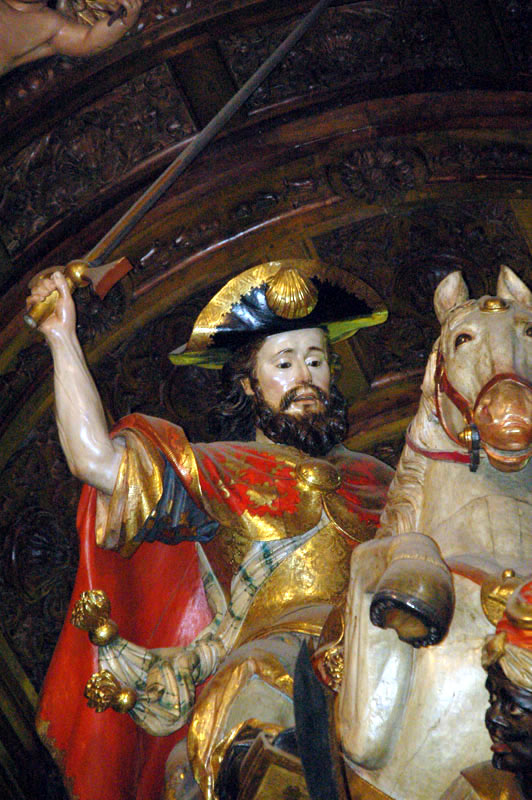
The altarpiece is dedicated to the apostle Saint James the Great, just as the medieval chronicles describe the battle of Clavijo. According to the legend, on 23rd May 844 the christian king Ramiro I fought against the muslim troops in Clavijo (next to Logroño) and invoked the apostle for protection. Saint James appeared on a cloud riding a white horse.
This picture is commonly known as Saint James the Moor-slayer. The same legend tells that the christians defeated and killed more than 5,000 enemies thanks to the miraculous help of Saint James.
Description:
The 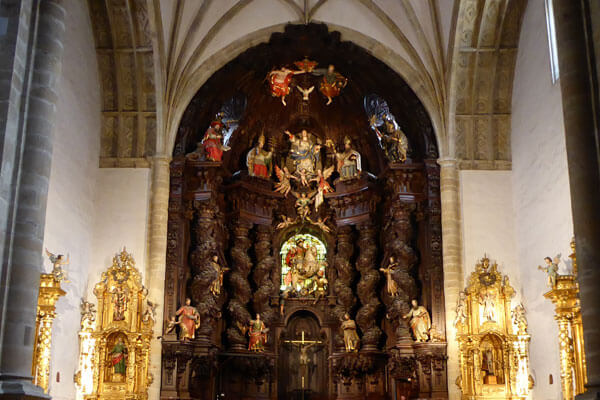
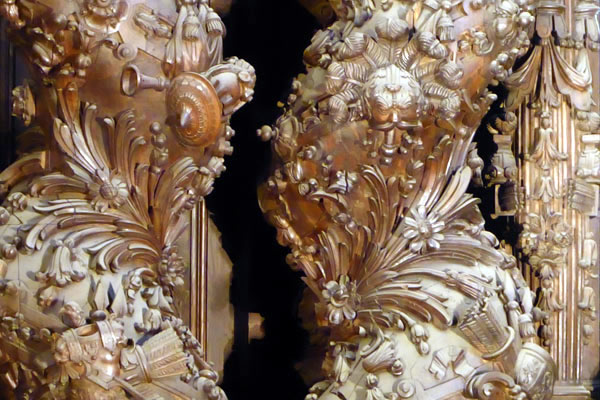
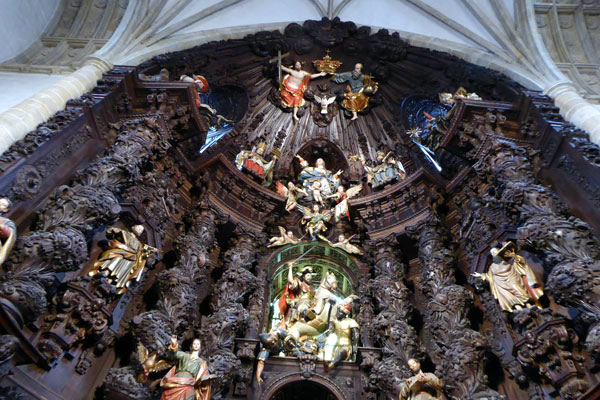
The altarpiece is dedicated to the apostle Saint James the Great, who occupies the central part in front of a translucent church window. The natural sunlight makes the sculpture seem more monumental. The central section is completed with pictures of the crucified 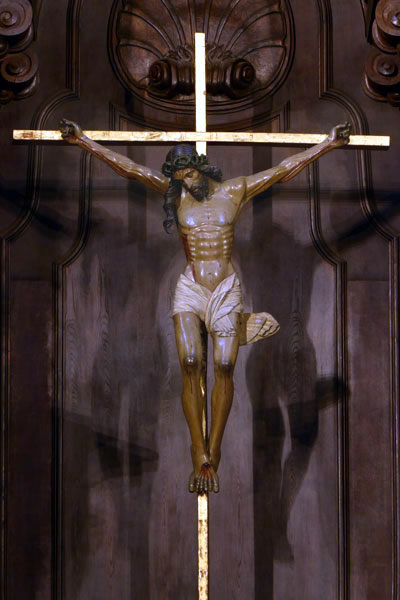
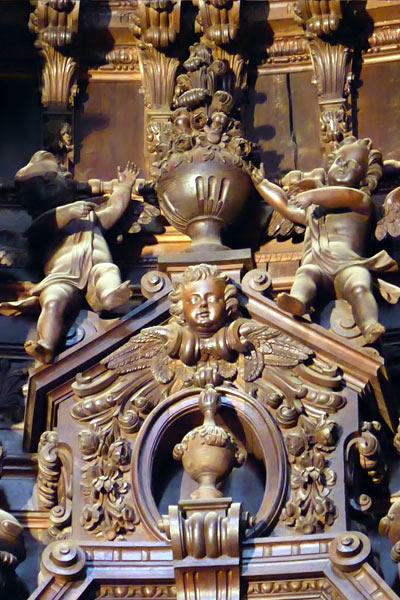
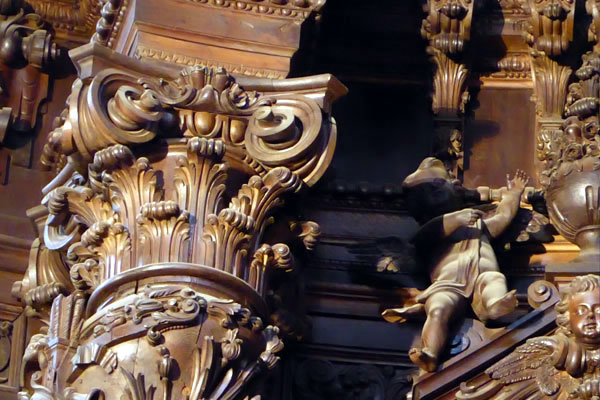
The furniture is not gilded, but kept in the dark colour of the chestnut 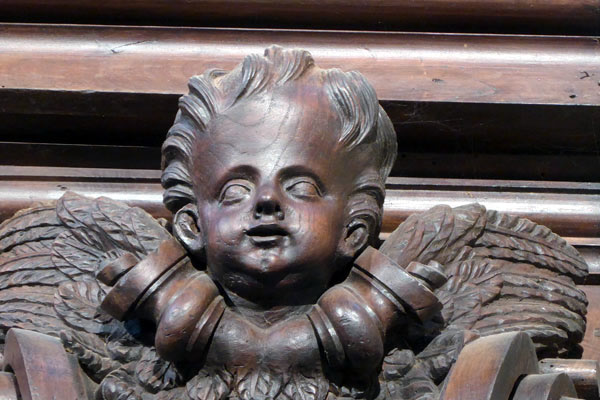
History:
Andrés de Orbe y Larreategui, an influential person from the beginnings of the 18th century, ordered the altarpiece. Born in Ermua, Andrés was ordained priest and became bishop of Barcelona in 1720 and archbishop of Valencia in 1725. Furthermore, he held the offices of president of the Council of Castile, Grand Inquisitor and apostolic nuncio, which means the diplomatic representative of the Holy See with the rank of an ambassador. In 1742, he ordered the main altar for the church in his birthplace Ermua, where he financed other important works too. This includes the tower of the church or the Valdespina palace, which was his family’s residence and is today the town hall of Ermua.
The construction of the altarpiece is ascribed to the architect José de Zuaznábar and the sculptor Juan de Munar. José de Zuaznábar was an architect from the province of Guipúzcoa, born in Oiartzun, who worked and lived in Ermua since 1742, the time when the work of this altarpiece began. Juan de Munar was born in Meruelo (Cantabria) and lived in Elorrio in the province of Biscay. He was a sculptor, who worked on several altarpieces in the entire region, for example in Ermua or Amorebieta-Etxano.
The altarpiece was restored in 1995.
Sculptures:
Body
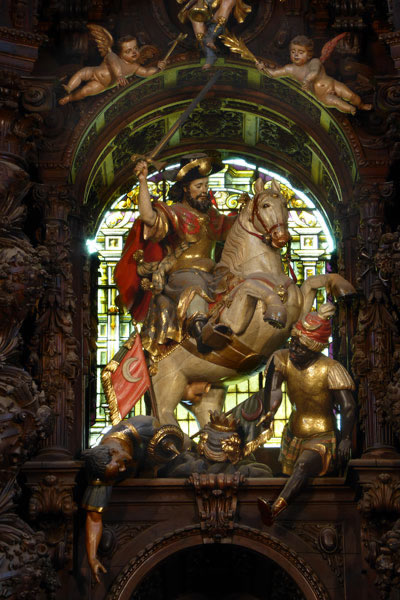
Saint James the Moor-slayer (Saint James the Great)
The picture shows the moment when Saint James kills the moslems in the mythical battle of Clavijo. He is riding a horse and raising the sword in the battle. With its two forehooves, the horse kicks one of the enemies, who has black skin and wears a turban with the crescent. Another dead man is lying on the ground with his arm hanging down from the altarpiece. He is lying next to crescent-standards and a crown, which alludes to the Emir of Córdoba, Abd ar-Rahman II. , who was defeated in the battle.
It is a sculpture full of details such as the horseshoe, the flags …, which stand out from the rich polychromy.
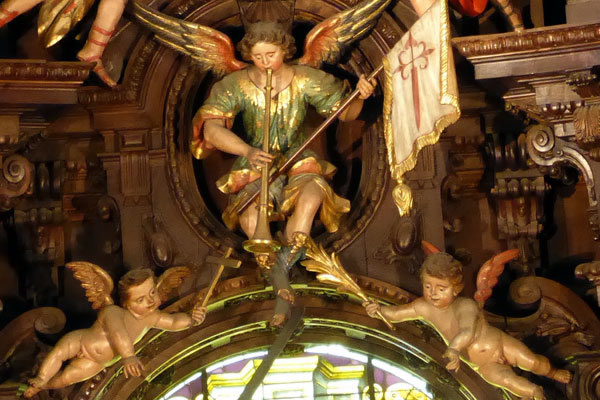
Group of Angels
A group of Angels above the main picture complete the scene of the battlefield with symbols alluding to the victory of the christians. The two smallest angels are naked, fly around and hold a palm leave and a cross. The main figure and tallest angel is dressed with beautiful clothes and sitting in one of the alcoves of the altarpiece. He plays a trumpet as expression of the triumph and holds a flag with the Saint James cross.
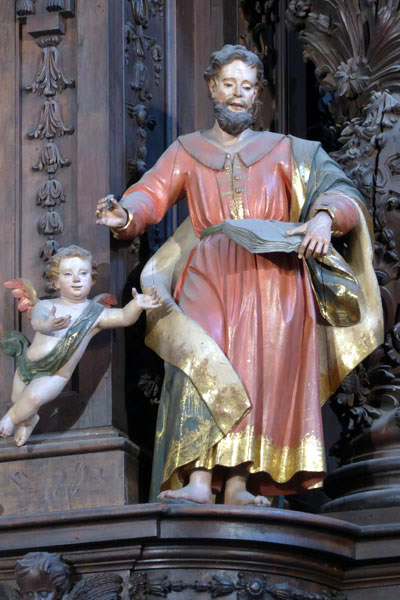
Saint Matthew
Matthew is the author of one of the four gospels in the Bible, which the catholic church considers as directly inspired by God. Each evangelist has a symbol; the one for Matthew is a winged-man, as if he were an angel. In this picture, the winged man accompanies Matthew, while he is writing with the feather in his right hand in the open book, which he is holding in his left one.
The carving of his clothes stands out, which are emphasised by the golden colour of the coat and the details.
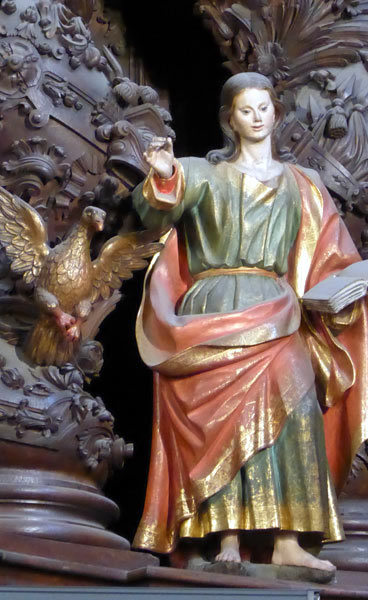
Saint John the Evangelist
John is the author of one of the four gospels in the Bible, which the catholic church considers as directly inspired by God. Each evangelist has a symbol; the one for John is an eagle such as in this picture. John is depicted as a young man without beard, writing with the feather in his right hand (today disappeared) in the open book, which he is holding in his left one.
The carving of his clothes stands out, which are emphasised by the golden colour of the coat and the details.
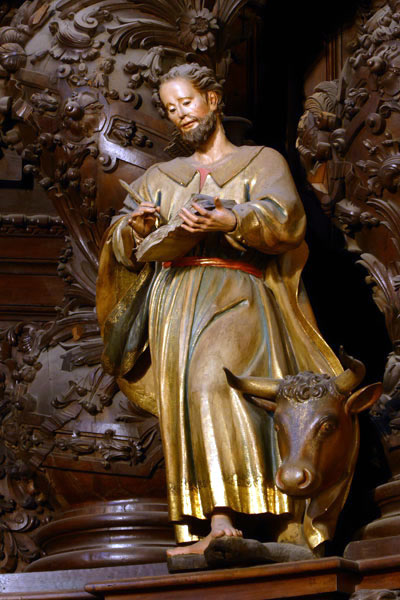
Saint Luke
Luke is the author of one of the four gospels in the Bible, which the catholic church considers as directly inspired by God. Each evangelist has a symbol; the one for Luke is an ox, which in the picture appears beneath Luke’s coat. The saint is depicted as a young man without beard, writing the open book in his left hand.
The carving of his clothes stands out, which are emphasised by the golden colour of the coat and the details.
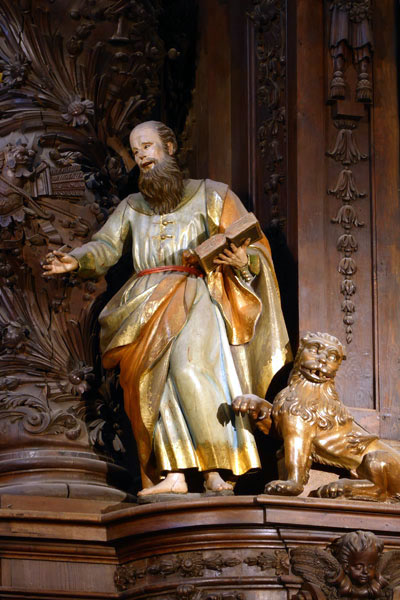
Saint Mark
Mark is the author of one of the four gospels in the Bible, which the catholic church considers as directly inspired by God. Each evangelist has a symbol; the one for Mark is a lion, which in the picture appears next to his feet. Mark is writing with the feather in his right hand the open book, which he is holding in his left one.
The carving of his clothes stands out, which are emphasised by the golden colour of the coat and the details.
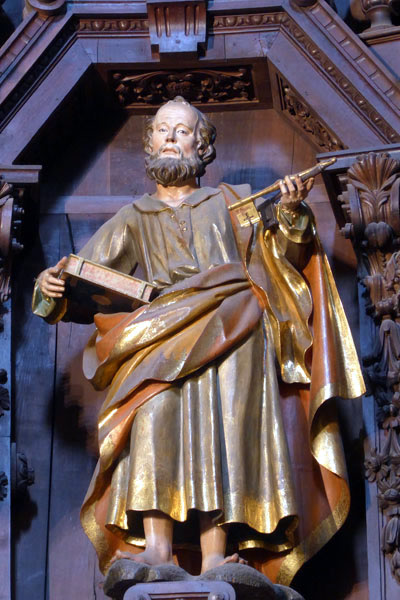
Saint Peter
According to the gospels, Peter was together with his brother Andrew the first of the twelve apostles, which were called by Jesus of Nazareth. Jesus appointed Peter as his successor, therefore he is considered as the first pope of the Catholic Church.
In this picture, Peter is holding a book in his right hand and the keys of the Kingdom of Heaven in the left one. His facial expression and the fringes of his clothes stand out.
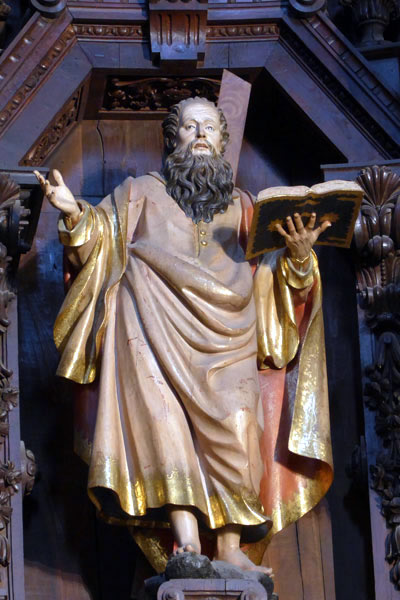
Saint Andrew
According to the gospels, Andrew was together with his brother Peter the first of the twelve apostles, which were called by Jesus of Nazareth. His legend tells that he preached in Thrace (a region in today’s Greece, Bulgaria and Turkey) where he was sentenced to be whipped and bound to an X-shaped cross (known as the “Saint Andrew’s Cross”) until he dies. The saint is depicted with the Saint Andrew’s cross behind him and an open book in his left hand – symbolising him as apostle.
His facial expression, emphasised by the carving of his hair and beard, and the beautiful polychromy of his garment attract attention.
Eggshell attic
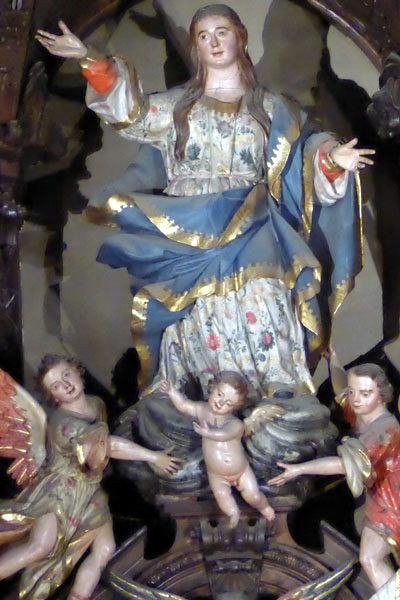
Assumption of Mary
According to the catholic tradition, at the end of her life, Mary was taken to heaven and her body and soul is in Paradise. Mary appears on a cloud surrounded and carried by Angels, as they took her body into the Glory.
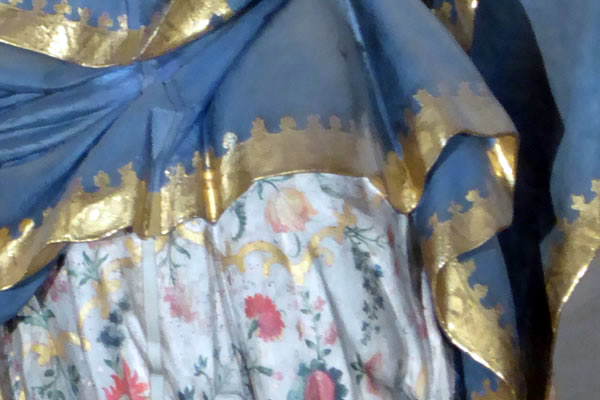
The sculpture stands out with its expressiveness emphasised by the carving and the polychromy of the clothes. The tunic is decorated with flowers and the blue coat with gilded fringes of ample pleats, which makes the picture seem to be in motion.
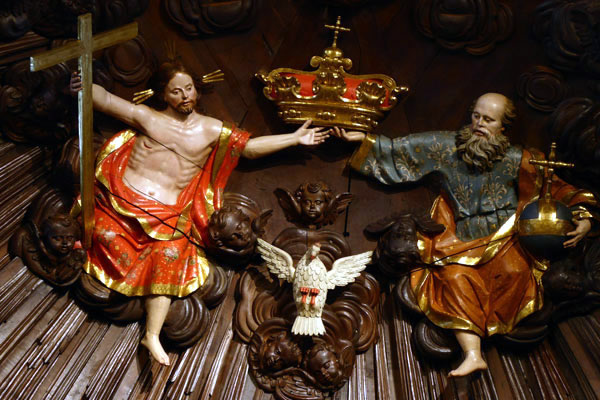
The Trinity crowning the Virgin
According to the tradition, after Mary had arrived in the Glory she was crowned Queen of Heaven. Therefore, in this picture the Trinity is carrying a large golden crown with a cross. The Trinity is the representation of the Christian God, who exists in three persons: God the Father, the Son and the Holy Spirit. God the Father (on the right side) is depicted as an old man with a long beard. He is holding a cross-crowned globe in his left hand, symbolising the triumph of the christianity in the world. God the Son (on the left side) is depicted as the Risen Christ with the wound in the flank. He is dressed with a red and golden cloak and carries the cross in his right hand. The Holy Spirit (between them) is depicted as a white dove with outstretched wings forming a cross.
This sculpture is characterised by a rich polychromy of red, blue and golden colour tones.
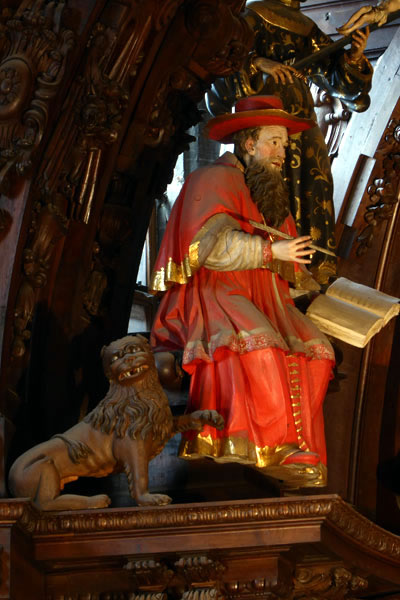
Saint Jerome
Jerome was a studious christian from the fourth century and translated the Bible to latin. He is one of the fathers of the catholic church. In the picture he is depicted writing. Jerome became secretary of pope Damasus. Therefore, he is dressed like a cardinal with a red robe and a cardinal hat. The golden polychromy of the robe’s fringes stand out.
According to the legend, he was always accompanied by a lion, which has followed Jerome like a tame dog since the Saint had pulled out a splinter of its paw.
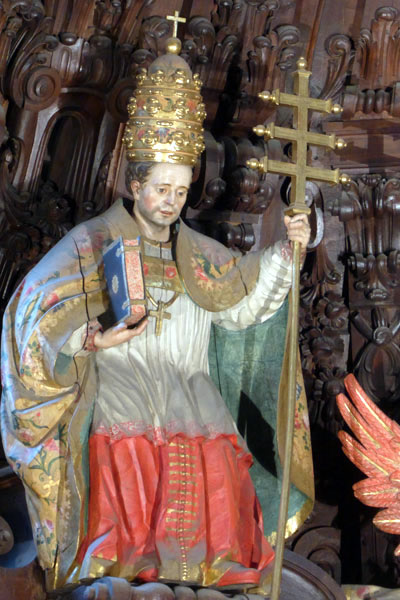
Saint Gregory the Great
Gregory was a pope from the sixth century and is dressed with precious clothes. He wears an important coat, red shoes, the tiara – a hat consisting of three crowns, which indicates his authority as pope, bishop and king – and the ferula – a stick forming a cross.
As author of many theological works, he is considered one of the fathers of the catholic church.
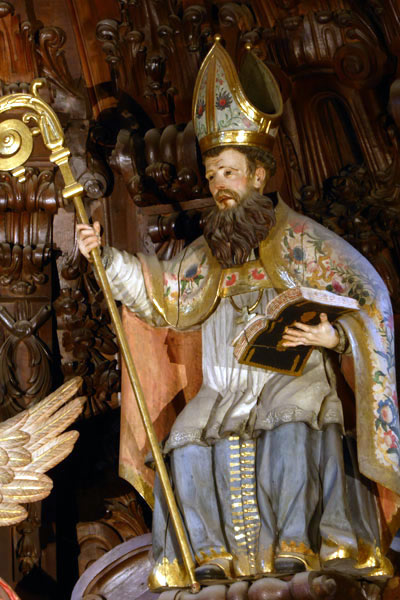
Saint Ambrose
He was bishop of Milan in the fourth century. Ambrose is depicted with a richly ornamented coat, a Bishop’s cross on his neck, the mitre – a hat used by bishops in solemn celebrations – and a crosier. As author of many theological works, he is considered one of the fathers of the catholic church.
The polychromy of the coat based on plant elements stand out, as well as the gold used for the crosier, for the coat’s fringes and for the mitre.
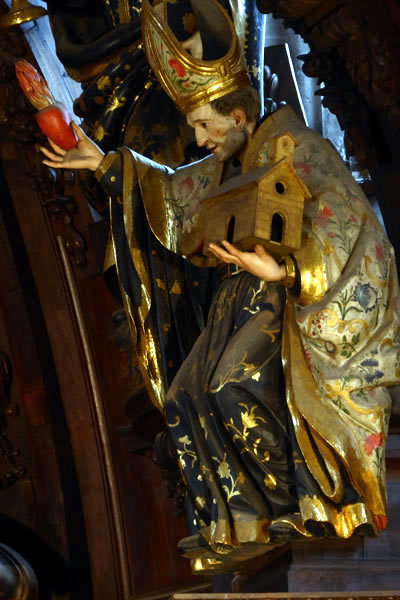
Saint Augustine
Augustine was a philosopher from the fourth century, who, after having converted to christianity, became bishop of Hippo (today’s Algeria). Augustine is dressed like a bishop with a richly ornamented coat and crowned with a so-called mitre – a hat used by bishops in solemn celebrations. He commonly carries a small church in one hand and a flaming heart in the other one. As author of many theological works, he is considered one of the fathers of the catholic church.
The polychromy based on golden tones, which brings light to the picture, stands out.
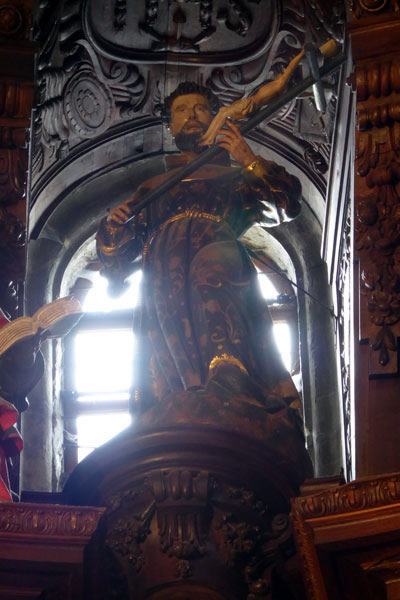
Saint Francis Xavier
Francis Xavier was the first missionary of the Society of Jesus as well as one of its founders. He appears holding an image of Christ crucified, thus representing his evangelising mission.
His gestures and the golden details of his habit stand out.
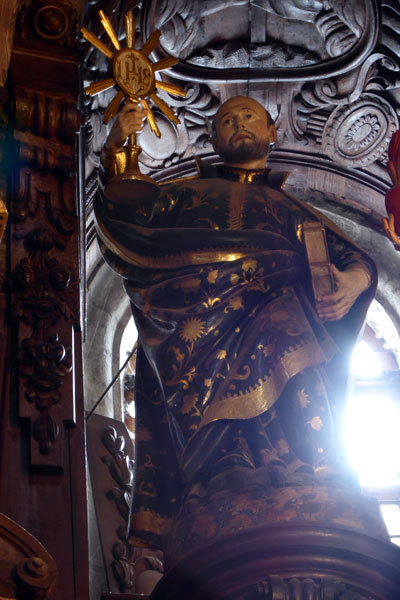
Saint Ignatius of Loyola
Ignatius of Loyola was founder and first Father General of the Society of Jesus. In his right hand he holds an ostensory with the letters IHS, an abbreviation of Jesus “IHSOUS” and symbol of the Jesuits, and in his left hand a closed book representing the rule of the Society.
His expressive gestures and the gilded details of his habit stand out.