
High Altarpiece of the Immaculate Conception
- Town: Elorrio
- Church: Immaculate Conception Church
- Location: High Altar
- Artist: Diego Martín de Arce (planner), Juan de Munar and Juan Antonio de Ontañon (sculptors) and Antonio Jiménez Echevarría (paintor of the polychromy)
- Chronology: 18th century (1729-1752 sculpture, 1754-1758 architecture, 1765-1767 polychromy)
- Style: Baroque
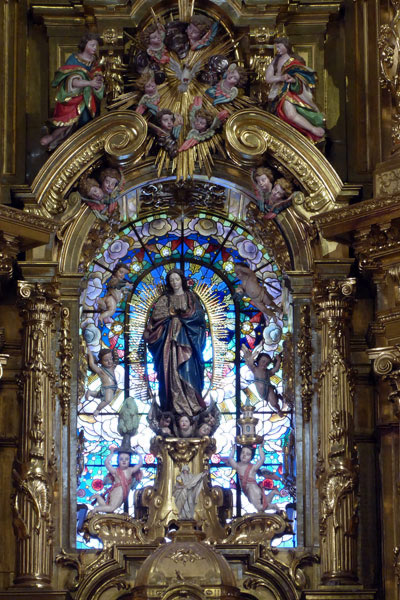
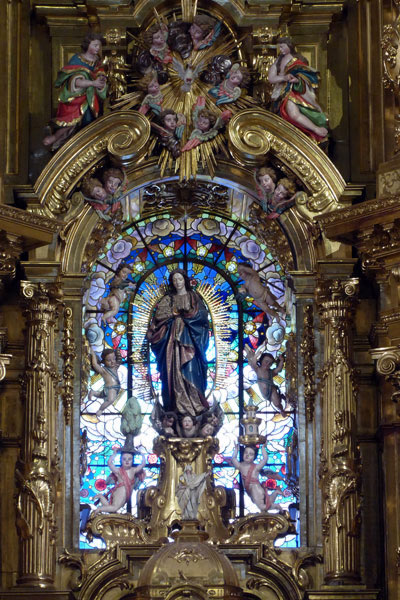
An exceptional baroque altarpiece with a special translucent shrine
Interactive altarpiece: click on the pictures to get more information.
Church:
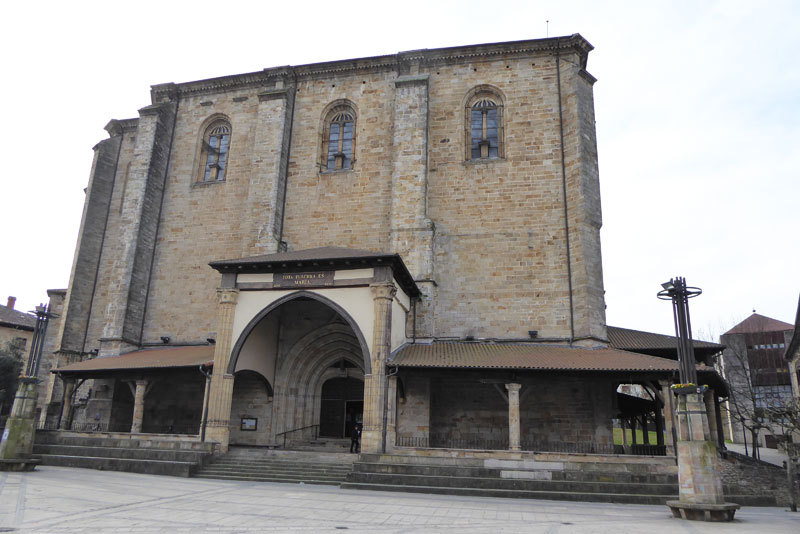
Gonzalo de Otálora y Guissasa, a historian from Durango, wrote in 1634 that the Immaculate Conception Church of Elorrio was one of the best buildings in Europe. It is true that the building is one of the most significant examples of the basque churches between the gothic time and the renaissance, as all its naves are of equal height. This type of churches – known as “hallenkirche” (German for Hall Church) – are very common in the Basque region and are inspired by Central European examples.
Patronage:
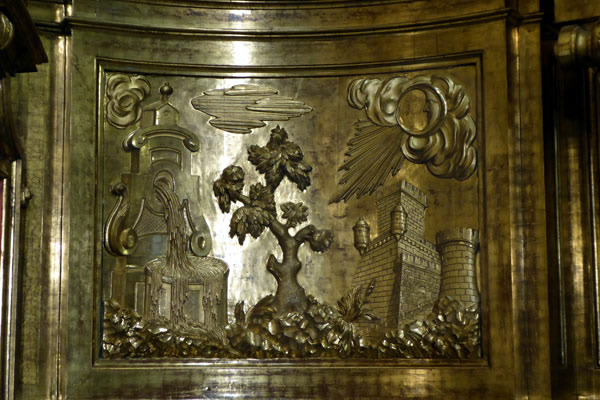
The Most Pure Conception or Immaculate Conception is a doctrine of the catholic religion saying that Mary was the only person who was born without the original sin. This sin has been transmitted from Adam and Eve to all people and can only be removed by being baptised. This means that no person could be free from this sin before having received the sacrament of baptism. However, the catholic church considers that God wanted Mary to be free from this sin so that she can be the Mother of Christ. Throughout history, this complex topic has been depicted in a symbolic way. In this church in Elorrio, Mary is depicted standing on a moon, surrounded by sunrays and accompanied by a tree next to her. The tree stands for the original sin committed by Adam and Eve in the Paradise. They disobeyed God and ate from the fruit of the tree of the knowledge of good and evil.
Description:
The 
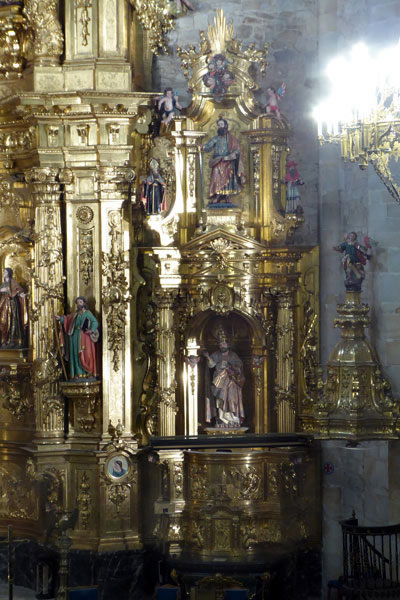
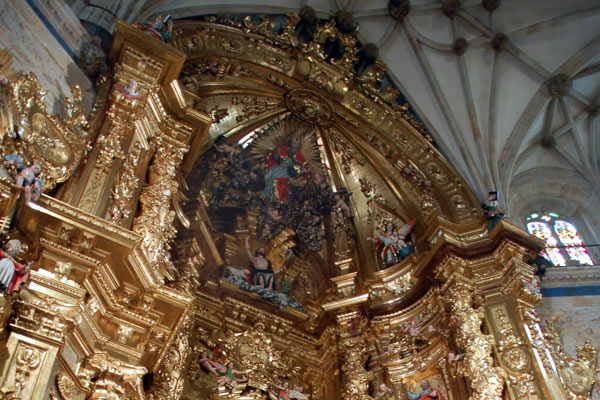
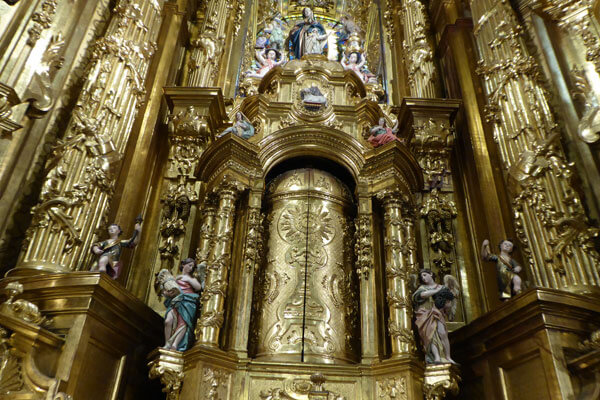
In the upper part of the altarpiece, above the sculpture of the Immaculate Conception, are the pictures of Saint John the Baptist and God the Father. Furthermore, the altarpiece consists of sculptures of apostles, angles and archangels, and 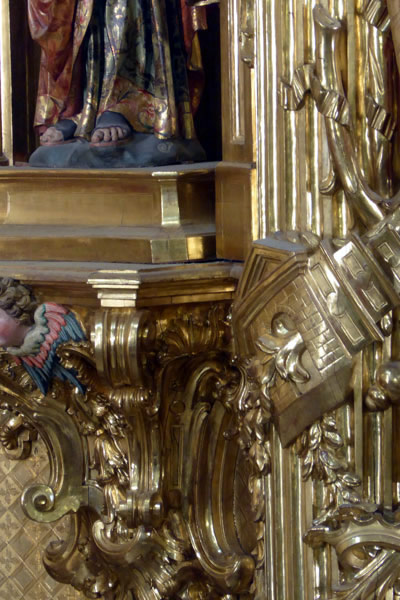
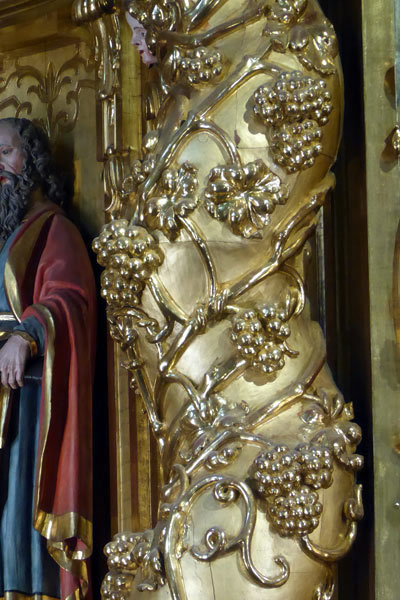
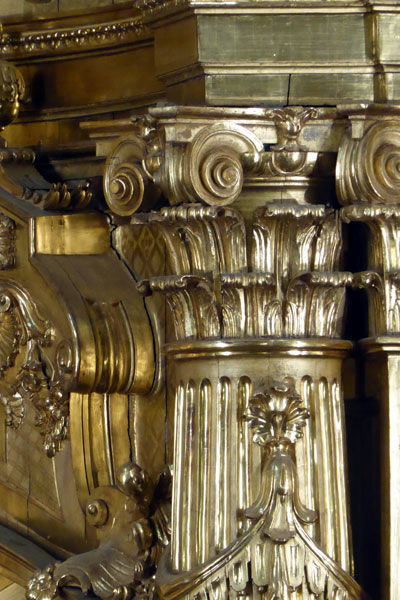
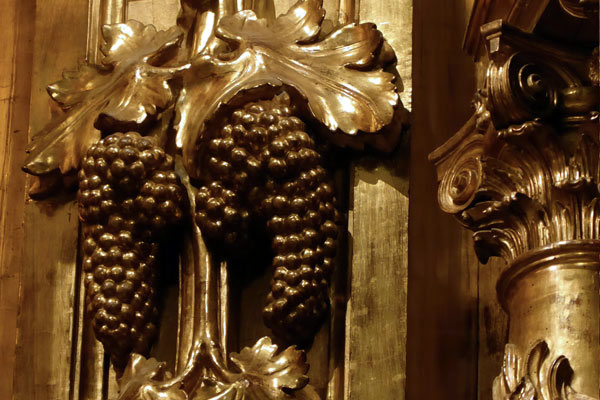
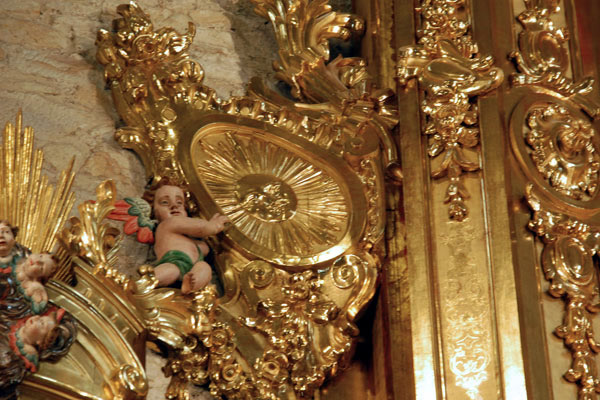
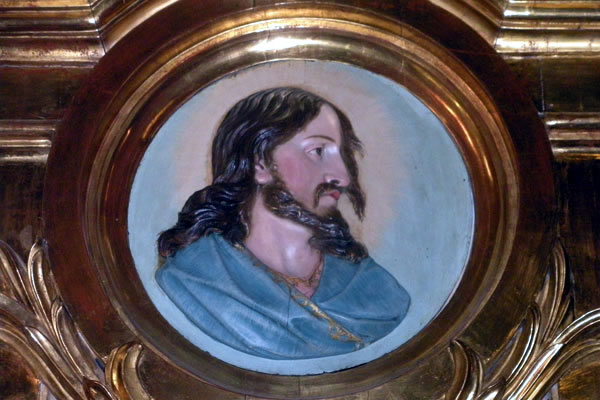
The entire altarpiece is gilded: It consists of 285,000 sheets of leaf gold and 2,500 sheets of leaf silver. This altarpiece is one of the most splendid baroque ones in Biscay.



History:
The history of this altarpiece is long and complex. The construction process started in the 17th century, but due to the lack of financial resources, only the main picture dedicated to the Immaculate Conception could be built at this time. The money needed to carry out the work came very slowly. It was paid by people from Elorrio who lived in Cádiz and especially in the Americas: many donations came from Lima, Potosí, Tucumán, Arequipa, Cartagena de Indias … However, the construction works had to be stopped several times. The lower part of the altarpiece was finished in 1719, but the shrine with the main picture was not built before 1728. Several artists intervened, such as Martín de Olaizola, Alberto de Churriguera, Sebastián de Lecuona or Juan Antonio de Ontañón. From 1729 to 1752 two sculptors from Cantabria, Juan de Munar, then resident of Elorrio, and Juan Antonio de Ontañón carved parts of the sculptures. However, the altarpiece remained unfinished. Finally, in 1754 the architect Diego Martínez de Arce planned a new altarpiece, which was built between 1754 and 1758 by another architect Silvestre Soria. Only the sculptures and solomonic columns remained from the former altarpiece. The furniture was completely modified. The work was finished between 1765 and 1767 with the painting of Antonio Jiménez Echevarría, who is a gilder from Arrasate (Gipuzkoa).
Sculptures:
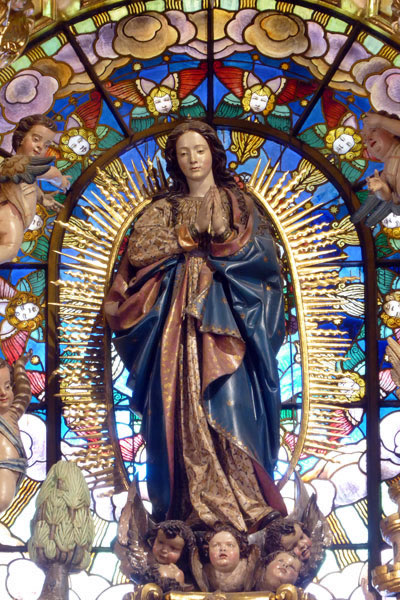
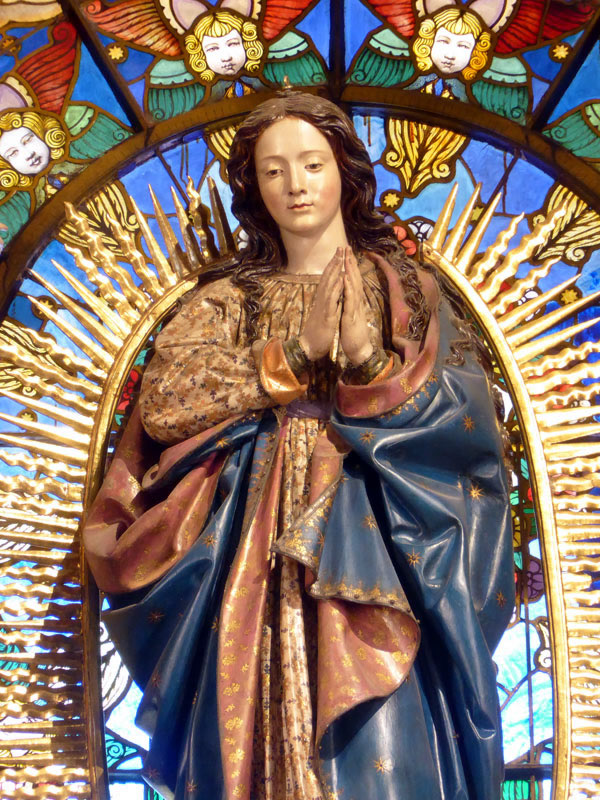
Immaculate Conception
Mary is portrayed in accordance to the Vision, which is told in the Book of Revelation – the last book of the Bible. The Virgin is surrounded by a ring of golden rays and stands on the moon in allusion to her chastity and the triumph of the christianity over the turks after the battle of Lepanto.
She puts her hands together and looks down in prayer showing her humility. Her clothes, especially the blue coat (symbol of heaven), stand out with the thick and stiff folds of the cloth. The polychromy makes this picture seem gentle. It is the oldest sculpture of the altarpiece and was made in the 17th century.
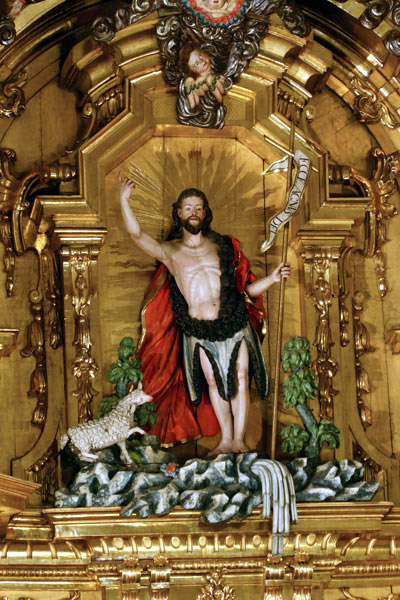
Saint John the Baptist
According to the gospels, John the Baptist carried out his work in the beginnings of christianity, in the region of the Jordan River. He baptised those who searched for the conversion. Therefore, in this sculpture he is placed in an environment with trees and a river, which seems to burst its banks. The Holy Scripture describes him as a hermit who lived in the desert and covered himself with a camel-skin robe. He is portrayed semi-nude and being accompanied by a lamb, the symbol for Jesus Christ. John carries a stick forming a cross with the inscription – originally in Latin – “Behold the Lamb of God.
Furthermore, he raises his finger and points it at Jesus of Nazareth, the Son of God. The christian tradition considers John as the last prophet who announced the arrival of the Messiah. It is a work of Antonio de Ontañón.
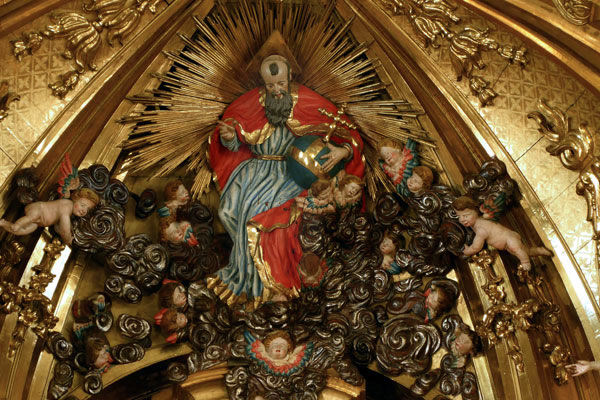
Eternal Father
God the Father is depicted in the upper part of the altarpiece as an old man with a long and grey beard holding in his left hand a globe with a cross, which symbolises the triumph of christianity in the world. He is accompanied by angels, which look at him. Behind the Father is a huge amount of gilded rays symbolising his power.
He is crowned with a triangle, the symbol for the Trinity. His facial expression stand out, as well as the colour of the clothes and the carving of the pleats of the coat and tunic. It is a work of Antonio de Ontañón.
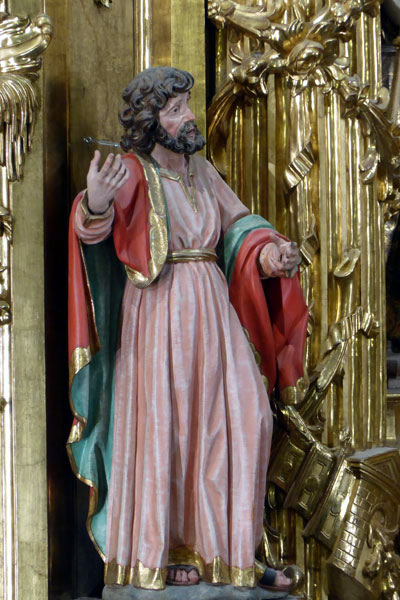
Saint Philip
According to the gospels, Philip was one of the twelve apostles who accompanied Jesus of Nazareth. The tradition narrates that he was martyred and crucified in Hierapolis (today’s Turkey). The apostle usually carries a cross as the symbol for his martyrdom.
This was certainly the case in this picture too, as the position of his hands indicates that he was originally carrying a large object, which has now disappeared. This is a work of Juan Antonio de Ontañón.
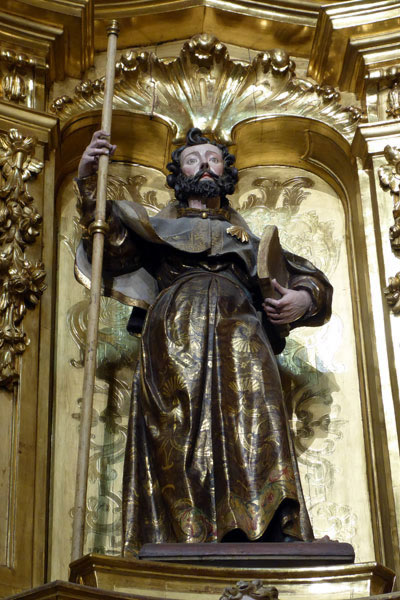
Saint James the Great
Saint James, son of Zebedee, was together with his brother John one of the twelve apostles who, according to the gospels, accompanied Jesus of Nazareth. He is known as Saint James the Great to distinguish him from the other apostle Saint James the Less, son of Alphaeus. According to a medieval tradition, James the Great is buried in Iria Flavia (Compostela). This was the origin for the pilgrimage to his grave and for the Camino de Santiago.
The saint is dressed like a pilgrim; with a scallop shell on his chest, a stick in his right hand and a closed book in the left one. The brown coat is decorated with gilded tones and plants. It is a work of Juan Antonio de Ontañón.
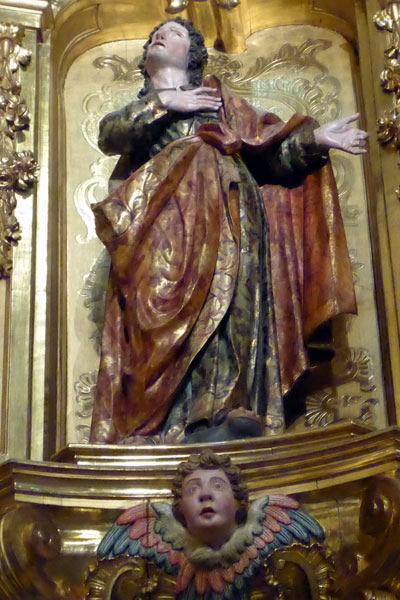
Saint John the Evangelist
According to the gospels, John was one of the twelve Apostles. At a young age, he and his brother James were called by Jesus to be his disciples. He is depicted as a young man without beard. This picture shows a dramatic situation: John puts one hand to his chest, while he is looking towards heaven to get the divine inspiration for his gospel.
The beautiful polychromy of his clothes, decorated with plant elements and painted with golden tones, stands out. It is a work of Juan Antonio de Ontañón.
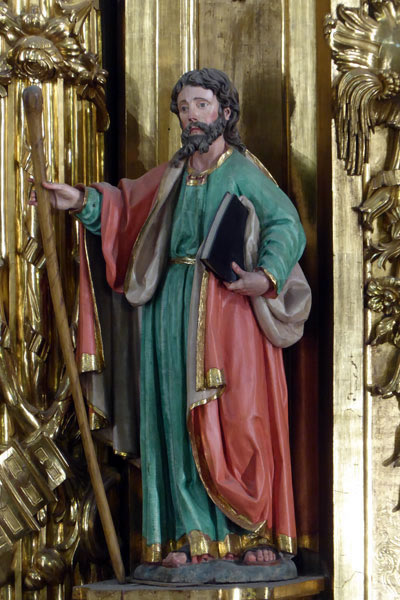
Saint James the Less
Saint James, son of Alphaeus, was one of the twelve apostles who, according to the gospels, accompanied Jesus of Nazareth. He is known as Saint James the Less to distinguish him from the other Apostle Saint James the Great, son of Zebedee. According to the tradition, the jewish priest Ananias ordered to stone him next to the temple in Jerusalem to prevent him from preaching the gospel. As he had not died after a while, he was martyred with a deathblow from a club on his head. In this picture, James is depicted carrying a large stick in his right hand and a book in his left one, which identifies him as apostle. It is a work of Juan Antonio de Ontañón.
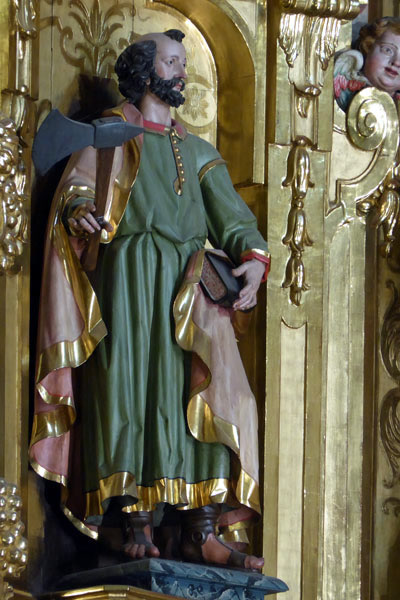
Saint Matthew
Matthew was one of the twelve apostles who accompanied Jesus of Nazareth. Furthermore, he is considered as the author of one of the four gospels recognised by the catholic church as true and directly inspired by God. Therefore, he holds a book in his left hand. In the right hand, he carries an axe in allusion to his death by beheading, as it is described by the tradition.
The gilded fringes of the cloths and the gilded details stand out. It is a work of Juan Antonio de Ontañón.
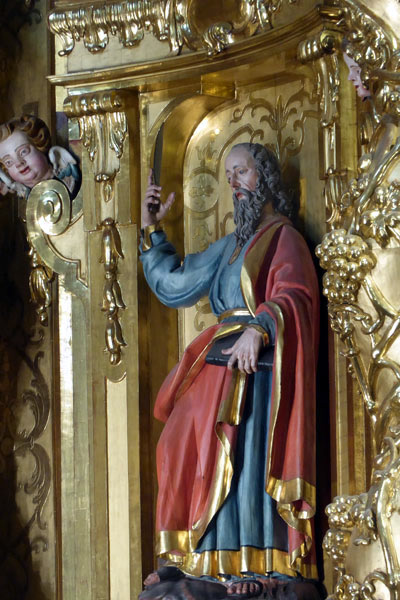
Saint Bartholomew
According to the gospels, Bartholomew was one of the twelve apostles who accompanied Jesus of Nazareth. According to the tradition, he was martyred in Armenia, where the king wanted him to renounce christianity. As the saint refused to do so, the king ordered to flay his skin until he dies. He holds a knife in his right hand as symbol for his martyrdom. In his left hand, he carries a book, which identifies him as apostle.
The gilded fringes of his tunic and coat as well as his facial expression, which is emphasised by the polychromy, attract attention. It is a work by Juan Antonio de Ontañón.
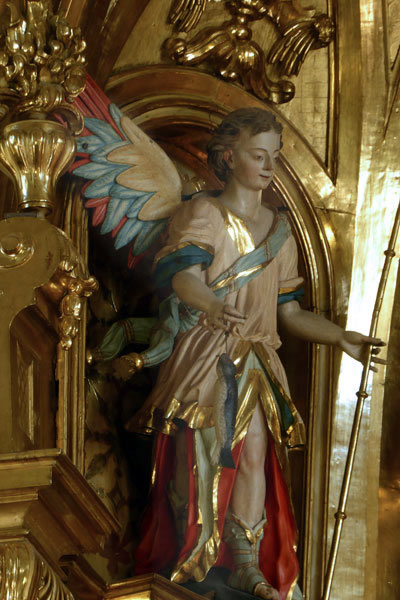
Archangel Saint Rafael
Rafael is one of the four archangels who are mentioned in the Bible. His name means, “God has healed”. He is depicted with a fish with whose gall he helped Tobias to heal his father-in-law from blindness.
In his left hand, he carries a walking stick, which shows that he is a great hiker. Together with Saint Christopher, Saint Roch and Saint James the Apostle, he is one of the patron saints of pilgrims. The colourful clothes and wings – typical for the baroque – and the movement of the tunic attract attention. It is a work of Juan de Munar.
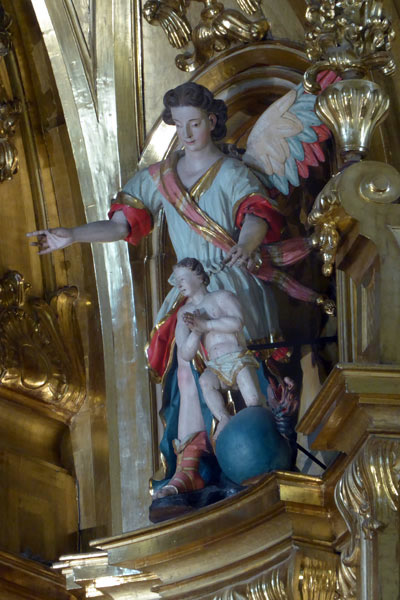
Guardian Angel
According to the tradition, all christians have an angel as a protector since their baptism. This picture shows the angel accompanying a child to protect it from the dangers of the daily life.
The colourful clothes and wings and the movement of the tunic attract attention. It is a work of Juan de Munar.

Saint Joachim
Joachim was the father of the Virgin Mary and the grandfather of Jesus. According to the legend, he fathered his daughter by embracing his wife Anne next to the Golden Gate in Jerusalem without having any sexual act. Therefore, he is commonly depicted next to pictures of the Immaculate Conception. Joachim is portrayed in the upper part of the altarpiece. To show that he is a pious man, Joachim puts his right hand on his chest and reads a book, which he is holding in the left hand.
The gilded fringes of his clothes attract attention. His facial expression stands out, with slanted eyes, which give the sculpture an oriental aspect, characteristic of the works of Juan de Munar.
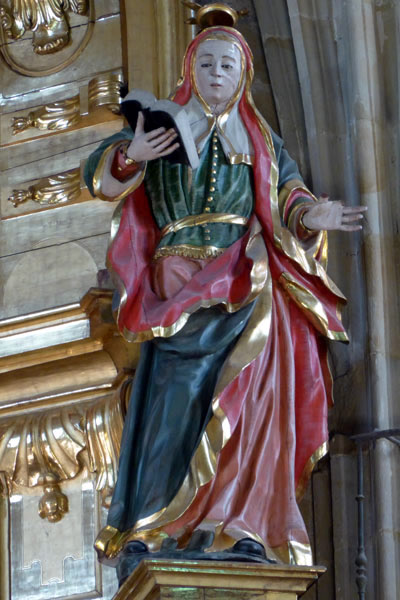
Saint Anne
Anne was the mother of the Virgin Mary and the grandmother of Jesus. According to the legend, she conceived a child by embracing her husband Joachim next to the Golden Gate in Jerusalem without having any sexual act. Therefore, she is commonly depicted next to pictures of the Immaculate Conception. Anne is portrayed in the upper part of the altarpiece. To show that she is a pious woman, her head is covered and Anne reads a book, which she is holding in the right hand.
The gilded cloths and the details such as buttons or the bobbin lace, attract attention. It is a work of Juan de Munar.