
High Altarpiece of the Assumption of Mary
- Town: Durango
- Church: Saint Mary Church
- Location: High Altar
- Artist: Martín Ruiz de Zubiate (sculptor)
- Patron: Council of Durango and parish of Santa María de Uribarri
- Chronology: 16th century (1578-1590)
- Style: Renaissance
Spanish-Flemish elements from Bruges for one of the oldest altarpieces in the Basque region
Interactive altarpiece, klick on the pictures to get more information.
Church:
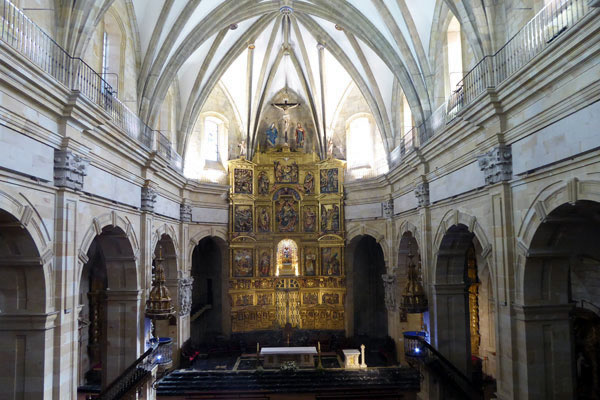
The basilica of Saint Mary is one of the most monumental buildings in the Basque region and one of the best examples for the baroque architecture.inside the church, the ample central nave, which is much higher than the laterals, and the chapels in the apse attract attention.
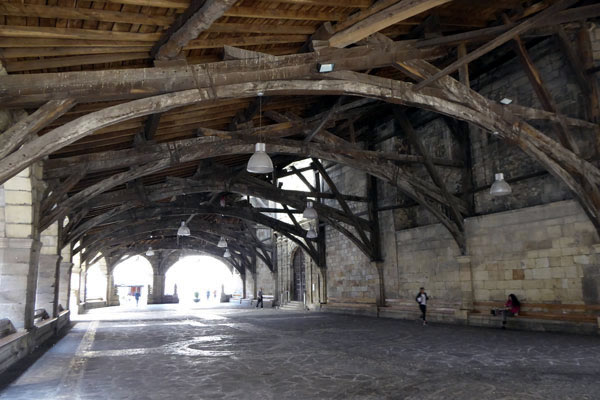
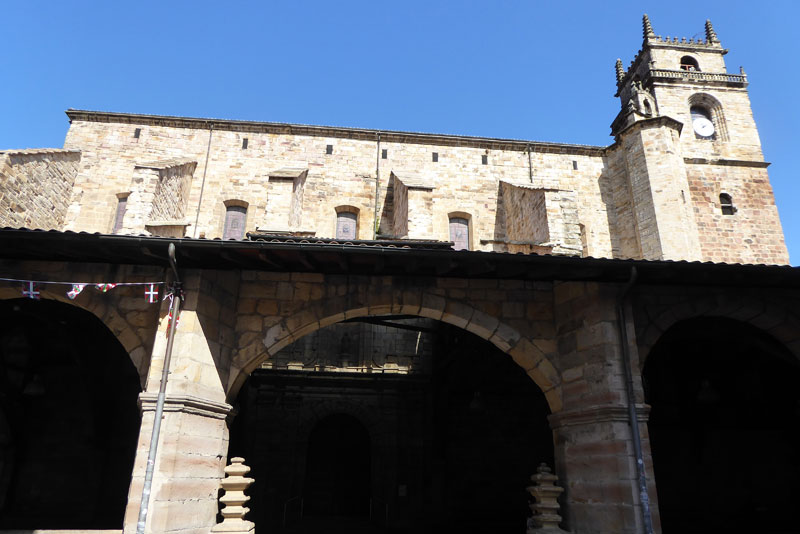
The ample portico outside on the south side of the church stands out.
Patronage:
The altarpiece is dedicated to the Assumption of the Virgin Mary.
According to the catholic tradition, at the end of her life, Mary was taken to heaven and is – together with Jesus Christ – the only person whose body and soul is in Paradise without having to wait for the Last Judgement and the Resurrection of the dead.
She is depicted on clouds and surrounded by angels, because they took up her body into the Glory.
Description:
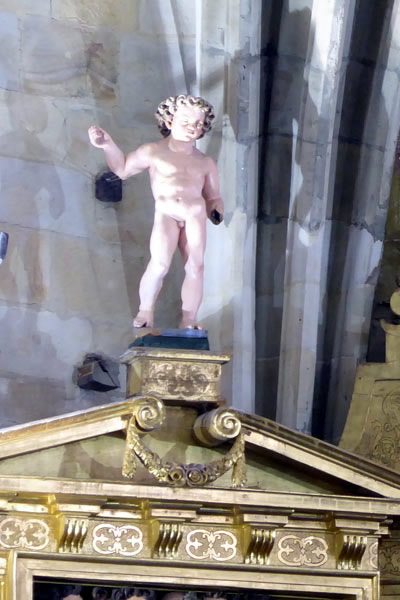
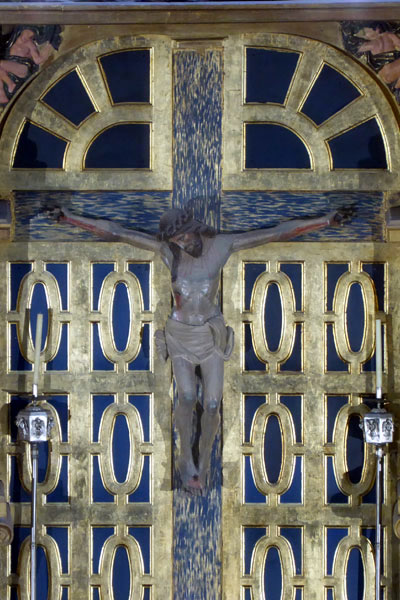
The altarpiece has a polygonal shape, so that it is perfectly adapted to the apse of the church. It consists of four parts; the pedestal, three body parts divided into five sections, and an attic crowned with the Golgotha. Beside the Golgotha are two naked angels. The altarpiece combines reliefs and sculptures located in boxes, which are framed by columns and crowned with curved and 
The pictures narrate the life of Mary highlighting her role as Mother of God. The reliefs and main pictures are dedicated to her and the sculptures of the main section – the Virgin with the Child in the shrine, the Assumption of Mary accompanied by God the Father, and the Coronation of the Virgin Mary – stand out. The pictures of Mary alternate with sculptures of Saints and Apostles.
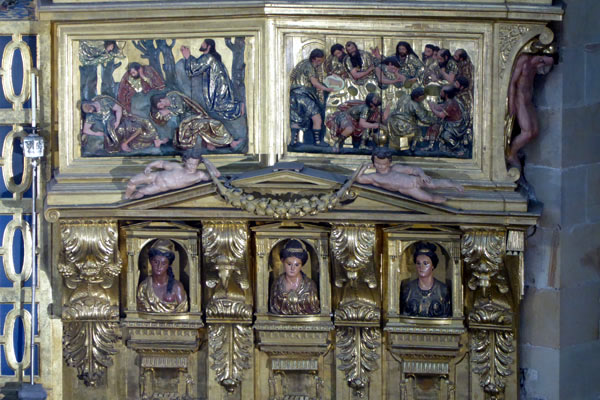
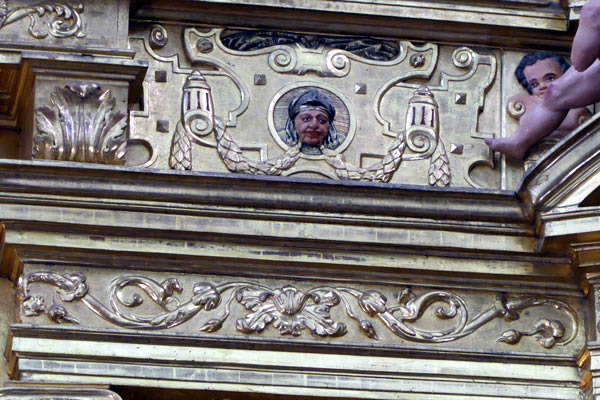
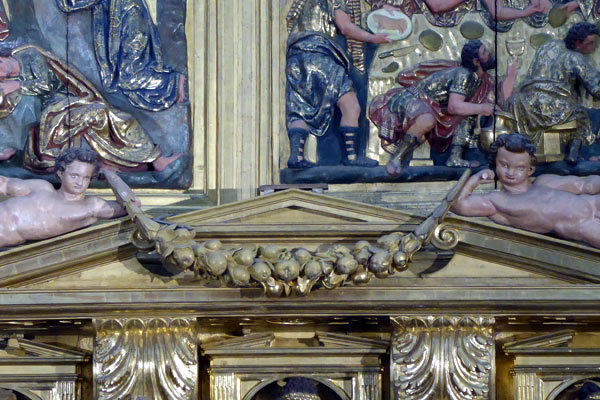
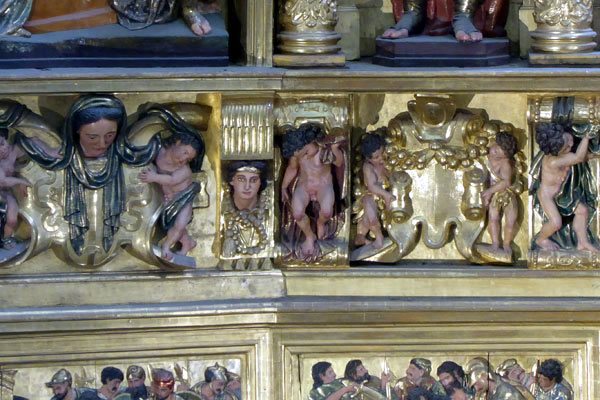
The lower part of the altarpiece is decorated with pictures form the passion of Jesus Christ, with a crucifix and with six busts of women under a plant-decorated gable roof. The busts contain the reliquaries of many other Saints and are the most peculiar element of the altarpiece.
It is a very precious decoration with plants, animals, human faces and little angels or putti. These elements fill the entire surface of the altarpiece and this causes the feeling that there is no space without any decoration. This is called horror vacui (“fear of empty space”).
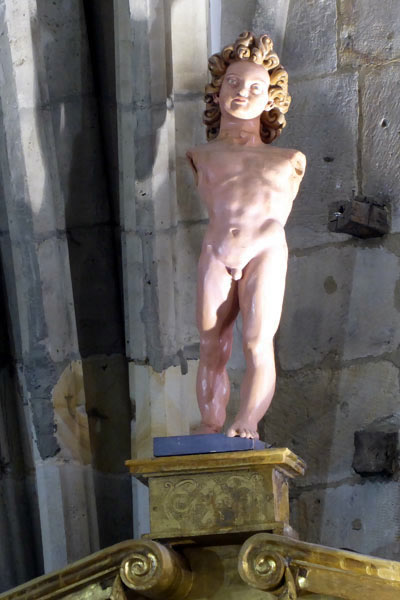
All sculptures, except for the main one (Andra Mari) showing the Virgin with the Child, – it is the oldest picture – were built in the 16th century style and in accordance with the works of the Italian sculptor Michelangelo, who worked for the popes in Rome, among others. Therefore, it is said that this altarpiece is built in a roman style. The roman influence can be seen in the muscular anatomy of the people and in particular of the naked figures on both sides of the Golgotha scene.
History:
In 1578, the council of Durango and the responsible persons from the parish of Saint Mary de Uribarri decided to order an altarpiece for the chancel of the church, which had been finished decades ago. Martín Ruiz de Zubiate from Arratzu was in charge of the sculpture. He was an alumnus of Juan de Anchieta, the most important basque sculptor at this time, who may also have intervened in this work. The work was concluded in 1590 with the altarpiece and sculptures being gilded and painted.
Sculptures:
Andra Mari
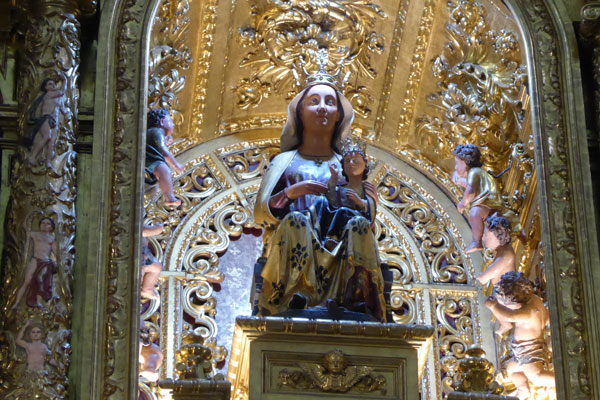
The sculpture of the Virgin Mary sitting with the Child in her lap is called “Virgin Mary on the Throne” and in the Basque region “Andra Mari” (“Lady Mary”). It is the oldest picture of the altarpiece – at least 100 years older than the other sculptures and reliefs.
It is based on medieval pictures and built in a gothic style. However, it was certainly painted up in the 16th century, when it was put in the shrine.
Assumption of Mary
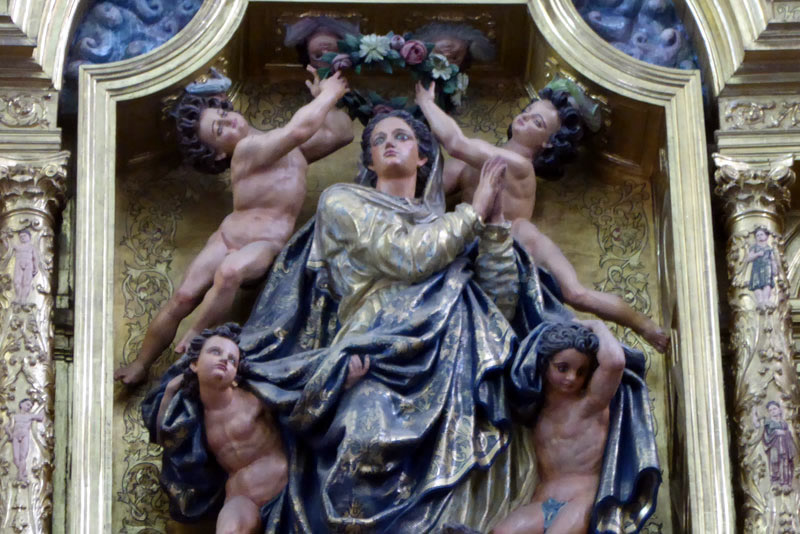
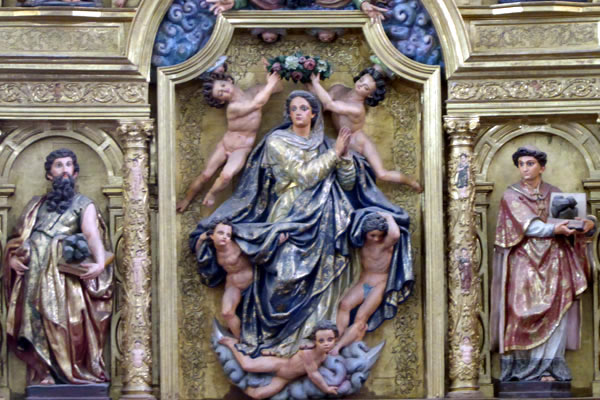
According to the catholic tradition, at the end of her life, Mary was taken to heaven and her body and soul is in Paradise. She is depicted on clouds and surrounded by Angels. They crown her head with flowers and back her, because they took up her body into the Glory.
The Angels in the picture do not have any wings, are completely naked and very muscular. They resemble figures of the Italian sculptor Michelangelo.
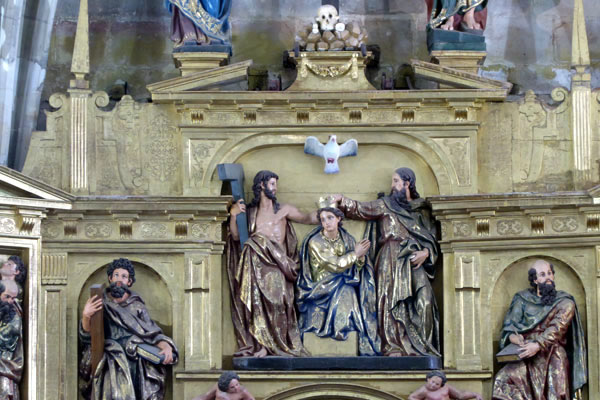
Coronation of the Virgin Mary
According to the catholic tradition, Mary, who is already in the Glory, is crowned Queen of Heaven. She is accompanied by the Trinity. The Father to her right represented as a middle-aged man with long beard and dressed with a tunic and cape. The Son, Jesus Christ, to her left side with an uncovered trunk carrying the cross, which is the symbol for his death. The Holy Spirit in the centre symbolised by a white dove, which extends the wings forming a cross. The polychromy of her clothes stands out.
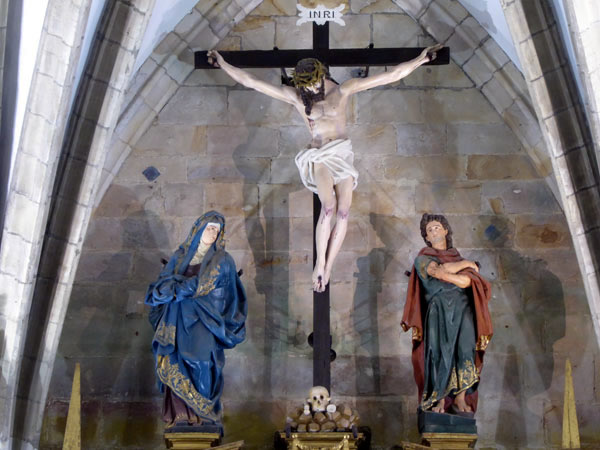
Golgotha
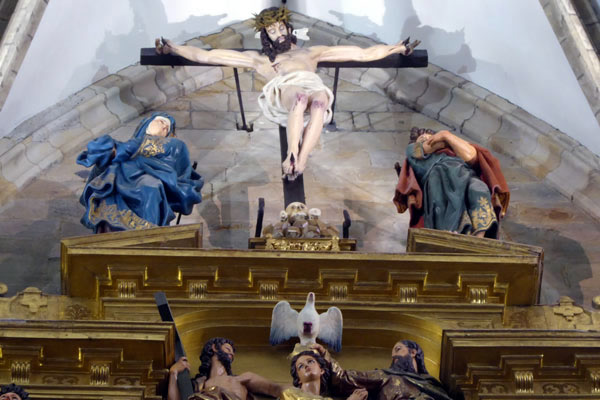
The altarpiece is crowned with the scene of Golgotha, which shows the crucified Christ surrounded by his mother, Mary, and John, the disciple whom Jesus loved. At the foot of the cross is a skull, as an allusion to the place where Jesus was crucified – Golgotha (place of skull). It also refers to a medieval legend, according to which the tree whose wood was used to build the cross of Jesus had sprang from Adam’s skull. The carving and the painting of these three sculptures is excellent with the clothes of the Virgin and of John as well as the anatomy of the crucified Christ standing out.
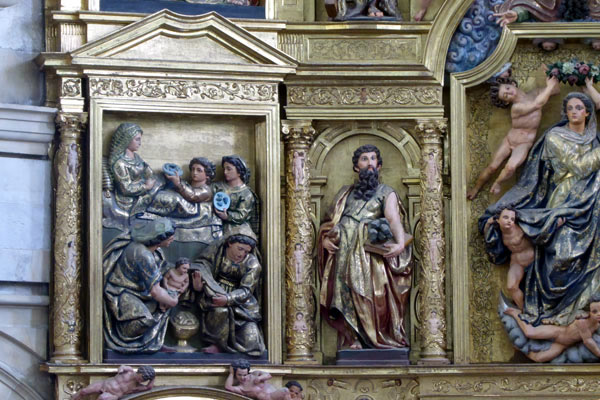
The Birth of the Virgin Mary
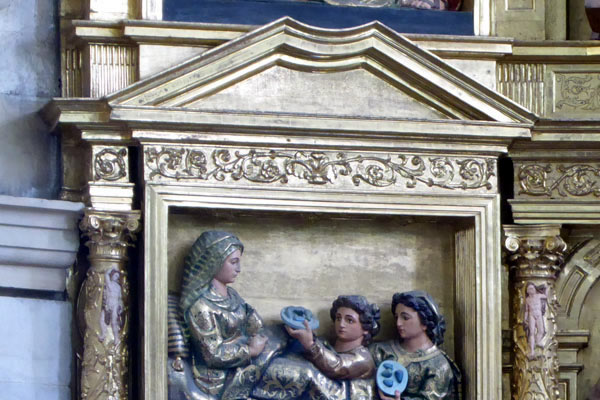
The Bible tells hardly anything about the life of Mary. We know her mainly from legends and medieval traditions. In this altarpiece, her birth is portrayed as an everyday occurrence: Her mother, Anne, has given birth and two women take care of her on the bed offering food, while two midwifes are washing the recent born girl.
The clothes of the women and the bedsheet attract attention. They are painted with precious colours of which the golden tones stand out. The anatomy of the girl, who is exaggeratedly muscular, stands out, too. All this resembles the style of the Italian sculptor Michelangelo.

The Presentation of the Blessed Virgin Mary in the Temple
The Bible tells hardly anything about the life of Mary. We know her mainly from legends and medieval traditions. At a young age, her parents, Joachim and Anne, took her to the temple in Jerusalem, where she was educated by the priests until she reached the marriageable age. This is the moment, when the priest Berechiah receives Mary, who climbs the stairs of the temple of Jerusalem and prophesies that she will be the mother of the Messiah. Her parents and a maid are watching the scene.
Joachim in the foreground stands out. His gesture and frizzy beard resemble the famous Moses sculpture of the Italian sculptor Michelangelo.
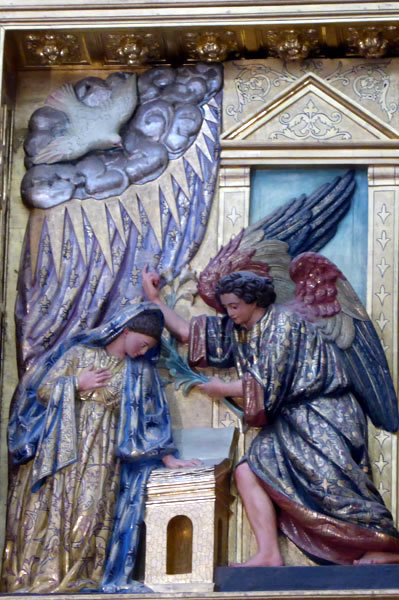
Annunciation
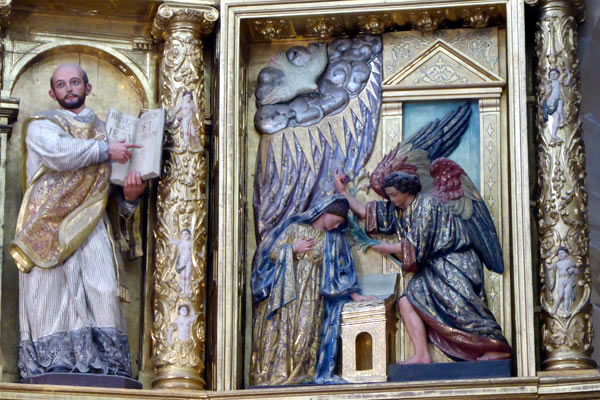
According to the gospels, the Archangel Gabriel was send by God to annunciate Mary that she will be the mother of the Messiah. This moment is of great symbolic importance for the christianity, as it represents the mystery of the Incarnation, which means, the moment when God becomes a human to save humanity from sin. This scene shows the moment when the archangel appears to Mary, kneeling in front of her and offering her some white lilies, the symbol of purity and virginity. The woman, who is reading at this moment, puts one hand on her chest and inclines her head to express humility and her acceptance. The Holy Spirit appears above them as a white dove extending the wings to form a cross. This is an allusion to the miraculous and divine conception of Jesus Christ.
It is a very expressive picture and the gestures of the figures, the quality of the carving and the fine polychromy stand out.
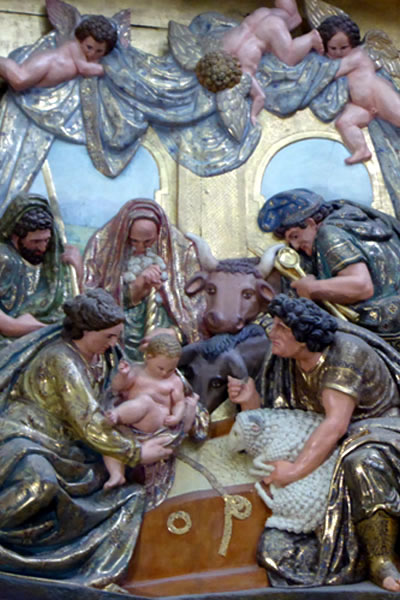
Adoration of the shepherds
According to the gospels, after the birth of Jesus in Bethlehem, an angel announced the shepherds that the Messiah had been born. They went to the manger to adore him. The picture shows Mary holding the Child in her arms. Jesus raises his right hand for the blessing, while a shepherd kneels down to show his respect. The shepherd gives Jesus a lamb as a gift in allusion to Christ as the Lamb of God and therefore to his role as the Saviour of humanity.
The picture is completed with Joseph beside Mary, and two other shepherds looking at the Child as well as the donkey and the ox, animals that traditionally accompany the pictures of the Nativity of Jesus. Three flying angels push back a precious curtain, this underlines the divine character of this scene. The very detailed polychromy of the clothes, the muscular anatomy of the angels and of the Child, and their gestures, which are inspired from sculptures of Michelangelo, stand out.

The Escape to Egypt
According to the gospels, an angel warned Joseph that king Herod, who confuses the birth of the Messiah with the birth of a future monarch of the Jews, would command the killing of all boys under the age of two years, because he was afraid that one of them would dethrone him. Mary and Joseph then decided to escape to Egypt to save Jesus from this act, which is known as the massacre of the innocents.
Mary is sitting with the naked Child in her arms on the back of a donkey, led by Joseph in front of them. The scene is located in a landscape of trees, which makes it more natural and ostensive.
The expressiveness of the face of Joseph, who is turning towards Mary and the Child, and the beautiful and careful polychromy of the clothes stand out.
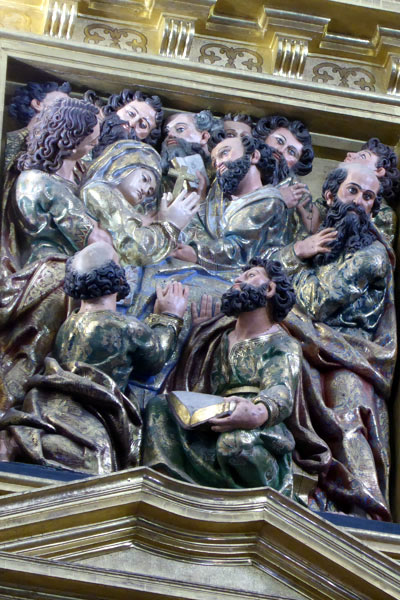
Dormition of the Virgin Mary
According to the catholic tradition, at the end of her life Mary was taken to heaven and is – together with Jesus Christ – the only person whose body and soul is in Paradise without having to wait for the Last Judgement and the Resurrection of the dead. She did not die, but kept sleeping after all apostles had come to accompany her.
Mary is lying down in the bed with a crucifix in her hands saying goodbye to the apostles, who are surrounding her. John is the closest to her, depicted as a young man without beard. He backs the Virgin putting his arms under her shoulders. One of the other disciples, a man with a long and frizzy beard, turns directly towards the observer, which makes the picture very vivid.
The faces and the beautiful polychromy of the clothes with many gilded details attract attention.
Pedestal (upper part)
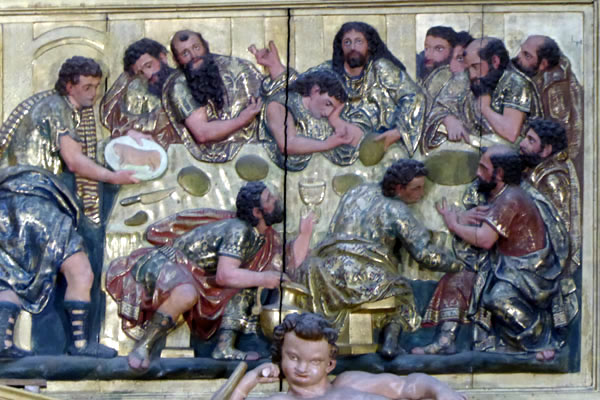
The Last Supper
A scene from the gospels describing the moment when Jesus meets with his disciples for dinner and announces that one of them will betray him. The figures in the picture make gestures to express their surprise. They talk to each other to find out who of them will be the betrayer. The picture shows the apostles sitting around the table, which is set with many details of everyday life such as plates, knives, cups …
Jesus takes a bread with his left hand and raises his right one for the blessing. This gesture refers to the Institution of the Eucharist, which the catholics remember every mass. During the Last Supper, John, the disciple whom Jesus loved, is leaning on the chest of Jesus.
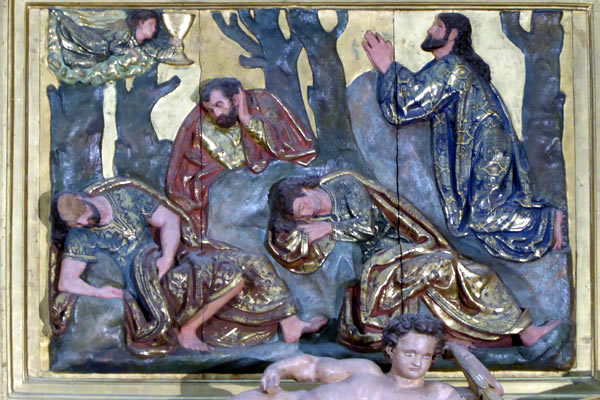
Prayer in the Garden of Gethsemane
According to the gospels, after the Last Supper Jesus went – together with Peter, James the son of Zebedee and John – to the Garden of Gethsemane to pray with his disciples. Knowing that he will be arrested and crucified, Jesus prays to God asking him “My Father, if it is possible, may this cup be taken from me. Yet not as I will, but as you will.” This means that Jesus as a man suffers under the imminent death, but he accepts God’s will.
Therefore, Jesus is depicted in this picture praying on his knees and with folded hands, while an Angel comes to offer him a chalice. The three apostles, who accompany him, are sleeping, in accordance with the description in the Bible.
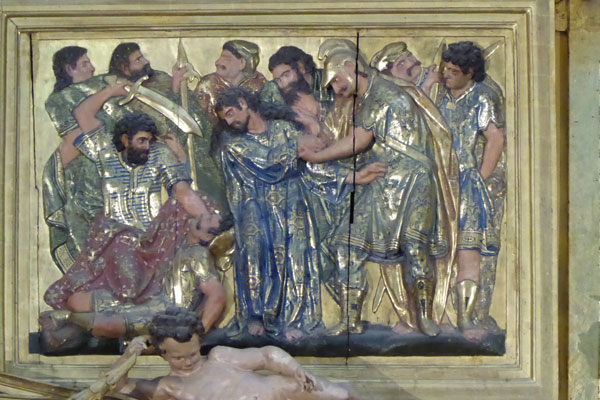
The arrest of Jesus
According to the gospels, the soldiers of Sanhedrin (the court of the jewish judges) come to Jesus, while he is praying in the garden of Gethsemane. Judas Iscariot, who betrays Jesus and makes it possible that the soldiers can arrest him, accompanies them.
In this picture, one of the guards detains Jesus, while his disciples try to prevent the arrest. Jesus in the centre of the picture is dressed with a blue tunic and inclines his head, as a sign that he accepts his fate.
Peter stands out, as he has knocked a soldier down, while he is raising a sword. According to the Bible, Peter cut off the soldier’s ear, but Jesus healed it miraculously. It is a very expressive scene, intensified by the gold colour shades of the polychromy.
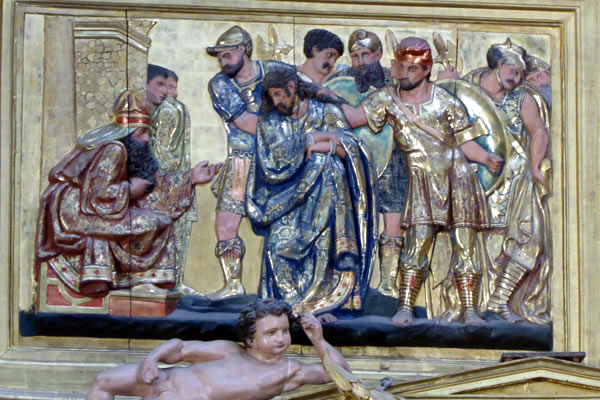
Jesus before Annas
According to the gospels, after having been arrested, Jesus was questioned by Annas, one of the priests who formed the court of the jewish judges, known as Sanhedrin. This picture shows the moment, when the judge, who is sitting and dressed with beautiful clothes, receives Jesus. The hands of Jesus are tied up and the guard pulls him by his hair.
The details of the soldiers’ clothes and some elements such as helmets, lances or shields stand out.
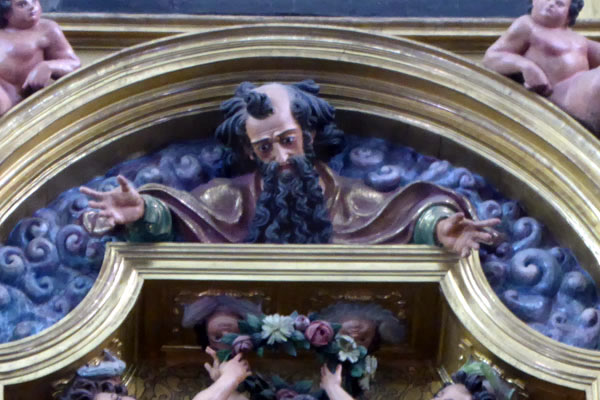
God the Father
This picture is located above the one of the Assumption of Mary and depicts God the Father as an old man with a long and frizzy beard. He is surrounded by clouds and opens his arms to receive Mary in the Glory. The carving of the sinuous-shaped clouds attract attention and makes the scene more dynamic.
His gesture stands out, which is emphasised by the polychromy. He is accompanied by two naked Angels, which imitate figures from the Italian sculptor Michelangelo.
Between rows (two by two and top to bottom)
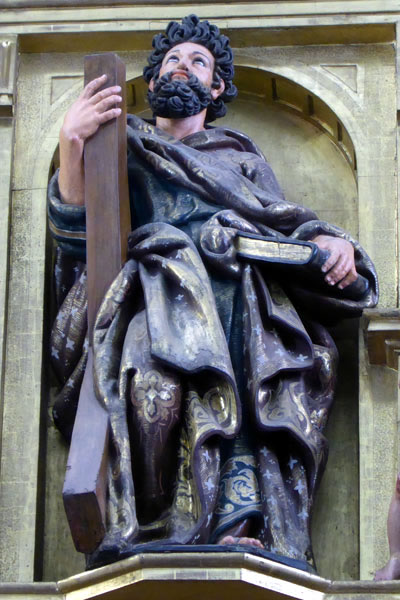
Saint Andrew
According to the gospels, Andrew was one of the twelve apostles who accompanied Jesus of Nazareth. He was the brother of Peter and probably the first of the disciples to be called by Jesus. According to his legend, he preached in Thrace (a region in today’s Greece, Bulgaria and Turkey) where he was sentenced to be whipped and bound to an X-shaped cross (known as the “Saint Andrew’s cross”) until he dies. The saint carries a closed book in his left hand – symbolising him as apostle – and the Saint Andrew’s cross in his right one, which stands for his martyrdom.
His face, the curly hair and beard, and the beautiful polychromy of his garment attract attention.
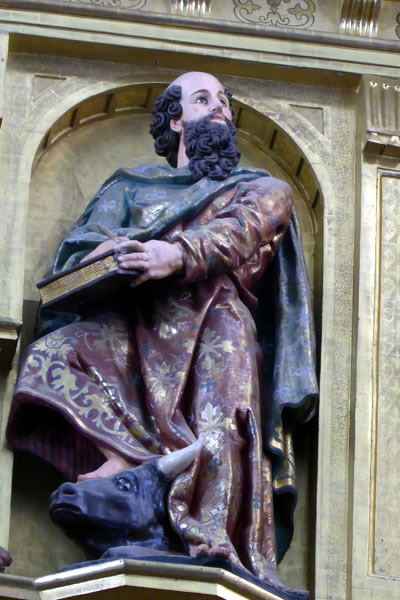
Saint Luke
According to the Bible, Luke was one of the disciples of Paul of Tarsus. The christian tradition ascribes him two books of the Bible: one of the four gospels which are directly inspired by Good and the Book Acts of the Apostles. He is commonly depicted with a bull, in this case next to his feet. It is the symbolic animal for the third evangelist. Furthermore, he carries a book in his left hand and a feather with his right one, as allusion to his texts.
His facial expression stands out, due to the carving of his hair and beard. He turns his head towards heaven to look for the divine inspiration. The colours of his clothes, which are decorated with golden motives, attract attention.
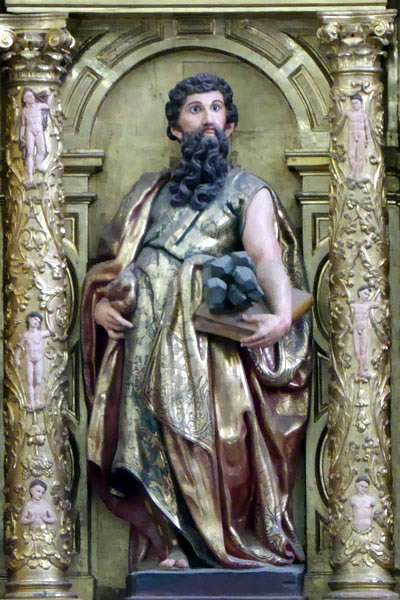
Saint Barnabas
According to the Bible, Barnabas was a pious man who converted to christianity. He sold his properties and shared the money with the apostles. After having converted to christianity, he accompanied Paul of Tarsus to his homilies. According to the tradition, the jews stoned Barnabas to death in Salamis on the isle of Cyprus. Therefore, he is depicted with a book, which symbolises him as disciple of Jesus, and a pile of stones in allusion to his martyrdom.
The sculpture stands out for its slightly tilted posture, which looks like the figure is moving and it resembles sculptures from Michelangelo. The similarity to Michelangelo is obvious in the carving of the hair and beard, as well as in the very muscular and uncovered left arm.
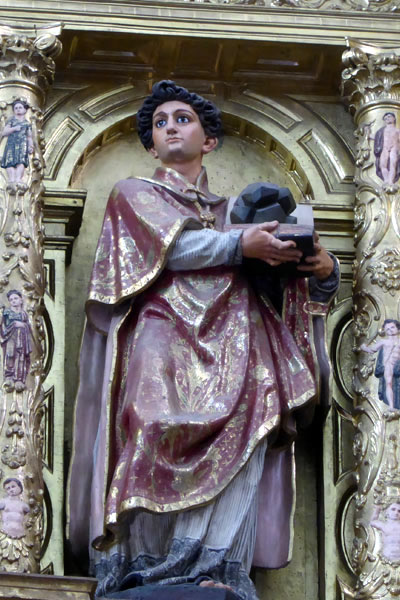
Saint Stephen
According to the Bible, Stephen was the first martyr of the christianity. He lived in the beginnings of the 1st century and was one of the deacons who were named by the apostles. He was accused of blasphemy and sentenced to death by stoning for his statements against the jewish church and against the commercial use of the temple in Jerusalem. The saint is depicted as young man, still without beard. He is dressed like a deacon with a short coat, opened on both sides and with sleeves to the elbow, called dalmatic.
He is holding a book and a pile of stones in his hands, in allusion to his martyrdom. The carving of the clothes stands out. The illusion of moving pleats is intensified especially by the red and golden colour of the dalmatic.
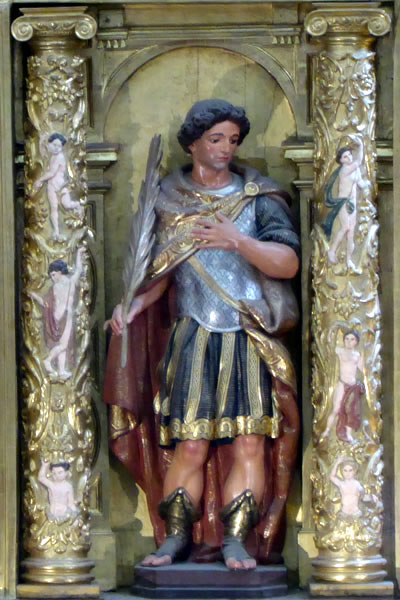
Saint Faustus of Milan
According to the tradition, Faustus was a Roman soldier from the 2nd century, who converted to christianity and was martyred for defending the christian faith. As a roman soldier, Faustus is depicted with coat, armour and a short skirt, which is proper to the roman army. In his right hand, he carries a palm leave, which symbolises the victory of the martyrs over the death.
The quality of the carving and the polychromy stand out. It imitates materials such as the cloth of the garment, the metal of the armour or the golden brooch on the coat.
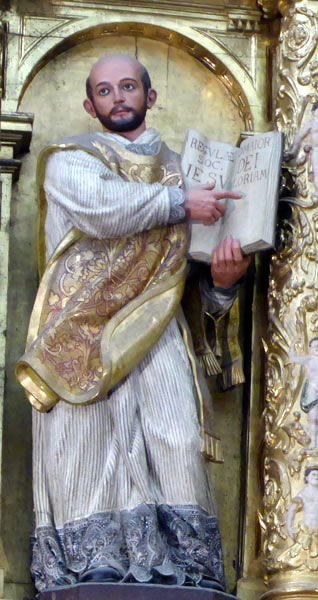
Saint Ignatius of Loyola
In 1534, Ignatius of Loyola founded the Society of Jesus, also known as the jesuits. He is depicted pointing with his right hand at the book in his left one, which describes the norms for the order. The book also contains the motto of the Jesuits Ad Maiorem Dei Gloriam, “for the greater glory of God”.
The picture stands out due to the careful use of colour and especially due to the movement of the clothes and the expressive gestures, which resembles some sculptures of Michelangelo.
Pedestal (lower part)
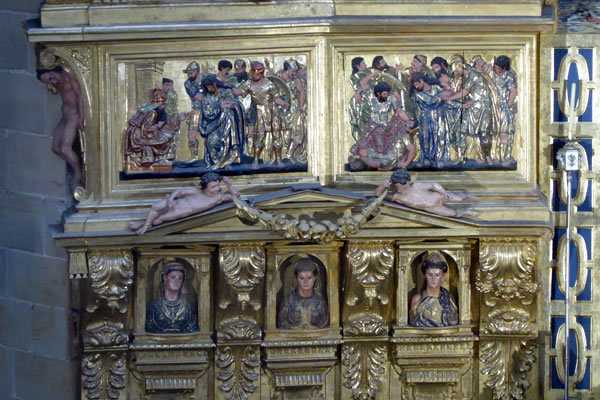
Reliquary caskets
On both sides of the central cross, on the lower part of the altarpiece, is a presentation of classical architecture, decorated with garlands and plants. As if the altarpiece were a building, there are windows in the lower part with busts of women. The six sculptures represent beautiful women with luxurious clothes and headdress. They contain relics of many other Saints who are venerated by the Catholic Church.
These reliquary busts are a rare element in altarpieces from Biscay, which makes the one of Durango exceptional.