
Altarpiece of Our Lady of Solitude
Collection of altarpieces
- Town: Bilbao
- Church: Saint John the Baptist and Saint John the Evangelist Church
- Location: Chapel of Our Lady of Sorrows (on the right side of the crossing)
- Artists: José de Egusquiza (architect), Martín Amigo (painter) and Ventura de Sugazu (gilder)
- Patron: Confraternity of Vera Cruz
- Chronology: 17th century (1694-1695)
- Style: Baroque
An altarpiece translated from the old Saint John the Baptist and Saint John the Evangelist church in Atxuri
Interactive altarpiece: click on the pictures to get more information.
Church:
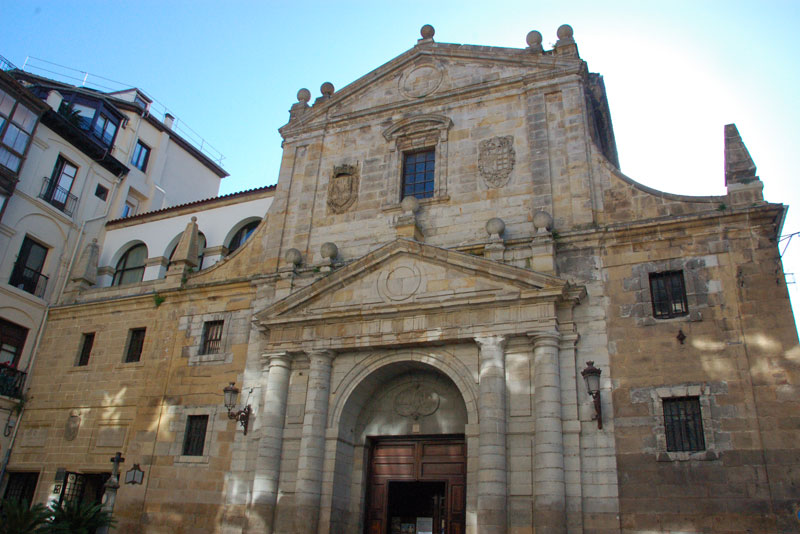
The Saint John the Baptist and Saint John the Evangelist church is located in the historic centre (Casco Viejo) of Bilbao, in the street “Calle de la Cruz”. It was founded by the Jesuits in 1617 as a church for the Saint Andrews college, which was located outside of the city wall, in a place which had not been part of the seven original streets of Bilbao.
As it is common for the jesuit churches, its ground plan forms a rectangle with chapels on both sides of the central nave.
Today, the cloister and the premises of the college are used by the Euskal Museoa – the Basque Museum.
Patronage:
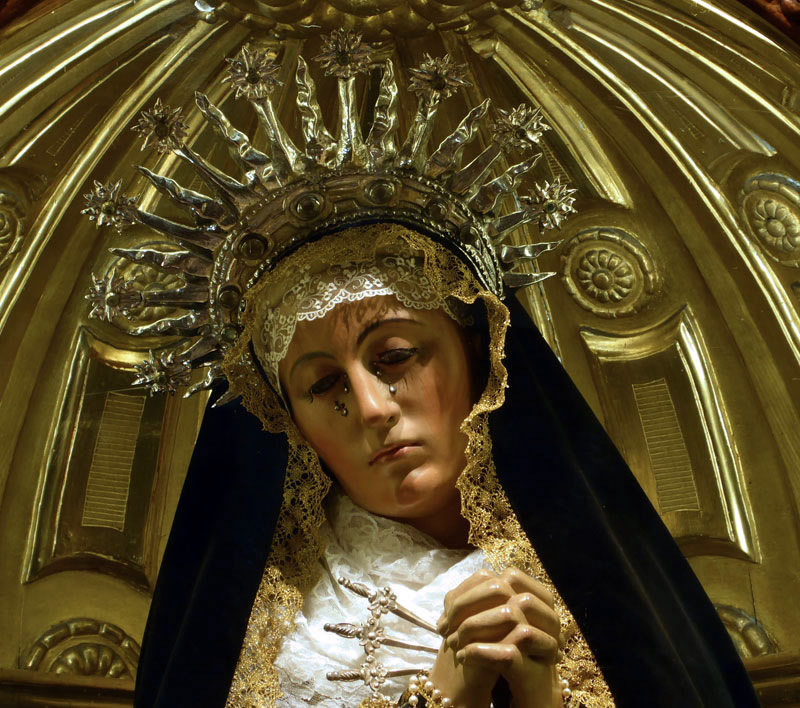
The catholic tradition describes seven sorrows of Mary during her life when she suffered due to her son. The Solitude is the last sorrow, from which she suffers after the burial of Jesus, whom she has to leave in the grave. Mary remains in solitude and awaits his Resurrection.
Therefore, she is depicted with a black coat, folded and strained hands and is crying anxiously about her son’s death.
Description:
The single body 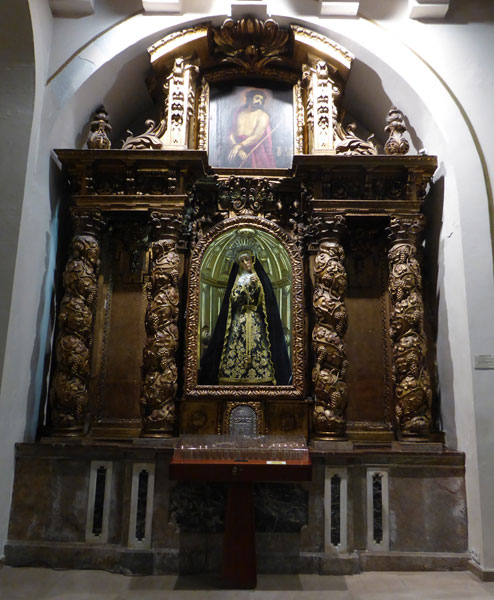
It is made of 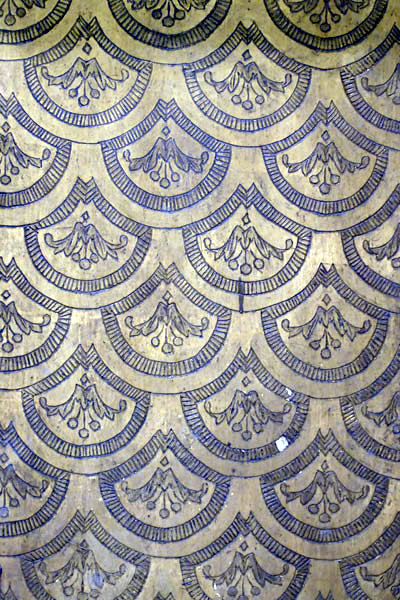
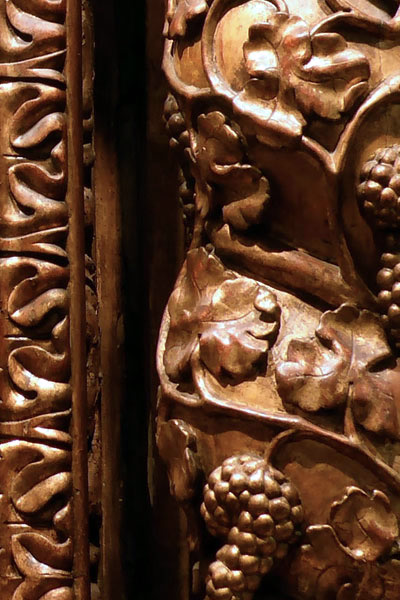

The combination of a sculpture with a painting in the same furniture is also something proper to the baroque style. In this case, the main picture is a sculpture, while the one on the top of the altarpiece is a rectangular painting.
History:
This altarpiece was ordered in 1694 by the confraternity of Vera Cruz, the oldest one of all existing confraternities in Bilbao (the foundation dates back to 1553). The work was built by the architect José de Egusquiza from Bilbao and cost 1500 spanish real.
The painter Ventura de Sugazu from Bilbao received 2915 Spanish real for gilding the furniture. Martín Amigo, also a resident of Bilbao, was paid 180 Spanish real for painting the picture Ecce Homo, which crowns the altarpiece.
The main picture, which is ascribed to the sculptor Raimundo Capuz, was brought from Madrid. The altarpiece was originally in the Saint John the Baptist and Saint John the Evangelist church in Atxuri, which nowadays no longer exists, and was translated in 1770. At that time, the Saint Andrew church no longer belonged to the Jesuits but became one of the parish churches in Bilbao and was named after the church in Atxuri.
Sculptures:
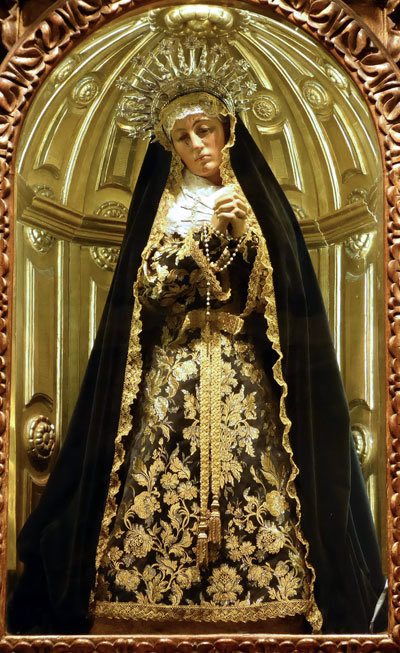
Our Lady of Solitude
The Virgin Mary has been depicted weeping bitterly about her son’s death. The sculpture is made of “clothes”, only the face and the hands are carved from wood. The body is a simple frame covered with the sculpture’s clothes.
During the Holy Week, this picture – ascribed to the sculptor Raimundo Capuz – is carried in procession by the confraternity of Vera Cruz.
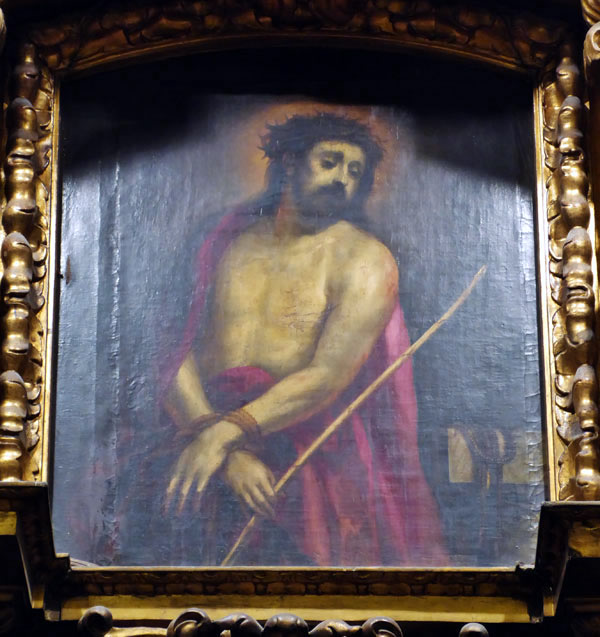
Ecce Homo
A painting of Jesus of Nazareth arrested, whipped and crowned with thorns, in the moment when the roman governor Pontius Pilate presents him to the Jews so that the people can choose whether they want him to be free or Barabbas. Pilate presented him saying in Latin: “Ecce Homo”, which means, “Behold the man”.
In this painting, Jesus is depicted with an uncovered chest and tied up hands. He wears a scarlet robe, is crowned with thorns and carries a staff in his right hand. These elements are a mockery of the proper attributes of kings. According to the gospels, after Jesus had been arrested, the soldiers clothed him with royal attributes to mock him for calling himself king of the jews.
It is a work of the painter Martín Amigo.