
Altarpiece John the Evangelist
Collection of altarpieces
- Town: Bilbao
- Church: Saint John the Baptist and Saint John the Evangelist Church
- Location: Chapel of Saint John the Evangelist
- Artists: Juan de Echevarría (planner) and Santiago de Castaños (architect)
- Patron: donations from private persons and from institutions (Council of Bilbao)
- Chronology: 17th century (1683)
- Style: Baroque
A Saint John from the 18th century in a former jesuit altar
Interactive altarpiece: click on the pictures to get more information.
Church:
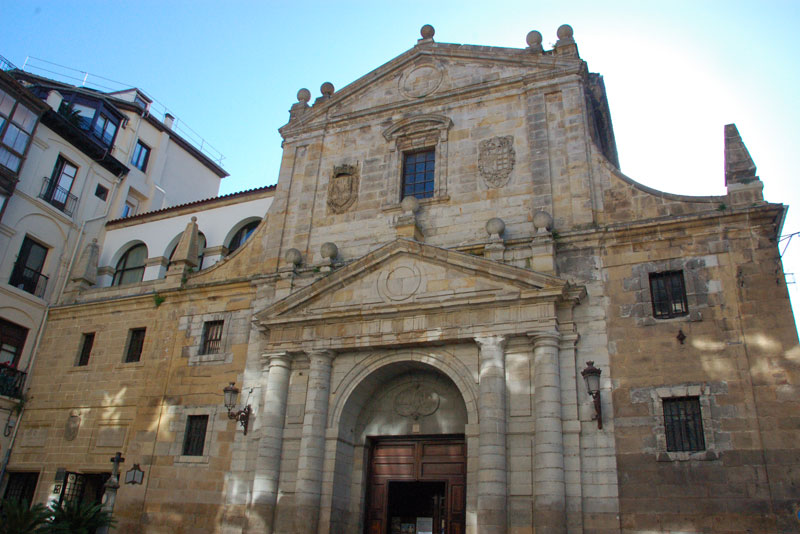
The Saint John the Baptist and Saint John the Evangelist church is located in the historic centre (Casco Viejo) of Bilbao, in the street “Calle de la Cruz”. It was founded by the jesuits in 1617 as a church for the Saint Andrews college, which was located outside of the city wall, in a place which had not been part of the seven original streets of Bilbao.
As it is common for the jesuit churches, its ground plan forms a rectangle with chapels on both sides of the central nave.
Today, the cloister and the premises of the college are used by the Euskal Museoa – the Basque Museum.
Patronage:
John was one of the twelve apostles. When he was a young man, he and his brother James were called by Jesus to be his disciples.
During the persecution under the roman emperor Domitian, about 50 years after the death of Christ, John was send into exile to the island of Patmos in the Aegean Sea (today’s Greece). There, according to the tradition, he had the vision of the end of the world, the Apocalypse, on which he reports in the last book of the Bible.
He is also the author of one of the four gospels which the catholic church acknowledges as true and directly inspired by God.
Descripción:
A single-piece 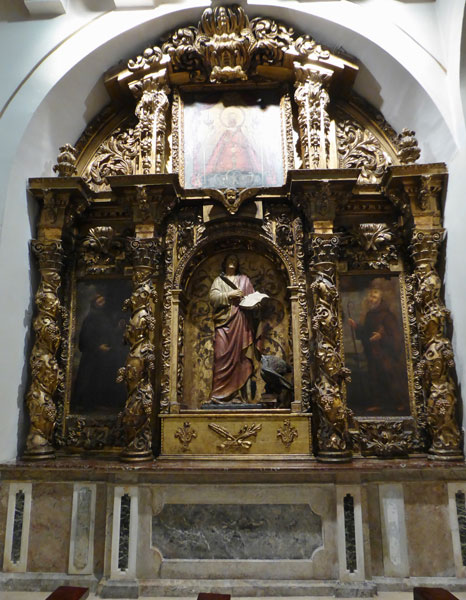
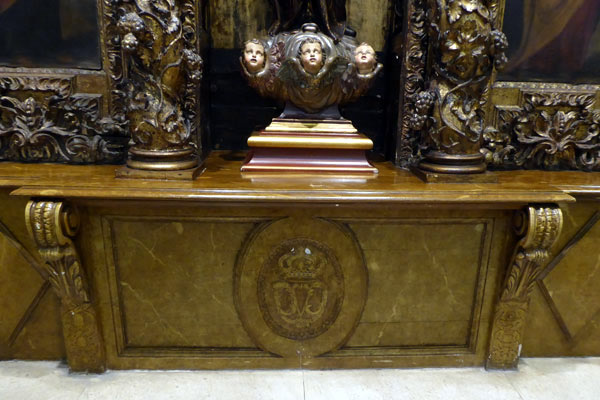
It has a plinth or bench with an attached altar table; a central section divided into three sections by twisted 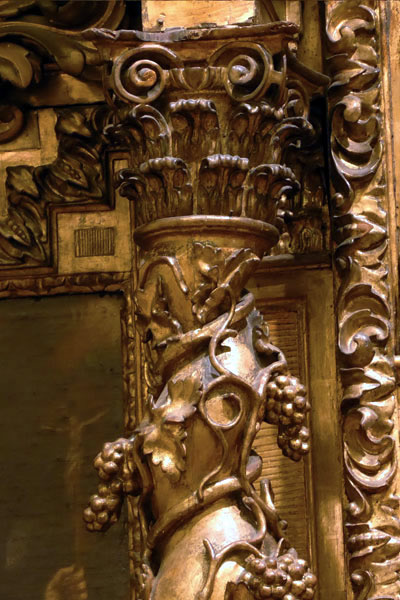
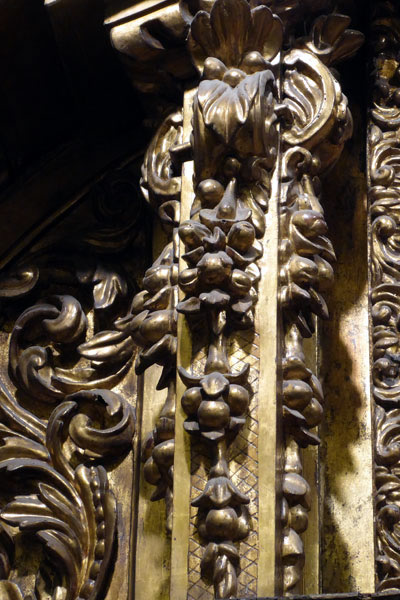

In terms of polychromy, the painting of fine lines on the golden background behind Saint John stands out, made using a technique called 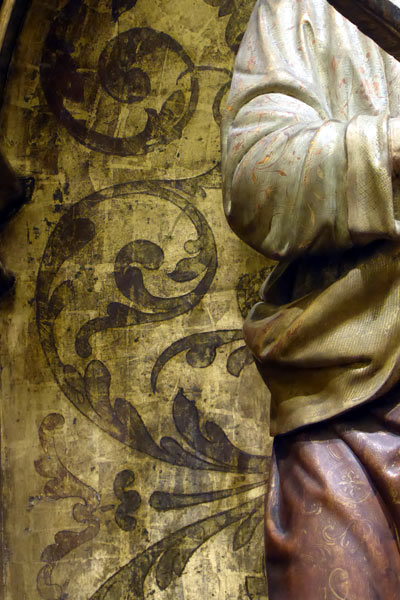
History:
In 1683, the director of the Jesuits Saint Andrews college (today Saint John the Baptist and Saint John the Evangelist church) ordered this altarpiece, which originally was dedicated to Saint Francis Xavier, one of the most important saints of the Society of Jesus.
The works cost 300 pesos and were made by Santiago de Castaños, an architect from Bilbao, in accordance with the construction plan of another architect, Juan de Echevarría.
In 1770, the patronage of the altarpiece changed to Saint John the Evangelist. This was at a time when this church no longer belonged to the jesuits and became one of the parish churches in Bilbao.
Sculptures
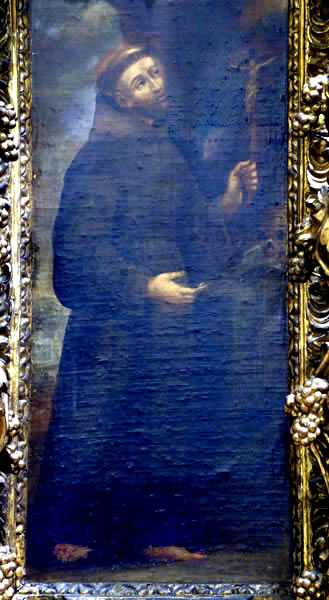
Saint Francis of Assisi
Francis was the son of a wealthy mercer from the town of Assisi (today’s Italy). As a young man, he decided to relinquish his money and founded the franciscan order. The order’s members have to take three vows or solemn promises: chastity, obedience and above all poverty. Therefore, Francis is depicted barefoot wearing the habit of his order and the cincture with three knots standing for the three vows. He holds a crucifix in his left hand and next to him is a skull, which symbolises his meditation on the caducity of life and the imminence of the death.
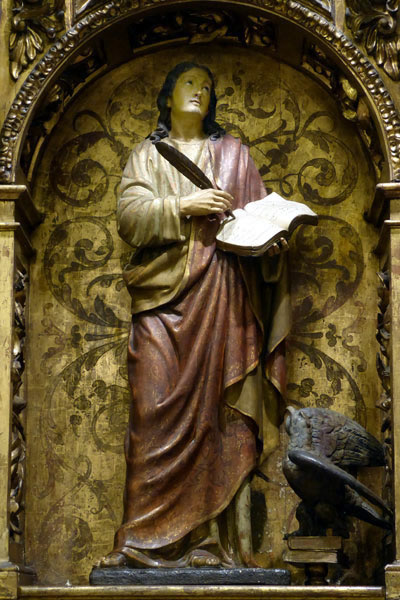
Saint John the Evangelist
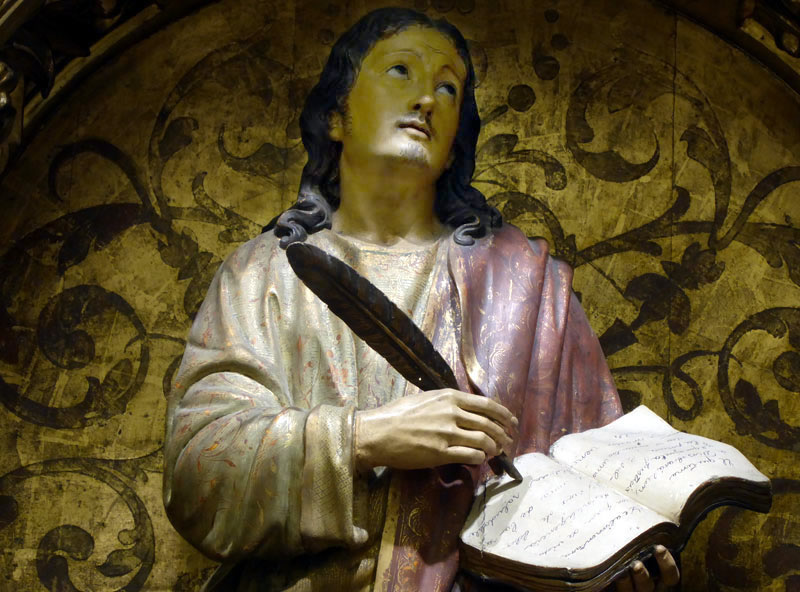
John is the author of one of the four gospels which the catholic church acknowledges as true and directly inspired by God and are part of the Bible. Each Evangelist has a symbol: John is the eagle, which accompanies him in this sculpture from the 18th century. Juan is depicted as a young man without beard.
It seems like he is writing with the feather in his right hand into the open book he is holding in his left one, while he is turning is eyes towards heaven searching for the divine inspiration.
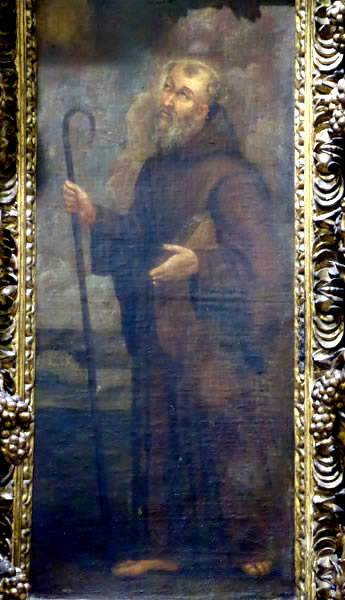
Saint Francis of Paola
Francis was born in the town of Paola (today’s Italy) and since a very young age, he wanted to live a life of devotion and prayer. At the age of 24, he decided to seclude himself to live like a hermit in an inaccessible place. Other men joined him in his retreat and they formed the order of the poor hermits of Saint Francis of Assisi, which soon became known as the order of Minims.
The Saint wears a monk’s habit and carries a book under his left arm, while he is holding a walking stick with his right hand.

Virgin of Begoña
The Virgin of Begoña is one of the most venerated pictures of Mary in Bilbao and Bizkaia.
In this picture, the Virgin wears a beautiful coat and the Child is sitting on her lap. She holds a fruit in her right hand and is crowned by two angles.