
Altarpiece of Saint Blaise
Collection of altarpieces
- Town: Bilbao
- Church: Saint Nicholas of Bari Church (Bilbao)
- Location: Gospel Side (the left nave of the Church), next to the entrance
- Artists: Diego Martínez de Arce (architect and planner), Juan Pascual de Mena (sculptor), José López Perella (painter of the polychrome) and Ildefonso de Bustrín (painter)
- Patron: Council of Bilbao
- Chronology: 18th century (1754)
- Style: Baroque
A cord blessed on this altar by Saint Blaise will heal your throat
Interactive altarpiece: click on the pictures to get more information.
Church:
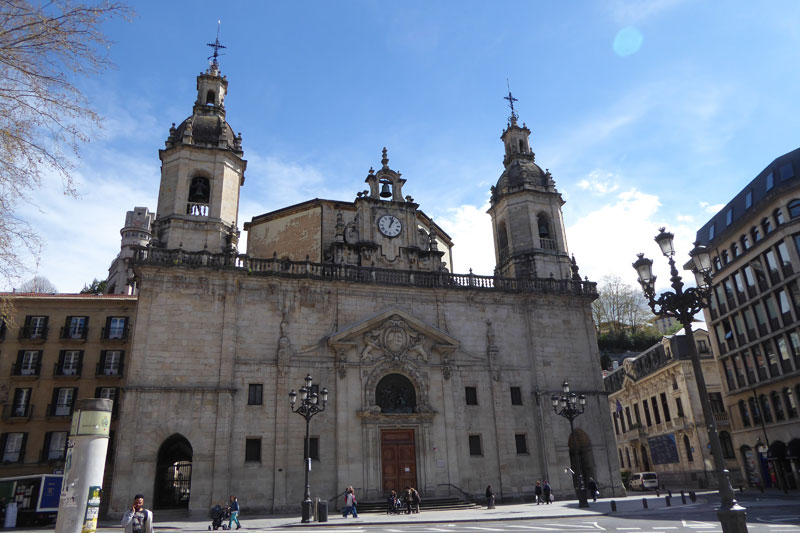
The Saint Nicholas of Bari Church is located on the promenade Arenal in Bilbao. The Church was constructed between 1743 and 1756 following the design of Ignacio de Ibero, the same architect who had been in charge of the construction work at the Sanctuary of Loyola in Azpeitia/ Gipuzkoa.
Originally, it was the parish church of the suburb of San Nicolás, a district located outside the city wall of Bilbao, where sailors met at the beach or promenade to ask their patron Saint, Saint Nicholas, for protection from storms.
It is a monumental church, which stands out due to its architecture, but also due to the magnificent collection of altarpieces inside.
Patronage:
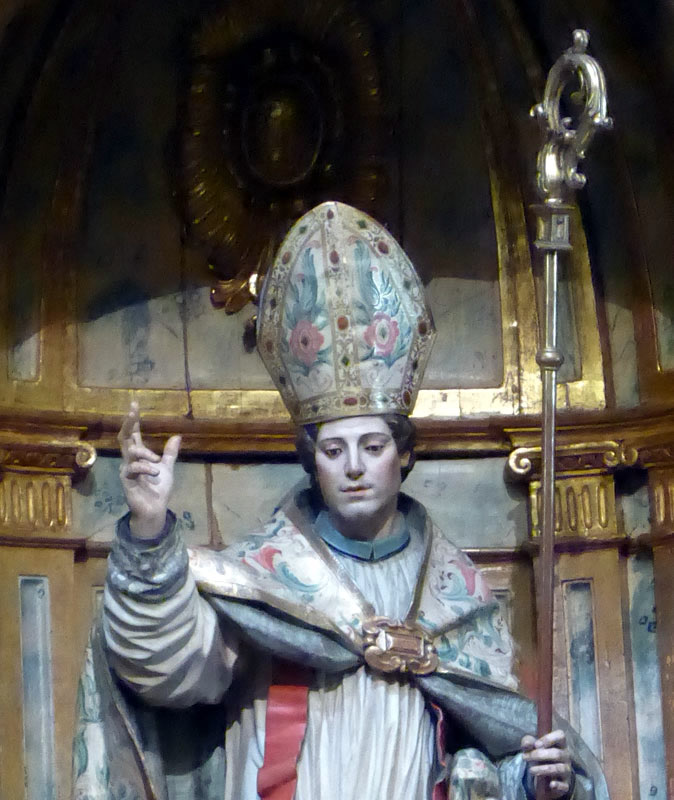
According to the tradition, Blaise was a doctor from Sivas (today’s Turkey), who converted to Christianity and retired from society to live as a hermit in a cave of Mount Erciyes. As he was known for being a pious man, the Christians in the region appointed him as their bishop. Therefore, he is portrayed with a mitre (the high and pointed hat used by bishops in solemn masses) and he holds in his left hand a crozier.
During his lifetime, he performed miraculous healings: The most famous was the rescue of a boy with a fishbone stuck in his throat.
This miracle led to the popular belief that wearing a blessed cord around the neck on February 3rd, which is the feast day of Saint Blaise, and praying a novena to the Saint, protects against sore throat.
Description:
This 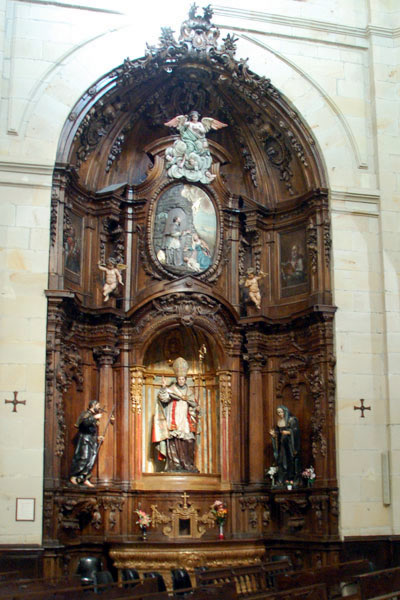
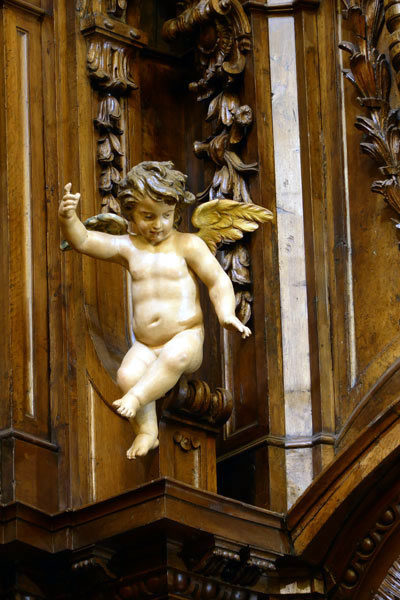
The altarpiece is dedicated to Saint Blaise, who occupies the central alcove, which is marked with Corinthian columns. Above the columns are two Angels or putti sitting on mouldings and on the laterals of the altarpiece are the sculptures of Saint Francis Xavier and Saint Rita of Cascia. Above the sculptures are the paintings of Saint Charles Borromeo and Saint Francis de Sales.
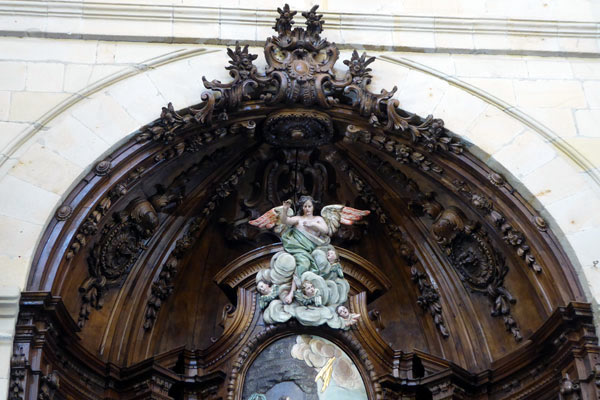
In the attic is a medallion, which shows one of Saint Blaise’s miracles: The healing of a moribund boy with a fishbone stuck in his throat. Above the medallion, in the eggshell, an 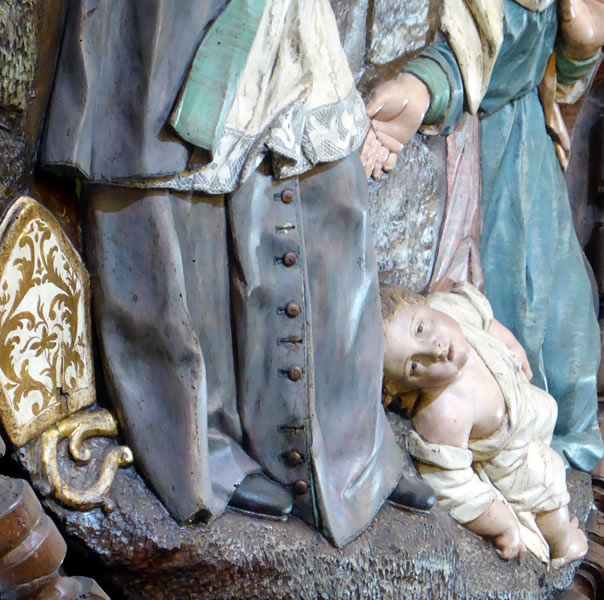
The entire architecture or 

History:
In 1752, the Council of Bilbao decided to place an order for a collection of altarpieces for the Saint Nicholas Church, which was under construction at this time.
For this work, three of the best artists, who worked at this time for the king’s court in Madrid, were commissioned: Diego Martínez de Arce, an architect from Valladolid, was responsible for the design or planning of the altarpieces; Juan Pascual de Mena, a sculptor from Toledo, concluded the pictures, which had been painted by José López Perella from Madrid. The two latter were teachers at the Real Academia de Bellas Artes de San Fernando (San Fernando Royal Academy of Fine Arts), the institution, which dominated at this time all aspects of arts. Important Basque artists, such as the architects Juan de Aguirre and Juan de Iturburu, or the painter Ildefonso de Bustrín, who was in charge of the paintings, collaborated with the two teachers.
The altarpieces were refurbished between 2007 and 2011.
Sculptures:
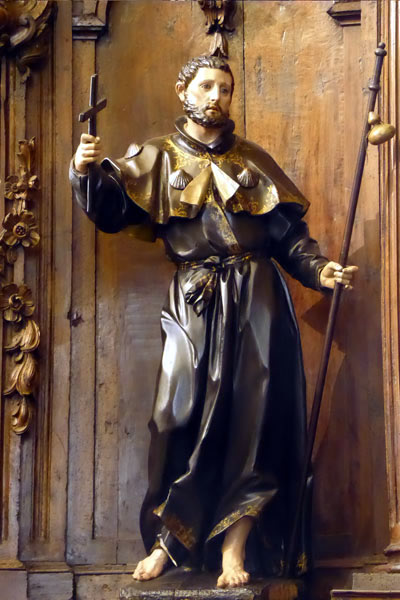
Saint Francis Xavier
Saint Francis Xavier was a Saint from Navarre, who announced the gospel in India, Ceylon (Sri Lanka), Japan, etc. Together with Ignatius of Loyola, he founded the Jesuits (1539). Alluding to his pilgrimage as missionary, he is depicted with the clothes of pilgrims and with scallop shells and a stick with the pumpkin in his left hand, which he used as water bottle. He is discalced and holds a crucifix in his right hand.
The gilded polychromy stands out against the brown clothing. It is a work of the sculptor Juan Pascual de Mena.
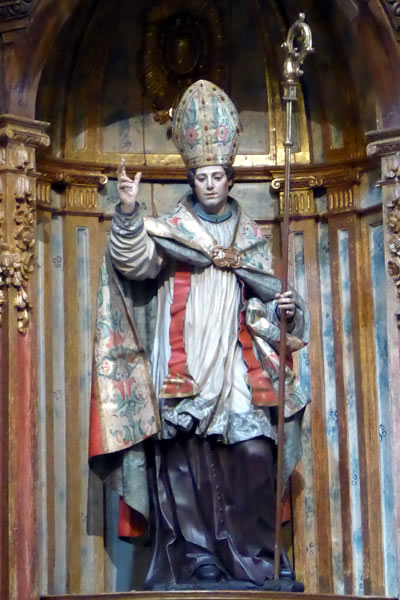
Saint Blaise
He is dressed like a bishop, with mitre and crozier, and raises the hand for the blessing. As his left leg is bended, it seem like he is walking.
The polychromy of the cope with the floral motives stand out. The pleats and work of the cloth make this sculpture a good example of carving.
It is a work of the sculptor Juan Pascual de Mena.
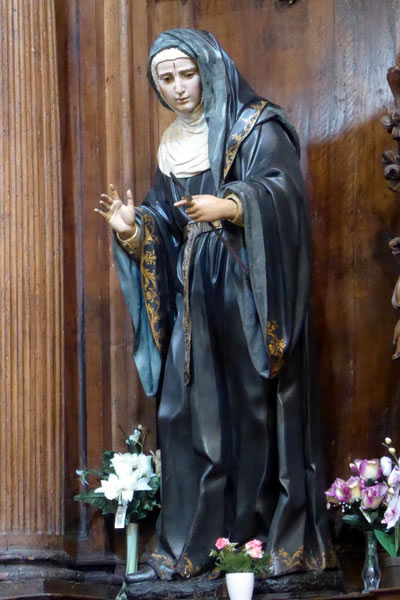
Saint Rita of Cascia
Rita of Cascia was an italian Saint, who joined an augustinian community of religious sisters after her husband’s death. According to the tradition, one day when she was praying, she identified with the sufferings of Jesus that a mark or stigma of the crown of thorns. Therefore, Rita is depicted with a splinter of wood in her forehead and a crucifix in her hand, in front of which she prays.
The polychromy stands out. The dark colour of her augustinian habit is contrary to the white veil and face and to the gilded edges of her clothes.
It is a work of the sculptor Juan Pascual de Mena.
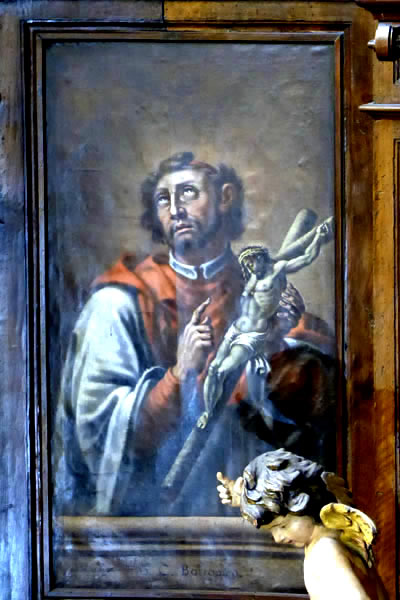
Saint Charles Borromeo
Charles Borromeo was a noble man from Italy, who was ordained priest and appointed cardinal in 1560 by pope Pius IV. He was noted for reforming the clergy and taking special care in founding seminaries.
He is depicted being dressed like a cardinal. The purple colour of his clothes stands out, which is contrary to the dark background. He looks towards heaven while he is praying and he holds a crucifix in his left hand, which stands out because of the way it is painted, as if it was a sculpture.
The painting is a work of Ildefonso de Bustrín.
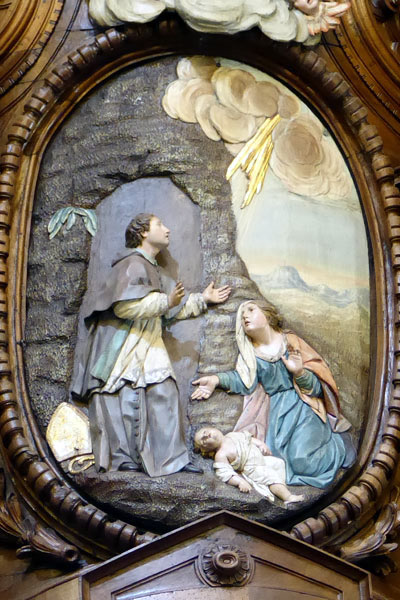
The miracle of Saint Blaise
A relief shaped as a medallion, which shows the moment when Saint Blaise rescued a boy from choking on a fishbone stuck in the throat.
The scene shows the moment when a mother brings her moribund son to the Saint. Saint Blaise, depicted with attributes of a bishop – mitre and crozier – next to his feet, is looking towards heaven and from the clouds and with golden rays, he received divine help to heal the boy.
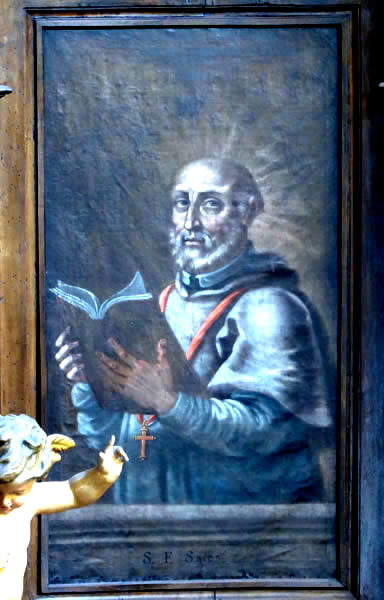
Saint Francis de Sales
Francis de Sales was a noble man, who was ordained priest in secret, concealing it from his father. He is dressed as a priest and wears red a cord with a golden cross around his neck.
He holds an open book in his hands alluding to the many literatures he wrote; therefore, he is the patron Saint of authors. A halo behind his head shows him as a Saint.
The painting is a work of Ildefonso de Bustrín.