
Altarpiece of Our Lady of the Rosary
Collection of altarpieces
- Town: Bermeo
- Church: Assumption of Our Lady Church
- Location: At the feet of the gospel side (the left nave of the church)
- Artists: Pedro Belaunzaran (planner) and José de Alcoverro (sculptor)
- Patron: Council of Bermeo
- Chronology: 19th century (1869-1871)
- Style: Neoclassicism
An altarpiece to protect farmers and sailors
Church:
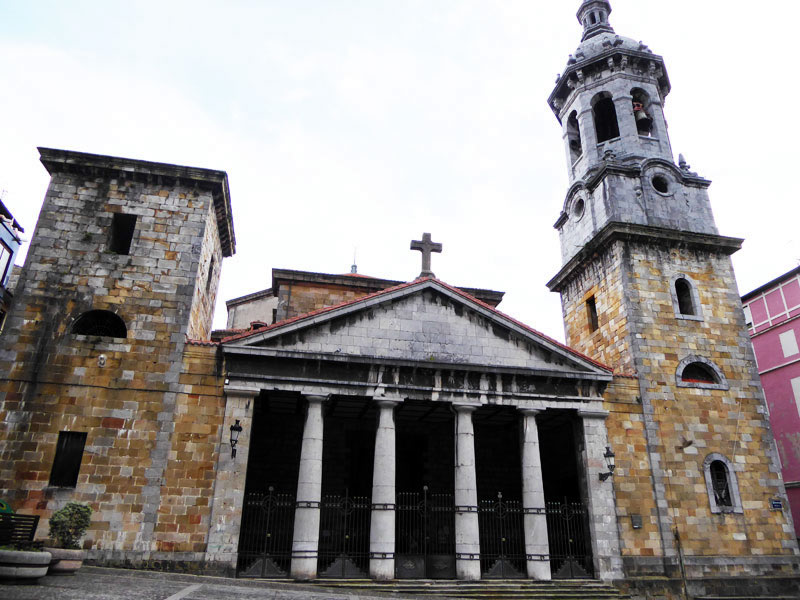
The parish church dedicated to the Assumption of Our Lady was constructed at different periods in the 19th century (1820/22 – 1869) and was designed by the architect Silvestre Pérez. The main portal protrudes from the building, its columns and triangular gable roof resembling an ancient greek temple. The church is flanked by two towers. The tower on the left side is unfinished, and that on the right, completed in the 19th century, functions as the belfry. The church’s ground plan with four equal arms forms a greek cross, which is surmounted by a large central dome. Inside the church, between the arches, supporting the dome, there are four altarpieces, above which are paintings, by Pablo Uranga from 1912, depicting the four evangelists.
Patronage:
The altarpiece is dedicated to the Virgin of the Rosary and refers to the miraculous apparition of Mary to Saint Dominic de Guzmán. According to tradition, Saint Dominic was in a chapel in the monastery of Prouihe, in southern France, when the Virgin appeared to him in 1028. She carried a rosary in her hands, which means, a string of beads separated ten at a time by another bead of a different size, joined at both ends to a cross. With this rosary the Virgin taught Saint Dominic how to pray a sequence of The Lord’s Prayer (1x), The Hail Mary (10x) and Glory Be (1x) to remember every single Mystery of Christ’s Life. Mary then asked him to spread this prayer among everybody he will meet on his way. Saint Dominic did so and taught the soldiers of Simón IV of Muret to pray the rosary before the battle of Monfort, which they won. The soldiers ascribed this triumph to the intercession of the Virgin. From this time onwards, the practice to pray the rosary spread throughout the entire christianity.
Description:
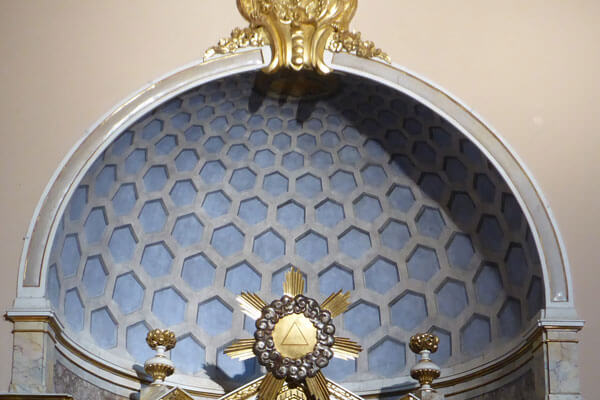
The 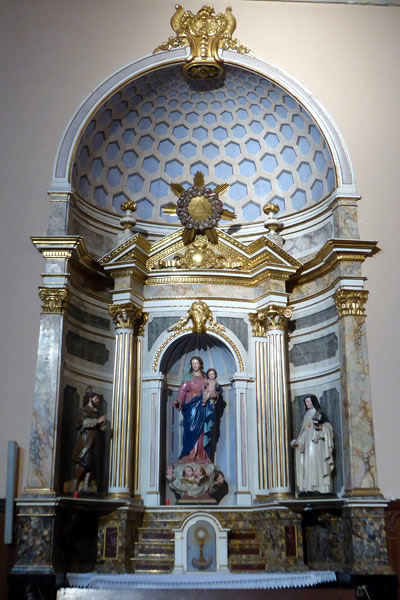

History:
The four lateral altarpieces of the Assumption of Our Lady Church were ordered by the council of Bermeo and paid by the locals. Furthermore, private people gave donations, such as the one of Andrés de Uriarte left in his testament, which was mainly used for the sculptures. The architect, Pedro de Belaunzaran, was commissioned to plan the design. Another architect, Pedro Lumbreras (1869), was in charge of the construction process and of the polychromy. The Catalan sculptor José de Alcoverro (1870-1871) made the pictures.
Sculptures:
Our Lady of the Rosary
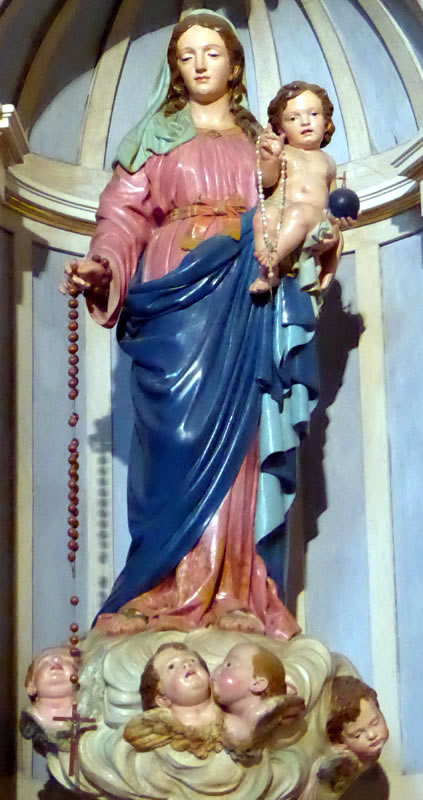
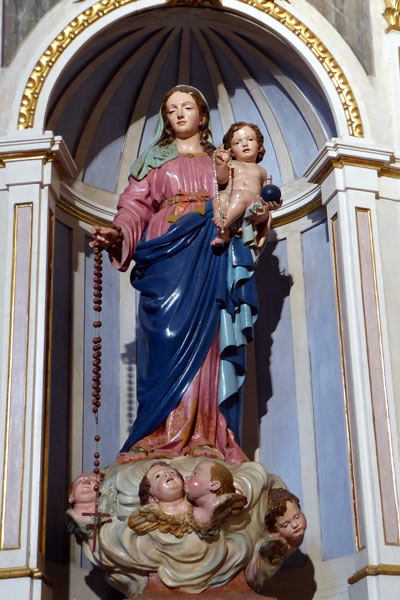
The sculpture of the Virgin appears on cloud from which the heads of angels poke out. The Virgin holds a large rosary in her right hand and the Christ Child in her left. The Christ Child is naked and has a rosary in his right hand, too. In the left hand, he holds a globus cruciger, an orb surmounted by a cross. The cross represents christ’s dominion over the orb of the world. The sculpture is of high quality, both in the details of the carving and the colour.
Saint Isidore
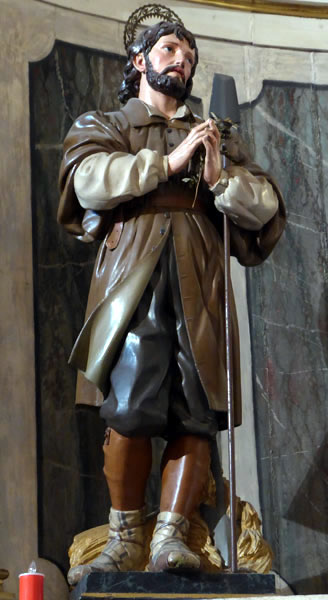
According to tradition, Isidore was a Cristian farmer who lived in the 12th century in Madrid and worked for the noble man Juan de Vargas. Isidore was a very pious man, who attended mass each morning and spent much of his time to prayer. That’s why he sometimes was late at work. His co-workers then denounced him of being lazy. The landowner wanted to verify the accusation and went to the field one morning to observe Isidore. Juan de Vargas was surprised seeing that the oxen pulled the plough by themselves and the work in the fields was miraculously carried out, while Isidore was praying. Therefore, Isidore is considered as the patron saint of farmers and he is portrayed as a peasant. His hands are folded in prayer and he carries a walking stick and a small bouquet of leaves. The quality of this sculpture is shown clearly in the fine details of the carving of the clothes and the footwear.

Saint Mary of Cervellione/ Mary of Help
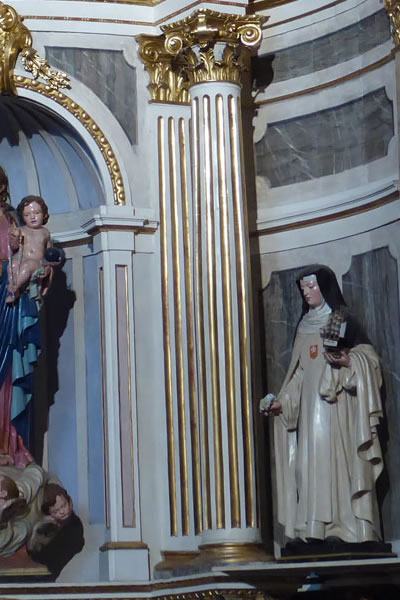
Maria de Cervello, who was named Mary of Help when she became a saint, was the first member of the second order of mercedarians. She is clothed in the habit of this congregation: white tunic, cloak and scapular and black bonnet and belt: on her chest, the order’s coat of arms depicted on the scapular According to tradition, she came miraculously to rescue boats in storms. Therefore, she is considered as the patron saint of sailors and she carries a boat in her left hand. The quality of this carving and the sculpture’s polychrome are noteworthy.