
High Altarpiece of the Assumption of Mary
- Town: Amorebieta – Etxano
- Church: Saint Mary Church
- Location: High Altar
- Artists: Juan Bautista de Jaúregui and Ignacio de Ibero (planner), Francisco de Munar and Luis de Foncueva (painters), Ramón del Solar and Jerónimo de Argós (sculptors)
- Patron: Parish
- Chronology: 18th century (about 1749-1752)
- Style: Baroque style
An altarpiece build with money from the Americas
Interactive altarpiece: click on the pictures to get more information.
Church:
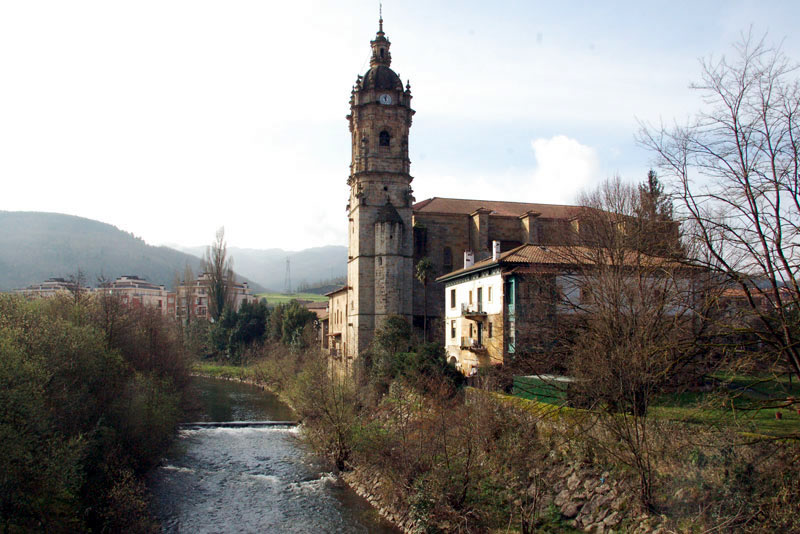
The Saint Mary’s church was built in the heart of the municipality of Amorebieta next to the river Ibaizabal. The church consists of one single nave whose construction started in 1556 – in the middle of the Renaissance. However, some pieces of a former late gothic building were used for the construction (lower part of the tower). Outside the church there is an impressive baroque belfry from 1774.
Patronage:
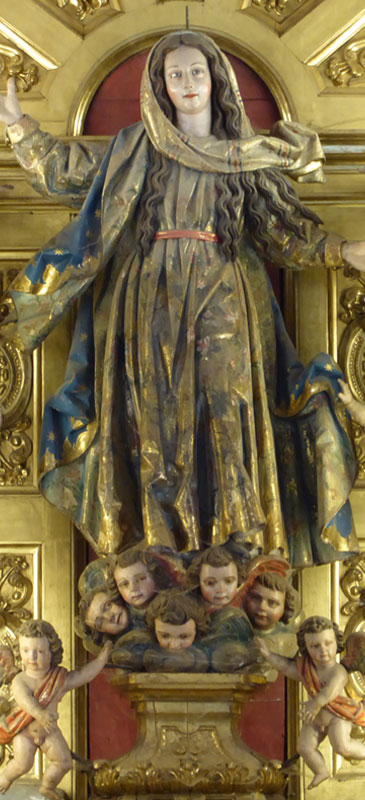
The church and its main altarpiece are dedicated to the Assumption of the Virgin Mary. According to the catholic tradition, at the end of her life Mary was taken to heaven and is – together with Jesus Christ – the only person whose body and soul is in Paradise without having to wait for the Last Judgement and the Resurrection of the dead. She is depicted on clouds and surrounded by angels, because they took up her body into the Glory.
Description:
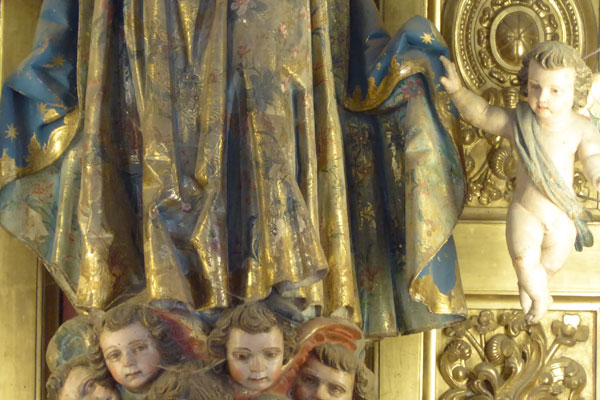
The 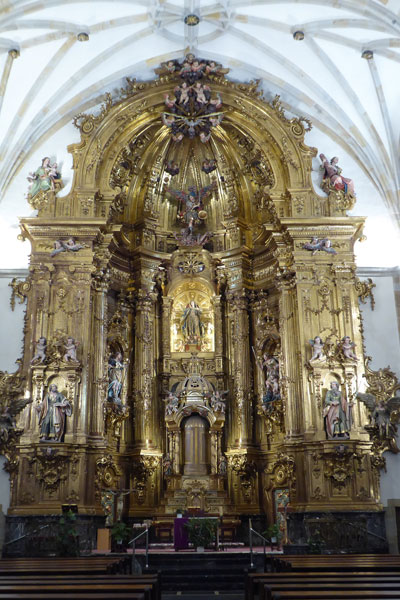

History:
The parish placed an order to construct an altarpiece with two important artists from Guipúzcoa (province in the Basque Country): the architects Juan Bautista de Jáuregui and Ignacio de Ibero. They drew the general design of the work, however Domingo de Gutiérrez, Juan de Avendaño – both are from Liendo (Cantabria) – and Juan de Iturburu from the municipality of Lekeitio were responsible for the material construction. The pictures were made by Ramón del Solar from Cantabria, except the sculpture of the Assumption of Mary in the central part. This work was probably carried out by Antonio de Alloytiz and derives from an old altarpiece from about 1650. The construction and wood work was completed in 1752. However, only 20 years later the pictures could be gilded and painted by Francisco de Munar and Luis de Foncueva, who also were from Cantabria. It means that the work could not be finished before 1778. All this work could be paid thanks to private donations, including those of two from Amorebieta who had made their fortune in Peru and Mexico: Martín de Celayeta and Domingo de Osoategui. The altarpiece was restored in 1999.
Pictures:
Lower part
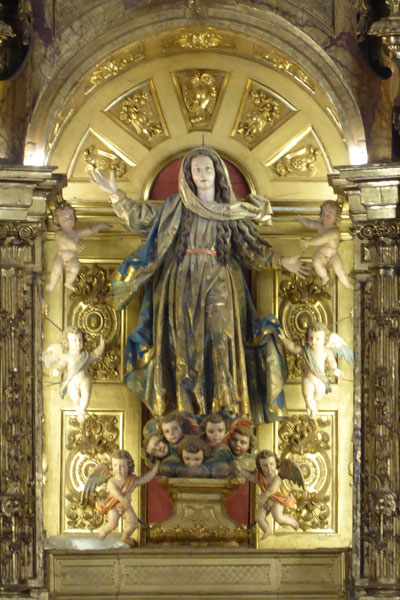
Assumption of the Virgin
Mary appears standing upright above clouds and surrounded by Angels. This picture was part of an old altarpiece and seems to have been made around 1650 by Antonio de Alloytiz.
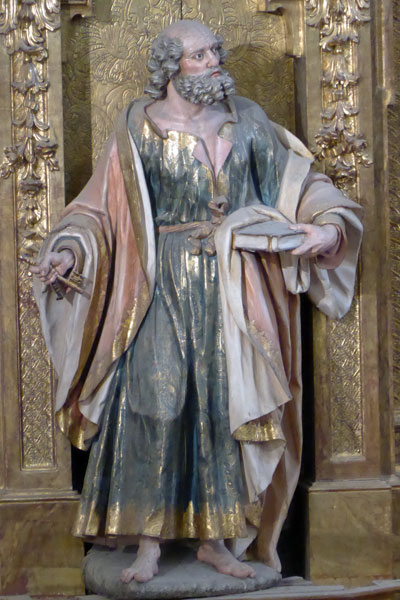
Saint Peter
Peter was one of the twelve Apostles. Jesus appointed him as his successor, that’s why Peter is considered as the first Pope of the catholic church. In this picture he can be recognised by the book in his left hand and the keys of the Kingdom of God in his right hand. This picture is a work of Ramón del Solar.
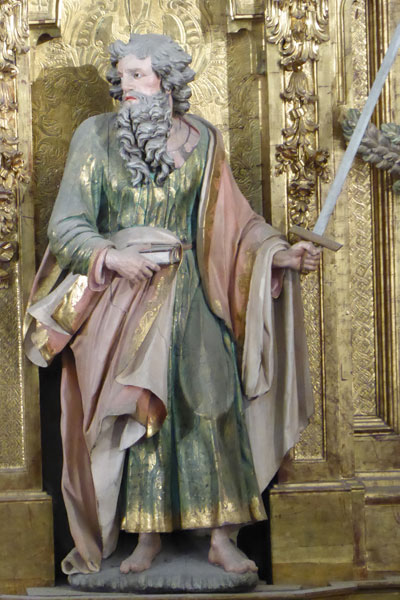
Saint Paul
Paul was one of the first missionaries of christianity, the religion to which he himself converted after Christ had appeared to him. In this picture, he is portrayed with the sword, symbolising his death by beheading, and the book, a reference to the text of the Acts of the Apostles and his fourteen Pauline epistles that are part of the Bible. The picture is a work of the sculptor Ramón del Solar.
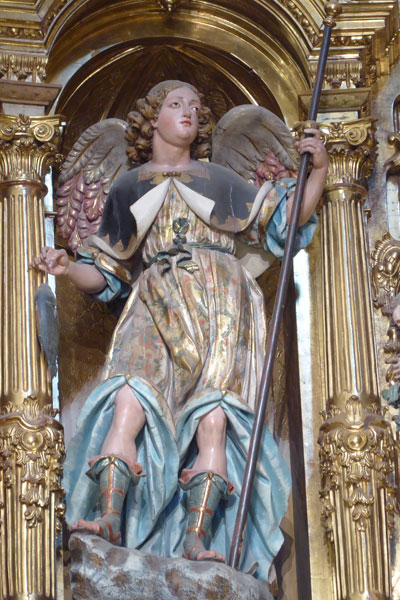
Archangel Saint Raphael
Raphael is one of the three archangels mentioned in the Bible. His name means “God has healed”, that’s why he is portrayed with a fish, with the gall of which he helped Tobias to heal the blindness of his father-in-law. Furthermore, he carries a walking stick, showing him as a walker and referring to the fact that he is – together with Saint Christopher, Saint Roch and Saint James – one of the patrons of the pilgrims. This sculpture is a work of Ramón del Solar.
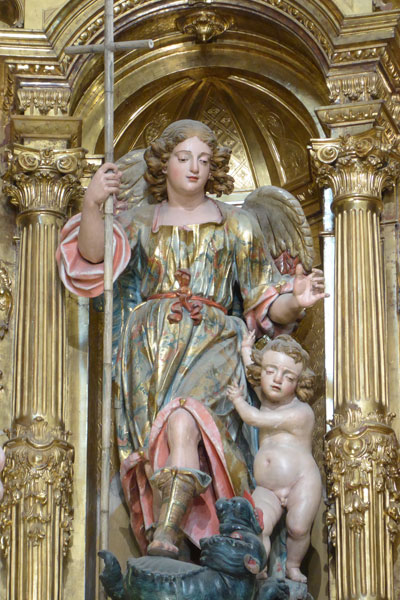
Ángel de la Guarda
According to the tradition, all christians have an Angel as a protector since their baptism. This picture shows the Angel accompanying a child to protect it from the dangers of the daily life. That’s why the angel is stepping on the dragon – the symbol of sin – and is carrying a cross which stand for the christianity. The picture is a work of Ramón del Solar.
Attic
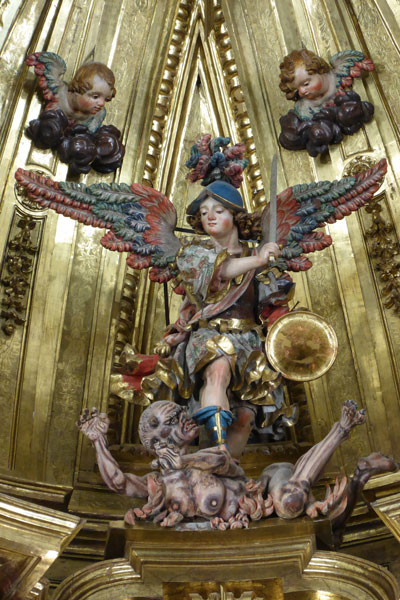
Saint Michael Archangel
Michael is one of the three archangels mentioned in the Bible. His name means “Who is like God?”. According to the tradition, Michael defeated Lucifer when he rebelled against God. That’s why Michael is portrayed as a soldier with helmet, suit of armour, sword and shield while he is stepping on the devil, which lies defeated at his feet. In this sculpture, by Ramón del Solar, the movement of the Angel’s clothes stands out.
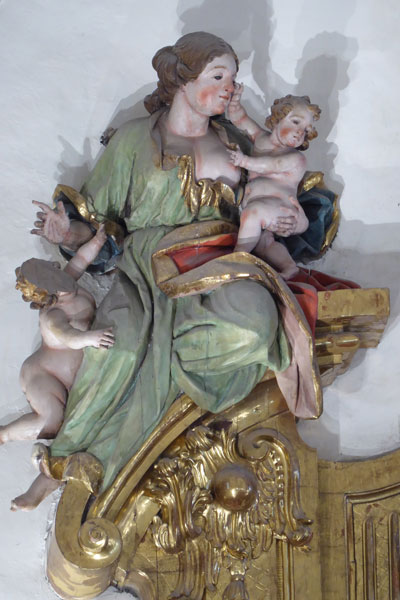
Charity
Charity is, together with Faith and Hope, one of the virtues which – according to the cristian religion – God pours in everybody. Charity means to have love for the Lord above all things and to have love for the neighbour as for oneself. Therefore, it is considered as the most important virtue. Charity is portrayed as a woman breastfeeding various children or, as it is in this case, holding them in her arms while showing her uncovered breasts. This is a work of the sculptor Ramón del Solar.
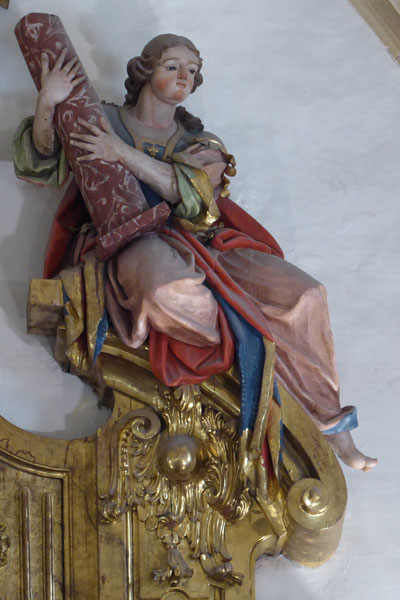
Fortitude
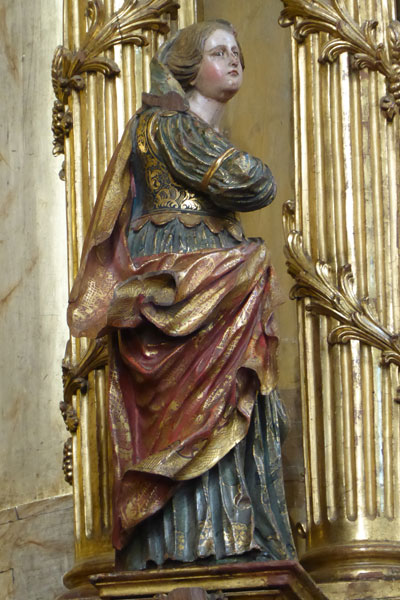
Fortitude is – together with Justice, Prudence and Temperance – one of the four virtues, which the catholic religion calls cardinal. The aim is that people who live according to these virtues achieve honesty. Fortitude means to overcome fear and to flee from recklessness. It is portrayed as a woman who carries a column as a symbol for her strength. The picture is a work of the sculptor Ramón del Solar.
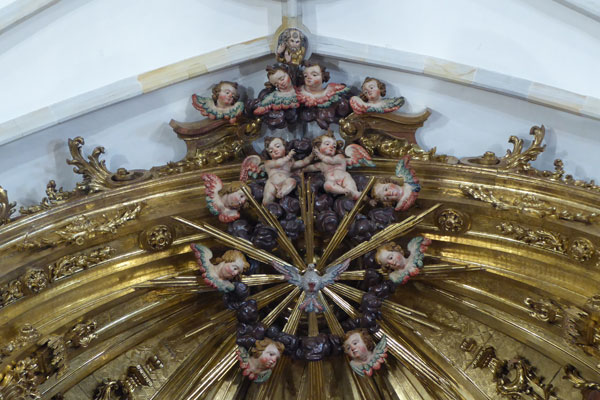
Holy Spirit
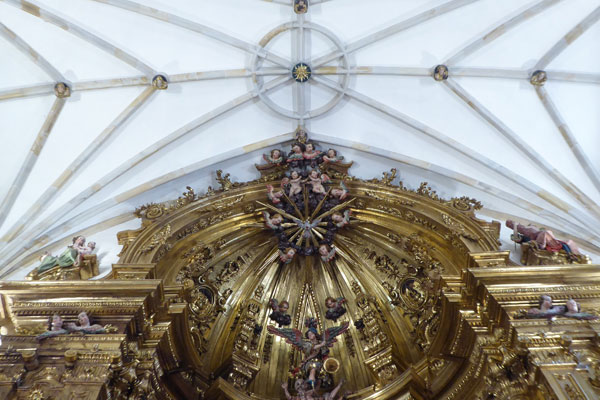
According to the cristian religion, the Holy Spirit is one of the three persons of the Most Holy Trinity. Together with God the Father and his son Jesus Christ, the Holy Spirit forms a single divine essence. The Holy Spirit is usually portrayed as a white dove, with outstretched wings forming a cross. In this case, the dove is surrounded by clouds and gilded lightning bolts and is accompanied by a group of Angels. The face of another person of the Trinity – God the Father -, located above the altarpiece in the meeting point of the church vault’s ribs, attracts attention. This completes the theological message of the work.