
Altarpiece of the Assumption of Mary (Gautegiz-Arteaga)
- Church: Assumption of Mary Church (Saint Mary) (Gautegiz Arteaga)
- Location: High Altar
- Artist: Juan Bautista de Belaunzaran (planner), Juan Bautista de Mendizábal II (sculptor) and Bernardo de Costa (painter of the polychromy)
- Patron: Parish
- Chronology: 1810-1811
- Style: Neoclassicism
A polemic controversial altarpiece at its time
Interactive altarpiece: click on the pictures to get more information.
Church:
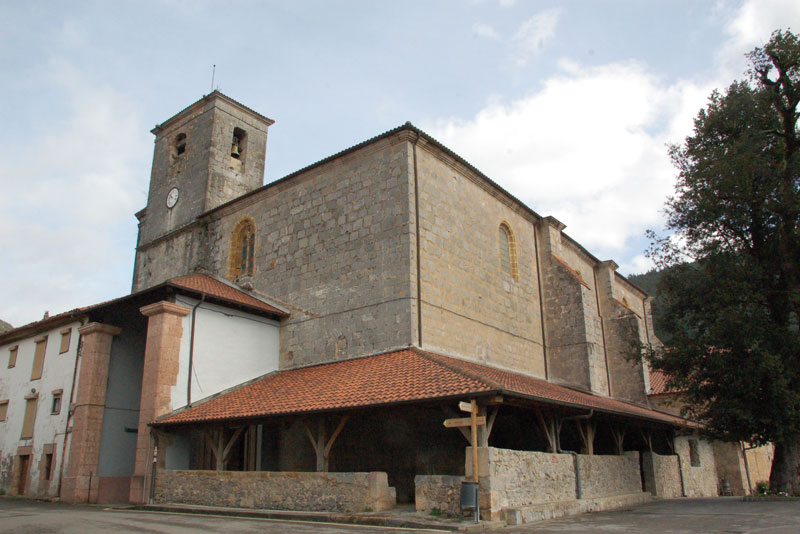
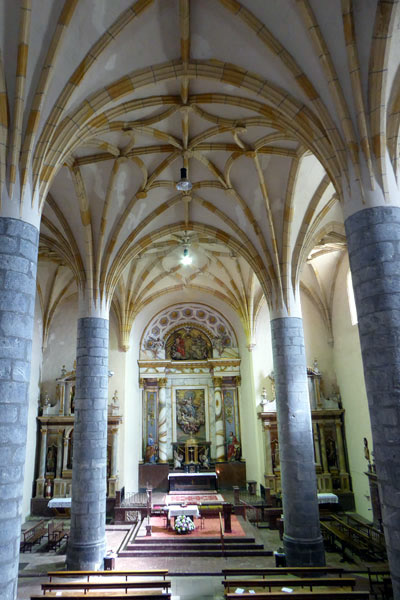
La iglesia de la Asunción de Santa María se encuentra en el barrio de Zelaieta, a las faldas del monte de Ereñozar, en el municipio de Gautegiz-Arteaga. Su portada sur, románica, nos habla de un templo de hacia 1200, pero su imagen actual corresponde a una reconstrucción de la segunda mitad del XVI. Se reedificó entonces siguiendo los gustos de la época, como una iglesia salón, es decir, con todas sus naves de la misma altura y las naves separadas por gruesas y elevadas columnas. Este tipo de templos, muy habituales en el País Vasco desde la centuria de 1500, se conocen con la expresión alemana 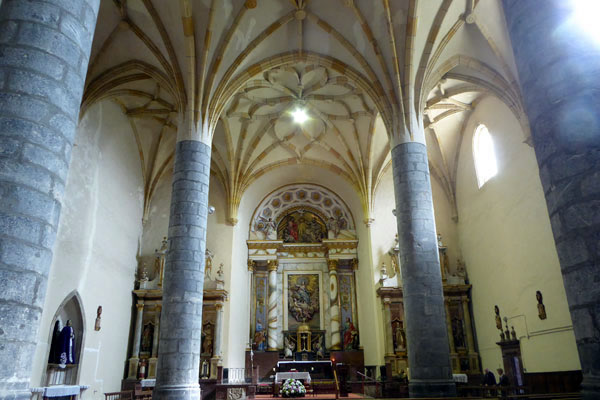
Patronage:
The church and the altarpiece are dedicated to the Assumption of the Virgin Mary. According to the catholic tradition, at the end of her life Mary was taken to heaven and is – together with Jesus Christ – the only person whose body and soul is in Paradise without having to wait for the Last Judgement and the Resurrection of the dead. She is depicted on clouds and surrounded by angels, because they took up her body into the Glory.
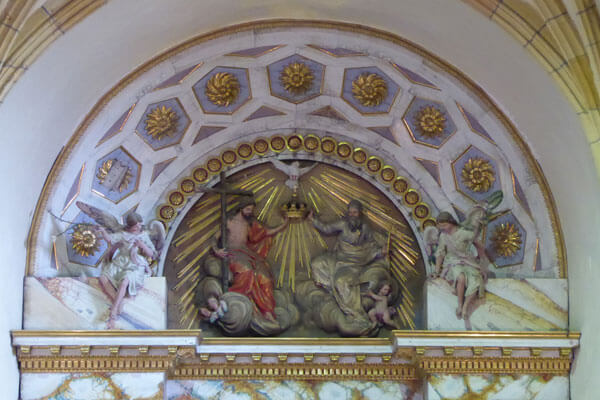
The altarpiece occupies the high altar of the church and is characterised by its spectacular architecture, which is inspired by examples from the ancient world, in particular from greek and roman temples. It consists of a pedestal, a body part and a semi-circular attic. Between big corinthian columns, the body part contains a relief of the Assumption of Mary, which is flanked by the sculptures of Saint Peter and Saint John the Evangelist. The attic shows the Glory with the Most Holy Trinity and one angel on each side. The collection is completed by a gilded pavilion-shaped 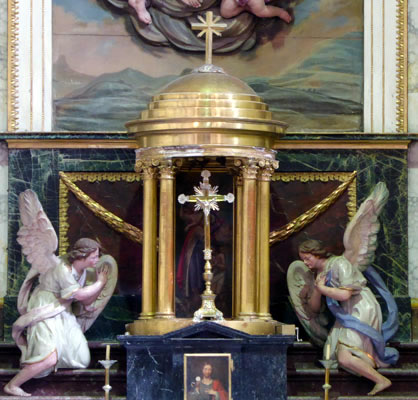
The painter of the altarpiece tried to imitate the 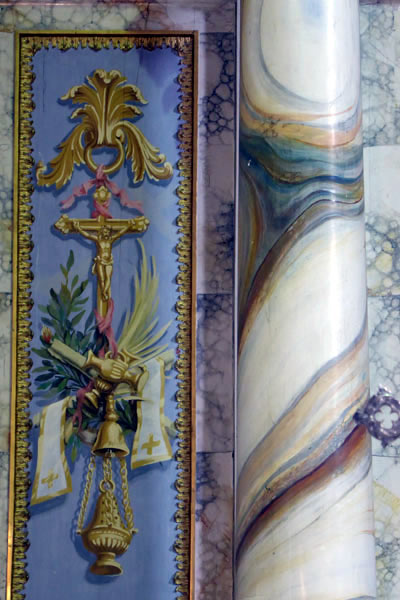
This altarpiece is an excellent neoclassical work and considered one of the most important in the Basque region.
History:
In 1810 the parish decided to build a new altarpiece for the Assumption of Mary church. An order was placed with two of the most important neoclassical artists of that time. The architect Juan Bautista de Belaunzaran, from Lekeitio, was in charge of the planning and Juan Bautista de Mendizabal II, from Eibar (Gipuzkoa), was responsible for the sculptures. His son Juan Bautista de Mendizabal III and the painter Bernardo de Costa from Bilbao helped with the polychromy. The works were paid partly from the parish and from the residence of Arteaga, who collected 36,000 Spanish Real (20,030 for the draft and the architecture, 10,200 for the sculptures and 5,770 for the painting of the altarpiece). This high financial investment was very controversial and considered an excessive spending for a small church in a rural municipality.
Sculptures:
Body
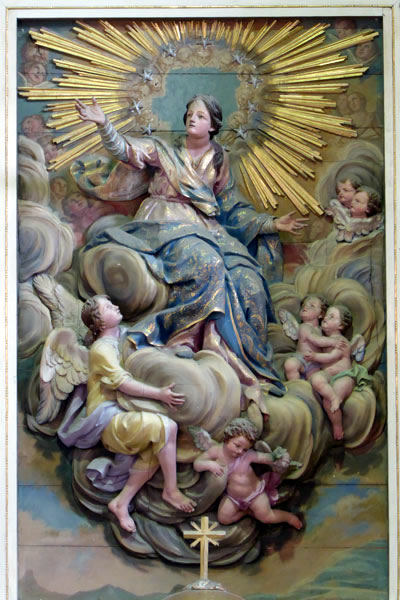
Assumption of Mary
According to the catholic tradition, at the end of her life Mary was taken to heaven and is – together with Jesus Christ – the only person whose body and soul is in Paradise without having to wait for the Last Judgement and the Resurrection of the dead.
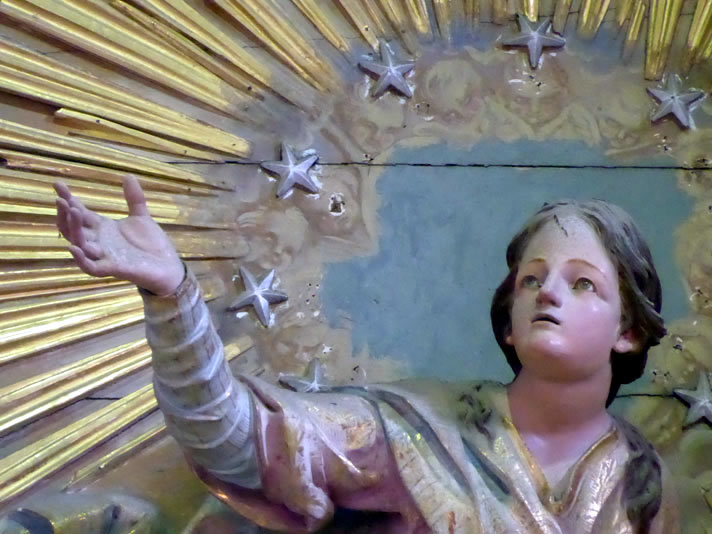
Mary is crowned with stars and surrounded by gilded lightning bolts. She is sitting on clouds and accompanied by angels, as they took her body up into the Glory.
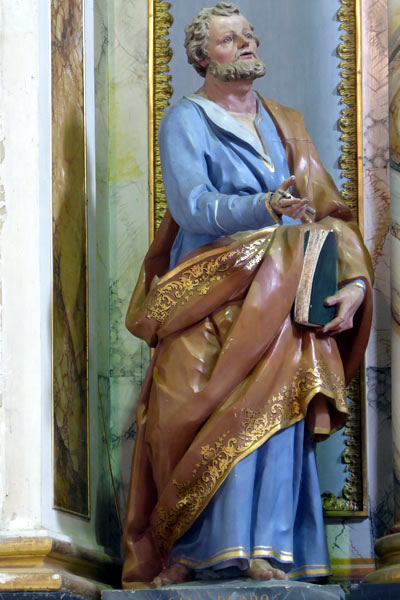
Saint Peter
Peter was one of the apostles and Jesus appointed him as his successor. Therefore, he is considered the first pope of the catholic church. Peter is holding a book in his left hand and the keys of the Kingdom of Heaven in his right one.
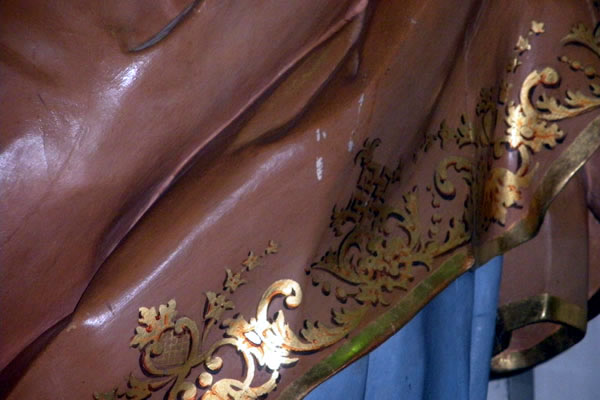
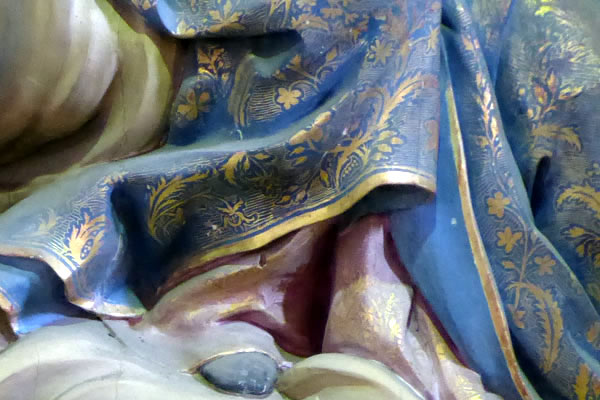
The polychromy of the garments and the golden details of the robe’s fringes stand out.
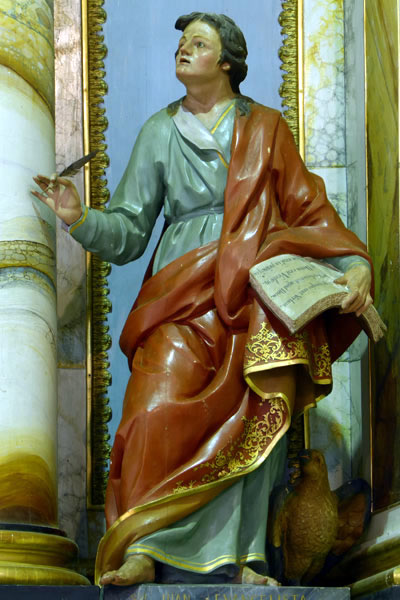
Saint John the Evangelist
John is the author of one of the four gospels in the Bible, which the catholic church considers as directly inspired by God. Each evangelist has an own symbol: the one for John is an eagle, which accompanies the saint in this sculpture. John is depicted as a young man without beard. He is holding an open book and the feather in his hands, while he is receiving the divine inspiration.
The polychromy of the clothes and the golden details of the robe’s fringes stand out.
Attic
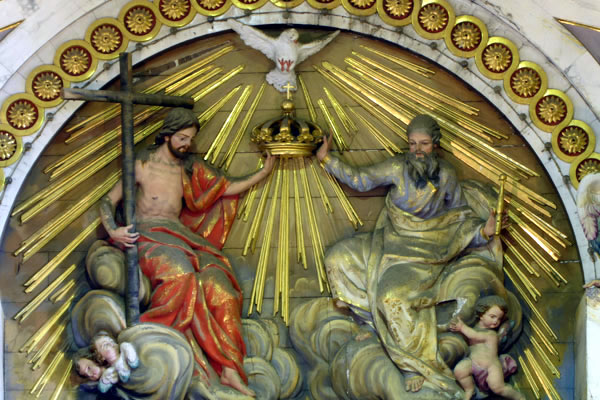
The Trinity
According to the tradition, after having arrived into the Glory Mary was crowned Queen of Heaven. Therefore, the Trinity, which is accompanied by angels, carries a large golden crown with a cross on top. For christians, the Trinity is the symbolic representation of God who exists in three persons: the Father, the Son and the Holy Spirit.
God the Father (on the right side) is depicted as an old man with a long beard. He is holding a sceptre in his left hand. God the Son (on the left side) is depicted as the Risen Christ, with the wound to his torso. He is dressed with red and golden clothes and carries the cross in his right hand. The Holy Spirit (between them) is depicted as a white dove with outstretched wings forming a cross.
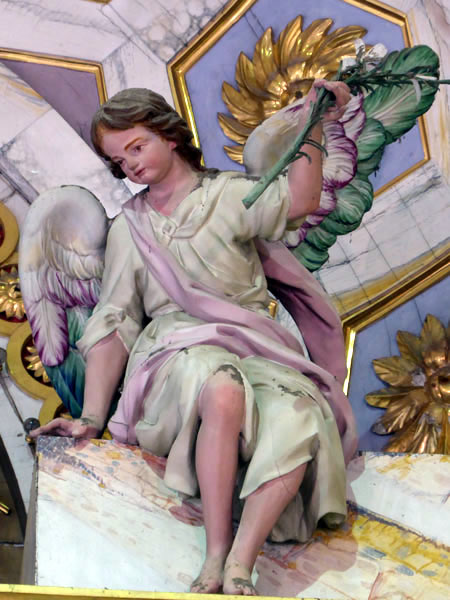
Angels with flowers
In the attic, next to the Trinity, are two Angels with blue flowers in their hand. It is an allusion to the purity and virginity of Mary.
Both Angels outstretch their wings and the left one holds the hand on his chest venerating the Mother of God.
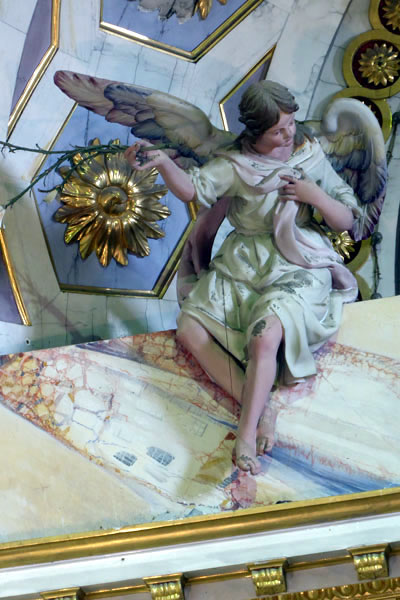
Angels with flowers
In the attic, next to the Trinity, are two Angels with blue flowers in their hand. It is an allusion to the purity and virginity of Mary.
Both Angels outstretch their wings and the left one holds the hand on his chest venerating the Mother of God.