
Altarpiece of Saint Nicholas of Bari
Collection of altarpieces
- Town: Bilbao
- Church: Saint Nicholas of Bari Church
- Location: High Altar
- Artists: Diego Martínez de Arce (architect and planner), Juan Pascual de Mena (sculptor), José López Perella (painter of the polychrome)
- Patron: Council of Bilbao
- Chronology: 18th century (1754)
- Style: Baroque
An altarpiece dedicated to Saint Nicholas, patron of the sailors, for the Church that protected the old port of Bilbao
Interactive altarpiece: click on the pictures to get more information.
Church:
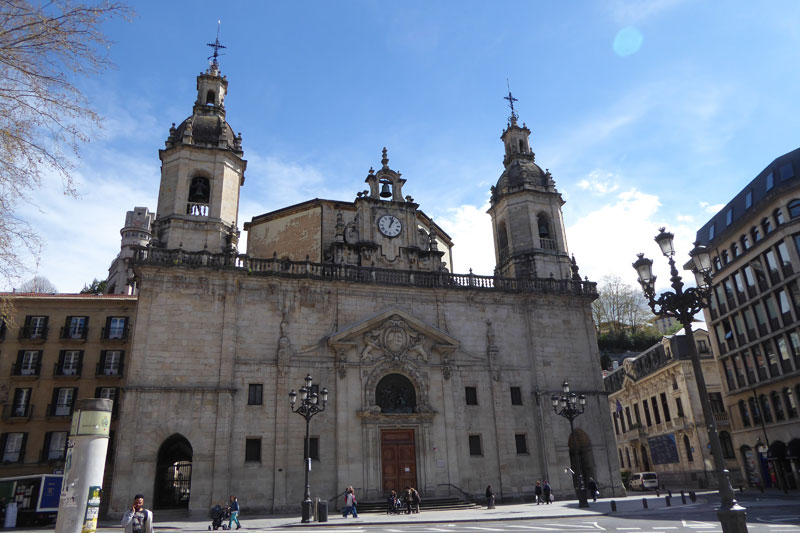
The Saint Nicholas of Bari church is located on the promenade Arenal in Bilbao. The church was constructed between 1743 and 1756 following the design of Ignacio de Ibero, the same architect who had been in charge of the construction work at the Sanctuary of Loyola in Azpeitia/ Gipuzkoa.
Originally, it was the parish church of the suburb of San Nicolás, a district located outside the city wall of Bilbao, where sailors met at the beach or promenade to ask their patron saint, Saint Nicholas, for protection from storms.
It is a monumental church, which stands out due to its architecture, but also due to the magnificent collection of altarpieces inside.
Patronage:
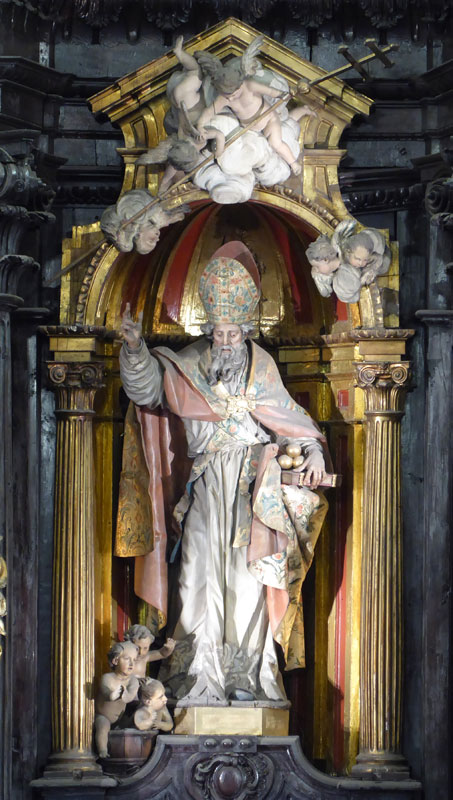
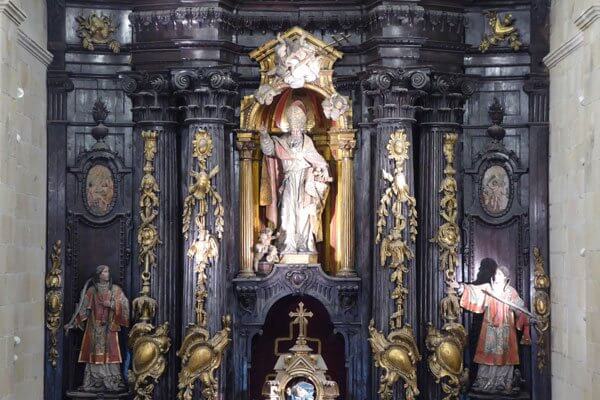
Nicholas was a pious man who lived in the sixth century in Licia (today’s Turkey). According to the legend, when he became orphan, he was ordained priest, sold all his possession and distributed his assets. Among the people he benefitted were three young women of virtue, who, after their father fell in distress, feared they had no money for the dowry and would be forced into prostitution. Nicholas helped them by dropping three coins of gold into the chimney of their house. Over time, the coins were represented as three gilded balls such those the saint shows in the picture. Another miracle is ascribed to Saint Nicholas, that he rescued three children from an evil innkeeper who wanted to serve them for dinner. Therefore, they are depict next to Nicholas’ feet, emerging from a barrel where they had been butchered.
Over time, Saint Nicholas was appointed bishop of Myra (today’s Turkey), so he is depicted with the Mitre (the high and pointed hat, which bishops use in solemn masses) and a group of angels, which carry a crosier above him, forming a cross. After his death, the christians translated his relics to the italian town of Bari, to prevent the Muslims from profaning them. Therefore, he is commonly known as Nicholas of Bari.
Description:
The 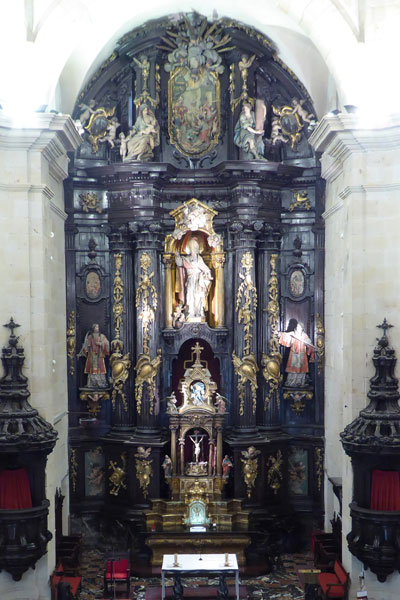

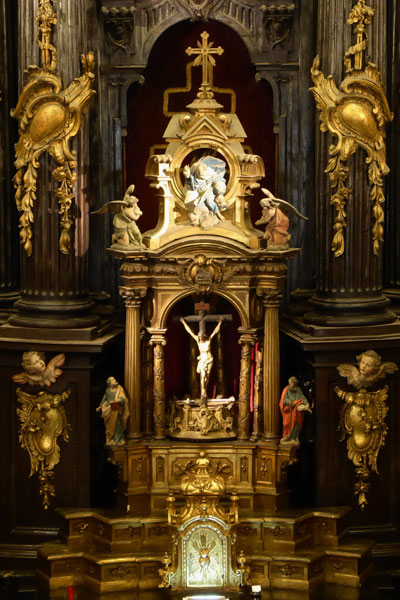
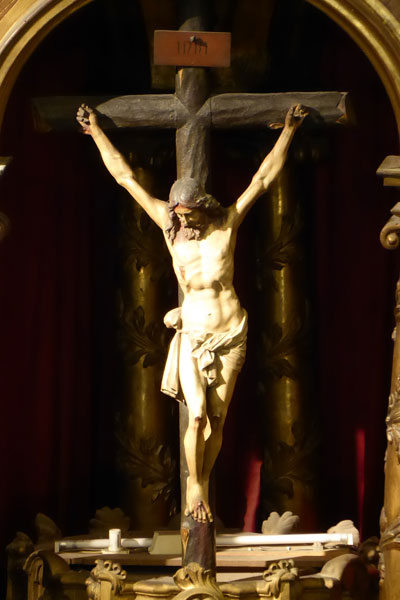
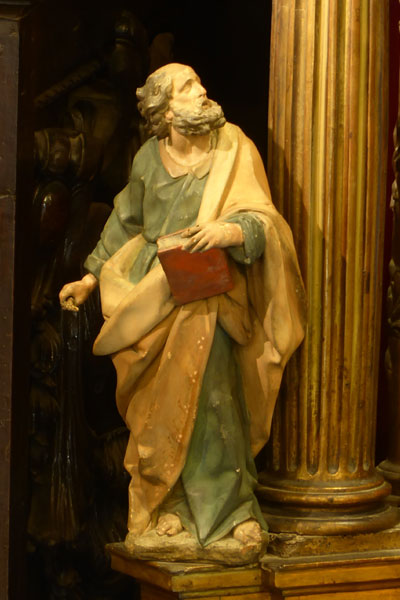

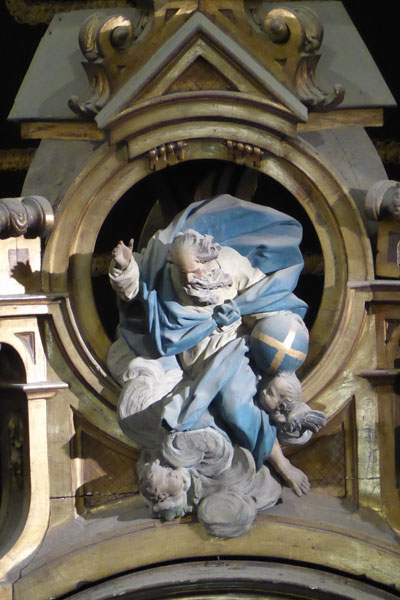
A relief showing the Massacre of the Innocents occupies the central part of the 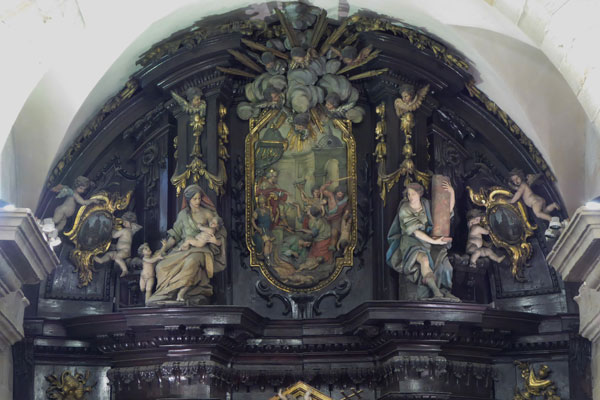
The architectural elements of the altarpiece have been kept in the dark colour of the wood so that the exceptional 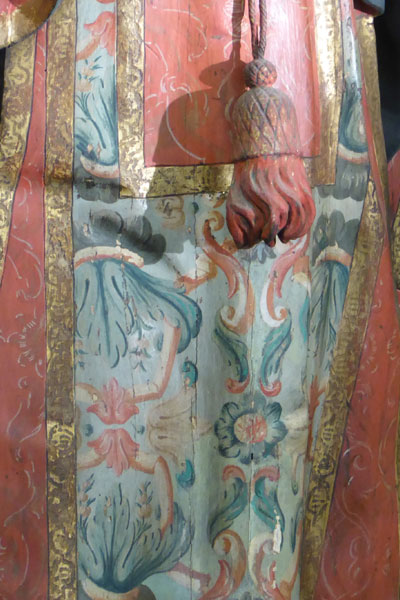
History:
In 1752, the Council of Bilbao decided to place an order for a collection of altarpieces for the Saint Nicholas church, which was under construction at this time. For this work, three of the best artists, who worked at this time for the king’s court in Madrid, were commissioned: Diego Martínez de Arce, an architect from Valladolid, was responsible for the design or planning of the altarpieces; Juan Pascual de Mena, a sculptor from Toledo, concluded the pictures, which had been painted by José López Perella from Madrid.
The two latter were teachers at the Real Academia de Bellas Artes de San Fernando (San Fernando Royal Academy of Fine Arts), the institution, which dominated at this time all aspects of arts.
Important Basque artists, such as the architects Juan de Aguirre and Juan de Iturburu, or the painter Ildefonso de Bustrín, who was in charge of the paintings, collaborated with the two teachers.
The altarpieces were refurbished between 2007 and 2011.
Sculptures:
Body
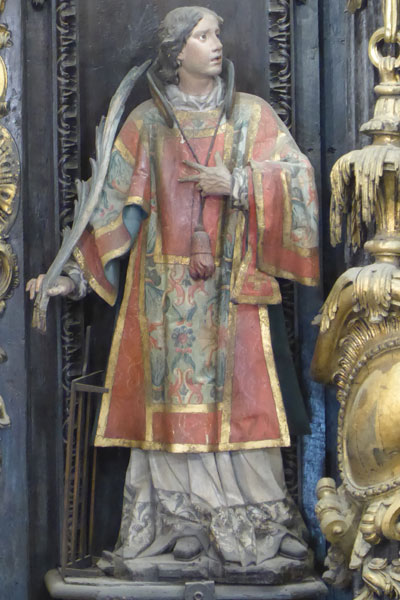
Saint Lawrence
Lawrence lived in the third century and was one of the seven deacons of Rome. He was sentenced to death as he refused to turn over the riches of the church to the emperor. Lawrence is depicted as young man dressed like a deacon with a coat, opened on both sides, called dalmatic. In his right hand, he has a palm leave, the symbol for the victory since the ancient world, which represents his triumph over the death.
His facial expression and hands, as well as the colour of the picture, stand out. It is a work of the sculptor Juan Pascual de Mena.
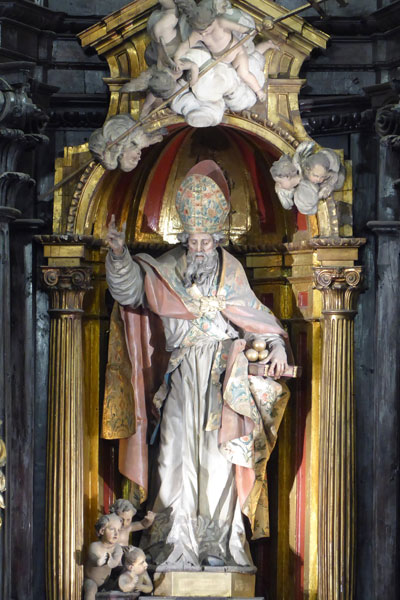
Saint Nicholas of Bari
The main sculpture of the altarpiece shows Nicholas as a bishop. He is surrounded by elements, which allude to his miracles: next to his feet, the three children who had been butchered and he resurrected; in his right hand, the three golden balls he had dropped into the chimney of the house of three you woman of virtue to prevent them from being forced into prostitution.
The quality of the carving stands out. This is notable in the pleats of his clothes, in his facial expression, in the perfect polychromy and in the detail of his clothing. It is a work of the sculptor Juan Pascual de Mena.
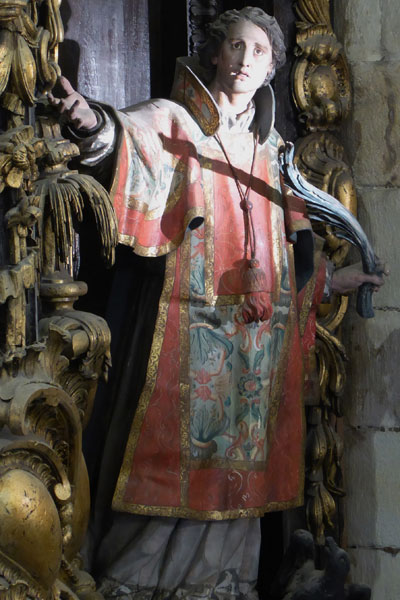
Saint Vincent
Vincent of Huesca lived in the fourth century and was deacon in Zaragoza. As he was christian, he was persecuted and sentenced to death and suffered a long and painful martyrdom. Vincent is depicted as young man dressed like a deacon with a coat, opened on both sides, called dalmatic.
In his left hand, he has a palm leave, the symbol for the victory since the ancient world, which represents his triumph over the death. His facial expression and hands, as well as the colour of the picture, stand out.
It is a work of the sculptor Juan Pascual de Mena.
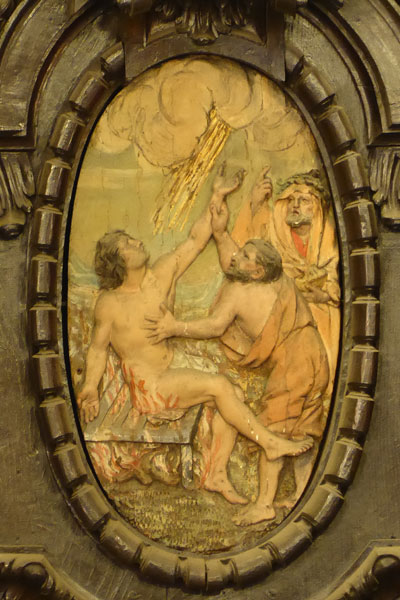
Martyrdom of Saint Lawrence
Lawrence was the administrator of the church’s riches. After the prefect of Rome had demanded him to turn the riches over to the emperor, Lawrence distributed them to the poor people and presented himself to the authorities together with a group of beggars and ill people saying, “Here are the treasures of the church. You see, the church is truly rich, far richer than your emperor!” Lawrence was accused of mocking Rome and sentenced to be burned alive on a gridiron.
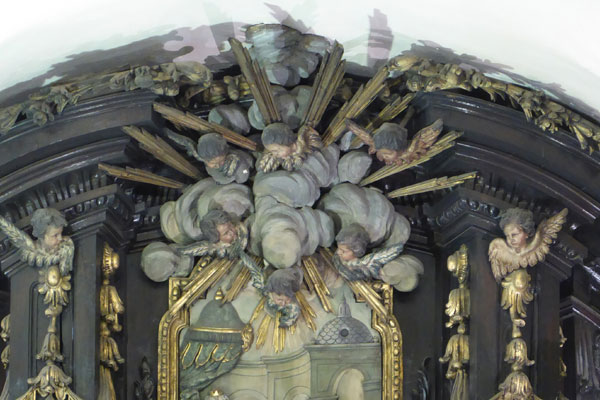
A relief, which shows the death of the saint who is looking to heaven offering his suffer while some gilded lightning bolts, which come from the clouds, show that his soul is received in Paradise.
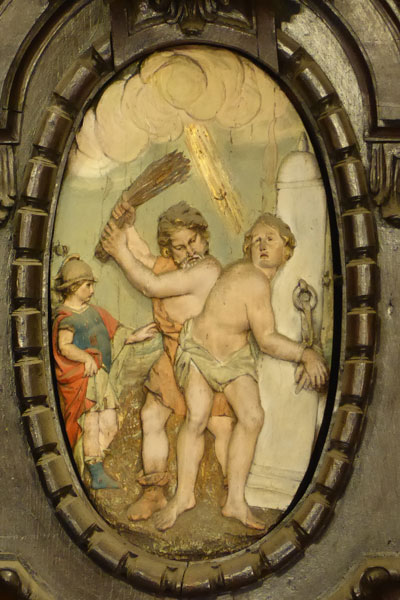
Martyrdom of Saint Vincent
After having been arrested by the romans, Vincent suffered uncountable tortures. He was fixed on a cross, his bones were broken on a torture rack, his flesh was torn with iron hooks and he was whipped as it is depicted in this relief.
The Saint is looking into heaven and offering his suffer while some gilded lightning bolts, which come from the clouds, show that his soul is received in Paradise.
Attic
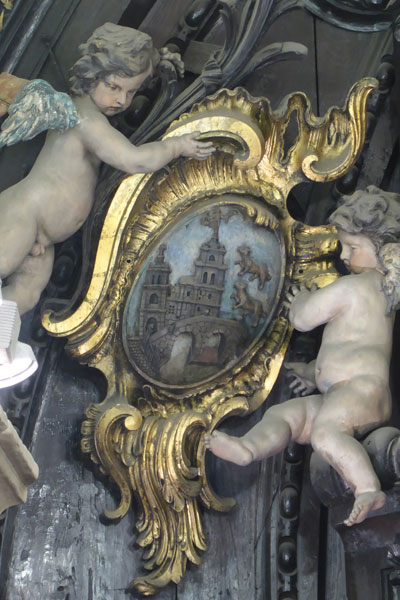
City arms of Bilbao
Two Angels hold a decorated oval relief, which shows the Saint Anthony church and bridge, the old town hall (which was located there) and two lions, which are the family crest of the Haro family, the founders of Bilbao.
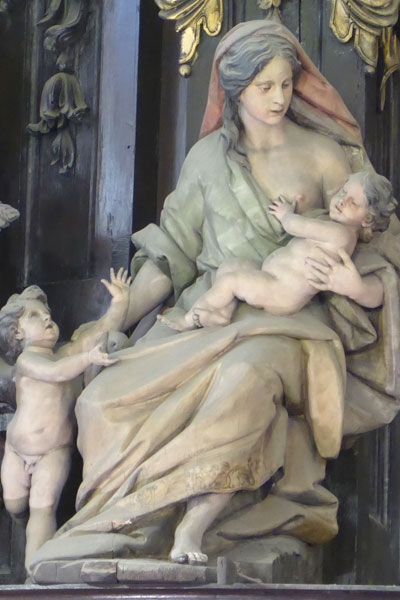
Charity
Charity is, together with Faith and Hope, one of the virtues which, according the christian religion, God infuses into all people. It consists of loving God more than anything else and the neighbour as oneself. Therefore, it is considered as the most important virtue.
Charity is depicted a woman who breastfeeds various children or, as in this picture, carries them in the arms while showing her uncovered chest. It is a work of the sculptor Juan Pascual de Mena.
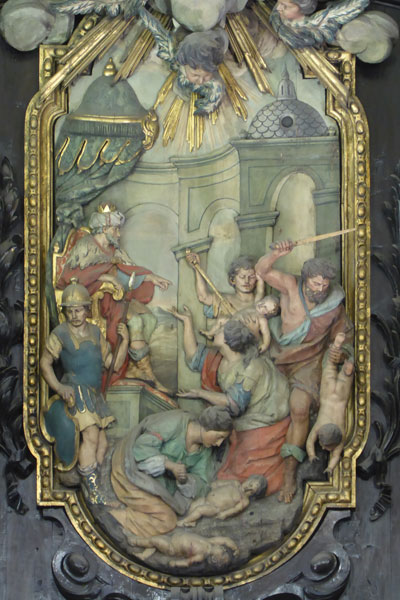
Massacre of the Innocents
According to the gospels, king Herod confused the birth of the Messiah with the birth of a future monarch of the jews. He commanded to kill all boys in Bethlehem under the age of one year, because he was afraid that one of them would dethrone him. The relief shows with brutality the moment when the soldiers obey the order of king Herod and kill the children, without listening to the pleas of the mothers. The detailed composition of this scene stands out, which even shows in its background the palace of Herod.

Fortitude
Fortitude is – together with Justice, Prudence and Temperance – one of the four virtues, which the catholic religion calls cardinal. The aim is that people who live according to these virtues achieve honesty. Fortitude means to overcome fear and to flee from recklessness. It is portrayed as a woman who carries a column as a symbol for her strength.
The picture is a work of the sculptor Juan Pascual de Mena.
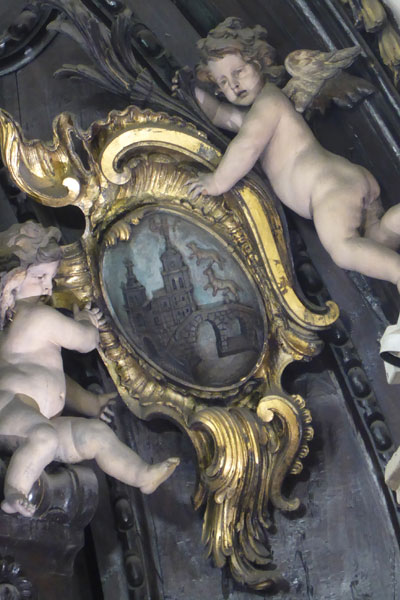
City arms of Bilbao
Two Angels hold a decorated oval relief, which shows the Saint Anthony church and bridge, the old town hall (which was located there) and two lions, which are the family crest of the Haro family, the founders of Bilbao.