
Altarpiece of Saint Crispin and Saint Crispinian
Collection of altarpieces
- Town: Bilbao
- Church: Saint Nicholas of Bari Church (Bilbao)
- Location: Epistle Side (the right nave of the Church)
- Artists: Diego Martínez de Arce (architect and planner), Juan Pascual de Mena (sculptor), José López Perella (painter of the polychrome) and Ildefonso de Bustrín (painter)
- Patron: Guild of shoemakers and Council of Bilbao
- Chronology: 18th century (1754)
- Style: Baroque
The shoemakers of Bilbao promoted this altarpiece in their Patron Saints’ honour
Interactive altarpiece: click on the pictures to get more information.
Church:
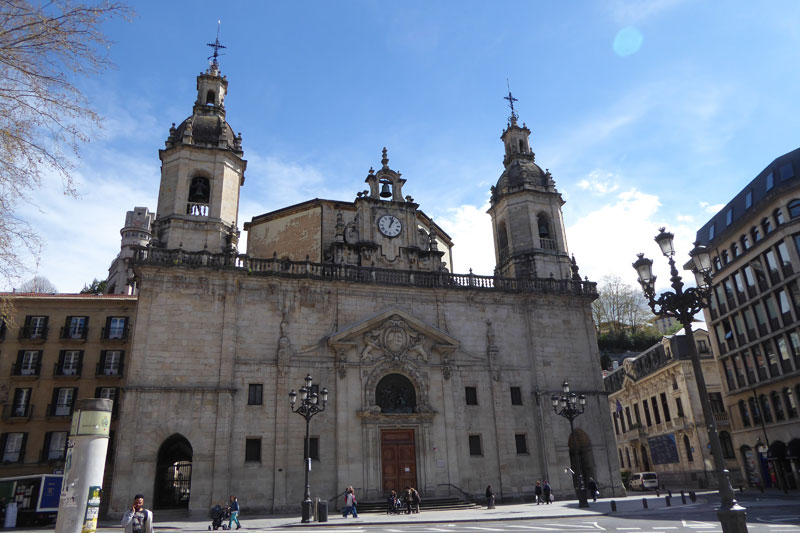
The Saint Nicholas of Bari church is located on the promenade Arenal in Bilbao. The church was constructed between 1743 and 1756 following the design of Ignacio de Ibero, the same architect who had been in charge of the construction work at the Sanctuary of Loyola in Azpeitia/ Gipuzkoa.
Originally, it was the parish church of the suburb of San Nicolás, a district located outside the city wall of Bilbao, where sailors met at the beach or promenade to ask their patron caint, Saint Nicholas, for protection from storms.
It is a monumental church, which stands out due to its architecture, but also due to the magnificent collection of altarpieces inside.
Patronage:
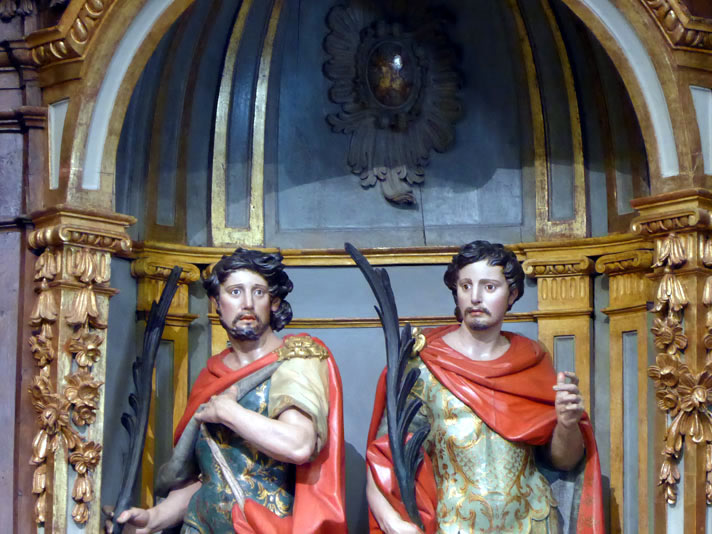
According to tradition, Saint Crispin and Saint Crispinian were two christian brothers from the third century, who belonged to a noble roman family. During the persecutions against the christians, they fled from Rome to the town of Soissons (today’s France). During the day, they preached their faith to the pagans and at night, they made shoes and sold them, so that they could stay there. Therefore, they are considered as patron saints of shoemakers and tanners.
When they were captured, the romans tortured them brutally: they were whipped, nails were driven in their hands and feet and they were drowned in a pot with boiled water, finally, they were beheaded.
They are depicted being dressed like romans and they hold a palm leave, the symbol for the victory since the ancient world, which symbolises the triumph over the death.
Description:
This 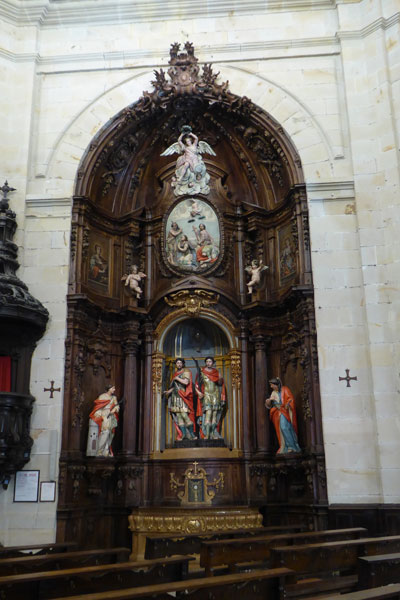
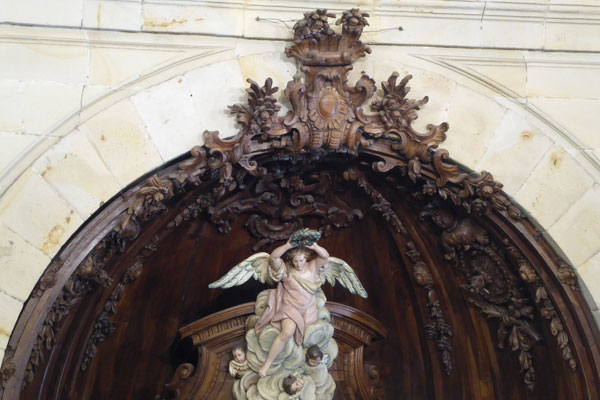
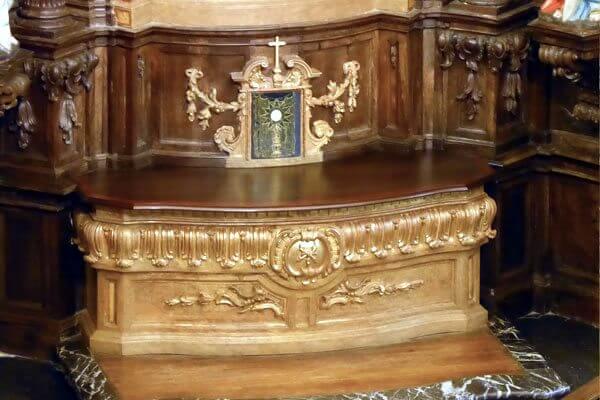
It is dedicated to saint Crispin and saint Crispinian, the patron saints of shoemakers and tanners. Their sculptures, they are dressed like romans, occupy the main alcove, which is framed with corinthian columns. Above the columns are two little angels or 
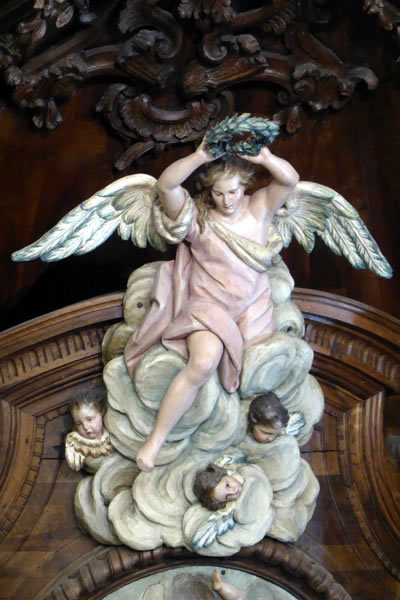
In the attic is a 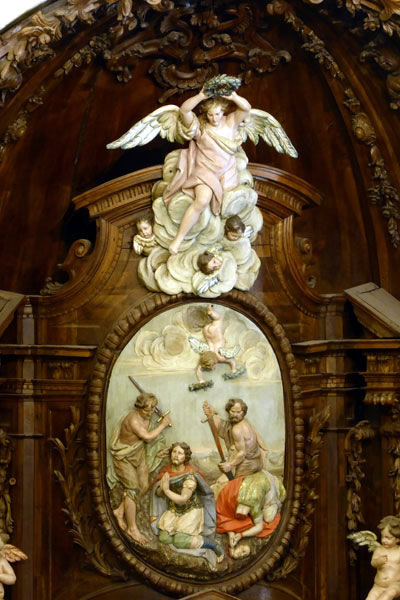
The rest of the carved decoration, garlands and plants, has been kept in the dark colour of the wood.
History:
In 1752, the council of Bilbao decided to place an order for a collection of altarpieces for the Saint Nicholas Church, which was under construction at this time. The council counted on the donations from the town’s retailers. The shoemakers paid the altarpiece, which is dedicated to their patron saints.
For this work, three of the best artists, who worked at this time for the king’s court in Madrid, were commissioned: Diego Martínez de Arce, an architect from Valladolid, was responsible for the design or planning of the altarpieces; Juan Pascual de Mena, a sculptor from Toledo, concluded the pictures, which had been painted by José López Perella from Madrid. The two latter were teachers at the Real Academia de Bellas Artes de San Fernando (San Fernando Royal Academy of Fine Arts), the institution, which dominated at this time all aspects of arts. Important basque artists, such as the architects Juan de Aguirre and Juan de Iturburu, or the painter Ildefonso de Bustrín, who was in charge of the paintings, collaborated with the two teachers.
The altarpieces were refurbished between 2007 and 2011.
Sculptures:
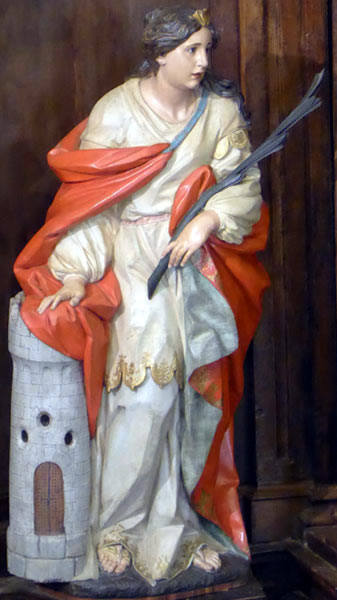
Saint Barbara
According to her legend, Barbara was the daughter of the king of Nicomedia (today’s Izmir in Turkey). Her father did not want her to have contact to the christians, so he locked her up in a tower with two windows. However, the young woman converted to christianism and put a third window in the wall of her cell, as a symbol for the Trinity. Her father became angry and brought her to the authorities so that she were condemned. After she had suffered many tortures, her own father beheaded her.
She is depicted with the tower with three windows next to her feet and she holds in her left hand a palm leave, which indicates that she died as a martyr. Her flame red coat, which is contrary to her white tunic and skin, stands out.
It is a work of the sculptor Juan Pascual de Mena.
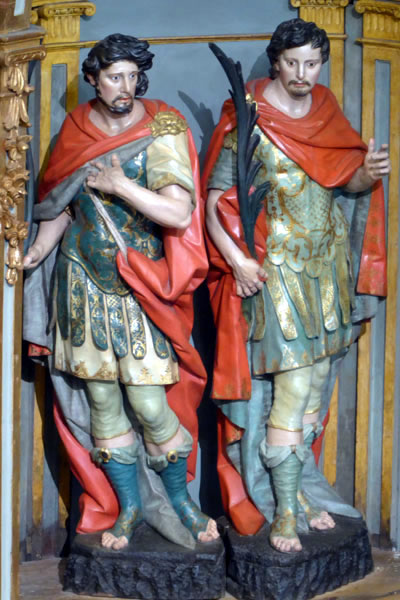
Saint Crispin and Saint Crispinian
According to tradition, Saint Crispin and Saint Crispinian were two noble brothers from Rome who were persecuted and killed for preaching christianity. Therefore, they are depicted being dressed like roman soldiers and they carry a palm leave, which indicates that they died as martyrs.
The fine polychrome work of the military armour, with special care taken on ornaments, and their facial expressions stand out. The carving of their hair, which seems to be moved by the wind, highlights their facial expressions even more. It is a work of the sculptor Juan Pascual de Mena.
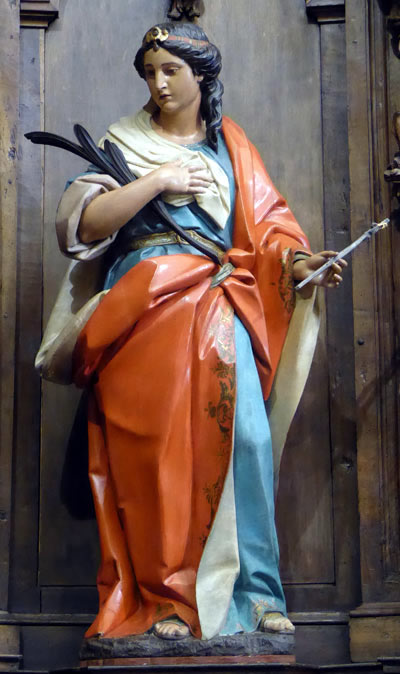
Saint Apollonia
According to her legend, Apollonia was a young noble woman from Alexandria (today’s Egypt). She was sentenced to be burnt to death, as she was a christian. Before her martyrdom, all her teeth were broken with pincers. Therefore, she is depicted holding in her left hand the tool with which she was tortured. She puts the right hand on her chest while holding the palm leave in her arm, which indicates that she died as a martyr.
In the sculpture the good carving, notable in her hair and in the pleats of her clothes, and the small details, like the diadem or the belt, stand out.
It is a work of the sculptor Juan Pascual de Mena.

Saint Agatha
According to her legend, Agatha was a young woman from Catania, on the island of Sicily (today’s Italy), who had converted to christianity and therefore suffered many tortures. The most known torture is that her breasts were cut. That is why she is depicted with a plate next to her with these attributes on it, which are a still life.
In the right hand, she holds the palm leave, which indicates that she died as a martyr. This is emphasised by the light ray, which illuminates her head.
It is a work of the painter Ildefonso de Bustrín.
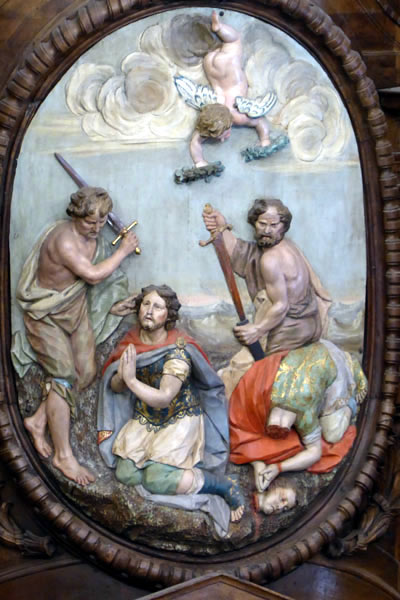
Martyrdom of Saint Crispin and Saint Crispinian
A relief shaped as a medallion represents the moment, when one of the brothers has already been beheaded and the executioner puts the sword in the scabbard, while the other brother is waiting for his end, with folded hands as the sign that he accepts. Above them, an Angel with two laurel wreaths, which is the symbol for the victory over the death, appears from heaven.
In this bloody scene the facial expression of the executioner stands out, which is contrary to the facial expression of the head on the ground.
The polychromy stands out due to the fine work of the metallic reflections on the saints’ military armour.
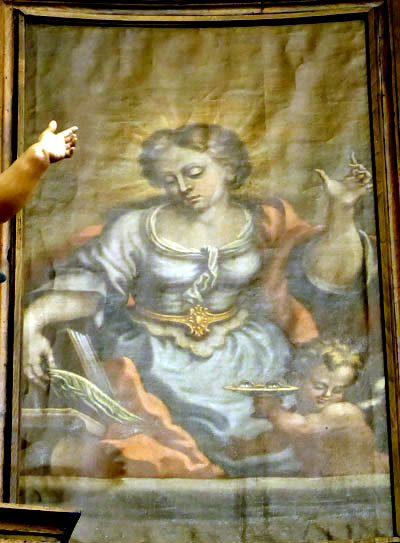
Saint Lucia
According to her legend, Lucia was a young woman from Sicily, who was denounced by her betrothed of being christian, therefore martyred and beheaded for not wanting to make sacrifices to the roman gods. During her martyrdom her eyes were ripped out, they are depicted on a plate, which is carried by a small angel.
In the right hand, she carries a book and holds the palm leave, which indicates that she died as a martyr. This is emphasised by the light ray, which illuminates her head.
It is a work of the painter Ildefonso de Bustrín.