
Altarpiece of Our Lady of Piety
Collection of altarpieces
- Town: Bilbao
- Church: Saint Nicholas of Bari Church (Bilbao)
- Location: Gospel Side (the left nave of the Church)
- Artists: Diego Martínez de Arce (architect and planner), Juan Pascual de Mena (sculptor), José López Perella (painter of the polychrome) and Ildefonso de Bustrín (painter)
- Patron: Council of Bilbao
- Chronology: 18th century (1754)
- Style: Baroque
A processional picture of great devotion in Bilbao
Interactive altarpiece: click on the pictures to get more information.
Church:
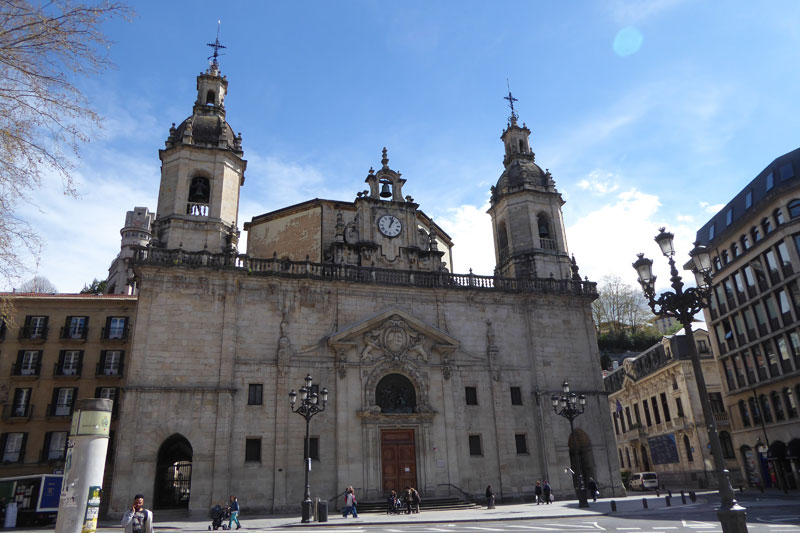
The Saint Nicholas of Bari church is located on the promenade Arenal in Bilbao. The Church was constructed between 1743 and 1756 following the design of Ignacio de Ibero, the same architect who had been in charge of the construction work at the Sanctuary of Loyola in Azpeitia/ Gipuzkoa.
Originally, it was the parish church of the suburb of San Nicolás, a district located outside the city wall of Bilbao, where sailors met at the beach or promenade to ask their patron saint, Saint Nicholas, for protection from storms.
It is a monumental church, which stands out due to its architecture, but also due to the magnificent collection of altarpieces inside.
Patronage:
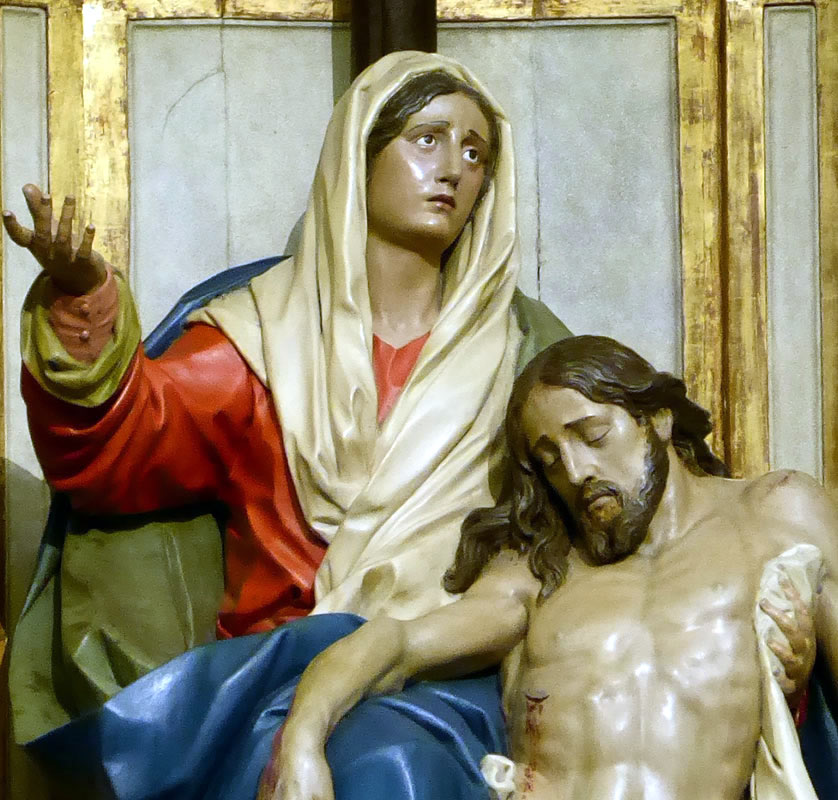
Our Lady of Piety is one of the many ways in which the catholic church venerates the Virgin Mary. The picture shows the moment when the dead body of Christ is taken from the cross and held by his mother, who expresses her pain. Mary sits under the cross and holds her son’s body on her lap. The nail marks in the feet and hands and the wound in the side are the symbols for his death on the cross.
It is a scene with the Virgin as the main protagonist: Her facial expression and her gestures are emphasised by the polychromy, which is based on red and dark blue. The colours symbolise the passion of Christ and are contrary to Mary’s white coloured headscarf or the white shroud with which the body of Jesus is wrapped.
Description:
This 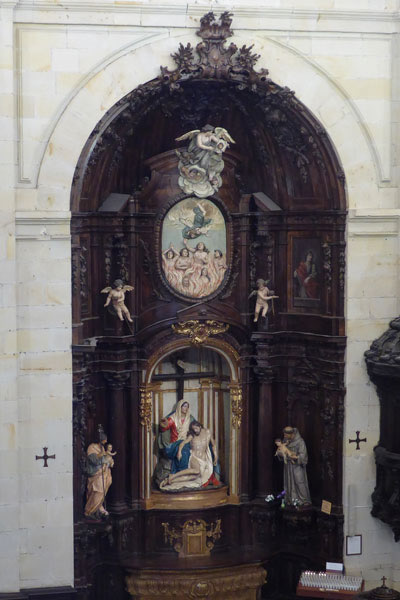
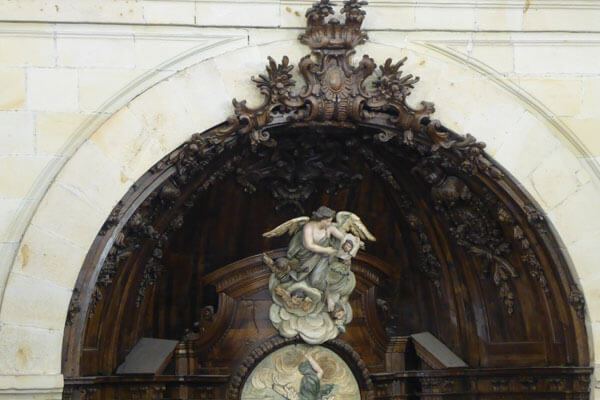

It is one of the most venerated pictures in Bilbao and is carried in procession every Good Friday. The altarpiece occupies the central alcove framed by corinthian columns. Above them, two 
On the upper part of the altarpiece is a 
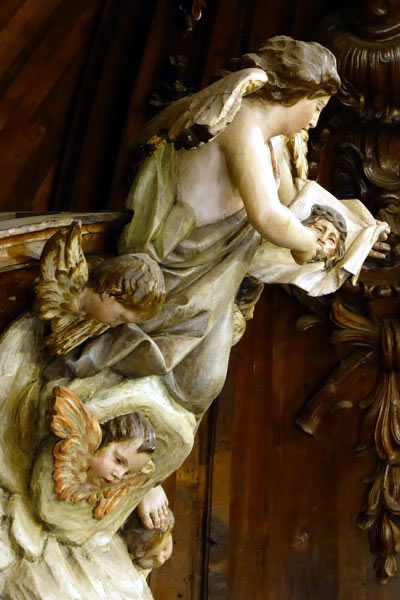
The entire architecture of the altarpiece is not gilded, which makes the richly polychrome painted pictures and the details of the central alcove stand out. The rest of the carved decoration, garlands and plants, has been kept in the dark colour of the wood.
History:
In 1752, the council of Bilbao decided to place an order for a collection of altarpieces for the Saint Nicholas church, which was under construction at this time. For this work, three of the best artists, who worked at this time for the king’s court in Madrid, were commissioned: Diego Martínez de Arce, an architect from Valladolid, was responsible for the design or planning of the altarpieces; Juan Pascual de Mena, a sculptor from Toledo, concluded the pictures, which had been painted by José López Perella from Madrid. The two latter were teachers at the Real Academia de Bellas Artes de San Fernando (San Fernando Royal Academy of Fine Arts), the institution, which dominated at this time all aspects of arts.
Important basque artists, such as the architects Juan de Aguirre and Juan de Iturburu, or the painter Ildefonso de Bustrín, who was in charge of the paintings, collaborated with the two teachers.
The altarpieces were refurbished between 2007 and 2011.
Sculptures:
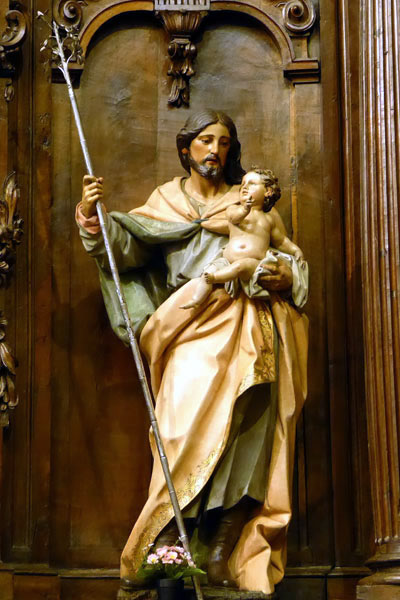
Saint Joseph
Joseph is the husband of Mary and the adoptive father of Jesus of Nazareth. In this sculpture, he is portrayed with the Child in his arms, who turns towards the saint, emphasising their proximity. In his right hand, Joseph carries a flourishing stick as an allusion to the miracle that made the priests recognise him as the most suitable husband for the Virgin Mary.
It is a work of the sculptor Juan Pascual de Mena.
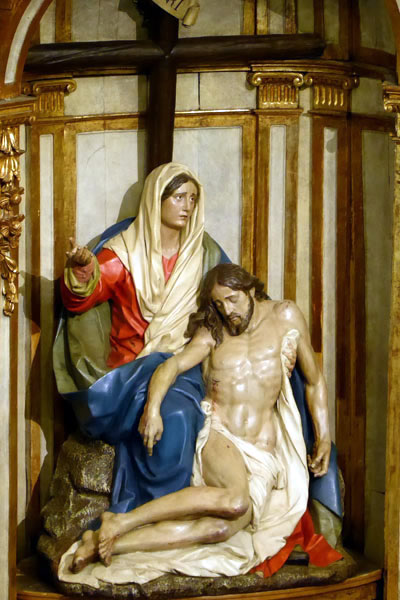
Our Lady of Piety
Mary is sitting at the foot of the cross on mount Golgotha holding the dead body of Jesus. Her facial expression and hands stand out underpinned by her clothes’ colours, red and dark blue, which symbolise the passion of Christ. Her emotions are contrary to the dead Jesus, whose perfect anatomy poke out of the white shroud with which he is wrapped.
It is a work of the sculptor Juan Pascual de Mena.
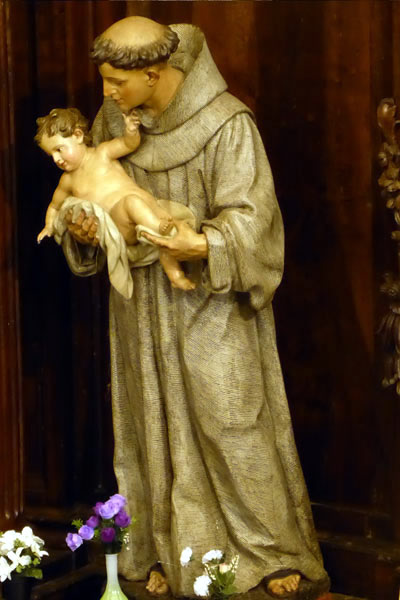
Saint Anthony of Padua
Anthony of Padua was a franciscan monk, who preached against the greed of creditors who received excessive interest for their deals. According to the legend, he was so pious that even the Christ Child came to attend his prayer. Anthony of Padua is depicted being dressed like a franciscan with the brown habit, sandals and a shaved head, like a tonsure. In his arms, he carries the Christ Child, whom he looks and smiles at; it is a scene of great love.
It is a work of the sculptor Juan Pascual de Mena.
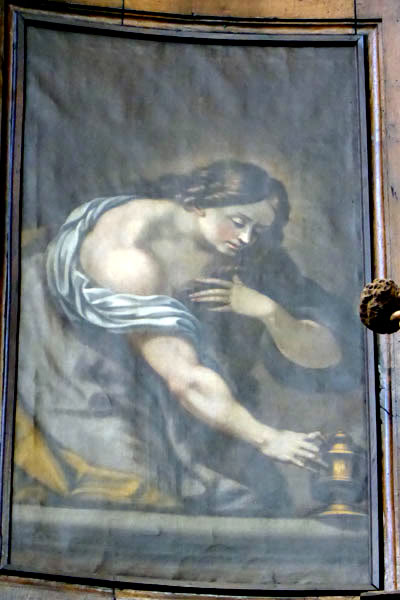
Saint Mary Magdalene
According to the gospels, during the passion of Christ, Mary Magdalene was at the foot of the cross together with the Virgin Mary. On Sunday, she went to the tomb where Jesus had been buried, she found it empty and thus bore witness to his Resurrection.
In the painting Magdalene is depicted with long and loose hair, bending down to pick up a small vessel of ointment. This alludes to the perfumes, which Mary used to anoint the body of Jesus. It is a work of the painter Ildefonso de Bustrín.
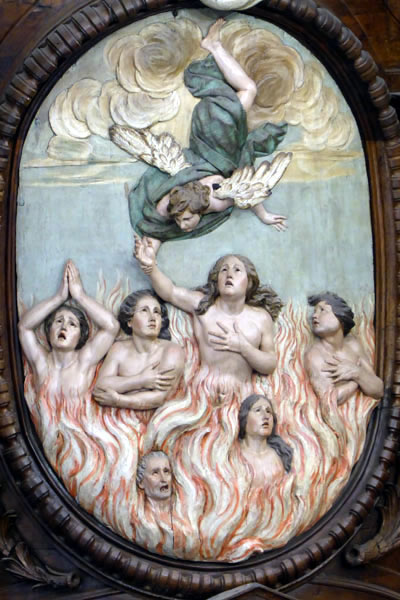
The Souls of the Purgatory
The Purgatory, the place where the souls are purified from sins which were not forgiven during the life, before entering into Glory, is symbolically depicted as a group of naked men and women of different ages, surrounded by flames, who are looking towards heaven begging for help.
In the centre of the picture, an angel grabs the hand of one soul to lift it up into Heaven, showing, that, thanks to Christ’s sacrifice (depicted in the picture of Our Lady of Piety), all people will be saved.
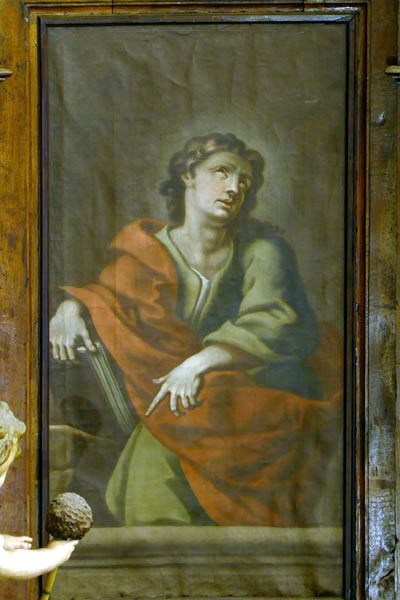
Saint John the Evangelist
According to the gospel, John was the closest disciple of Jesus of Nazareth, and during the passion of Christ, he was at the foot of the cross, together with the Virgin Mary. In this painting, the Evangelist is portrayed as a young man, still without a beard. In his right hand, he carries a book, symbolising him as author of one of the four gospels which are recognised by the catholic church as being directly inspired by God. Therefore, he is looking towards heaven in search of the divine illumination.
It is a work of the painter Ildefonso de Bustrín.