
Altarpiece of Lazarus
Collection of altarpieces
- Town: Bilbao
- Church: Saint Nicholas of Bari Church (Bilbao)
- Location: Epistle Side (the right nave of the Church), next to the entrance
- Artists: Diego Martínez de Arce (architect and planner), Juan Pascual de Mena (sculptor), José López Perella (painter of the polychrome) and Ildefonso de Bustrín (painter)
- Patron: Council of Bilbao
- Chronology: 18th century (1754)
- Style: Baroque
A parable to console beggars and those in need
Interactive altarpiece: click on the pictures to get more information.
Church:
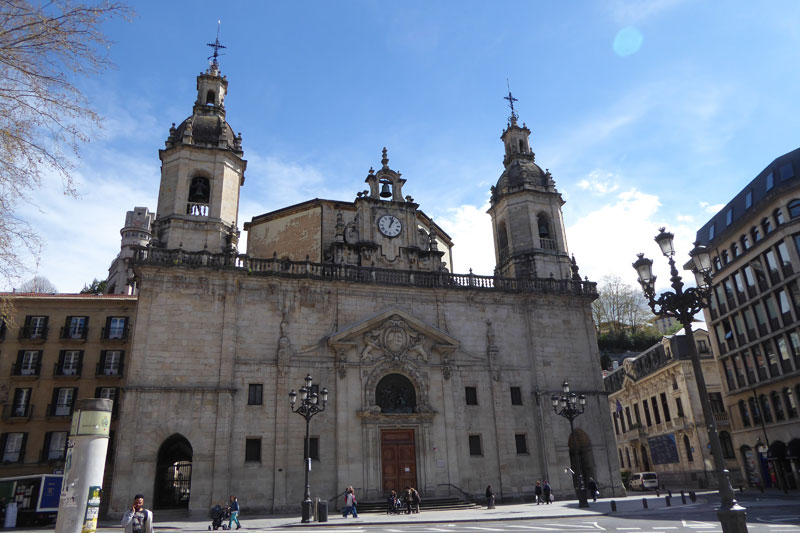
The Saint Nicholas of Bari church is located on the promenade Arenal in Bilbao. The church was constructed between 1743 and 1756 following the design of Ignacio de Ibero, the same architect who had been in charge of the construction work at the Sanctuary of Loyola in Azpeitia/ Gipuzkoa.
Originally, it was the parish church of the suburb of San Nicolás, a district located outside the city wall of Bilbao, where sailors met at the beach or promenade to ask their patron saint, Saint Nicholas, for protection from storms.
It is a monumental church, which stands out due to its architecture, but also due to the magnificent collection of altarpieces inside.
Patronage:
The poor Lazarus is a fictive person who appears in one of the parables or reports with a moral teaching of Jesus of Nazareth and is considered as patron of the beggars. According to the parable, he was a beggar who came each day to the house of Epulón to ask for alms. However, the rich man has never helped him. After his death, Epulón was condemned to hell while Lazarus was consoled on Abraham’s side, the place where the souls of the righteous go. The rich man regretted not having been helpful during his life and asked Abraham to allay his thirst and warn his brothers of what awaits them if they do not help those in need. However, it is already too late.
Even though the Catholic Church has never sanctified Lazarus, he has been venerated by poor people and beggars and is considered as patron of lepers and people affected by skin diseases.
Description:
The 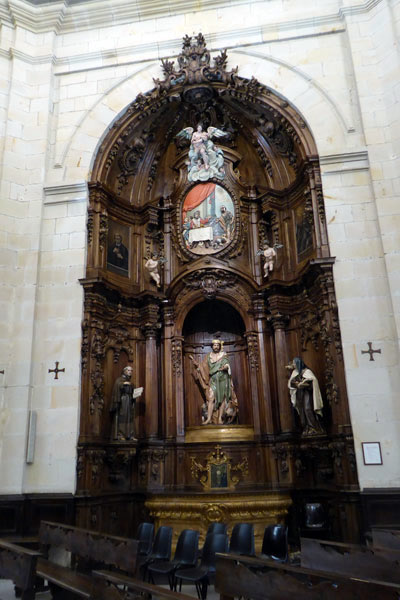
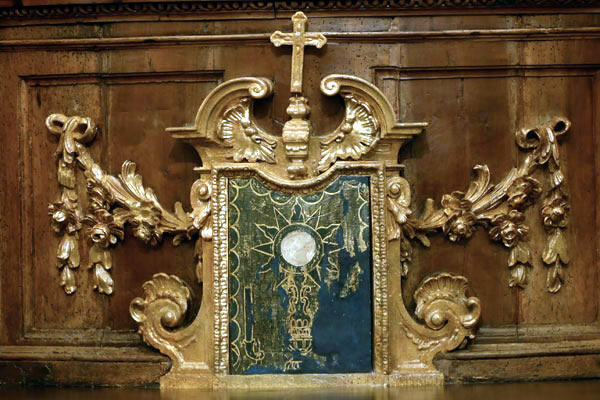
The altarpiece is dedicated to Lazarus, the patron of beggars, whose picture occupies the central alcove, which is marked with Corinthian columns. Two 
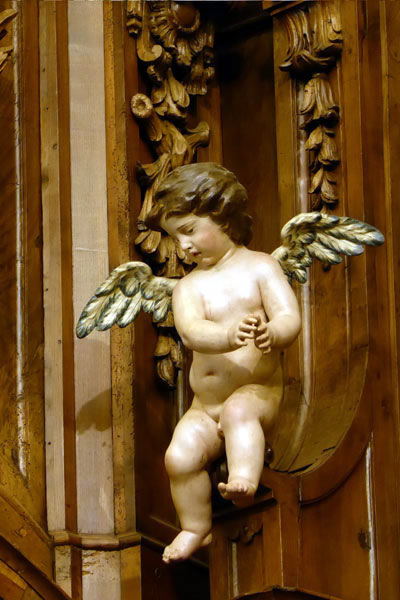
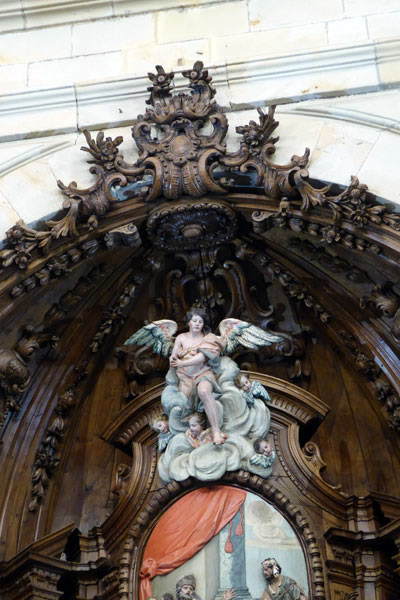
In the attic is a 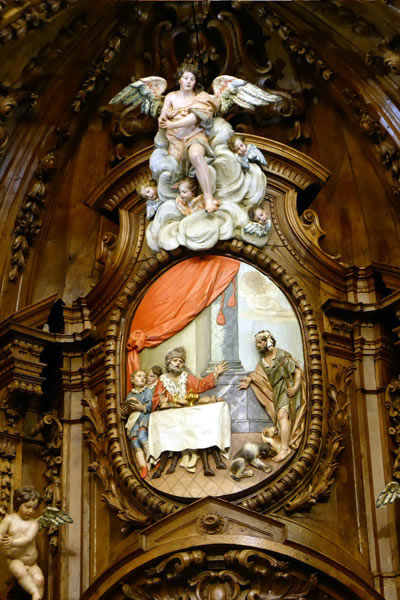
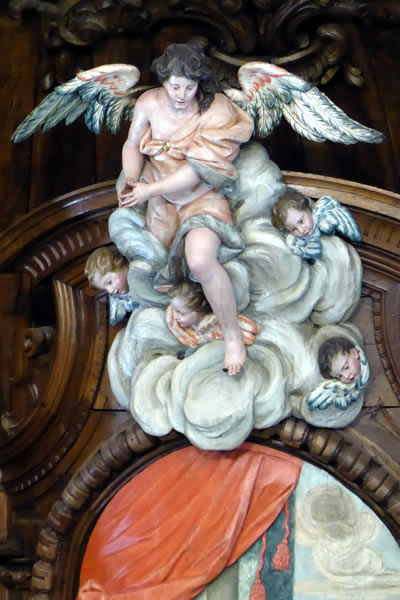
The entire architecture or 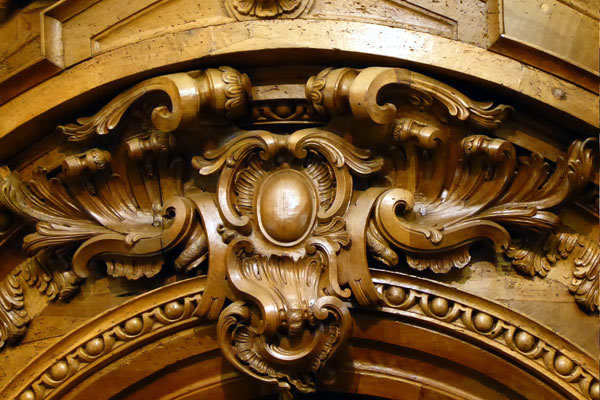
History:
In 1752, the council of Bilbao decided to place an order for a collection of altarpieces for the Saint Nicholas church, which was under construction at this time.
For this work, three of the best artists, who worked at this time for the king’s court in Madrid, were commissioned: Diego Martínez de Arce, an architect from Valladolid, was responsible for the design or planning of the altarpieces; Juan Pascual de Mena, a sculptor from Toledo, concluded the pictures, which had been painted by José López Perella from Madrid. The two latter were teachers at the Real Academia de Bellas Artes de San Fernando (San Fernando Royal Academy of Fine Arts), the institution, which dominated at this time all aspects of arts. Important basque artists, such as the architects Juan de Aguirre and Juan de Iturburu, or the painter Ildefonso de Bustrín, who was in charge of the paintings, collaborated with the two teachers.
The altarpieces were refurbished between 2007 and 2011.
Sculptures:
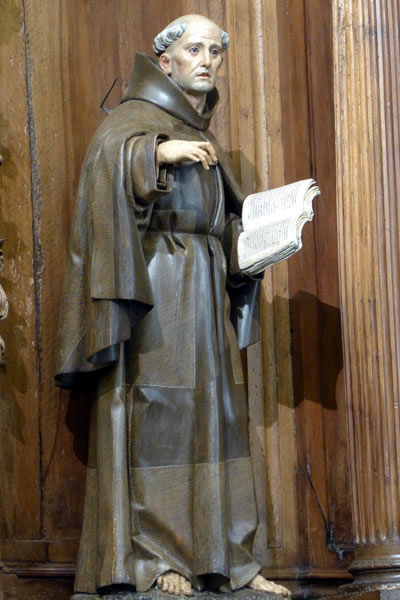
Saint Peter of Alcántara
Peter of Alcántara was a franciscan monk who has already been considered saintly in his lifetime. He is depicted discalced, with the habit of his congregation and his hair is cut into a tonsure. In his left hand, he carries an open book and in his right hand, he was probably holding a feather, which today is disappeared. The feather indicated that he was the author of the first biography of Teresa of Ávila. She is also part of this altarpiece and Saint Peter was her spiritual companion.
His facial expression and the highly skilled carving of the franciscan habit, stand out.
It is a work of the sculptor Juan Pascual de Mena.
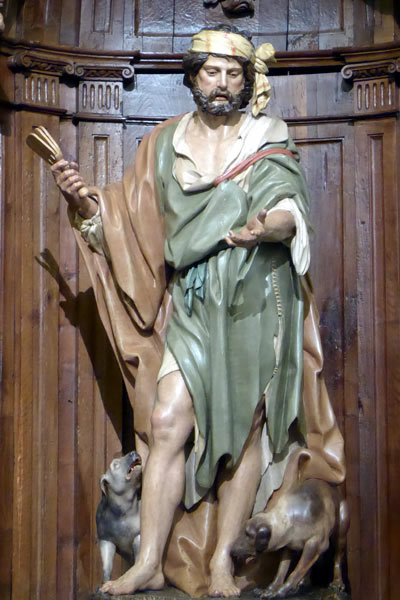
Lazarus
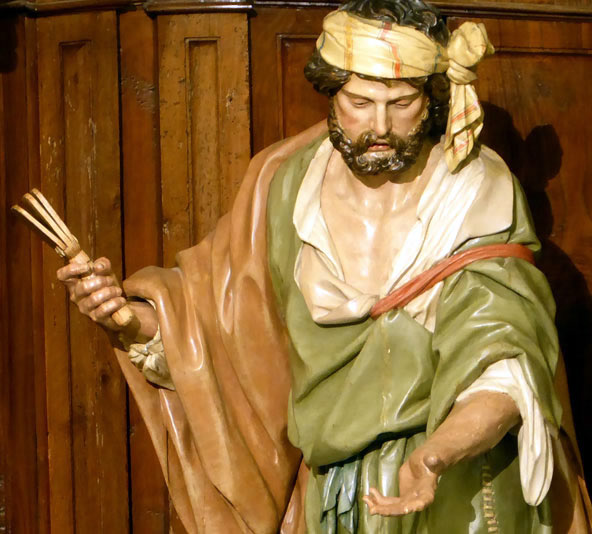
The poor Lazarus is depicted with rags of a beggar and two dogs next to his feet, as it is described in the parable in the Holy Bible. With his right hand, he played a rattle, which indicates that he was a leper, to avoid that others approach and contract the disease. He reaches out his left hand to beg for alms.
The details of the sculpture and the good quality of the carving, underlined by a good use of colour, stand out.
It is a work of the sculptor Juan Pascual de Mena.
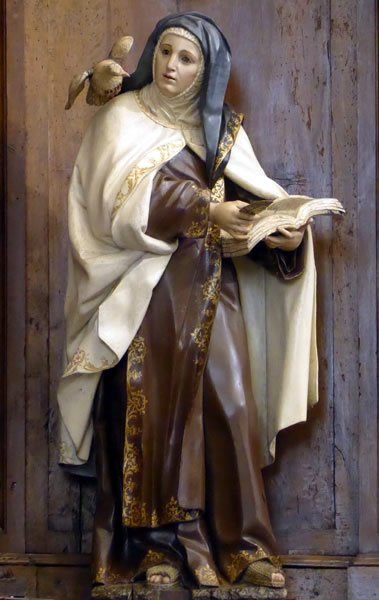
Saint Teresa of Ávila
Teresa of Ávila, also known as Teresa of Jesus, was the reformer of the congregation of the discalced carmelites in the 16th century. She wears sandals the habit of the congregation, which is richly decorated with gilded trimmings on the vail, cloak, tunic and scapular.
She carries a book and a feather and is writing while she turns towards the Holy Spirit looking for divine inspiration. The Holy Spirit is depicted as a dove sitting on the Saint’s shoulder.
All this alludes to the many books of great importance for the Catholic Church, which she wrote.
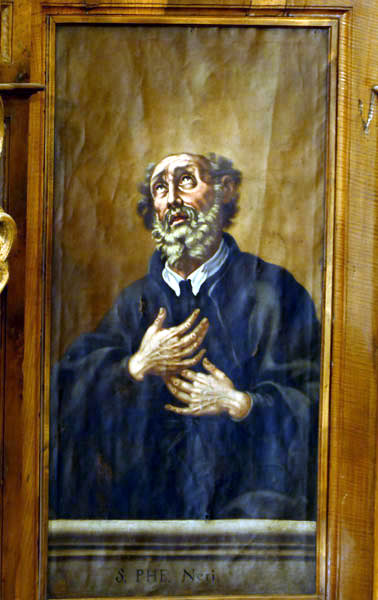
Saint Philip Neri
In the 16th century, Saint Philip Neri founded the Congregation of Oratories of Saint Philip Neri. Therefore, he is wearing a black habit with white collar. His very expressive face and hands stand out.
It is a work of the painter Ildefonso de Bustrín.
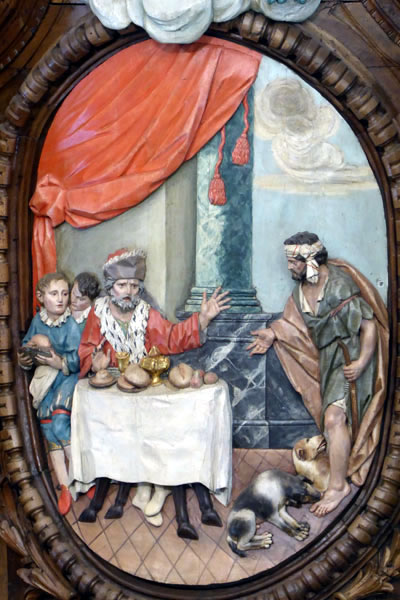
Banquet of the rich Epulón (parable of the Rich man)
The relief in the medallion shows the moment when Lazarus enters the house of Epulon together with two dogs. He is begging, but the rich man, sitting at the table, refuses to help him.
The picture has many details such as the big red curtain, the column that seems to be made of marble, Epulón’s splendid clothes, the expensive wine glasses and plates, the waiters who set the table …
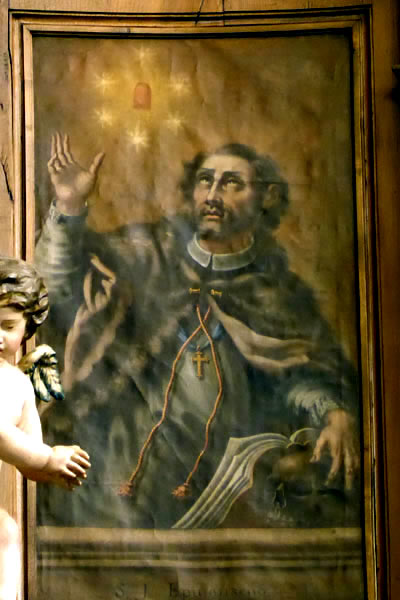
Saint John of Nepomuk
The picture of John of Nepomuk, a religious man, whom the King Wenceslaus IV of Luxembourg ripped out his tongue, because John refused to break the seal of confession of the queen of Bohemia.
The Saint is dressed as a priest and is looking towards heaven, where a crown of stars surrounds a tongue, in allusion to his martyrdom.
It is a work of the painter Ildefonso de Bustrín.