
Altarpiece of Saint Joseph
Collection of altarpieces
- Town: Bermeo
- Church: Assumption of Our Lady Church
- Location: At the feet of the Epistle Nave (the right nave of the church)
- Artists: Pedro Belaunzaran (planner) and José de Alcoverro (sculptor)
- Patron: Council of Bermeo
- Chronology: 19th century (1869-1871)
- Style: Neoclassicism
An altarpiece to praise the love between Saint Joseph and the Christ Child
Interactive altarpiece: click on the pictures to get more information.
Church:
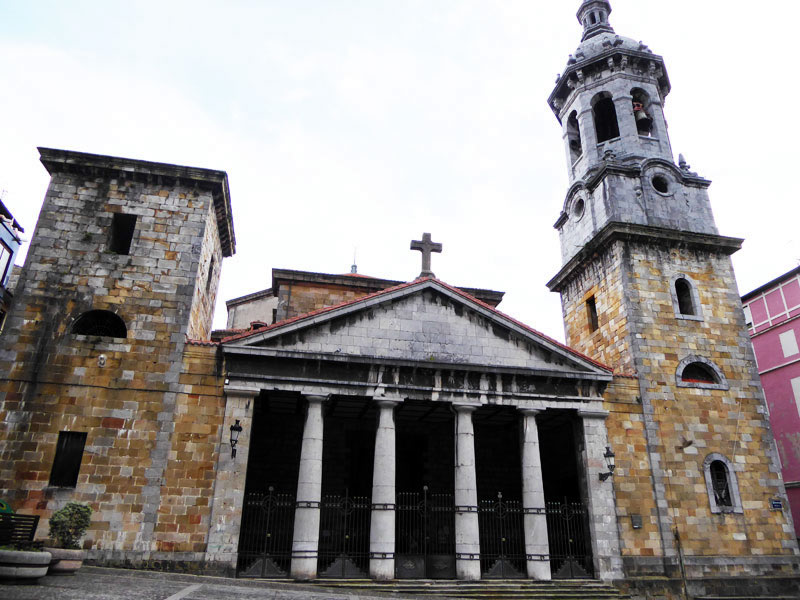
The parish church dedicated to the Assumption of Our Lady was constructed at different periods in the 19th century (1820/22 – 1869) and was designed by the architect Silvestre Pérez. The main portal protrudes from the building, its columns and triangular gable roof resembling an ancient greek temple. The church is flanked by a tower on each side. The tower on the left side is unfinished, and that on the right, completed in the 19th century, functions as the belfry. The church’s ground plan with four equal arms forms a greek cross, which is surmounted by a large central dome. Inside the church, between the arches, supporting the dome, there are four altarpieces, above which are paintings, by Pablo Uranga from 1912, depicting the four evangelists.
Patronage:
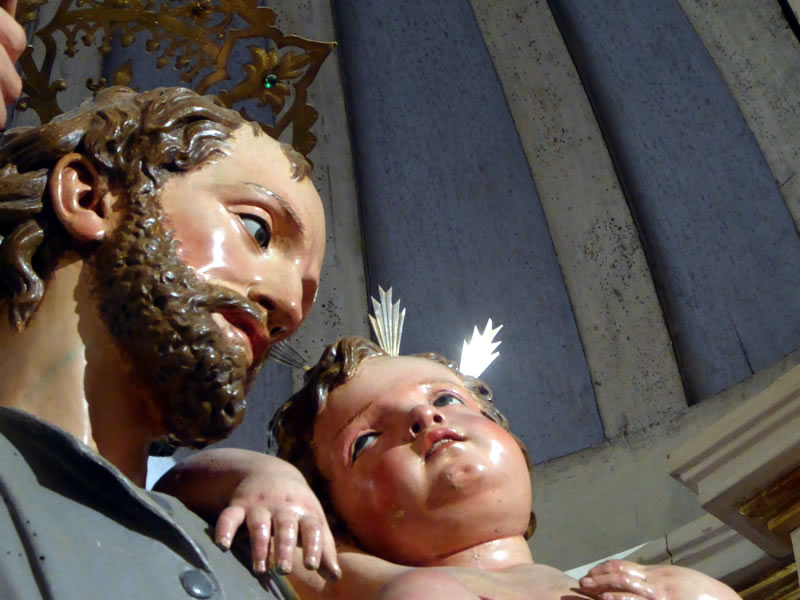
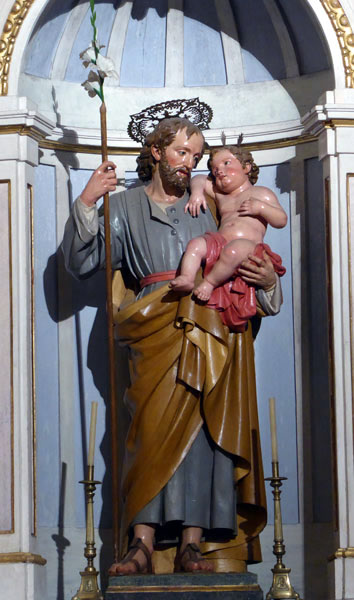
Joseph is the husband of Mary and the adoptive father of Jesus of Nazareth. According to the gospel of Matthew, he was an artisan – later, the tradition concretised his profession as carpenter. He was of humble status, although he belonged to the lineage of King David. In this sculpture, he is portrayed with the Child in his arms, who turns towards the saint, emphasising their proximity.
Description:
The 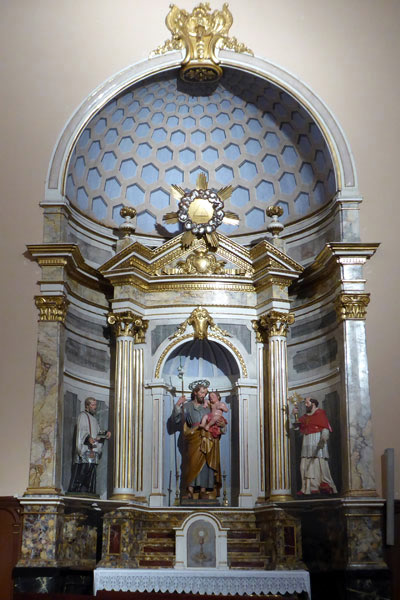
History:
The four lateral altarpieces of the Assumption of Our Lady Church were ordered by the council of Bermeo and paid by the locals. Furthermore, private people gave donations, such as the one of Andrés de Uriarte left in his testament, which was mainly used for the sculptures. The architect, Pedro de Belaunzaran, was commissioned to plan the design. Another architect, Pedro Lumbreras (1869), was in charge of the construction process and of the polychromy. The Catalan sculptor José de Alcoverro (1870-1871) made the pictures.
Sculptures:
Saint Joseph
This sculpture of Saint Joseph is notable for showing the special relationship with the Christ Child, whom he carries with his left hand. Both look at each other, emphasising their proximity. In his right hand, the Saint carries a flourishing stick as an allusion to the miracle that, according to the legend, made the priests recognise him as the most suitable husband for the Virgin Mary.
Saint Andrew Avellino
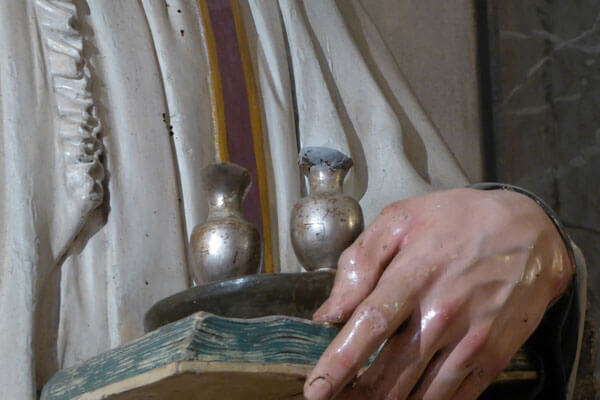
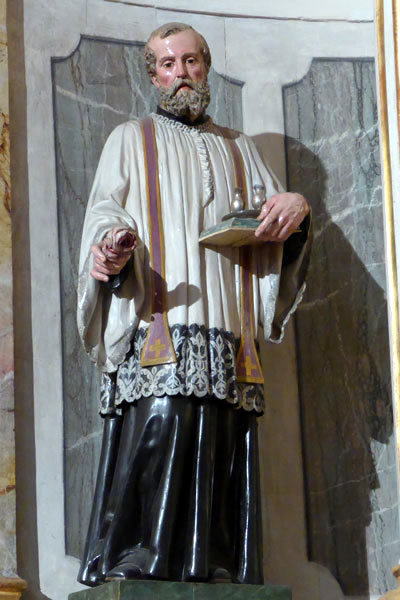
Andrew Avellino was an Italian Saint and priest of the order of theatines (the congregation of clerics regular). From a very young age, he stood out for his piety and in the age of only 16, he was ordained sub deacon. In 1545, he was ordained priest and went to Naples to study canon and civil law. After having rejected the heritage of his family, he entered the order of theatines where he became the novice master. In this sculpture, he is portrayed being dressed like a priest. In his left hand, he carries a book – probably the rule of the female monastery of Sant’Arcangelo a Baiano that he reformed – and some cruets like those used in the holy mass. The carving of the face, the good work of the beard in particular, stands out.
Saint Raymond Nonnatus
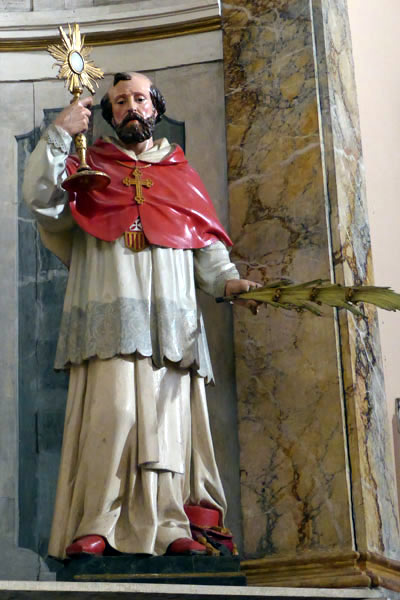
This Saint gets the surname nonnatus – this means, not born – because he was not born in the common way, but put out by Caesarean from his mother’s womb after she had died. Therefore, he is the patron saint of the midwives and pregnant women and he is invoked in difficult childbirths. He was a very pious man, who entered the order of mercedarians to free the christians who had been captured by the moslems during the crusades. In 1240, he was appointed cardinal by pope Gregory IX, so in this sculpture he is portrayed with purple-coloured elements, distinctive for the cardinals: the shoes, the cardinal’s hat next to his feet, a small bag with coins hidden in the hat and the mozzetta, which covers the white habit with the coat of arms of the mercedarians. In the right hand, Raymond carries an ostensory, showing his devotion to the Most Holy Sacrament. In the left hand, he has a very special palm leaf of the martyrdom with three crowns, for the three virtues of the saint: chastity, eloquent preaching and martyrdom.