
Altarpiece of Saint John the Baptist
Collection of altarpieces
- Town: Bermeo
- Church: Assumption of Our Lady Church
- Location: Gospel Nave (the left nave of the church)
- Artists: Pedro Belaunzaran (planner) and José de Alcoverro (sculptor)
- Patron: Council of Bermeo
- Chronology: 19th century (1869-1871)
- Style: Neoclassicism
An altarpiece to invoke protection from illnesses and the plague
Interactive altarpiece: click on the pictures to get more information.
Church:
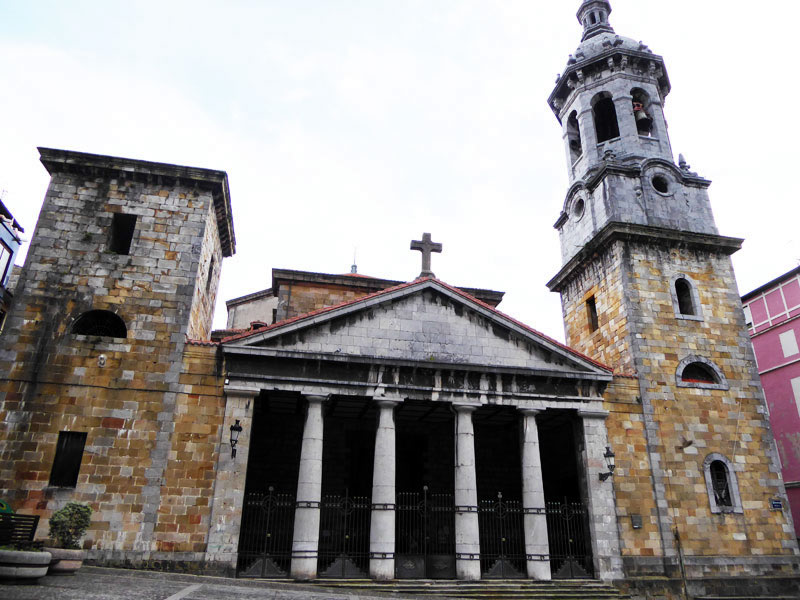
The parish church dedicated to the Assumption of Our Lady was constructed at different periods in the 19th century (1820/22 – 1869) and was designed by the architect Silvestre Pérez. The main portal protrudes from the building, its columns and triangular gable roof resembling an ancient greek temple. The church is flanked by a tower on each side. The tower on the left side is unfinished, and that on the right, completed in the 19th century, functions as the belfry. The church’s ground plan with four equal arms forms a greek cross, which is surmounted by a large central dome. Inside the church, between the arches, supporting the dome, there are four altarpieces, above which are paintings, by Pablo Uranga from 1912, depicting the four evangelists.
Patronage:
According to the gospels, John the Baptist carried out his work in the beginnings of christianity, in the region of the Jordan River. He baptised those who searched for the conversion – therefore he is called the Baptist. Among the people he baptised was Jesus of Nazareth. John’s background is linked to that of Jesus, as they were cousins. John was consecrated even before his birth, when the Virgin Mary visited his mother Saint Elizabeth. In the Holy Bible, he is described as a hermit who lived in the desert and covered himself with a camel-skin robe. John died beheaded by the order of king Herod Antipas, whom he publicly denounced for incest by marrying his sister-in-law, Herodias. It was her daughter, Salome, who asked for the head of the Baptist in a silver charger after having danced for Herod and having achieved that the king promised to grant her any wish.
Description:
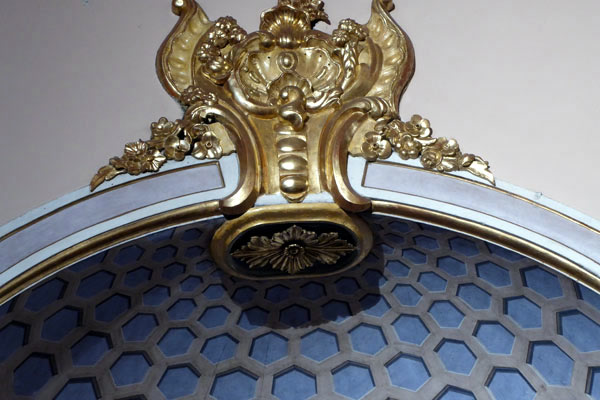
The 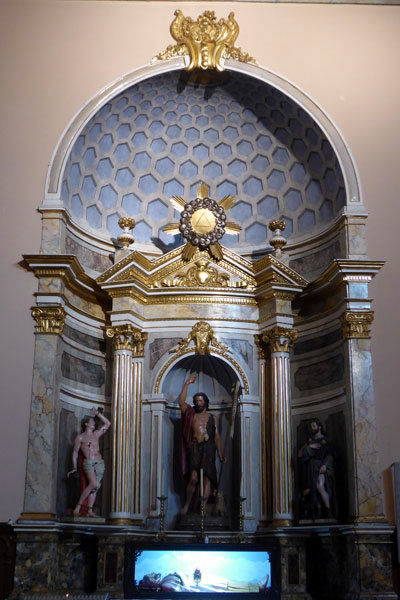
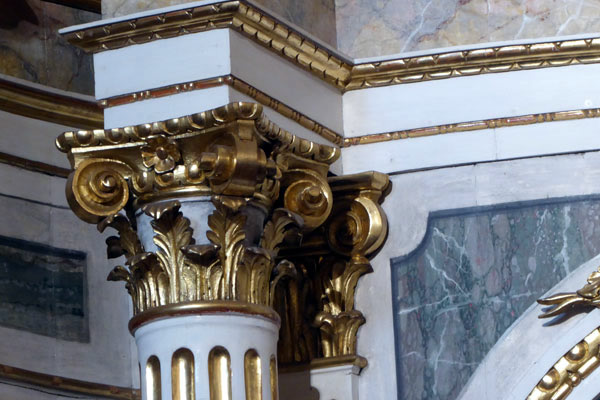
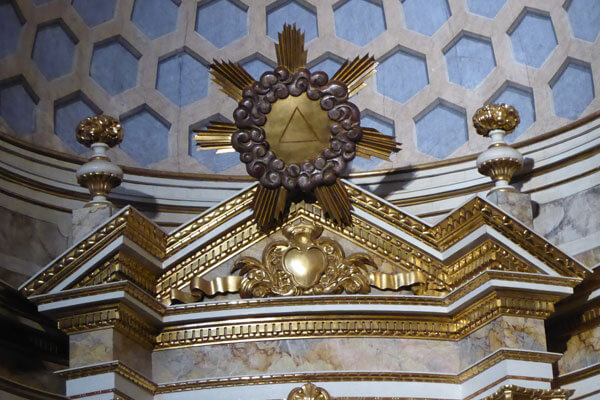
History:
The four lateral altarpieces of the Assumption of Our Lady Church were ordered by the council of Bermeo and paid by the locals. Furthermore, private people gave donations, such as the one of Andrés de Uriarte left in his testament, which was mainly used for the sculptures. The architect, Pedro de Belaunzaran, was commissioned to plan the design. Another architect, Pedro Lumbreras (1869), was in charge of the construction process and of the polychromy. The Catalan sculptor José de Alcoverro (1870-1871) made the pictures.
Sculptures:
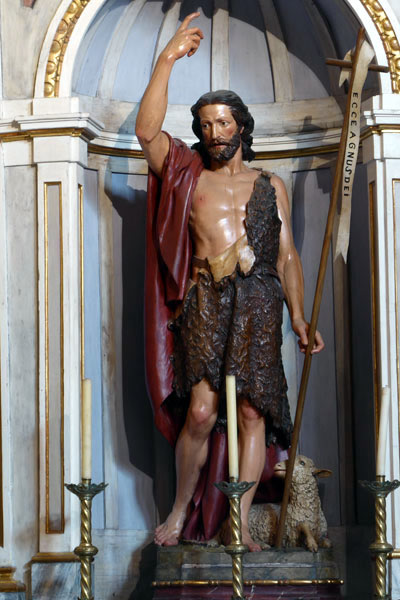
Saint John the Baptist
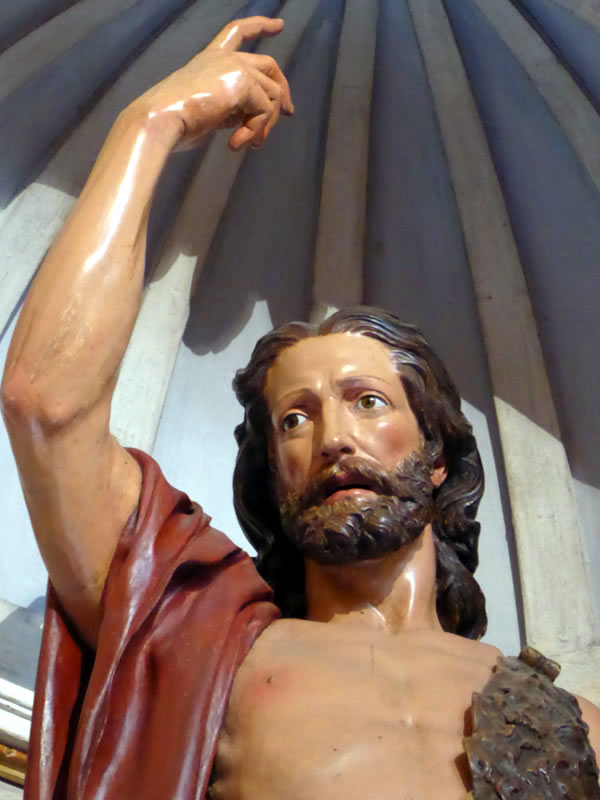
A sculpture of John the Baptist, who wears a camel-skin robe and is accompanied by a lamb, symbolising Christ. He carries a stick forming a cross with the Latin inscription “Behold the lamb of God.” Furthermore, John raises his finger to point at Jesus of Nazareth, the Son of God. According to the christian tradition, John is the last prophet who announced the arrival of the Messiah. The facial expression and the quality of the carving stand out, noticeable in the textures of his hair, the camel-skin robe or the lamb.
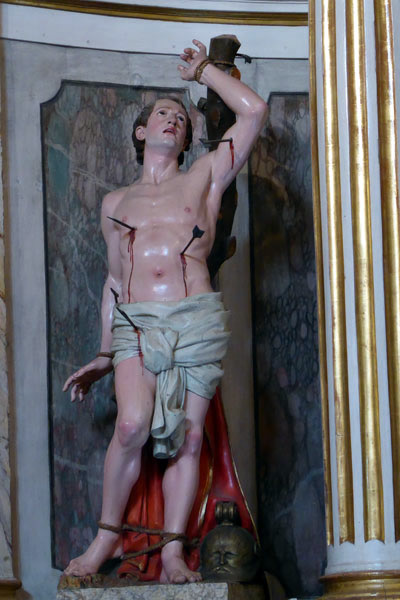
Saint Sebastian
According to his legend, Sebastian was a roman soldier who converted to christianity and refused to participate in the sacrifice rituals for the pagan gods. He was caught by his superiors and sentenced to death by the arrows of the emperor’s soldiers. Therefore, in this altarpiece the saint is portrayed being tied up on a tree and with arrows stuck in his body as a symbol of his martyrdom. A helmet and a red coat next to his feet characterise him as a roman soldier. The saint survived this martyrdom, and this ability of recovery is why he is considered as the protector against plagues and illnesses. In this sculpture, Sebastian’s facial expression, offering up his suffer to God, and the manner in which the blood of his wounds is painted stand out.
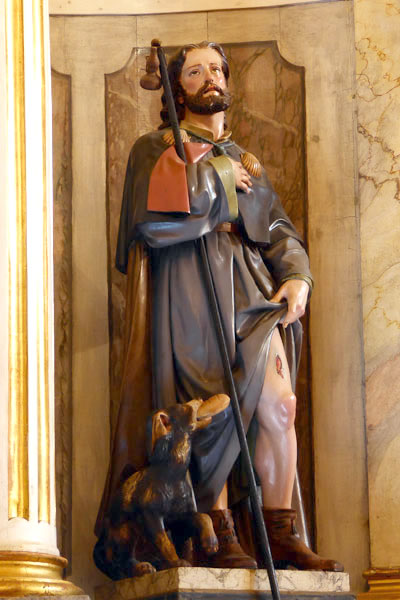
Saint Roch
According to the tradition, Roch was a young man from Montpelier (France), who had shared his heritage with the poor people and hiked through Italy as a pilgrim to cure sick people from the plague. Having been in contact with sick people, he himself became infected, so he decided to go into a forest to avoid spreading the disease. Roch survived thanks to a dog who brought him every day a small bread that he took from his owner’s table. Furthermore, every day the dog licked Roch’s wounds, which cured miraculously. All this makes him the patron saint against the epidemics and plagues. In this altarpiece, Saint Roch is portrayed being dressed like a pilgrim on the way to Santiago de Compostela, (even though, the saint had never been to this place) with the scallop shells, the coat and a stick with the pumpkin, which he used as water bottle. A dog accompanies him, having a bread in the mouth, and Saint Roch lifts the tunic with his left hand to show the plague marks on his leg. It is a very expressive sculpture thanks to the quality of the carving and the polychromy.