
Altarpiece of the Immaculate Conception
Collection of altarpieces
- Town: Bermeo
- Church: Assumption of Our Lady Church
- Location: Epistle Nave (the right nave of the church)
- Artists: Pedro Belaunzaran (planner) and José de Alcoverro (sculptor)
- Patron: Council of Bermeo
- Chronology: 19th century (1869-1871)
- Style: Neoclassicism
Saint Aloysius Gonzaga and Saint Antoninus accompany the picture of the Immaculate Conception of Mary
Interactive altarpiece: click on the pictures to get more information.
Church:
The parish church dedicated to the Assumption of Our Lady was constructed at different periods in the 19th century (1820/22 – 1869) and was designed by the architect Silvestre Pérez. The main portal protrudes from the building, its columns and triangular gable roof resembling an ancient greek temple. The church is flanked by a tower on each side. The tower on the left side is unfinished, and that on the right, completed in the 19th century, functions as the belfry. The church’s ground plan with four equal arms forms a greek cross, which is surmounted by a large central dome. Inside the church, between the arches, supporting the dome, there are four altarpieces, above which are paintings, by Pablo Uranga from 1912, depicting the four evangelists.


Patronage:
The Most Pure Conception or Immaculate Conception is a doctrine of the catholic religion saying that Mary was the only person who was born without the original sin. This sin has been transmitted from Adam and Eve to all people and can only be removed by being baptised. This means that no person could be free from this sin before having received the sacrament of baptism. However, the Catholic Church considers that God wanted Mary to be free from this sin so that she can be the Mother of Christ. Throughout history, this complex topic has been depicted in a symbolic way.
Description:
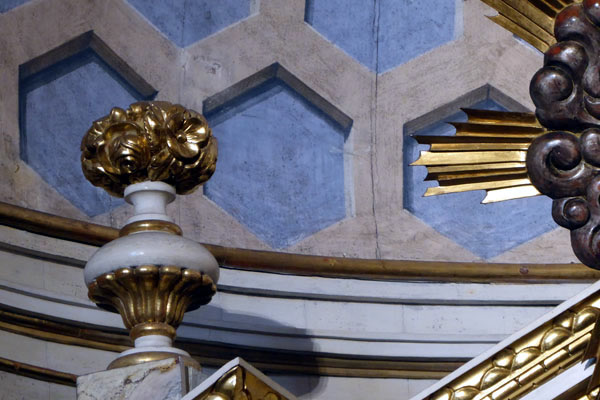
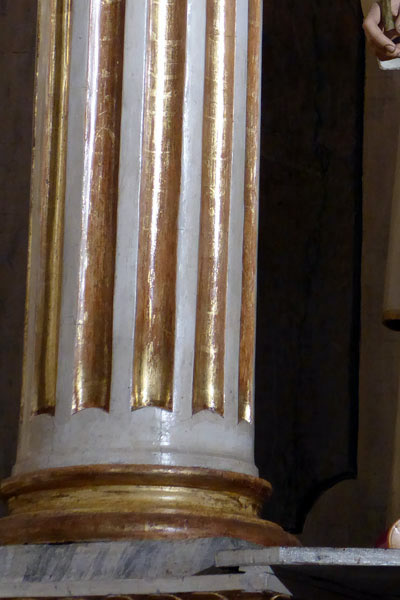
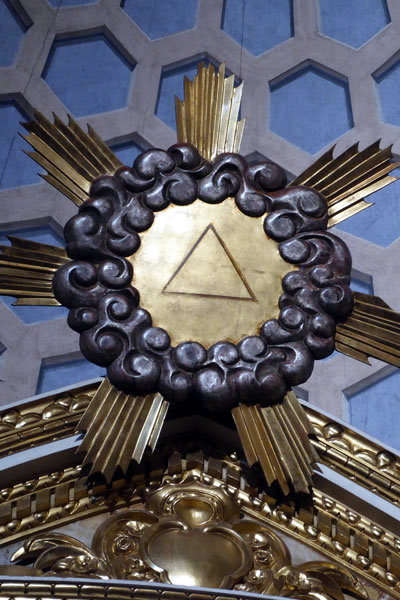
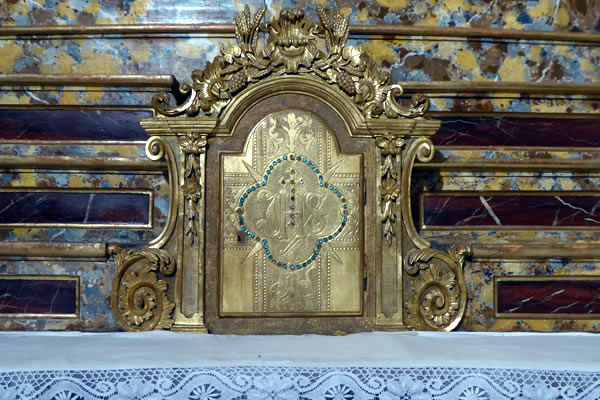
The 
History:
The four lateral altarpieces of the Assumption of Our Lady Church were ordered by the council of Bermeo and paid by the locals. Furthermore, private people gave donations, such as the one of Andrés de Uriarte left in his testament, which was mainly used for the sculptures. The architect, Pedro de Belaunzaran, was commissioned to plan the design. Another architect, Pedro Lumbreras (1869), was in charge of the construction process and of the polychromy. The Catalan sculptor José de Alcoverro (1870-1871) made the pictures.
Sculptures:
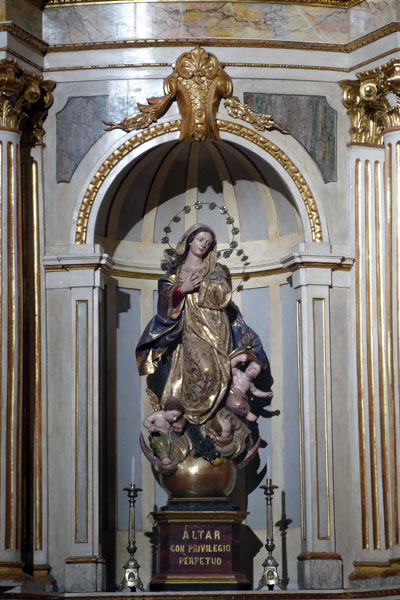
Immaculate Conception
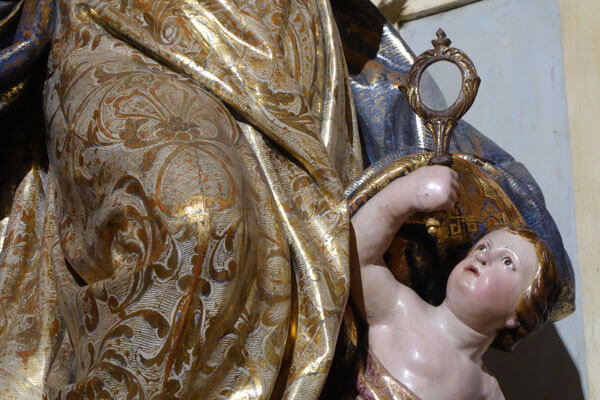
Mary is portrayed as inspired by the description of the woman in the Book of Revelation – the last book of the Bible. The catholic theology considers this description as a symbolic picture of the Immaculate Conception. She wears a crown of twelve stars and stands on the moon and a gilded sphere, which represents the universe. Furthermore, she steps on a dragon, which has an apple in its mouth, the symbol for the original sin, which has been transmitted to the humankind since Adam and Eve. Several sculptures of Angels, which seem to play in her wind-moved clothes, are next to Mary.
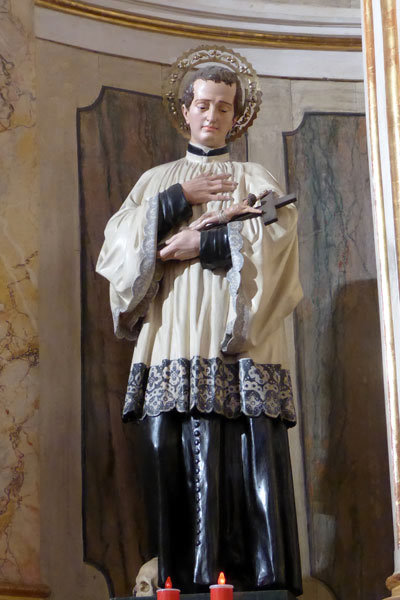
Saint Aloysius Gonzaga
Aloysius Gonzaga was an italian noble who rejected his heritage and position to become a jesuit. During the plague epidemic, which ruined Rome in 1591, he cared for the sick people. He himself became infected with this disease and died at the age of only 23 years. He is commonly portrayed wearing the Jesuit habit and holding a crucifix to which he is looking in prayer. Next to his feet, there is a skull, a symbol for his early death. The workmanship of the sleeves, which are daintily folded, stands out.
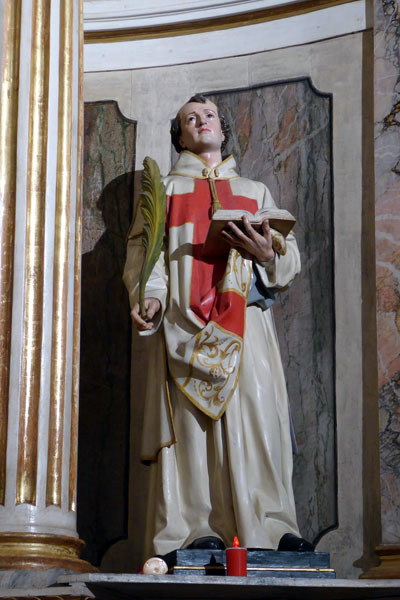
Saint Antoninus of Pamiers
According to his legend, Antoninus of Pamiers was a visigoth martyr who lived between the 5th and 6th century in Gaul (today France). He was educated as an arian christian who believed that Jesus Christ is God but not a human. However, in his early age, he converted, rejected his asset and went to Rome, where he was ordained deacon. Therefore, Antoninus is commonly portrayed with a short coat, opened on both sides and with sleeves to the elbow, called dalmatic. He was sent to preach in Toulouse, where he was wrongly accused of having a love affair with the king’s wife and was sentenced to be submerged in boiling oil and thrown into the river with a millstone on his neck. After having survived these martyrdoms miraculously, he returned to his birthplace Pamiers, where he was persecuted, arrested and sentenced to death by being teared into two. In this picture, the saint is portrayed as a young man carrying an open book in his left hand and in the right hand a palm leave. The palm has been the symbol for victory since the ancient world and is therefore an attribute of the martyr saints, as it represents their victory over the death.